The One-in-Six Audience You’re Campaigning Without
Somewhere in every campaign brief there is a line that says “add alt text” or “captions on the video,” and somewhere in every review meeting someone checks it off and moves on. That is the moment most marketing teams leave a sixth of their audience behind — not because they meant to, but because they treated accessibility as a compliance chore: a cost to minimize, a box to tick, a lawyer’s problem.
Flip the frame and the same work changes meaning. Accessibility is not a tax on the campaign. It is a reach multiplier — one of the few levers left that adds audience you were already paying to reach, at near-zero marginal cost. Roughly one in six people on the planet lives with a significant disability, and nearly every accessibility fix you ship also helps everyone else: captions for the commuter watching on mute, alt text for the slow network, readable contrast for the glare on the café window. Brands that build campaigns accessibly don’t shrink their audience. They grow it, for everyone.
The compliance frame vs. the reach frame
What the checkbox mindset costs
The compliance frame asks one question: did we pass the audit? It’s a defensive posture, and it’s not irrational — the stakes are real. Seyfarth Shaw, the law firm that has tracked ADA Title III litigation for over a decade, counted 3,117 website-accessibility lawsuits filed in US federal court in 2025, up 27% from the year before, making website cases 36% of all federal ADA Title III filings. If you run a US-facing site, “avoid the lawsuit” is a legitimate sentence in your business case.
But here’s the trap: compliance is the floor, not the finish line. A campaign can be legally compliant and still quietly unusable. WCAG conformance says nothing about whether your message lands, converts, or gets shared. Teams that optimize for the checkbox optimize for the minimum — and the minimum is exactly what the reach frame is not.
The same work, a different ledger
The reach frame asks a different question: who are we excluding? Same captions, same alt text, same contrast work — but now it’s booked as audience acquisition, not risk mitigation. That reframe matters more than it sounds, because it changes what you’re willing to spend, how you staff it, and how you measure it. The compliance frame produces a line item that gets cut in Q4. The reach frame produces a growth lever that gets funded.
The 1-in-6 audience is not a niche, it’s a market
The WHO’s math
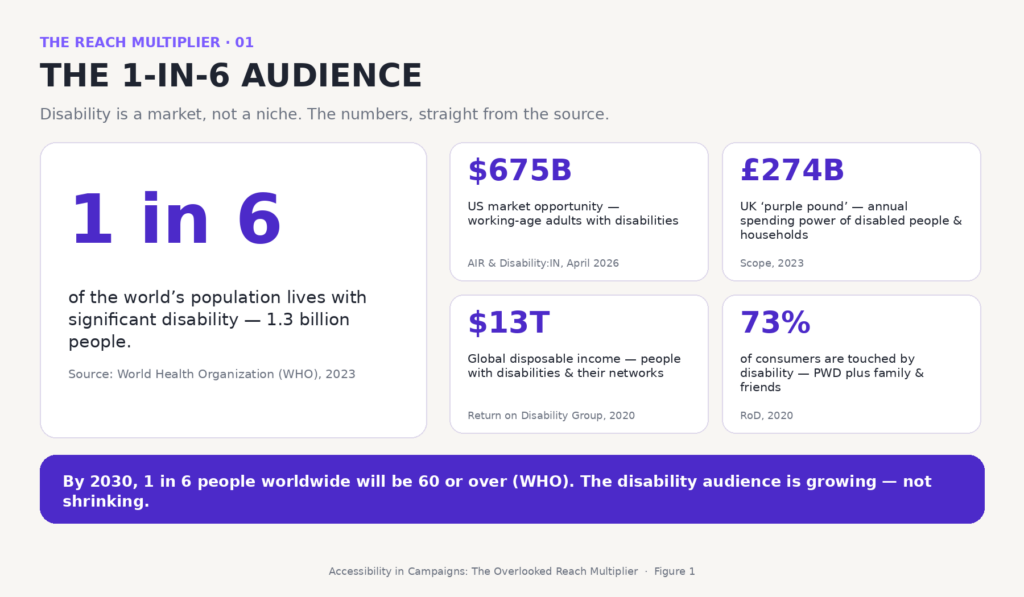
The World Health Organization estimates that 1.3 billion people — 16% of the global population, one in six — experience significant disability today, and the number is growing as populations age and chronic conditions become more common. This isn’t a fringe demographic you can ethically skip; it’s a sixth of humanity, in every market you sell into, at every age band, in every income bracket.
And it’s about to get bigger. The WHO projects that by 2030, one in six people worldwide will be aged 60 or over — the 60-plus cohort goes from 1 billion in 2020 to 1.4 billion by 2030 and 2.1 billion by 2050. Vision, hearing, and motor function decline with age, which means the “disability audience” is not a static category; it’s the whole population, aging into it. Every year, your audience’s accessibility needs rise. That is the definition of a growth market.
The money
Now the part that surprises people. The American Institutes for Research, in an April 2026 update with Disability:IN, put the US market opportunity among working-age adults with disabilities at $675 billion, with about $107 billion in discretionary spending. (A 2018 edition of the same analysis estimated $490 billion; AIR cautions that the two editions use different methods and aren’t directly comparable.) In the UK, the disability charity Scope puts the “purple pound” — the annual spending power of disabled people and their households — at £274 billion a year, with 16 million disabled people in the country, one in four of the population. Globally, Return on Disability Group’s 2020 study estimated 1.85 billion people with disabilities and, counting the friends, family, and networks who make purchase decisions around them, concluded the market touches roughly 73% of consumers and controls over $13 trillion in annual disposable income. Those are the group’s own estimates, so treat the exact figures as directional. The direction, though, is unmistakable: this is one of the largest under-served consumer segments on earth.
What accessibility actually unlocks
An audience that’s loyal because it’s under-served
Here’s the part the compliance frame completely misses. Scope found that 73% of disabled online shoppers have hit accessibility barriers on more than a quarter of the websites they visit, 70% say they wouldn’t return to a business after a bad experience, and half of disabled shoppers who hit problems while buying simply give up. When a whole segment is used to being excluded, the brand that genuinely includes them doesn’t just reach them — it wins a loyalty that most marketers can’t buy. This is an advocacy-and-retention asset, not a charity line item.
The universal situational lift
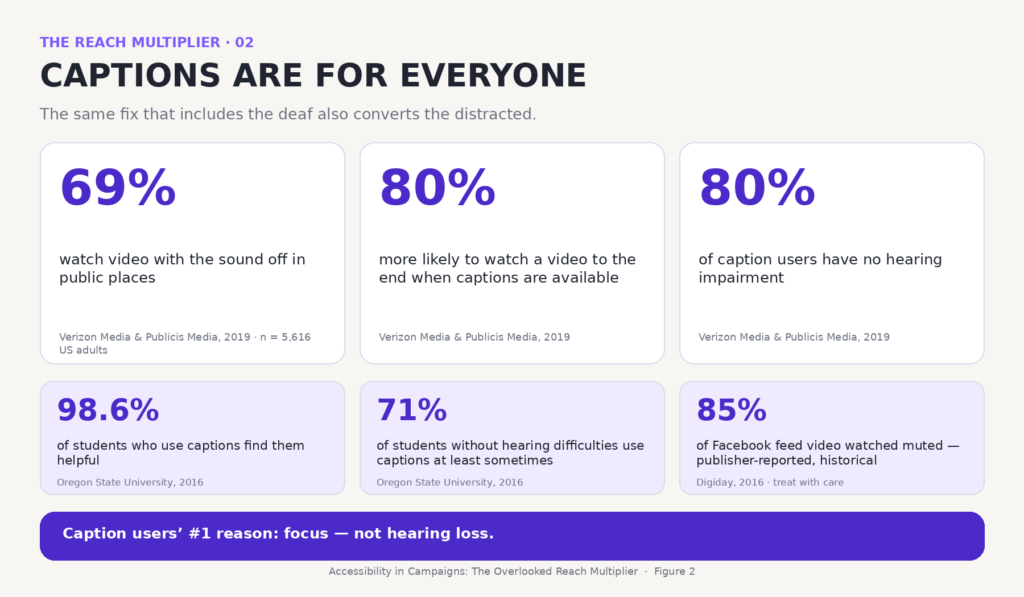
Then there’s everyone else. The famous “85% of Facebook videos watched without sound” figure is a decade-old, publisher-reported number from a 2016 Digiday survey — worth knowing, but treat it as history, not as Facebook’s own data. The better-sourced study is Verizon Media and Publicis Media’s 2019 survey of 5,616 US adults: 69% watch video with the sound off in public places, 80% say they’re more likely to watch a video all the way through when captions are available, and 80% of people who use captions have no hearing impairment at all. Academic data agrees: Oregon State University’s national study of 2,124 students found that 98.6% of those who use captions find them helpful, and 71% of students without hearing difficulties use them at least sometimes. Their number-one reason wasn’t hearing loss. It was focus.
So captions aren’t a deaf-audience feature. They’re a commuter feature, a focus feature, a non-native-speaker feature, a quiet-office feature. Alt text helps the screen-reader user and the slow-network user. Contrast helps the low-vision user and the sun-glare user. Every accessibility fix lifts the whole audience. That’s why it’s a multiplier, not a niche.
The discoverability bonus (with the honesty Google requires)
There’s a common claim that accessibility boosts SEO, and a good SEO person will stop you right there. Google’s John Mueller said in 2022 that accessibility is not a direct ranking factor, and in January 2025 he reiterated that alt text is not primarily an SEO decision — its purpose is accessibility. So don’t sell this as a ranking hack. Sell it as what it is: the accessible version of a page is usually the version search engines and AI assistants can read best. Semantic headings, descriptive link text, real transcripts of video, actual text instead of text baked into images — these are the same things that make content indexable, quotable, and citable. The accessibility work double-pays. It just doesn’t pay in the way the myth promises.
The trust signal
Finally, accessibility is a values signal that compounds. Accenture’s research with Disability:IN and the AAPD found that the 45 companies leading on disability inclusion among 140 benchmarked firms averaged 28% higher revenue, double the net income, and 30% higher economic profit margins over 2015–2018, and a 2021 update put leaders at 1.6x revenue versus peers. Take those numbers with the usual consulting-research salt — Accenture sells inclusion consulting — but the direction holds across every serious study that has tried. Consumers reward brands that are genuinely inclusive and punish ones that perform it. Inclusion is trust; trust is retention; retention is the cheapest growth there is.
The accessible-campaign checklist
You don’t need a new budget. You need four habits.
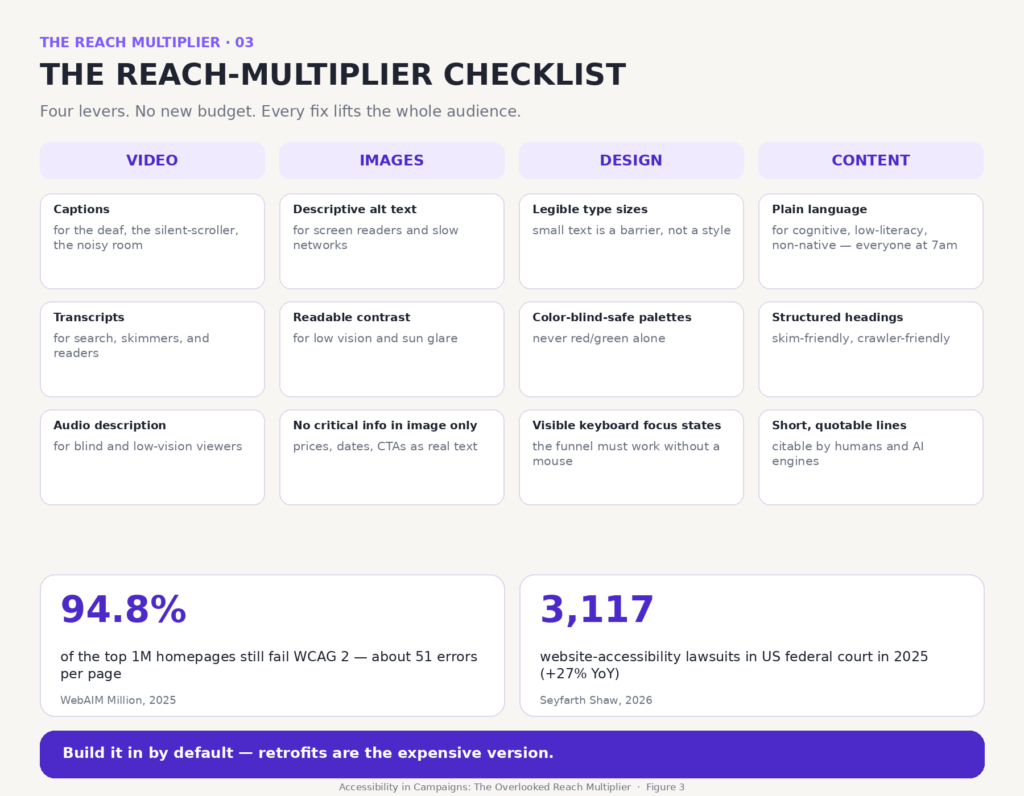
Video: captions, transcripts, audio description
Captions for the deaf, the silent-scroller, and the noisy room; transcripts for search engines, skimmers, and anyone who’d rather read; audio description for blind and low-vision viewers who otherwise miss half the story. One video, three fixes, and it reaches everyone.
Images: alt text, contrast, no critical info in images only
Descriptive alt text — which is what screen readers and slow networks actually read; readable contrast; and never put a price, a date, or a CTA only inside an image. If the image fails to load — and on a bad network it will — the message should still be there.
Design: readable type, color-blind-safe palettes, focus states
Legible font sizes; palettes that survive color blindness, so red/green is never the only differentiator; and visible keyboard-focus states, so anyone who can’t use a mouse can still get through the funnel.
Content: plain language, structured, quotable
Plain-language copy for low-literacy, cognitive, and non-native audiences — which is nearly everyone at 7am. Structured headings and short, quotable sentences so humans skim and AI engines cite. The content that’s easiest for a screen reader is the content that’s easiest for a search crawler and an AI assistant.
The state of the field
Here’s the uncomfortable context: WebAIM’s annual scan of the top million homepages found that 94.8% still have detectable WCAG 2 failures — about 51 errors per page on average — with low-contrast text on 79.1% of pages and missing image alt text on 55.5%. The basics are cheap, well-documented, and almost universally undone. That is your under-competed window.
What this means for brands
Ask “who are we excluding?” not “do we comply?”
Run each campaign through the exclusion audit: the deaf, the blind, the low-vision, the cognitive, the low-literacy, the keyboard-only. Every excluded person is a reach unit you left behind. Name the exclusions out loud and the fixes stop being optional.
Make it a default, not a retrofit
Accessibility retrofits are expensive; accessibility defaults are nearly free. Captions belong in the brief, alt text belongs in the asset spec, contrast belongs in the design system. If it’s in the template, it ships every time. If it’s an afterthought, it ships never.
Let AI do the volume, humans certify the quality
AI is genuinely good at generating alt text, captions, and transcripts at scale. It’s also genuinely capable of describing the wrong thing entirely — and an incorrect alt text is worse than none, because it confidently misinforms. Use AI for the volume; verify with real users, including people with disabilities. The machines do the quantity; humans do the quality.
Measure the multiplier, not the checkbox
Track what you gain: audience lift between inaccessible and accessible versions of the same asset, completion rates on captioned video, engagement from accessibility-aware segments, retention among customers who cite inclusion as a reason to stay. “Did we pass the audit” is a binary. “How much reach did we add” is a number you can grow.
Risks and honest caveats
Compliance is the floor, not the finish line
Passing WCAG is a starting point, not a conclusion. A compliant campaign can still be poorly usable, and the reach frame pushes past the checklist toward actual inclusion.
“Accessibility kills the creative” is backwards
The fear that constraints hurt design usually dies on first contact with good work: accessible design is clearer, more usable, more shareable design. The best creative isn’t built despite accessibility. It’s built out of it.
“AI handles it, so we’re done” is an overreach
Automation without verification produces confident errors. Budget the human step. Every time.
The honest sizing caveat
The 1-in-6 figure is directional, not precise, and the exact reach lift you’ll get is market- and category-specific. What’s robust across every study is the direction: accessible campaigns reach more people, keep more of them, and cost about the same to build. The precise number is noisy. The strategy is not.
The bottom line
Accessibility is the rare marketing decision where the moral case and the business case point the same way. The 1-in-6 audience is vast, loyal, and under-served; every fix also lifts everyone else; and the work is nearly free when it’s built in. Frame it as compliance and you’ll minimize it into irrelevance. Frame it as a reach multiplier and you’ll fund it into growth — which is exactly what it is.