Your Product Is the Ad Now
Marketing has spent a century writing promises. Somebody else was supposed to keep them.
That was the deal. The ad department built the dream; the factory, the call centre, the delivery driver and the returns desk were expected to honour it — usually with fewer people, a smaller budget and none of the credit. The message was marketing’s property. The experience was an operating cost.
That arrangement is now being unwound, and not by a strategy deck. By arithmetic. The arithmetic is unusually blunt about who holds the deed.
The Century-Old Split: Marketing Promised, Product Delivered
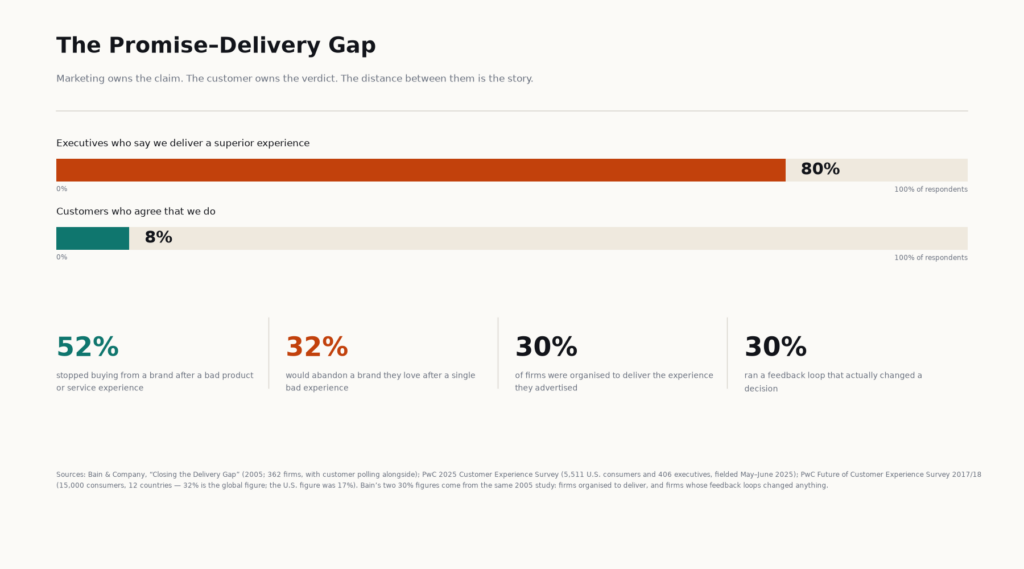
In 2005, Bain & Company asked 362 firms whether they delivered a superior experience. Eighty per cent said yes. Bain then asked those firms’ customers, and eight per cent agreed. The same study found that only 30 per cent of the firms were organised to deliver the experience they were advertising, and only 30 per cent ran a feedback loop capable of changing anything.
Twenty years later, PwC ran the question again with better instruments. Its 2025 customer experience survey — 5,511 US consumers and 406 executives, fielded between late May and the end of June — found that 52 per cent of consumers had stopped buying from a brand because of a bad product or service experience, and 29 per cent had walked away after a bad service interaction, online or in person. Executives told a different story: nine in ten said customer loyalty had increased in recent years. Only four in ten consumers agreed.
Same gap. New dashboards.
The accountability gap nobody budgeted for
Here is the mechanical reason that gap survived two decades of investment. Marketing was measured on the message — reach, recall, sentiment, share of voice — and almost never on the delivery. Fund what you measure and you get more of it. So the promise inflated, because promises are cheap and fast, while the experience lagged, because experiences are slow and expensive. And the distance between them belonged to nobody’s P&L.
It still mostly doesn’t. Which is why 70 per cent of the executives in that same PwC study said customer expectations now evolve faster than their organisation can follow. That is not a marketing problem. It is an ownership problem wearing a marketing costume.
The moment the split broke
Two numbers mark the break.
The first: 65 per cent of US consumers told PwC’s Future of Customer Experience survey that a positive experience with a brand is more influential than great advertising. That finding is from 2018, and it has aged into an understatement.
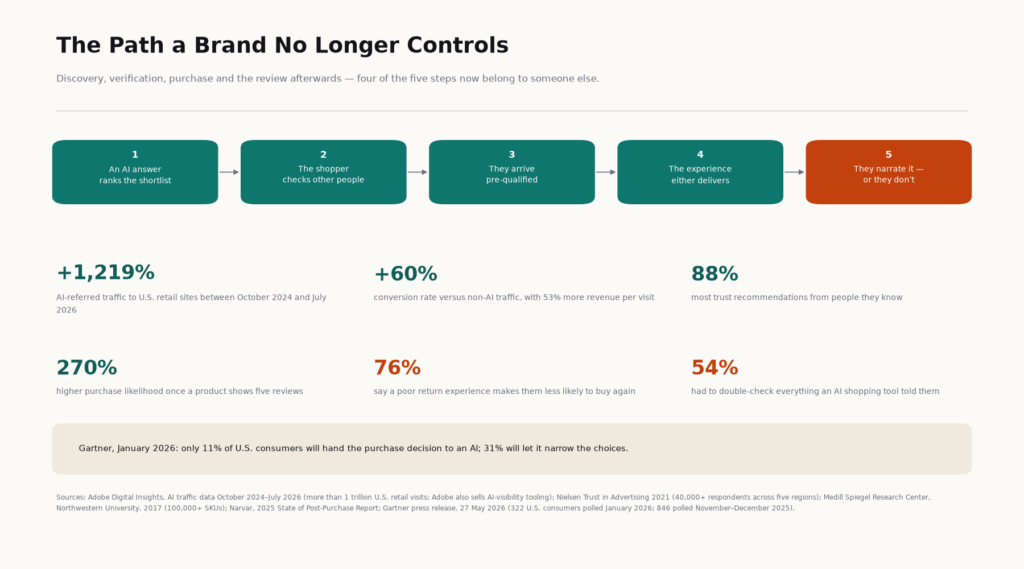
The second: in Nielsen’s Trust in Advertising study — more than 40,000 respondents across five regions — 88 per cent said they most trust recommendations from people they know, roughly 50 per cent above the lowest-ranked paid formats. Not “trust slightly more”. Half again as much.
Put those together and the conclusion stops being a matter of taste. If the experience outranks the ad, and the people who describe the experience outrank the people who buy the ad, then the experience is no longer the thing marketing talks about. It is the thing marketing is.
Four Forces That Moved the Deed
Nobody rewrote a job description. Four forces did the work.
Force one: the experience went public
A mediocre experience used to die quietly in a store. Now it becomes content within the hour: a one-star review, a screenshot, a fourteen-second video, a thread that outranks your landing page. A great one does exactly the same thing in the opposite direction.
The effect is measurable and bigger than most people assume. Northwestern’s Medill Spiegel Research Center analysed more than 100,000 SKUs and found that purchase likelihood for a product showing five reviews is 270 per cent higher than for a product showing none. When reviews first appeared, conversion rose 190 per cent for lower-priced items and 380 per cent for higher-priced ones.
Read that with the strategic implication attached. The first five reviews outperform most media buys you can afford, and they are generated by the experience — or they are not generated at all.
Force two: trust migrated to people the brand does not pay
Nielsen’s 88 per cent is the headline. The more interesting migration is institutional. PwC’s 2025 data shows the loyalty illusion in full: the people inside the building believe loyalty is rising, while the people outside the building are leaving. When your own instrumentation tells a story your customers contradict, the instrumentation is the problem.
So the customer routes around you. They ask a friend, a group chat, a review page, and — increasingly — a machine.
Force three: the machine now writes your brand summary
This is the newest force and the least negotiable.
Adobe’s digital insights team, tracking more than a trillion visits to US retail sites, found AI-referred traffic up 62 per cent year on year in July 2026 and up 1,219 per cent since October 2024. Those visitors converted 60 per cent better than everyone else and produced 53 per cent more revenue per visit. Twelve months earlier, the same traffic converted worse than normal. The flip is recent, sharp and structural — and Adobe sells AI-visibility tooling, so read the enthusiasm with that in mind.
But the machine does not decide. Gartner’s January 2026 survey of 322 US consumers found only 11 per cent would let an AI make the purchase decision outright, while 31 per cent would let it narrow the choices. The verification instinct is strong: a separate Gartner survey of 846 consumers found 54 per cent had to double-check every piece of information an AI shopping tool gave them, and 62 per cent said that information ended up wasting their time.
So the pattern is: the model shortlists, the human verifies, and verification lands on reviews, delivery dates, return policies, warranty behaviour. The experience, in other words. An AI can only narrate what you have already done.
Force four: the product got boring
Commoditisation is not a vibe; it is a share number. In 2025, US store-brand sales reached $282.8 billion, taking a record 21.3 per cent of dollar share and 23.5 per cent of units, growing 3.3 per cent against 1.2 per cent for national brands, according to Circana data published by the Private Label Manufacturers Association. In FMI’s 2024 survey, 71 per cent of shoppers rated store-brand quality equal to or better than name brands.
When the tin is the same, the only thing left to sell is what happens around the tin. How it arrives. How it is explained. What happens when it breaks. That is the experience, and it is the last asset in the category a competitor cannot copy in a quarter.
So Who Owns Marketing Now?
Officially, the chief marketing officer. Practically, whoever controls the moments customers actually remember — product, service, support, logistics, and the person answering at nine at night.
From message owner to experience owner
Bain’s 30 per cent was never really about capability. It was about architecture. Two decades on, Forrester’s 2026 predictions describe an industry still fighting the same fight: CX teams restructured, renamed or dissolved; 15 per cent sliding into a metrics death spiral, producing dashboards nobody uses; three in ten firms expected to damage their own total-experience scores by deploying AI self-service where it does not belong. The tell is stark — roughly two-thirds of US brands have invested in or plan chatbots, while only 16 per cent of US consumers say they use them often.
The discipline that measured the experience never owned the experience. That is why the deed moved.
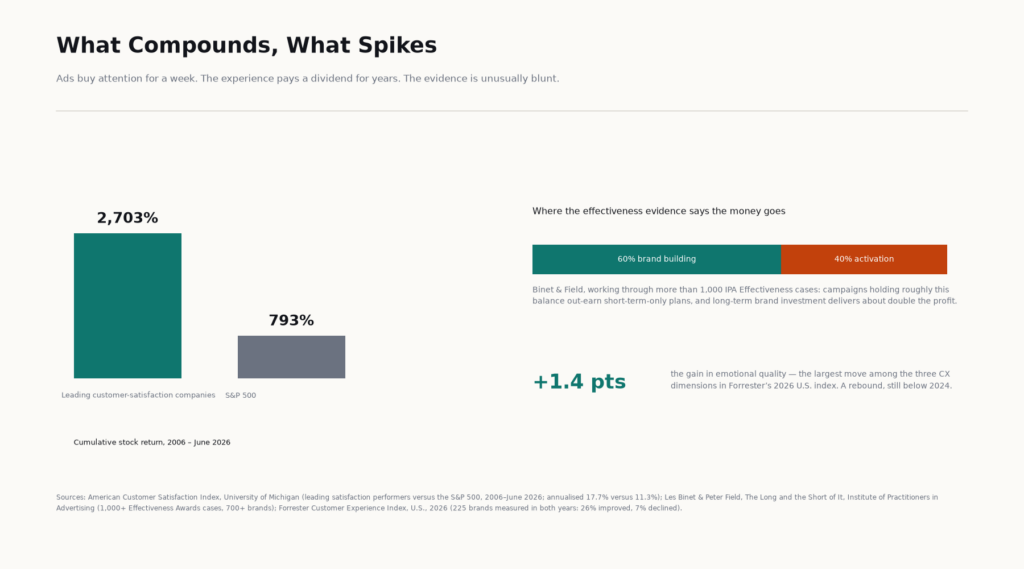
Forrester’s 2026 US index carries a second warning worth reading twice. After four consecutive years of decline, CX quality rose — the first increase since 2021 — with emotional quality gaining 1.4 percentage points, the largest move of the three dimensions, and 26 per cent of the 225 brands measured in both years improving against 7 per cent declining. Yet scores remain below 2024. A rebound, not a recovery. Experience quality is now a variable you can lose for years and win back by inches.
What the marketer actually becomes
Not the author of the promise. The designer of the moment worth repeating, and the amplifier of what customers say afterwards.
That sounds like a smaller job and is a much harder one, because you cannot fix it in a deck. You can only fix it in the product, the onboarding, the packaging, the returns policy, and the training of the person on the phone.
Reunifying the promise and the delivery
The org chart is where this argument either becomes real or stays a keynote. If the team that writes the claim is not the team accountable for delivering it, the gap reopens on schedule, politely, forever. One owner for both — or the gap is the strategy.
The Operating Model: Five Moves That Actually Work
Move one: put budget closer to the moment
If the experience is the campaign, the campaign budget belongs where the experience happens. Take the returns desk, because it is the cheapest test available. Narvar’s 2025 State of Post-Purchase Report found 76 per cent of shoppers say a poor return experience makes them less likely to buy again, while 51 per cent say a hassle-free return would make them more likely to shop with a retailer again after the holidays — and only 24 per cent of retailers say they are investing in making returns seamless.
That gap is a media plan nobody wrote. Every retailer in it is funding acquisition to refill a bucket with a hole in the bottom.
Move two: engineer the moment worth narrating
The first five reviews are a marketing deliverable, not an accident. Medill’s research found that most of the conversion lift arrives with the first handful of reviews, and that the large majority of reviews originate from post-purchase emails asking for them. Nobody writes a review because a brand had a nice logo. They write because something happened — an unboxing that felt considered, a problem solved on one call, a return handled generously when it did not have to be.
Design those three moments deliberately. Then ask.
Move three: under-promise, then over-deliver, on purpose
Medill found purchase likelihood peaks at ratings between 4.0 and 4.7, then falls as scores approach a perfect 5.0. Consumers read perfection as fabrication. A flawless wall of five stars is now a credibility tax.
So state the constraint before the customer discovers it. Say what the product does not do. Say how long support takes. Then beat it. The distance between a modest claim and a better delivery is the only marketing asset that cannot be faked — the delivery is right there, verifiable, in public.
Move four: amplify the real, not the ideal
Nielsen’s 88 per cent tells you where credibility lives. Point the amplification budget at things that already happened — a customer’s photo, a service recovery, an honest comparison — instead of manufacturing a story and paying to place it. The manufactured version gets exposed by the experience within a week, and the exposure compounds faster than the reach did.
Move five: measure narration, not reach
Track what customers say and do after the sale, not just what they saw before it: review sentiment and velocity, repeat purchase, referral, return rate, and whether AI answers describe you the way you would describe yourself. The financial case is not soft. Research from the American Customer Satisfaction Index at the University of Michigan compared leading satisfaction performers with the S&P 500 from 2006 to June 2026 and found cumulative returns of 2,703 per cent against 793 per cent, annualised at 17.7 per cent versus 11.3 per cent.
Where This Argument Is Wrong
Three honest caveats, because an argument with no failure modes is a pitch.
The ads-are-dead overreach
Advertising is not finished. Les Binet and Peter Field’s analysis of more than 1,000 IPA Effectiveness cases found that campaigns balancing roughly 60 per cent long-term brand building with 40 per cent activation out-earn short-term-only plans, and that long-term investment delivers about double the profit. Ads still buy salience. What changed is their job: they no longer carry the brand, they point at it and add reach to a story the experience already tells.
The great-products-sell-themselves myth
A great product does not market itself; it markets itself badly and unevenly. Medill’s numbers show reviews do most of the selling, and reviews arrive only if someone asks. Adobe’s own diagnostics found that a large share of retail homepages remain unreadable to language models, which means the machine cannot cite even a genuinely excellent experience. Excellence that is illegible to the customer and the model is a private virtue.
The part nobody wants to hear
Changing the experience is slower and costlier than changing the message. That is precisely why brands leaned on the message for a century. The ownership shift does not make the work easier; it makes the easier work worthless. And it is cross-functional by definition — which is why Bain found only 30 per cent of firms structurally organised for it, and why that number has barely moved.
The Takeaway
Marketing used to own the promise. The experience owns it now. A product that arrives well, a problem solved on the first attempt, a return handled generously — these are the ads, and they run everywhere, for free, indefinitely, whether or not you approved the creative.
Two kinds of brands are about to separate. The ones that reunite the claim with the delivery, put real money into the moments customers repeat, and amplify what actually happened. And the ones that keep buying reach for a promise the product cannot keep, while the reviews, the group chats and the machines narrate the gap for them — in public, at no cost to anyone but the brand.
Your campaign is not what you say. It is what your customer experiences on a Tuesday afternoon when nobody from marketing is in the room. The deed is already moving. The only question left is whether you are signing it or watching it.