OEM Factories Going Consumer: China’s White-Label-to-Brand Playbook
Two numbers deserve to be taped above every factory owner’s desk.
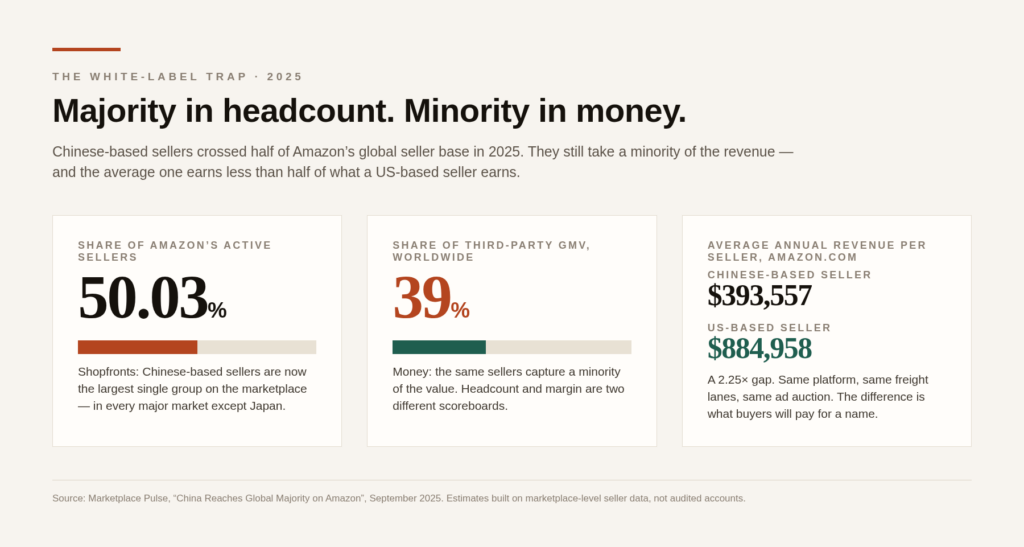
In September 2025, sellers based in China became the majority of active sellers on Amazon — 50.03% of the global base, the first time any single country has crossed that line in every major marketplace except Japan. In the same dataset, those sellers captured roughly 39% of third-party merchandise value worldwide. The average Chinese-based seller on Amazon.com booked $393,557 in a year. The average US-based seller booked $884,958.
Same platform. Same freight routes. Same advertising auction. A 2.25× gap in revenue per shopfront.
So when people say China’s factories are “going consumer,” this is the picture they mean — and it is not a picture of victory. It is a picture of presence without premium. Owning the shelf is not owning the margin.
Ask yourself the uncomfortable question: what is the point of being the largest seller group on the planet if the market still pays you less than half of what it pays the guy two time zones away? That question turns out to be the whole story. And the honest answer is not that factories have become brands. It is something more interesting, and a good deal less flattering.
What “White-Label to Brand” Actually Means
For thirty years the deal was simple, and slightly brutal. A factory in Dongguan or Yiwu made the product; somebody else’s logo went on the box. OEM meant you built to someone else’s specification. ODM meant you designed it too, and the buyer still got the name. You owned the machines, the quality control, the sample room and the shipping schedule. You did not own the story, the price, or the customer.
That arrangement was never a mistake. It was a division of labour, and it worked because the brand owner carried the expensive, uncertain parts: demand creation, distribution, returns, reputation. The factory carried the certain part.
Two decades of that arrangement built an asset nobody talks about at trade shows. Factories learned the true cost of things to the decimal. They learned which materials fail, which tolerances matter, which components can be swapped without a customer noticing. They also learned something subtler and more valuable: they learned what sells, because they were filling the order books of five brands at once and could see which of those order books was thickening.
Then the wall that had kept them anonymous started to come apart. Chinese sellers went from 7.1% of new Amazon.com registrations in 2015 to 62.3% in 2024 — a near-total reversal in nine years. By 2025 they were still 59.9% of new registrations even as total new-seller registrations collapsed 44% to 165,000, the lowest year since tracking began. The pipeline did not empty. It changed hands.
The Wall Came Down. Something Else Went Up.
It is tempting to tell this as a story about liberation: the distribution barrier fell, and the factory walked straight to the consumer. China’s customs data shows how much material is moving through that route. In 2025, cross-border e-commerce reached ¥2.84 trillion, up 4.8%, with exports of ¥2.27 trillion growing 5.4% and accounting for 8.4% of the country’s total goods exports. Consumer goods made up 97.3% of that export basket, and goods originating in Guangdong alone passed half of the national total for the first time, at 51.1%.
That is an enormous conveyor belt. But a conveyor belt is not a brand.
Look closely at what actually replaced the old brand owner, and the liberation story gets muddier. On Temu’s fully managed model, the supplier ships into a domestic consolidation warehouse and the platform owns everything downstream: price, listing, traffic, discounting, returns, last-mile delivery. The factory is not selling to consumers. It is selling to a platform that sells to consumers. That is a wholesale relationship with a very large, very demanding buyer — a better buyer than the trading company of 2010, perhaps, but still a buyer.
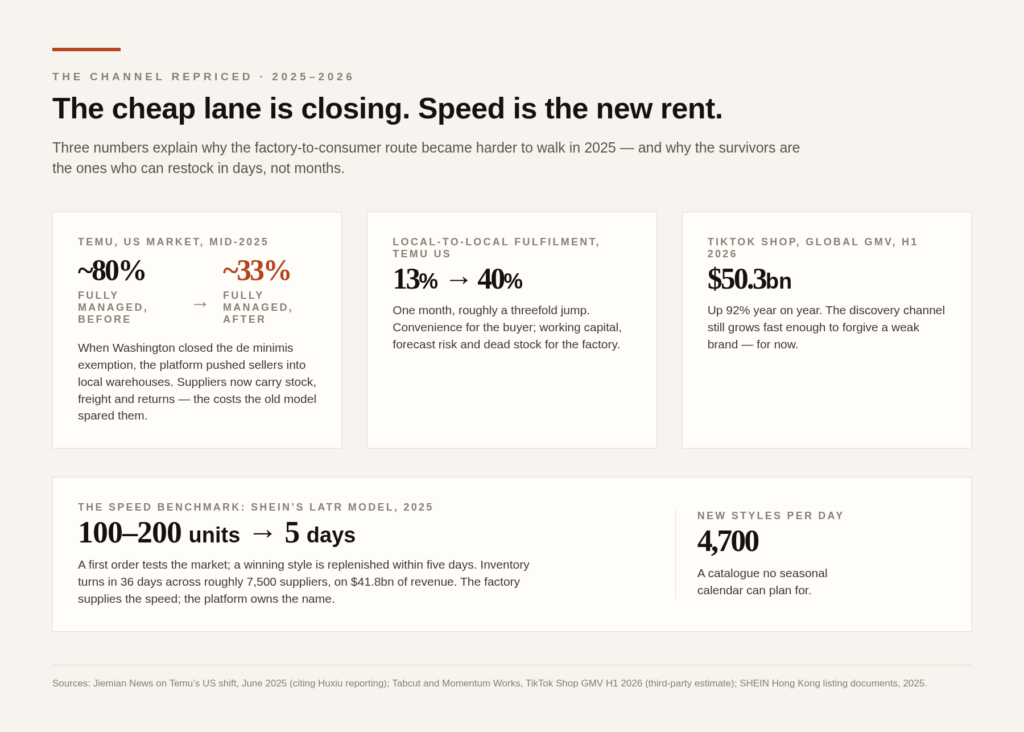
Then the toll went up. When the United States closed the de minimis exemption, the model that depended on cheap direct parcels lost its floor. Reporting in mid-2025 put Temu’s US fully-managed share at roughly one-third, down from about 80%, while local-to-local fulfilment jumped from 13% to 40% in a single month. Read that again, because it is the hinge of the entire story: the moment the cheap lane closed, the inventory risk moved from the platform’s balance sheet to the factory’s.
And that is the part nobody puts in the deck. The channel that unlocked the pivot is now repricing it. Holding stock in a US third-party warehouse, absorbing returns, forecasting demand eight weeks out — these are working-capital problems, not manufacturing problems. A factory that cannot finance sixty days of inventory abroad is not a brand-in-waiting. It is a supplier with a logo file.
Shein Is the Purest Version of This Outcome
If you want to see where the white-label-to-brand story actually lands, do not look at a factory. Look at Shein.
Its 2025 filing figures are almost absurd: $41.8 billion in revenue, $2.06 billion in net profit, 273 million active shoppers, 1.078 billion orders, roughly 7,500 contract manufacturers, 4,700 new styles a day, more than two million styles live in the catalogue, inventory turning in 36 days. The engine behind those numbers is a reorder discipline that most factories would call science fiction: a new style starts at 100 to 200 units, and if the market votes yes, it is replenished within five days.
Here is the uncomfortable part. That demand-signal machine — the single most valuable asset in apparel — sits inside the platform. The suppliers supply the speed. The platform owns the name, the data and the price. A factory inside that system gets certainty, fast payment and volume; it does not get the thing the whole pivot was supposed to deliver.
Which forces a sharper question. Is the real prize brand ownership, or demand-signal ownership? Because those are different assets, and only one of them can be rented.
The Margin Swap
Now the arithmetic, because this is where the romance dies.
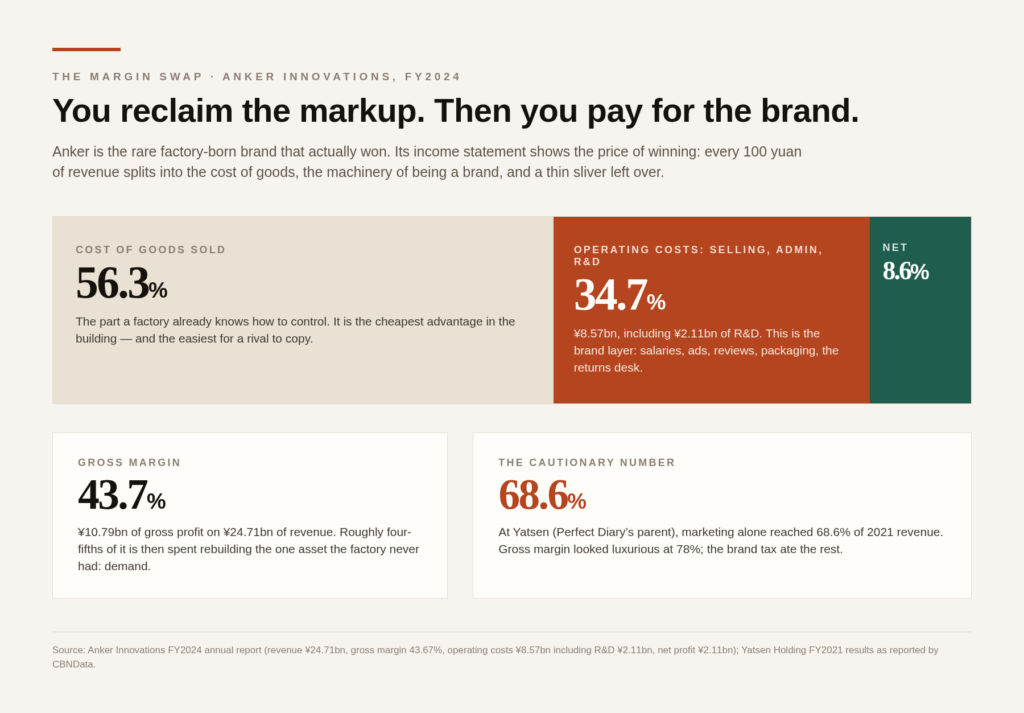
Anker is the rare factory-born brand that genuinely won. In 2024 it booked ¥24.71 billion in revenue, up 41.14%. Cost of goods took 56.3%. Operating costs — selling, administration and R&D, ¥8.57 billion in total including ¥2.11 billion of R&D — took another 34.7%. Net profit attributable to shareholders was ¥2.11 billion, about 8.6% of revenue.
Follow that: a 43.7% gross margin, and roughly four-fifths of the gross profit consumed before it reached the bottom line. The markup the factory “reclaimed” by owning the brand did not stay in the factory’s pocket. It went straight into the machinery of being a brand: the advertising, the salaries, the packaging, the review programme, the returns desk, the customer service team that answers at 2 a.m. in three languages.
Two more cases sharpen the point. Roborock began as an ODM supplier inside the Xiaomi ecosystem, launched its own label in 2017, and by 2021 was at 98.8% own-brand; by 2023 the Xiaomi business had shrunk to a rounding error of ¥1.42 million. In 2024 it posted ¥11.92 billion in revenue, a 50.4% gross margin and a 13.6% net margin — with marketing at 24.9% of revenue and R&D at 8.2%.
Ecovacs took the longer road: a vacuum-cleaner OEM from 1998, an own brand from 2009. In 2024 it did ¥16.54 billion in revenue at a 46.5% gross margin — and a non-GAAP net margin of 4.3%.
Same category. Same factory heritage. Gross margins within four points of each other. Net margins differing by a factor of three. The variable is not manufacturing. It is how efficiently the brand layer converts gross margin into profit — and no factory owner controls that number by being good at moulds.
The Three Advantages That Are Real
None of this means the factory has nothing. It means the factory’s edge is somewhere other than where the pitch decks usually point.
You see demand before the market does
A factory filling orders for six brands sees six order books. That is proprietary demand intelligence no pure brand can buy. It is the raw material behind C2M — reverse customisation where the source factory defines the product and holds pricing power. Alibaba’s 1688, which published its 2025 industrial-belt report in January 2026, describes exactly this shift: more than a million merchants on the platform, over 290,000 using its AI tools daily, and a stated move of factories “from contractor to brand owner.” Note the source and its interest — this is a platform describing its own customers’ ascent — but the direction is corroborated by the factory brands that actually scaled.
You own the cost curve
Industry analysis in China’s appliance sector makes the arithmetic blunt: because a brand’s revenue typically runs two to three times its purchase value, an OEM business tends to cap out around ¥3 billion, and owning the name is the only route past that ceiling. Treat the exact figure as shorthand rather than gospel. The logic, though, is sound — and it explains why so many factory owners keep trying, even after the failures.
You can move in days, not seasons
In Guangzhou’s Panyu garment cluster, sampling can happen in seven days. Shein’s five-day reorder is now the reference point for the entire category. A factory with a flexible line and material on hand can test a product in a fraction of the time a legacy brand needs to get through a buying committee. Speed, not sentiment, is the factory’s native advantage.
The Layer Everyone Underestimates
Here is where most factory brands break, and it is not a marketing problem. It is an accounting problem disguised as a marketing problem.
A brand layer is not a logo and a landing page. It is three functions that all cost money and none of which a factory has ever had to run: reassurance before purchase (reviews, certifications, warranty terms, comparison content), recovery after purchase (returns, replacements, spare parts, service), and memory (the salience that makes someone type your name instead of a category term).
Now put consumer behaviour next to that cost. Bain & Company and Worldpanel’s 2025 China Shopper Report found that in 2024 fast-moving consumer goods grew 0.8% in value on 4.4% volume growth, with average selling prices down 3.4% — the steepest decline in four years. White-label and private-label brands took share in tissues, bottled water, personal wash, makeup, shampoo and skincare. Domestic brands reached 76% of the tracked market.
You would think that is a factory’s dream. Cheaper is winning, and nobody is cheaper than the source.
But the same consumer still wants a name. A 2025 consumer trends study by the consultancy Zhimeng found 84.2% of shoppers prioritise known brands when buying, and 86.2% lean toward familiar names when undecided — both up sharply from 2022. That is the exact contradiction a factory brand has to live inside: buyers want brand-grade assurance, and they refuse to fund brand-grade markup.
Filling that gap means delivering assurance at factory cost. Which is expensive. Which is why the gross margin looks great on the way in and the net margin looks thin on the way out. There is no cheat code here, only a bill.
Two Graveyards Worth Walking Past
Two cautionary tales are worth keeping on the wall next to those first two numbers.
Thrasio raised roughly $3.4 billion, assembled close to 200 Amazon brands, hit a $1 billion valuation faster than any US company before it — and filed for Chapter 11 in February 2024, cutting about $495 million of debt. The failure was not that brand aggregation is impossible. It was that buying brands is not the same as building them, and when capital got expensive the arbitrage that had made the roll-up work evaporated.
Yatsen, the parent of Perfect Diary, is the other graveyard. Marketing spend hit ¥4.01 billion in 2021 — 68.6% of revenue — while cumulative losses ran past ¥6.5 billion and market value collapsed from over $16 billion to roughly $300 million. Its gross margin was a luxurious 78%. It did not matter. The brand had been positioned as the affordable substitute, which is a brilliant customer-acquisition wedge and a terrible pricing constitution: the moment it tried to move up, the positioning refused to follow.
Both stories end in the same place. Demand that is bought has to be bought again next quarter. A factory attempting this with a factory’s balance sheet has less room to absorb that than a venture-funded roll-up had — and the roll-up still failed.
The Supplier-Relationship Trap
There is a quieter risk, and it does not show up in any P&L.
The day a factory launches a consumer label, it starts competing with its own customers. The OEM accounts that fund the payroll are now buying from a rival. Some factories answer this by separating legal entities and sales channels so completely that the two businesses barely share a spreadsheet. Others answer it by refusing to sell in the same categories to the same accounts.
Anker took a third route entirely: it outsources manufacturing and keeps design and brand, walking the two ends of the smile curve. Roborock moved toward its own production. Ecovacs kept both the OEM business and the brands. Three different answers, one shared rule — do not put your own label into the same account list, at the same price, in front of the same buyer who is also your biggest customer.
The Playbook That Actually Works
Strip away the slogans and the pattern among survivors is boringly consistent.
Pick one narrow category and own the specification. Anker did it in charging; Roborock did it in robot vacuums. Depth buys credibility; breadth buys confusion.
Convert demand signal into cadence, not forecast. The winners plan in weeks. If your product calendar is still annual, you are running a factory with a marketing department.
Build assurance assets that compound. Reviews, warranty terms, spare-part availability and service response are not campaigns. They are balance-sheet items that get more valuable every quarter.
Set the first price above the floor. Yatsen’s ceiling was set by its launch price and never lifted. Price is a constitution, not a tactic.
Separate the brand P&L from the factory P&L. Judge the brand on contribution margin per order, not on gross margin per unit. Otherwise the factory’s comfortable numbers keep hiding the brand’s uncomfortable ones.
Treat marketing as capital with a payback test. Purchased growth is a treadmill; earned growth is an asset. The distinction is whether stopping the spend stops the sales.
Keep the OEM business as the cash engine. The brand compounds; the contract work pays for the compounding. Factories that shut the old business too early usually run out of runway before the new one takes off.
What This Means for Incumbent Brands
If you run a brand that has been sourcing from China for a decade, the competitive set has changed shape.
Your supplier now has your cost structure in its files. Through platforms, it increasingly has demand data you never shared. And it has a factory’s tolerance for thin margins in the early innings. That is a genuinely new kind of competitor — not a dupes seller, not a marketplace reseller, but a category specialist with factory economics.
Cost is the wrong place to fight. You will lose that fight, and you will lose it slowly, which is worse. The defensible ground is the layer the factory still has to build: trust that survives a bad batch, service that answers on a Sunday, and a reason to choose you that is not in the spec sheet.
The 2026 Twist: The Cheap Lane Is Closing
One more thing has changed since the pivot became fashionable, and it deserves its own paragraph.
The de minimis era made direct-from-factory parcels cheap enough to subsidise a weak brand. That era is over. Local fulfilment, formal customs clearance and platform compliance have all repriced the route. Meanwhile the compliance baseline itself moved: in China, transaction data reporting became routine, turning tax and invoicing from an option into a cost of doing business.
The consequence is filtering. Factories without working capital, forecasting discipline and a warehouse strategy abroad will be pushed back into supplying someone else — which, ironically, improves the quality of the survivors. The pivot is no longer open to anyone with a factory and an Instagram account.
AI Shrinks the Brand Layer — and Flattens It
The optimists have a point. Generative tools have cut the cost of the brand layer dramatically: product photography, localisation, listing copy, ad variants, packaging mock-ups. On 1688, 290,000 merchants use AI tools daily, and factory-floor stories of 72-hour sampling and five-figure order wins in weeks are now ordinary.
But the same tools flatten the difference. If everyone can generate the same ad, the same listing, the same three-second hook, then content stops being an edge and becomes a commodity. What is left as the moat is what AI cannot manufacture: your own demand data, your service records, your returns history, your physical responsiveness, and the accumulated trust of buyers who have already been burned by someone else.
AI makes the brand layer cheaper to enter and harder to win. That is not a contradiction. It is the usual shape of a technology that lowers the price of admission and raises the price of standing out.
The Honest Verdict
So here is what the white-label-to-brand pivot really is.
Not a value-chain grab. A value-chain swap.
The factory trades a thin, certain wholesale margin for a thick, uncertain gross margin — minus a brand layer it must now fund, staff and defend. The gross margin is the door. The net margin is the room. Between them sits the layer that nobody priced into the business plan, and its cost is set by competition, not by the factory’s competence.
The winners will be few, narrow, data-rich and patient: category specialists who pair manufacturing depth with compounding trust. Most factories will stay suppliers. That is not a defeat. Supplying a platform-brand is a better business than supplying an anonymous trading company — it is simply not the same business as owning the name.
Conclusion: The Margin Still Lives With the Name
China makes somewhere between a quarter and a third of the world’s manufacturing value added — a share no other economy approaches, and one that will not be dislodged by branding slogans. The capability is not in question. The pricing is.
That is the whole lesson of the 50.03% and the 39%: you can own the production of almost everything and still collect a minority of the money, because the market pays for certainty, memory and service — not for capacity.
The factory that made everyone else’s products now can make its own name. It just has to accept that the name comes with a bill, that the bill arrives before the revenue, and that most of the margin it thought it was reclaiming was never margin at all. It was rent — and rent is what you pay when you let somebody else own the story.