Why Review Volume Stopped Predicting Trust
There is a specific kind of failure that only shows up when two systems are optimised against different definitions of the same word. Trust infrastructure is currently in that state, and the cost is quietly borne by every brand that hired an agency to farm reviews.
Consider two numbers. Five. And nine thousand and twenty-three.
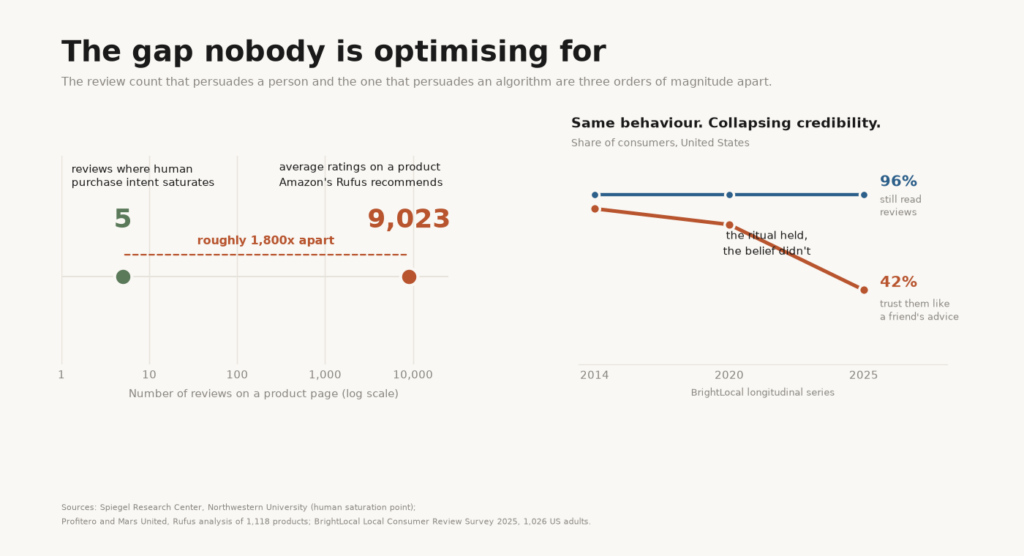
The first is where human purchase intent saturates. Northwestern’s Spiegel Research Center, working across more than 100,000 SKUs, found that a product with five reviews is 270% more likely to be bought than one with none, and that nearly the entire gain arrives within the first ten. By review eleven, a shopper’s mind is made up.
The second is where an algorithm starts paying attention. Profitero and Mars United analysed 287 prompts and 1,118 products surfaced by Amazon’s Rufus assistant. The average recommended product carried 9,023 ratings. A product with one review had a 0.2% chance of appearing.
That is a gap of roughly 1,800× between the evidence a person needs and the evidence a machine wants, and it is the single most expensive blind spot in e-commerce marketing today.
The incentive that broke the signal
Here is the mechanism, and it is honestly mundane.
A review has two jobs. It informs a buyer, and it signals rank to a platform. Those two jobs used to point the same direction, which is why review generation was a benign growth tactic for a decade.
Then the platform’s ranking function became the dominant term. Once ranking depends on review count and velocity, the rational move for any individual seller is to manufacture reviews, because the marginal review is worth far more to your search position than to any single shopper’s decision. Five reviews persuade the human; the next nine thousand only persuade the machine.
That asymmetry is the whole story. It explains why review trust fell from 88% in 2014 to 42% in 2025 while 96% of consumers kept reading reviews anyway — the ritual survived because the alternative is worse, not because the signal recovered. It explains why 46% of shoppers now read AI-sounding review text as evidence of fakery. And it explains why three regulators independently criminalised the same conduct inside fifteen months: the market could not self-correct, because the incentive pointed one way and the buyer’s interest pointed the other.
What the volume actually buys
Almost nothing, beyond a threshold.
On Taobao, a study of 323 shoppers modelled review attributes against purchase intention. Recency led at β=0.39, specificity followed at 0.36, and volume came last at 0.21. The number of reviews is the weakest of the three levers, and Chinese market regulators now explicitly teach shoppers to treat a uniform five-star photo wall as a fabrication tell rather than a credential.
Format is where the leverage actually sits. PowerReviews measured reviews with photos converting at 2.6× text-only, and with video at 4.1×. One detailed video review outearns two hundred plain ratings, and it costs a fraction as much to obtain honestly.
Field note: what this feels like on the buying side
I sat with a category manager at a mid-sized home goods brand while she reviewed her own product pages, and the moment that stuck was her reading her bestseller’s rating out loud — 4.8 stars, 11,000 reviews — then saying she no longer trusted it.
Her reasoning was not sophisticated. Eleven thousand reviews on a product launched two years ago implies a review rate no real customer base produces. She had started filtering to the one-star and three-star entries to find out what the product actually was. She was doing manually what the FTC rule now requires platforms to stop suppressing.
That is the practical shape of a dead signal. The metric kept climbing, the meaning drained out, and the buyer rebuilt the verification work herself, by hand, in the negative reviews.
The implication is uncomfortable
If volume no longer persuades and the algorithm still demands it, most brands are spending on the axis that stopped working while underinvesting in the one that did not.
The defensible position is narrower and cheaper than the industry assumes: reach five fast, keep them fresh, make every one of them provable, and stop treating the count as the goal. The reviews that survive inspection are the only ones that will survive the next two years of enforcement.