INSIGHT — Why the Open Web Still Loses on Programmatic, Even When Programmatic Works
For fifteen years the programme for the open web was simple and, on paper, unbeatable: take the same automated machinery that made Meta and Google efficient, run it across thousands of independent publishers, and let competition do the rest.
The machinery worked. OpenRTB became a genuine global standard. Real-time auctions cleared hundreds of billions of impressions a year. In France alone, the open-web programmatic perimeter still moves hundreds of millions of euros every half-year, across more than 1,500 sites and apps.
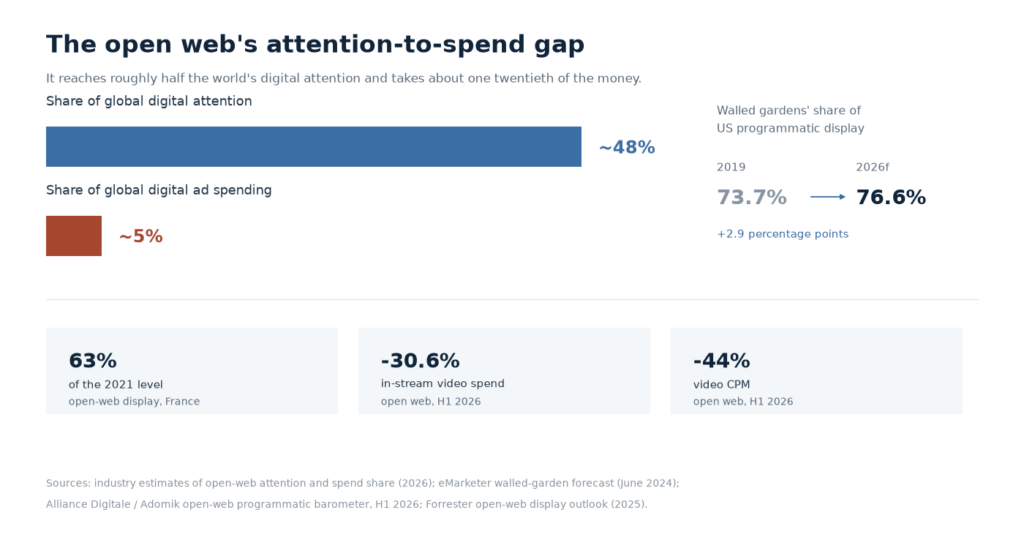
And yet open-web display keeps shrinking. Display investment fell 9.9% in 2025 and another 13% in the first half of 2026 — French display spend now sits at 63% of its 2021 level, and Alliance Digitale projects it will halve again by 2030. In-stream video on the open web fell 30.6% in a single half-year, with CPMs down 44%.
So here’s the question nobody answers properly. If programmatic advertising works, why does the open web keep losing?
Because the open web was never competing on technology. It was competing on something it structurally cannot supply.
The mechanism: outcomes got cheap to buy, and proof got expensive
Forrester expects brands to cut open-web display budgets by 30% in 2026 and move the money to CTV and paid social. Media buyers have been saying the quiet part out loud for a while now. One agency founder put it this way: why allocate budget to something “almost unmeasurable,” where you can’t see the performance lift without “tons of modeling” — when there’s a channel where you know the input and the output?
That is not an argument about ad quality. It’s an argument about audit cost.
Inside a walled garden, the audit trail is internal. The platform sees the impression, the click, the basket, the refund, and the repeat purchase — because all of it happens on infrastructure it owns. Attribution is a database join, not a research project. Outside the walled garden, each of those steps belongs to a different company, and stitching them together costs money, time, and a modelling layer that never quite convinces the CFO.
Now stack a second cost on top. Since Google’s AI Overviews and AI Mode arrived, a large share of searches end without a click. AI summaries have pulled an estimated 4–5% out of publisher revenue directly, and traffic-led monetisation has dropped 25–35% as users stop clicking through. Fewer arrivals means fewer monetisable sessions. Forrester’s logic is almost mechanical: as addressable audiences on publisher pages shrink, budgets follow the audiences.
So the open web faces a pincer. Its inventory is getting harder to prove, and there is less of it worth proving.
The part most people get backwards
Here’s the counterintuitive bit. The walled gardens are not winning because their automation is better. They are winning because they own the transaction the automation is supposed to prove.
Look at the direction of travel. Walled gardens held 73.7% of US programmatic display in 2019; eMarketer forecasts 76.6% by 2026. Not a collapse of the open web into irrelevance — a slow, steady squeeze of roughly three points over seven years. The open web didn’t lose a technology race. It lost a data-ownership contest that was decided before the race started.
This is precisely what makes the China comparison so clarifying. Recall that China runs about 80.7% of its digital display through programmatic — close to the US at 91.1%. Structurally, Chinese buying is more automated than the Western version in one respect: there is almost no open-exchange layer at all, because the platforms own the pipes end to end.
China didn’t fail to build an open programmatic market. It never needed one. The moment payment, identity, and inventory sit inside the same company, the audit problem disappears — and with it, the reason to route spend through an independent layer.
The West built that independent layer first, then watched its foundation get pulled out from under it: first by cookie deprecation, then by Google keeping cookies in Chrome while retiring the Privacy Sandbox in October 2025, leaving no cross-site replacement at all.
What this actually means for a media plan
Three implications, none of them comfortable.
First, the open web’s problem is a proof problem, not a reach problem. It still commands close to half of global digital attention while taking roughly 5% of spend. That gap is not going to close through better creative or better formats. It closes when someone makes independent inventory as auditable as platform inventory — which, realistically, means publisher-side identity and clean-room infrastructure maturing fast enough to be credible.
Second, treat “open web” as a portfolio, not a channel. Alliance Digitale’s data shows the collapse is uneven. Programmatic audio grew 23% and DOOH is expanding; mobile native ads rose 39%. Meanwhile in-stream video on non-broadcaster publisher sites is being abandoned. The category isn’t dying uniformly — it’s being sorted into proof-capable and proof-incapable segments.
Third, budget defence beats budget innovation. If you’re pitching open-web inventory to a CFO in 2026, the winning argument is not incremental reach. It’s a documented, repeatable incrementality method — geo holdouts, matched-market tests, clean-room measurement — that produces a number the finance team will accept without a modelling debate.
Because that’s the real lesson here. The open web didn’t lose to better advertising. It lost to cheaper accounting.