The Soul Was Never the Sizzle: What AI Actually Took From Marketing
Every few years someone stands up at an industry conference and announces that marketing has lost its soul. The wording barely changes. Television killed the craft. Digital killed the big idea. Data killed creativity. Now artificial intelligence has finished the job.
Notice the schedule. The obituary arrives on time, decade after decade, and the deceased keeps showing up for work on Monday. That alone should make you suspicious of the diagnosis.
I don’t think the soul is missing. I think we keep looking for it in the props.
The eulogy is a ritual, not an autopsy
The lament is emotionally true and analytically lazy. It describes a feeling — the discomfort of watching a craft you loved get reorganized around instruments you don’t trust — and then presents that feeling as a finding.
But nothing about a funeral proves a death. What actually happened, four times running, is that the instruments changed while the job stayed put: figure out what people want, say something true about it, and make it easy to act on. Nobody has yet proposed a replacement for that job. Not the spreadsheet, not the algorithm, not the model.
What the mourners are really grieving
Be fair to them, though. Something real is being mourned, and pretending otherwise makes the counter-argument sound like a vendor pitch.
What’s gone is a particular kind of professional romance. The long lunch with a difficult creative director. The campaign that ran because someone believed in it, not because a holdout test cleared it. The pleasure of making something beautiful and not being asked, in the same breath, what it earned. That world had real charms, and it had real waste. Both are gone.
Grief over the loss of the familiar is not the same as evidence that the essential thing died. Confusing the two is the category error at the center of every one of these essays, including the ones I agree with.
A definition of the soul that survives contact with reality
Strip away the nostalgia and the soul of marketing is embarrassingly simple. It is the discipline of seeing people clearly — their actual constraints, their actual fears, the gap between what they say and what they do — and then building something that closes a real distance between them and a solution. A message, a product, a refund policy, a human on the phone at 9pm.
That’s it. That’s the whole soul. It has never been more complicated than that, and it has never once depended on the delivery mechanism.
The medium was never the soul. Neither was the aesthetic, nor the mystique of the untracked genius account. Those are wardrobe. When the wardrobe changes, we mistake it for a change of body.
The instrument didn’t replace the goal. It removed the alibi.
Here’s the inversion almost nobody makes. Before measurement got good, you could claim connection without evidence. You could run a beautiful campaign nobody remembered and call it brand building. You could lose the sale and blame distribution.
Data didn’t kill the soul. It made faking it harder.
That is a moral upgrade dressed as a technical one, and it explains why so many practitioners experience the last fifteen years as a loss of dignity. What they lost was the right to be believed without proof. Some of them were telling the truth. Some were not. The instrument doesn’t care which.
The chart that ends most of this argument
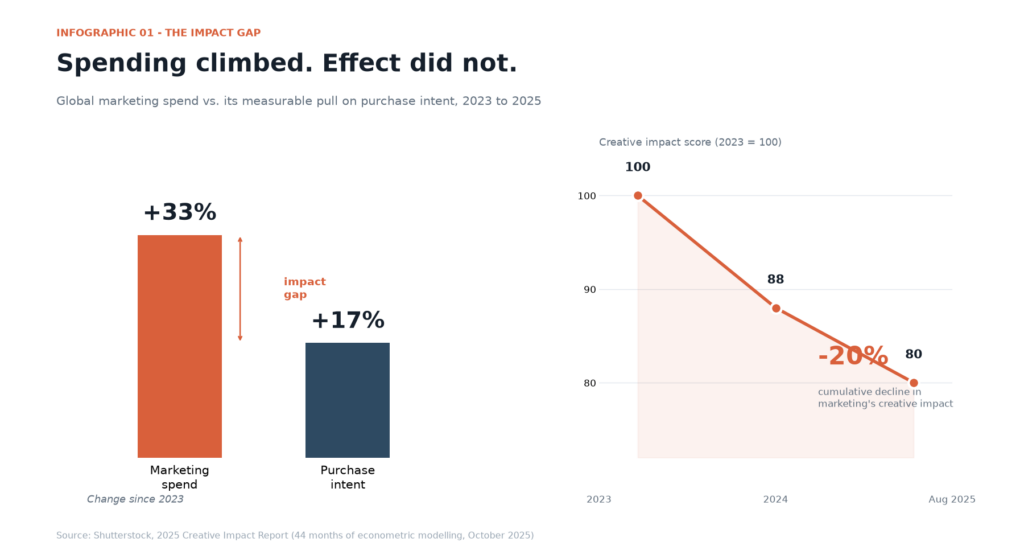
Between 2023 and 2024, marketing spend rose 33 percent while its effect on purchase intent rose 17 percent. Shutterstock calls the space between those two lines the impact gap, and by August 2025 its cumulative creative impact score had fallen almost 20 percent below the 2023 baseline.
Read that again, because it cuts against both camps. If AI were the soul-killer, effect should have collapsed as AI spread. What actually collapsed is the ratio between output and resonance. We got much better at producing things and no better at being felt. Volume was always the substitute for soul, never the proof of it — and AI made the substitution cheaper, faster, and impossible to hide.
The awkward part: the soul was already being starved before AI arrived
The most inconvenient fact for the AI-killed-it story is a timeline.
Peter Field’s analysis of the IPA Effectiveness Databank — almost 600 cases spanning 1996 to 2018 — showed that in the twelve years to 2008, creatively awarded campaigns were typically twelve times more efficient at driving market share than non-awarded work. Measured across 2006 to 2018, that multiplier fell to four. Isolate the most recent award years and the advantage disappears entirely. The 2019 report carrying the finding was titled, with admirable bluntness, The Crisis in Creative Effectiveness.
The cause was not generative models. It was short-termism: campaigns evaluated over six months or less, budgets cut below the level needed to maintain share, work judged on whether it produced a spike rather than a memory.
The diagnosis has only hardened. In the 2025 Cannes Lions State of Creativity survey of more than 1,000 marketers and creatives, 51 percent said their consumer insight was too weak to develop bold work, 57 percent said their brands struggle to react quickly to cultural moments, and only 13 percent described their companies as friendly to creative risk.
So the obituary was drafted years before the technology people now blame showed up. AI didn’t kill the patient. It arrived at a bedside where the patient had been quietly malnourished for a decade and got handed the death certificate.
The idea still does the selling
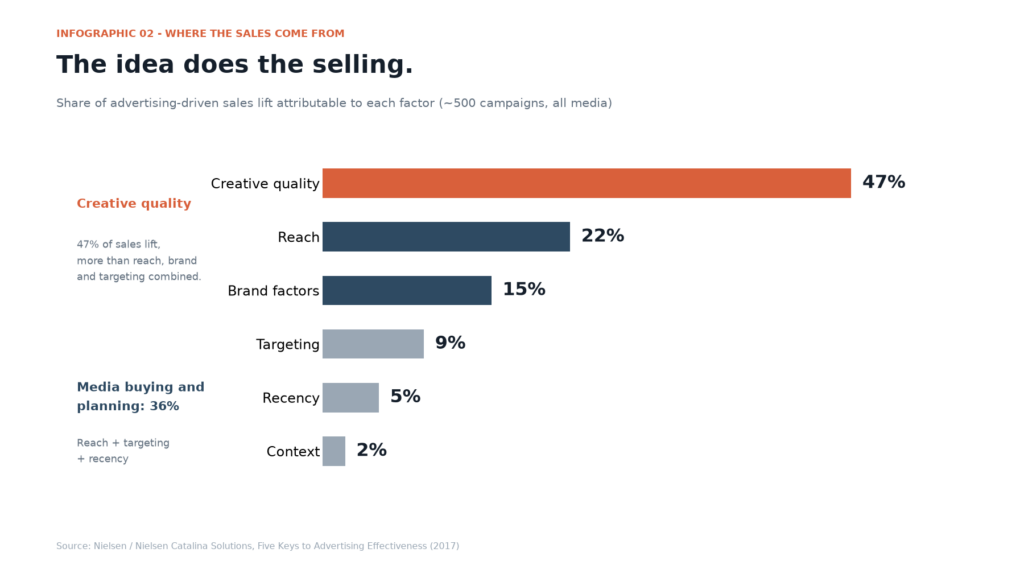
If precision were the new soul, targeting would be where the value sits. It isn’t. Nielsen’s analysis of almost 500 campaigns across every major media platform put creative at 47 percent of sales lift, reach at 22, brand factors at 15, targeting at 9, recency at 5, context at 2.
Targeting — the thing every dashboard is built to optimize — accounts for nine percent. The work accounts for nearly half, and 49 percent once you fold context into creative. All of media buying and planning together contributes 36 percent.
There’s a subtlety worth holding onto, because it rescues the case for data. In the comparable 2006 Project Apollo study, creative carried 65 percent of sales lift and media just 15. By 2017 media had reached 36 percent. Its share grew because media buying genuinely got smarter, and because television creative became more consistently competent. Precision didn’t replace the idea. It raised the floor beneath it. A great idea delivered to nobody is a diary entry.
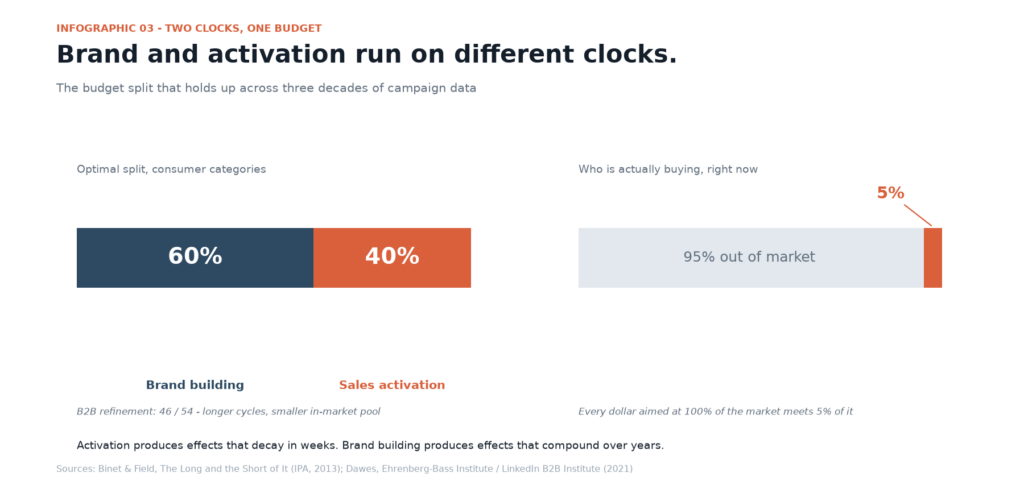
Two structural findings explain why the redefined soul looks different from the old one.
The first is Binet and Field’s profit hotspot from three decades of IPA cases: roughly 60 percent brand building to 40 percent sales activation, refined to 46:54 for B2B. Activation produces effects that decay in weeks. Brand building produces effects that compound over years.
The second is the Ehrenberg-Bass 95-5 rule. At any given moment, roughly 95 percent of category buyers are not in the market. Which means most of your addressable audience cannot be persuaded today, because they are not deciding today. They can only be remembered.
Put those together and the redefinition writes itself. The old soul lived in the moment of contact — the big ad, the clever line, the impression. The new soul lives in memory before contact, and in the experience after the click. Both are less glamorous than a Super Bowl spot. Both are more durable, and both are harder to fake.
What AI actually changed, honestly
Let’s give the technology its due, without the mysticism.
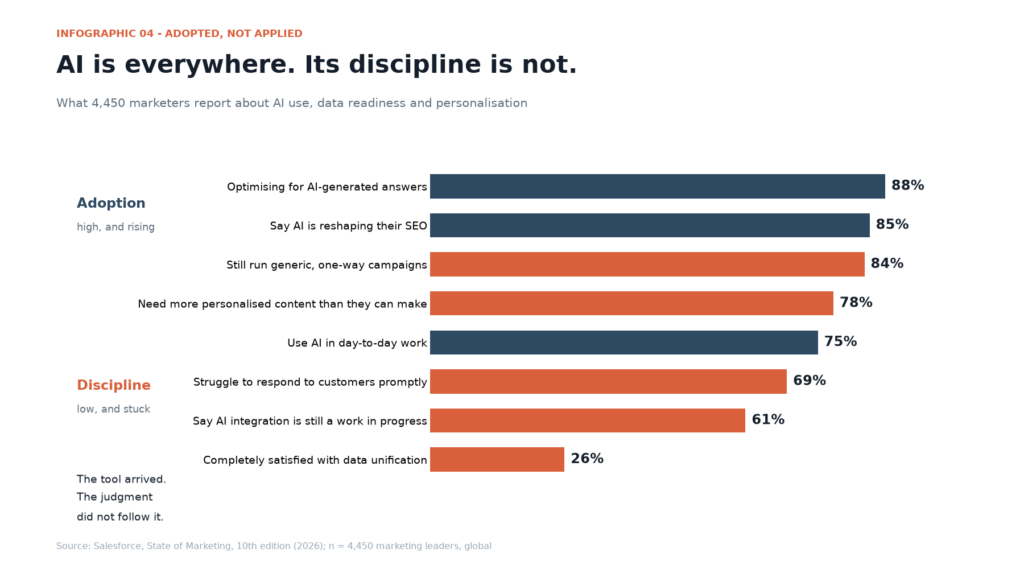
AI collapsed the cost of execution. Content at volume, variant iteration, localisation into fifteen languages, analysis of unstructured feedback at a scale no team could read — all of it now cheap. In Salesforce’s tenth State of Marketing survey of 4,450 leaders, 75 percent reported using AI in their day-to-day work, and 88 percent said they were optimizing for AI-generated answers in search.
That combination is the whole story of the moment. The tool is present. The practice hasn’t caught up.
What AI didn’t change
It didn’t change where the bottleneck sits. Ask the same 4,450 marketers what’s blocking personalisation and they don’t say model quality. They say data: fragmented, unintegrated, untrustworthy. Only 26 percent are completely satisfied with how well their customer data is unified. Sixty-one percent say full AI integration remains a work in progress. And 84 percent admit they are still running generic, one-way campaigns even so.
Bobby Jania, CMO at Salesforce’s Agentforce Marketing, put it in a line I’ve quoted more than any chart this year: we are using the most powerful technology in history to send more one-way spam, faster. The tool is not the constraint. The context is.
AI also didn’t change the part where someone has to decide what the brand is for, which trade-off is worth the backlash, and which sentence would genuinely hurt a customer to read. Those decisions have no prompt. They have a person attached.
The real risk isn’t soullessness. It’s sameness.
Here is where I stop reassuring anyone. There is a genuine casualty in this transition, and it isn’t the soul. It’s variety.
In a 2024 experiment published in Science Advances, Anil Doshi and Oliver Hauser gave roughly three hundred writers the option of using AI-generated story ideas. The writers who took the help produced stories rated more creative, better written, and more enjoyable — with the largest gains among the least confident writers. Then the second finding landed: those stories were markedly more similar to one another than stories written without AI.
Individual creativity up. Collective diversity down. The researchers called it a social dilemma, and that’s exactly right. Every writer is individually better off. The culture they all write into is narrower.
That is the honest version of the everything-looks-the-same complaint you hear in every brand review. It’s not that machines can’t be moving. It’s that when everyone draws from the same distribution and optimizes against the same averages, the tails vanish. The strange, specific, slightly-wrong idea — the one that actually becomes a memory — is the first thing to go.
System1’s testing makes the commercial consequence hard to argue with. Fewer than one in five ads clears the three-star line associated with long-term share growth. Neutrality — no emotional response at all — is the single most common reaction to advertising, and it is the response that predicts nothing.
This year’s Big Game made the point at scale. Ads averaged 2.7 stars, down from 3.0 a year earlier, while the 18 percent built around AI messaging averaged 2.1. Brand recognition landed at 78 percent, meaning 22 percent of viewers could not name the advertiser afterwards — the weakest recall in seven years of testing. Ads got more expensive and less attributable. That should worry you more than any headline about job losses.
The new soul has a trust problem it can’t dodge
Precision without permission reads as surveillance. That’s the whole risk, and the numbers are unforgiving.
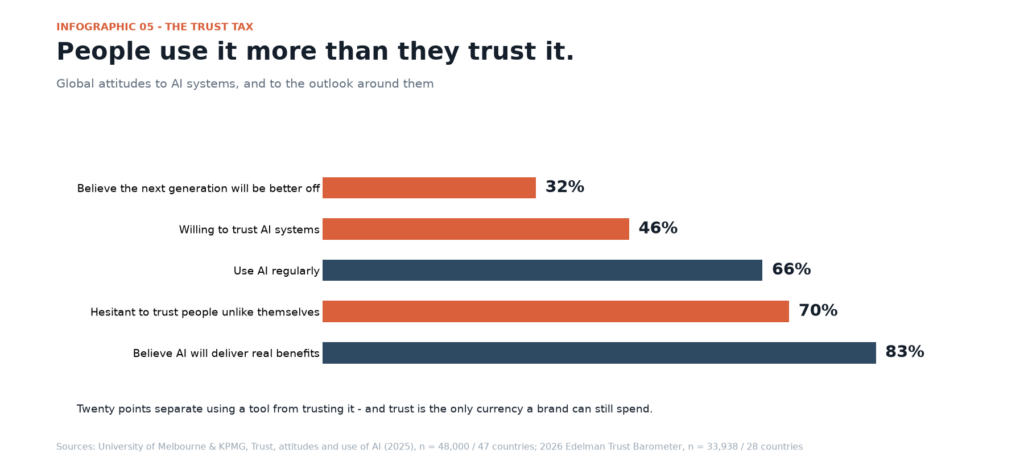
The University of Melbourne and KPMG surveyed more than 48,000 people across 47 countries: 66 percent use AI regularly, 46 percent are willing to trust it, and 83 percent expect it to deliver real benefits. Two thirds rely on its output while fewer than half trust the system producing it.
The social weather around that gap isn’t improving either. The 2026 Edelman Trust Barometer — 33,938 respondents across 28 countries — found 70 percent hesitant or unwilling to trust people whose values or information sources differ from their own, and only 32 percent believing the next generation will be better off.
Meanwhile the demand side has moved. Accenture’s 2025 Consumer Pulse study of 18,000 people across 14 countries found roughly half had made a purchase decision with generative AI’s help, and that for active users it had become the second most common source of product recommendations, behind only physical stores.
So your customer is now asking a machine for advice about you, and that machine’s users don’t fully trust it. That’s the new operating environment. Not a loss of soul — a change in where the soul has to be legible.
The four shifts, stated plainly
From persuasion to availability. The goal is not to convince someone today. It is to be the first name that surfaces when their circumstances change. That’s a memory problem, not a messaging problem.
From ad craft to experience craft. The work no longer ends at the impression. It runs through onboarding, the returns process, the reply time on a Saturday. Brands that treat service as marketing are quietly winning arguments their ads never win.
From claims to accountability. You can still lie, but you can no longer lie and be surprised when it’s measured. The audit trail is the new creative director.
From reach to resonance at reach. Precision didn’t replace mass. It made mass answerable. The interesting question is no longer how many people saw it, but how many would notice if you disappeared.
The rebuttal the nostalgics deserve
I’ll make their argument for them, because it’s stronger than most defenders of marketing admit.
Something was lost, and it wasn’t trivial. The unmeasured, unoptimized, slightly self-indulgent creative act produced things no brief could have specified — and a system that demands justification before the fact will produce fewer of them. The Lions data makes this concrete: half the industry says its insight is too weak to support bold work. That is not a technology problem. That is a starvation problem wearing a technology costume.
But note what the loss actually is. It’s the loss of a particular form, not a purpose. The big idea didn’t die. It moved — into variant testing that finds the one line that lands, into emotional craft measured in stars rather than applause, into patient brand building that pays out over three years instead of three weeks. It wears different clothes now. It still has the same face.
What I’d actually do on Monday
Four moves, all of them boring, all of them evidence-backed.
Protect a memory budget and judge it on its own clock. Sixty-forty, adjusted for your category, measured with brand lift and share of search rather than last click. If you can only defend what reports weekly, you will only ever fund what decays weekly.
Buy one uncomfortable idea a quarter and give it three messages, not thirty. Shutterstock’s data shows believability falling away after roughly three campaign messages, and concentrated multi-format campaigns returning 40 percent more than single-format ones. Most brands are running the opposite experiment and calling the result fatigue.
Fix the data room before you buy the agent. Twenty-six percent complete satisfaction with data unification tells you where the queue is. The tool amplifies whatever context you hand it. Hand it none, and you’ve automated your worst habits.
Keep a human in the room for the sentence that matters. Not for the whole process — that’s nostalgia. For the one line, the one image, the one decision a customer will remember. That’s where the soul actually lives now, and it’s a smaller, sharper job than it used to be.
So what got redefined, exactly
The soul of marketing moved from the glamour of reach to the substance of connection. From being seen to being remembered. From the wit of the message to the honesty of the follow-through. From a profession that could claim empathy to one that has to demonstrate it, in public, with the numbers attached.
That version is less romantic. It is also truer to what marketing always said it was, and considerably harder to fake. If that’s a loss, it’s the kind you take.
Marketing didn’t lose its soul. It stopped being allowed to pretend it had one it didn’t.