Why the Fourth Data Dimension Costs More Than It Earns
Personalization’s value curve peaks early and then turns hostile. Almost every program in production is running past that peak.
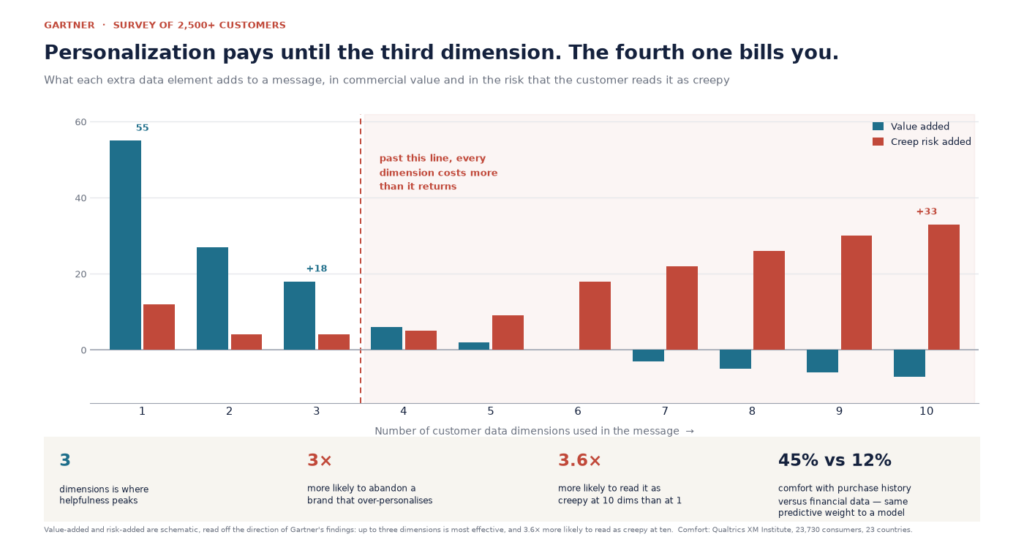
Gartner surveyed more than 2,500 customers and found that the single most effective category of personalized message was not the most personalized one. It was the helpful one carrying up to three customer data dimensions. That combination beat every other message type tested on brand intent, purchase and repurchase. Add more signal and the ranking does not improve; it degrades. Separate Gartner work puts a number on the degradation: content built on ten data dimensions is 3.6 times more likely to be read as creepy than content built on one.
Not 3.6 times more relevant. 3.6 times more unnerving.
The two curves do not share a shape
Value saturates. Risk compounds.
That asymmetry is the whole mechanism. Once you know a customer bought running shoes, the fifth dimension — their gym’s postcode, their inferred income, their age band — adds almost nothing to whether your message helps them. The helpful idea was already formed at dimension two. Everything after it is decoration on a solved problem.
Risk behaves in the opposite way, because creepiness is not a function of accuracy. It is a function of provenance. Each dimension is one more thing you know that the customer never handed you. Their reaction is not “that’s wrong”; it is “how did you get that?” — and that question gets louder with every element you add, even when every element is correct.
Aguirre and colleagues found the cleanest version of this in the Journal of Retailing: identical personalization, collected overtly, lifted response; collected covertly, it reversed. Same data. Opposite sign. Dimensions are not neutral units of knowledge — they carry a story about how you got them.
Why the machine crosses the line
Here is the part that should worry you, and it is not about intent.
A model has no native sense of the comfort ladder. To an optimizer, purchase history and financial information are both features with predictive weight. It has no way to feel that one sits at 45% comfort and the other at 12%. So it will confidently assemble the message no human strategist would ever send — the one that proves you know something the buyer deliberately did not tell you.
That is the real answer to “why does over-personalization keep happening?” It is not greed. It is an objective function with a revenue term and no penalty term. The creep cost never enters the loss, so the model never optimizes against it.
The ladder, and the one thing that moves it
Qualtrics XM Institute’s 23-country study of 23,730 consumers ranks the rungs: purchase history at 45%, website visits at 42%, social posts at 17%, financial information at 12%.
Now the useful finding. Consumers who trust a company to handle their data responsibly are, on average, eight percentage points more comfortable with every single data type. Trust shifts the entire ladder — and trust is built by using less, not more. Which is an awkward conclusion for anyone who bought a CDP to justify.
What three dimensions actually looks like
Gartner’s sequencing note is the operative detail: the effective programs start by identifying the help the customer needs, and assess the minimum data requirement last. Most teams do this in reverse, starting from the warehouse and asking what could be said.
Concretely: name your three. Write them down. Then ask whether the customer would accept being told, out loud, where each one came from. If the answer is no, the dimension does not clear the bar — regardless of lift.
The uncomfortable implication
Gartner expects 60% of brands to run agentic AI for one-to-one interactions by 2028. An agent personalizes continuously, at scale, without a human in the loop at the moment the message is assembled. It will not stop at dimension three out of restraint, because restraint is not a thing it has.
The dimension limit you write down now is the only control that survives that shift. Not the consent banner. Not the privacy policy. The list of what the model is permitted to act on.
The fourth dimension will still be available. It just will not be free.