Stop Budgeting for AI. Start Budgeting for Judgment.
Somewhere along the way, “AI marketing” became something you could point at.
It has a budget line. It has a conference track. It has a Slack channel called #ai-marketing, a rotating cast of vendors, and at least one person whose title contains the word “AI” and the word “lead.” You can walk into a marketing department, ask “where does the AI stuff live,” and be handed an org chart with a box on it.
That box is the problem. Not because the people in it are wrong, but because the box itself is a confession. The moment you can locate AI on an org chart, you have admitted it lives somewhere other than inside the work.
Here is the argument I want to make, and it is not the argument you will hear at most martech conferences: AI marketing succeeds precisely when the label disappears. Every statistic in this piece points the same direction. The brands getting real money out of AI are not the ones with the sharpest “AI strategy.” They are the ones who quietly stopped treating it as a strategy at all.
The Naming Reflex
There is an old instinct in this industry, and it is nearly impossible to resist. Something new appears. We name it. We give it a team, a budget, a KPI, a job title. Naming feels like progress, because an unnamed thing is hard to fund and impossible to put on a slide.
You have watched this happen before. “Social media marketing” was once a department. Then it was a line item inside every campaign. “Content marketing” was once a job title; now every marketer writes content and nobody calls themselves a content marketer. “Growth hacking” got a conference, a certification, and a backlash, and then dissolved into product and lifecycle teams where it actually belonged.
Each of those followed the same arc: born as a category, absorbed as a capability. The ones that survived stopped being nouns. The ones that stayed nouns eventually got restructured.
So why do we keep doing it? Because categories are legible to finance, and capabilities are not. A category has a number attached. A capability has a thousand small numbers scattered across every other line. One is easy to defend in a budget review. The other requires you to argue that the value shows up in places you do not own.
That is an uncomfortable argument to make in a room full of people who want to see a return on a specific investment. So we make the legible argument instead, and we build the box.
What the Money Actually Says
Gartner’s 2026 CMO Spend Survey is the closest thing this industry has to a shared mirror. It surveyed 401 CMOs and marketing leaders across North America, Europe and the UK, mostly at companies above a billion dollars in revenue, between January and March 2026. Read the numbers in sequence, and a strange picture emerges.
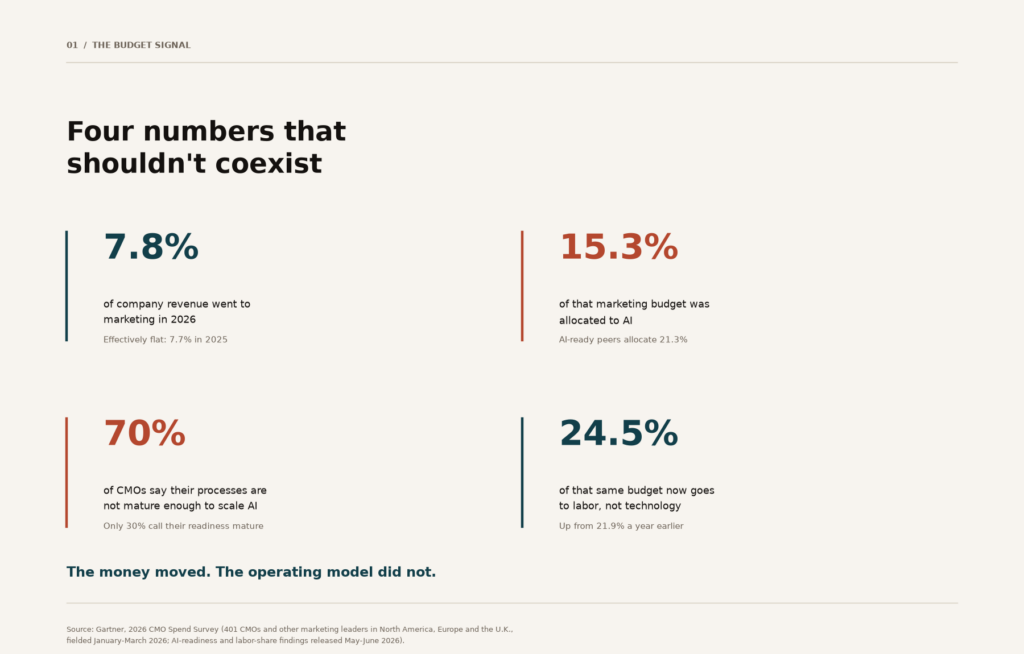
Marketing budgets went to 7.8% of company revenue, up from 7.7%. That is not growth. That is a rounding error with a press release. Within that flat envelope, 15.3% of the total marketing budget went to AI. Seventy percent of CMOs said becoming an AI leader was a critical goal for 2026.
And then: 70% of those same CMOs said their internal marketing processes were not mature enough to effectively implement and scale AI. Only 30% described their readiness as mature or fully developed. Thirty-eight percent named a lack of internal AI expertise as the single biggest barrier to getting efficiency out of the technology.
Sit with that for a second. The money moved. The operating model did not. You bought the tools, you set up the team, you put the number in the deck, and the way work actually gets done on a Tuesday afternoon is essentially unchanged.
There is one more number in that survey that almost nobody quotes, and it is the most interesting of all. Labor’s share of the marketing budget rose from 21.9% to 24.5%. In the same year that AI spending hit 15.3%, the share going to people went up, not down.
That is not a paradox. It is a signal. If AI were genuinely a category — a channel you bolt on, a tool that replaces a task — labor should have shrunk. Instead it grew, because what actually got expensive was the judgment required to direct the machines. Gartner’s own read is blunt: the CMOs who scaled successfully were not simply spending more, they were building the budget agility, governance and talent to turn the spend into something measurable.
Tools are cheap. Knowing what to do with them is not.
A Capability Is a Multiplier. A Category Is an Output.
The distinction sounds like semantics until you apply it, at which point it becomes the most useful test in this whole conversation.
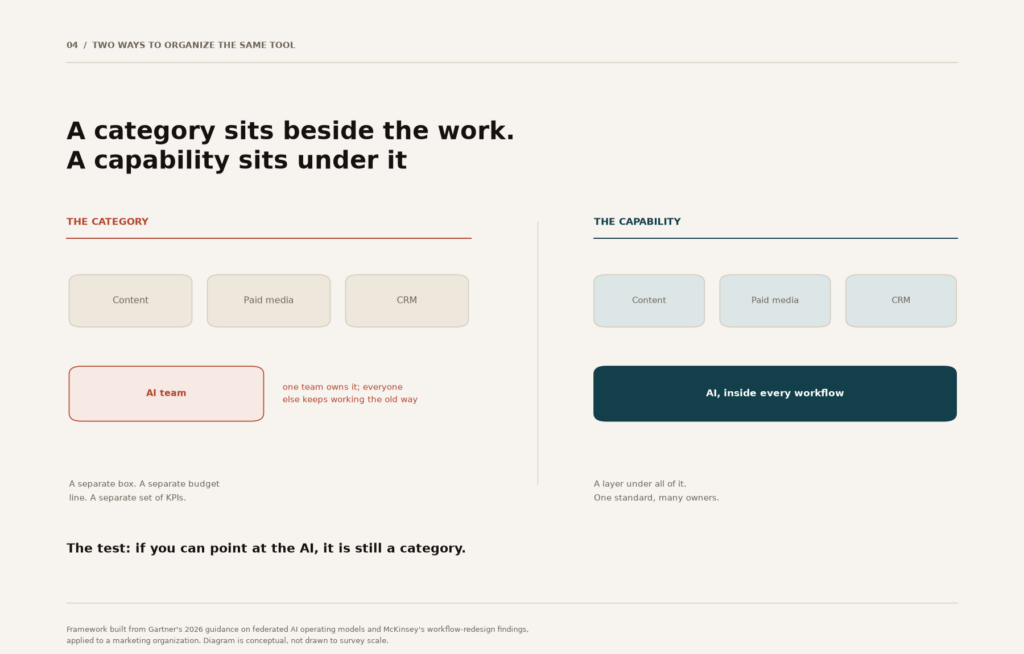
A category is a thing you produce. Social. Email. Paid search. Display. You can point at the output, count it, and put it in a channel report. A capability is a thing you do other things with. It has no output of its own. It raises the ceiling on everything it touches.
AI has no output of its own. Ask a marketing team what they made with AI last quarter and watch the answers scatter: fifty ad variants, a rebuilt attribution model, a faster research sprint, a rewritten onboarding email, a pricing sensitivity analysis, a localization pass across nine markets. None of that is “AI marketing.” All of it is marketing, done with AI.
This is why the box does so much damage. Put AI in a category and one team owns it, which means everyone else is off the hook. The content lead keeps writing copy the old way because “AI is their thing.” The media buyer keeps briefing the agency the old way because the AI team has not shipped the tool yet. The capability is nominally present and functionally absent.
Put AI in the workflow and there is no one to delegate to. Everyone is slightly better at their job, and nobody has a new job title.
Three Costs of Getting This Wrong
I want to be specific about the damage, because “silos are bad” is the kind of claim that gets nodded at and then ignored.
The pilot treadmill. A dedicated AI team is structurally incentivized to produce AI projects, not AI-infused marketing. Projects have demos, and demos get funding. Diffusion has no demo. Gartner has predicted that more than 40% of agentic AI projects will be canceled by the end of 2027 over escalating costs, unclear value or inadequate risk controls — a statistic that reads less like a technology failure and more like a portfolio of things that were never wired into how the business runs.
The adoption ceiling. Frame AI as a specialist capability and you have told most of your team it is not for them. The evidence for this is unusually clean. Salesforce’s 2026 State of Marketing research, covering roughly 4,450 marketers in 26 countries, found about three-quarters using at least one form of AI but only about one in eight using anything genuinely agentic. Wide, shallow, and shallow in exactly the places where the label made it someone else’s job.
The KPI distortion. Once AI is a category, it needs category metrics: number of AI projects delivered, seats licensed, prompts run, hours saved. None of these measure the outcome. They measure the label’s activity level. Meanwhile the numbers that actually matter — pipeline, retention, cost per qualified lead — stay flat, and everyone concludes the technology is overhyped when the reporting structure was the problem.
The Productivity Illusion
If you want to see the gap between “everyone got faster” and “the business made money,” McKinsey’s 2026 State of AI survey is the cleanest instrument available. Fielded in May and June 2026 across 1,719 respondents in 97 nations, it separates individual experience from enterprise result with almost surgical precision.
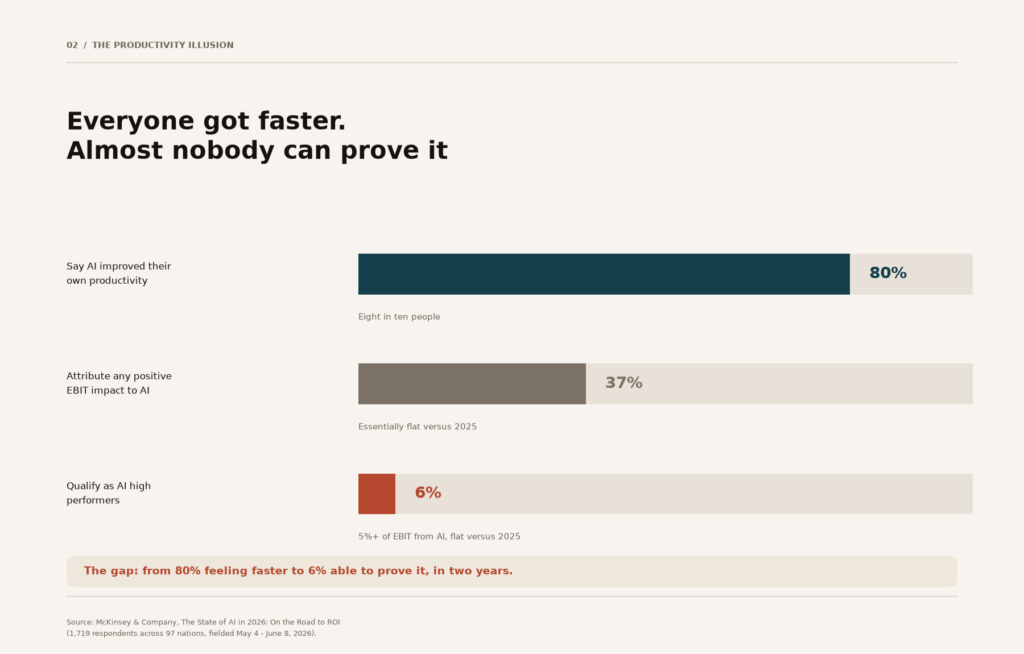
Eighty percent of respondents said AI had improved their own productivity. Thirty-seven percent said their organization could attribute any positive EBIT impact to AI — essentially unchanged from the year before. And the share qualifying as high performers, meaning they attribute at least 5% of EBIT to AI and describe the effect as significant, sat at 6%. Flat. Unchanged. For a second straight year.
Eighty percent of people are faster. Six percent of companies can find it in the P&L. That gap is the whole argument of this article in one chart.
And here is the part that should genuinely worry a CMO: 47% of mid-level managers and individual contributors reported at least one negative effect from AI use, against 31% of executives and senior managers. The people closest to the work are absorbing the friction of tools that were dropped on top of processes nobody redesigned. Executives, farther from the handoffs, mostly feel the speed.
That is what a category looks like from the inside. The tool arrived. The work did not change. The strain landed on the people doing it.
The One Variable That Actually Moves the Number
If structure is not the answer, what is? McKinsey’s high performers point at one thing with almost tedious consistency.
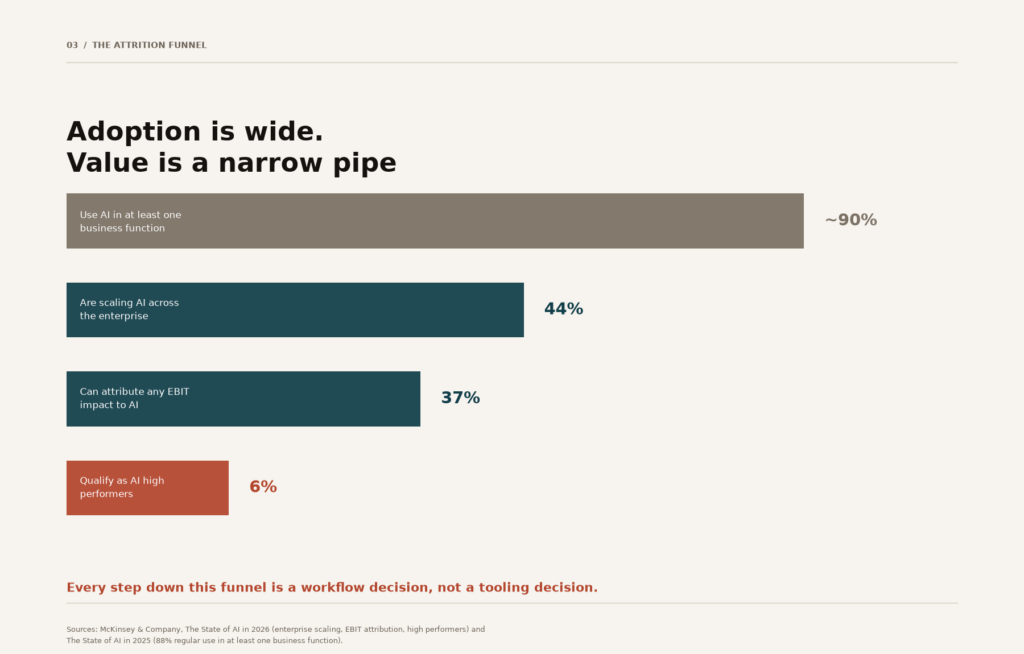
Nearly three-quarters of them report fundamentally redesigning workflows because of AI. Among everyone else, it is about one in four. Not “using AI in existing processes” — redesigning the processes. Asking, before you automate a step, whether that step should exist at all.
I find this the most clarifying finding in the entire literature, because it explains why the box fails. Workflow redesign is a decision made by whoever owns the workflow, in the room where the work happens, about a specific handoff on a specific Tuesday. A central AI team cannot make that decision. It can only make it easier for the team to make — by lowering the cost of trying something, measuring whether it worked, and safely deleting the step that stopped mattering.
The funnel makes the arithmetic unavoidable. Nearly nine in ten organizations use AI somewhere. Forty-four percent are scaling it across the enterprise. Thirty-seven percent can trace any EBIT to it. Six percent can prove it mattered.
Each wedge between those bars is not a model capability problem. It is a design problem inside somebody’s week.
Where the Counterargument Is Right
I have been arguing hard against the category, so let me steelman it properly, because the honest version of this position is stronger than the strawman.
New capabilities usually do need a temporary champion. Someone has to hold the standards, evaluate the vendors, write the governance rules, and carry the institutional memory while the practice is still fragile. Left entirely to organic diffusion, you get five incompatible tools, four overlapping contracts, and a compliance incident. That is real. Centers of excellence exist for a reason, and the reason is not stupidity.
There is also the accountability problem. Diffused ownership can quietly become no ownership. If everyone is responsible for AI quality, then when an agent produces a fluent, confident, wrong answer in a customer email, the answer to “who signed off on this” is a shrug. Someone has to own the guardrails.
And BCG’s rough heuristic is worth repeating here, with a caveat: roughly 10% of AI’s value comes from algorithms, 20% from technology and data, and 70% from changes to the operating model and ways of working. I will flag honestly that this ratio functions as a rule of thumb inside consulting practice rather than as a measured finding — it has been repeated for years with the same digits and no sourcing behind them. But directionally, it matches what McKinsey’s workflow data shows, and directionally right is enough to act on.
So the synthesis is not “never organize AI.” It is: organize AI as shared infrastructure, not as a marketing category.
Centralize the Substrate. Decentralize the Loop.
The distinction that makes this workable is between two different things people lazily call “AI ownership.”
Centralize the substrate: identity and permissions, model access, data governance, procurement, evaluation standards, audit trails, and the approved vendor stack. Every team needs this. Every team would build it badly and separately. Put your scarcest people here, and give them real authority over it.
Decentralize the loop: the specific decision inside a specific workflow about which handoff is now redundant, which approval step existed only because a human needed a queue, which report nobody has opened since 2023. Those calls belong to the person who does the work. A central team cannot see them, and any attempt to govern them produces a queue rather than a capability.
The trap to avoid is a central body that starts running projects. The moment the AI hub owns delivery, it has become the category again — with better branding. The test I would apply on day one, before hiring anyone: what does this team stop doing once it succeeds? If there is no answer, you have not built a capability function. You have built a department, and departments do not dissolve. They budget.
Stop Hiring an AI Marketer
Now the talent question, where the data gets genuinely interesting.
The American Marketing Association’s 2026 State of Marketing Careers Report tracked the share of marketing job postings mentioning AI and found it nearly doubled in a single year, from 8% in January 2025 to 15% by December. In the same period, roles like social media coordinator, copywriter and SEO manager lost ground, while senior leadership held up better than middle management and individual contributors.
The AMA’s summary line deserves to be printed on a wall: “Companies are not hiring less judgment. They are hiring less execution.”
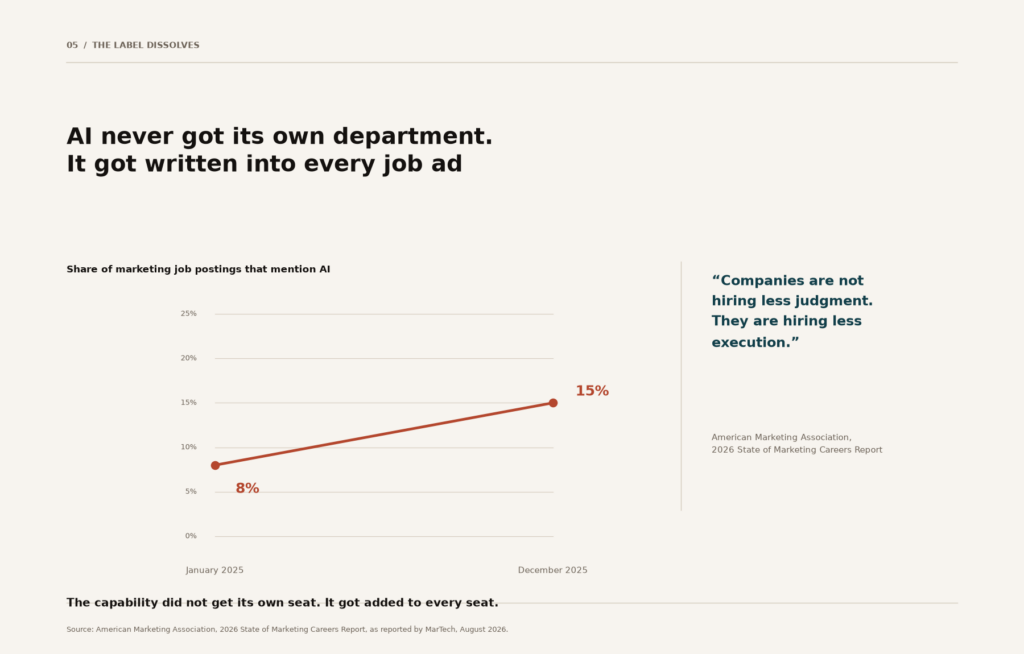
Read that as a hiring instruction rather than a trend, and the implication is uncomfortable for anyone still writing a job description for an “AI Marketing Manager.” The capability did not get a seat at the table. It got added to every seat. What you need is an AI-fluent strategist, an AI-fluent analyst, an AI-fluent content lead — people who can direct the system and read the output critically, not a new species of marketer who owns the topic and hands deliverables back over the wall.
There is a real cost buried here, and McKinsey names it precisely: if agents absorb the entry-level work through which people historically built expertise, today’s productivity gain becomes tomorrow’s judgment gap. The person who has reviewed a thousand AI-generated reports has not learned what a good number looks like. Junior seats that exist purely to produce volume are going away. Junior seats that exist to build judgment — review, critique, exposure to consequences — are not, but almost nobody has written that job description yet.
The Electricity Test
Here is the litmus test I keep coming back to, and it costs nothing to run.
Can you point at the AI?
If yes — if there is a team, a dashboard, a quarterly AI review, a named program — you have not embedded it. You have displayed it. The capability is on the wall, framed, rather than in the wiring.
If no — if AI shows up only as “how we do marketing now,” the way nobody has an “electricity strategy” because electricity is just the substrate everything runs on — then it is working. Mature capabilities become invisible infrastructure. That is not a metaphor; it is the actual life cycle. Email marketing stopped being a department when it became a line in every campaign brief. The same arc is available here, and it is not a downgrade. It is the promotion.
The test has a second half, and it is the harder one. Ask what changed in a system the business actually runs on. Not what changed in a chat window — what changed in the CRM, the ticket queue, the media plan, the pricing table. If the answer is “people draft faster now,” you are contributing to the 80%. If the answer is “this step no longer has a human in it,” you are contributing to the 37%.
What Winning Actually Looks Like
I want to end the diagnosis and describe the destination, because “make it invisible” sounds like defeat if you read it quickly.
Winning does not look like a brilliant AI campaign. It looks like a hundred small leverage points compounding — the localization pass that takes an afternoon instead of a month, the brief that arrives with three credible audience hypotheses attached, the weekly report that writes itself so the analyst spends the time arguing about what the number means, the onboarding email that is actually written for the segment it lands in.
None of that will ever appear in a case study, because there is no artifact to photograph. That is the point. The value is distributed across so many ordinary improvements that no single one is worth a press release.
And winning looks like a hiring bar that changed. It looks like job descriptions where AI fluency is assumed rather than advertised, the way spreadsheet literacy is assumed. It looks like the CMO being able to say something specific about model limitations when the CFO asks, rather than delegating the answer — a gap Gartner has flagged sharply. In its February 2026 survey of 402 senior marketing leaders, 65% expected AI to dramatically change the CMO role within two years, while only 32% believed significant changes to their own skills were needed. Only 15% of CEOs, in Gartner’s separate executive research, saw their CMO as genuinely AI-savvy. Gartner now predicts that by 2027, a lack of AI literacy will rank among the top three reasons CMOs at large enterprises get replaced.
That is what happens when you treat a capability as somebody else’s category. Eventually the somebody else is deciding whether you are still needed.
A Practical Scorecard
If you want something to act on Monday, here are six questions. Answer them honestly. The pattern of your answers matters more than any single one.
- Where does AI live on your org chart? If it has its own box with delivery responsibility, you have a category. If it lives as a standard inside every function, you have a capability in progress.
- What percentage of your workflows have been redesigned rather than automated? Not “have AI in them” — redesigned. If the answer is near zero, the tools are running on top of the old process.
- Who owns the guardrails, and who owns the loop? One name for standards and evaluation, many names for workflow decisions. If both answers are the same team, you have a bottleneck.
- What happens to your AI team when it succeeds? If the honest answer is “it grows,” you have built a department.
- Which of your job descriptions assume AI fluency rather than advertise it? The ratio tells you whether the capability has diffused or just been announced.
- What changed in a system of record last quarter because of AI? Name it specifically. If you cannot, the productivity gain is real and unrealized.
The Takeaway
“AI marketing” was always going to be a temporary name — scaffolding around a capability that belongs everywhere and to no one in particular. The category was useful while the practice was fragile. It is now the thing holding it back.
The brands that win the next three years will not have the smartest AI strategy on the conference circuit. They will have made AI so ordinary, so thoroughly embedded in every role and every workflow, that the term stops meaning anything. Their job postings will mention it the way they mention “proficient in Excel.” Their org chart will have no box for it. Their budget will show it scattered across everything, which will annoy finance and delight their customers.
The death of the category is the birth of the default. That is not how a category wins.
That is how a capability does.