The Toll Booth Behind the Creator Boom: Why Spend Keeps Rising While Creator Pay Keeps Falling
There is a version of this story everyone already knows by heart. The market is cooling, budgets are tightening, the influencer thing had its run.
Then you look at the actual number and it refuses to cooperate. US advertiser spending on creators hit about $37 billion in 2025, up 26% year on year and roughly four times the growth rate of the media industry overall, per the IAB’s survey of some 450 spend decision-makers. The same body expects around $44 billion in 2026.
So spending is not falling. Creator incomes, at the median, are. In CreatorIQ’s tracking of 65,000 flat-fee payments, average payment per creator campaign climbed to $11,400 in 2025 from $9,200 — while the median slipped from $3,500 to $3,000. Same money, same year, opposite directions.
Something is intercepting the transfer. And once you see what it is, the entire “is influencer marketing dying” debate turns out to be the wrong question.
The mechanism nobody budgets for
Here is the loop, in four moves.
One. A platform compresses organic reach. Metricool’s 2026 panel — over a million accounts and roughly 40 million posts — measured Instagram Reels average reach per post falling from 14,922 to 9,689, about 35%, in a single year. Static post reach fell 31%. Total interactions dropped 44%.
Two. A creator’s post now reaches fewer of the people who chose to follow them. The creator did not change, the audience did not change, the fee does not change. Delivery changed.
Three. The brand, holding content that no longer reaches anyone, buys distribution for it. That distribution is sold by the same platform that just reduced the organic version.
Four. The budget line moves from “creator fees” to “paid amplification,” and the creator — who supplied the asset — is not in the transaction.
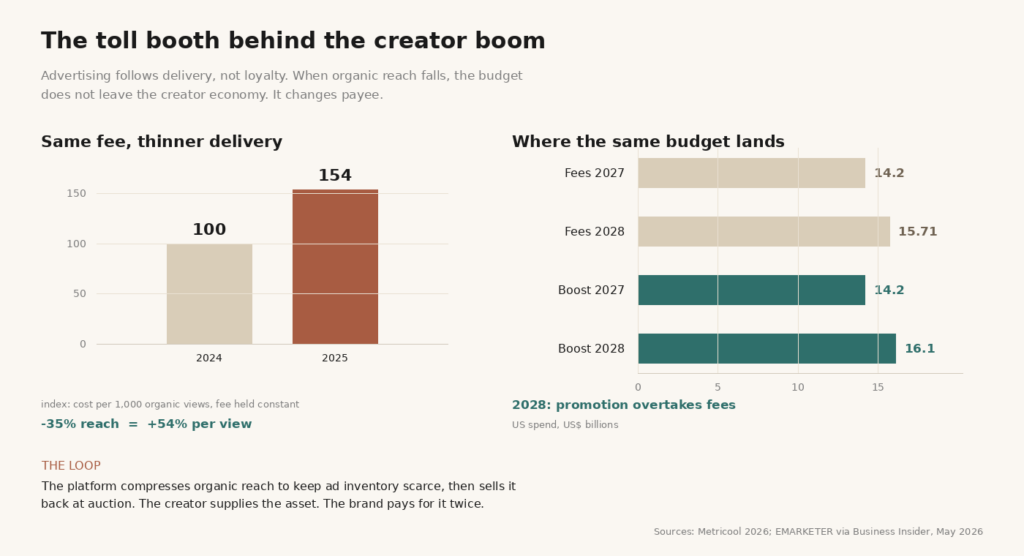
Do the arithmetic on the left panel and the whole “creator economics is cracking” story resolves into something much less mysterious. Your cost per delivered view did not rise because creators became greedy. It rose because 35% of the delivery quietly disappeared, and the fee stayed where it was. A 35% drop in reach against a fixed fee is a 54% increase in cost per thousand actual views — and you can verify that without any industry report at all, just a calculator and your own analytics.
Why the platform has no incentive to fix it
This is the part that makes the story a mechanism rather than a misfortune.
Organic reach and ad inventory are the same resource. Every view a creator gets for free is a view the platform cannot sell. Compressing organic distribution does not look, from the platform’s side, like sabotage. It looks like yield management — the exact logic airlines use when they hold back seats to protect the price of the ones they have not sold yet.
And the creator cannot arbitrage it, because there is no alternative supplier. They built on land they do not own, under terms they did not write, with no portability. When reach falls, their only lever is volume — and Metricool found exactly that: connected accounts nearly doubled posting volume and raised weekly frequency 21% in the same period reach fell by a third. More output, less distribution, no exit.
The brand’s position is worse than it looks, because the brand pays twice for the same audience. Once in the fee, for content designed to reach people organically. Again in the media budget, to reach the people the fee was supposed to reach. James Nord of the agency Fohr described the trigger to Business Insider without any diplomatic softening: creator content “generally is not performing as well as it should for how much it’s costing,” which is why buying distribution became mandatory rather than optional.
What this predicts, and what it does not
If the mechanism is right, three things follow — and they are testable rather than rhetorical.
The amplification line will keep growing faster than the fee line. EMARKETER already forecasts the crossover. The interesting detail is when it happened relative to the reach collapse: amplification did not become standard practice because brands got smarter about distribution. It became standard because organic delivery stopped being sufficient. Cause and effect are in that order.
Platforms will keep describing this as a creator-empowerment feature. Promoted posts, boosted Reels, “give your content a push” — every one of these is the same transaction, reframed as a favour. Watch the language, not the roadmap.
Creators with owned distribution will diverge sharply from those without. An email list, a community, a product, a site that ranks. Not because owned audiences convert better in the abstract, but because they are the only channel where delivery is not someone else’s pricing decision. This is the one genuinely durable strategy in the whole correction, and it has nothing to do with follower count.
What it does not predict: the death of creator marketing. The channel is growing, buyers rank it behind only paid search and social, and 48% now call creators a must-buy. The mechanism does not kill the market. It changes who gets paid inside it — and the answer, increasingly, is not the person who made the thing.
The uncomfortable reframe
Every budget conversation about creators eventually reaches the same question: what are we actually buying?
Under the bubble’s accounting, the answer was reach. You paid for a post, the post reached people, the reach was the product. Under the current arrangement, reach is not part of the product. It is a separate line item, sold back to you at auction, priced by the party that decided how much of it you would need.
That is not a crisis. It is a toll. And like most tolls, it is invisible until someone shows you the road was free yesterday.