Buyers Already Decided. Your Demo Agent Is Just Confirming It.
By 2028, Gartner expects AI agents to intermediate 90% of B2B buying, routing more than $15 trillion of spend through agent exchanges. The demo call is the first casualty — and the first thing most SaaS teams will rebuild badly.
The 30-minute meeting that sat in front of your whole funnel
Think about what a demo request actually asks of a buyer. They have to fill in a form. They have to wait for a reply. A human has to check a calendar, propose three slots, and hope the buyer’s week hasn’t rearranged itself in the meantime. Then, at an agreed hour, someone walks them through a product they have never touched, using a script built for nobody in particular.
We have all sat through that meeting. Most of us have also abandoned one.
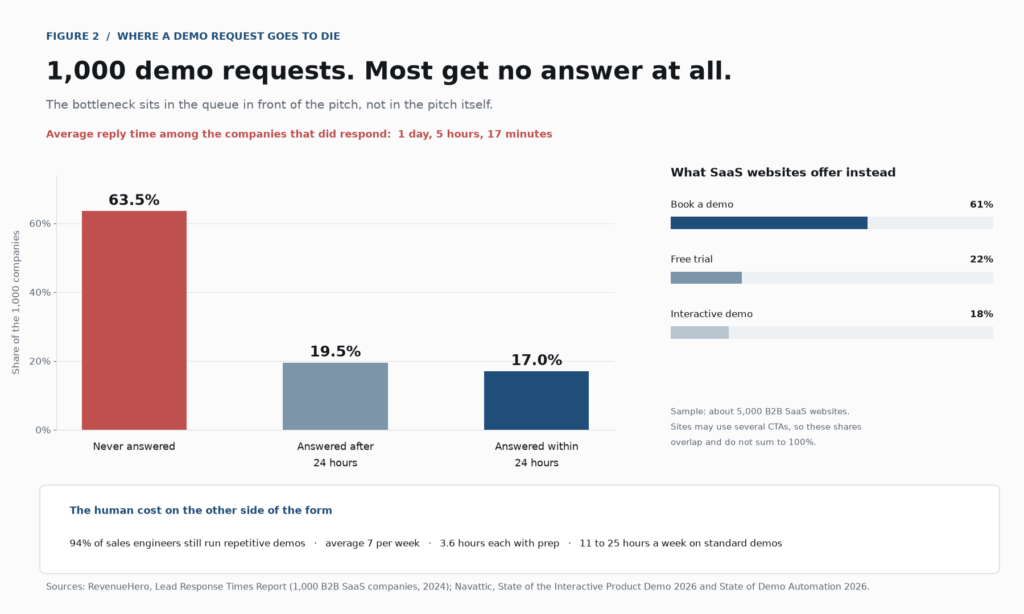
Here is the uncomfortable number. RevenueHero requested demos from 1,000 B2B SaaS companies and found that 63.5% never replied at all. Among the ones that did, the average response took one day, five hours and seventeen minutes. Not a week. A day and a half — before a calendar link even arrives.
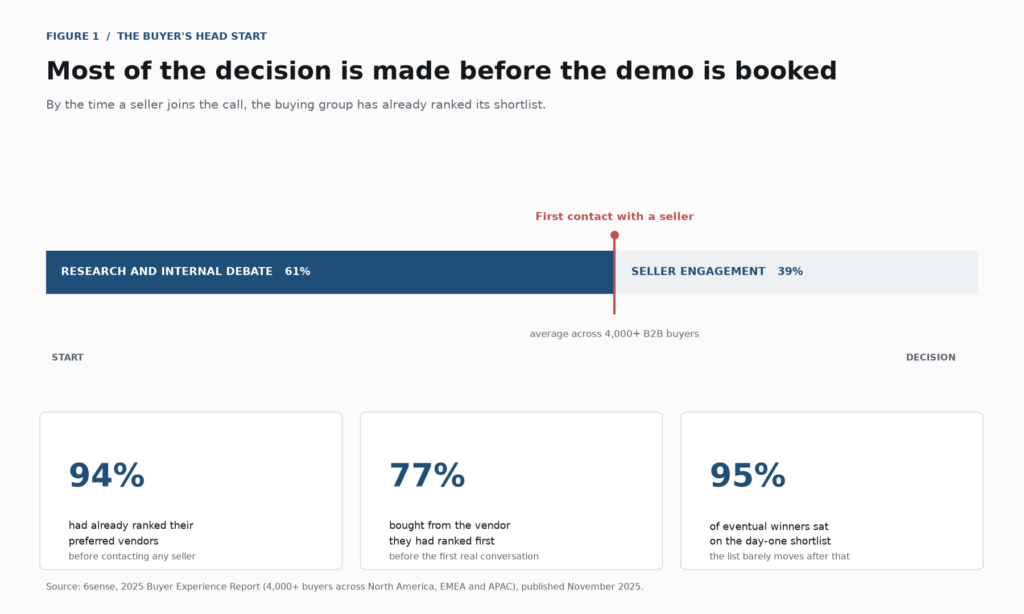
And the buyer’s patience was already spent elsewhere. 6sense’s survey of more than 4,000 B2B buyers found that first contact with a seller now happens about 61% of the way through the buying journey, and that 94% of buying groups had already ranked their preferred vendors before that contact. In the end, 77% bought from the vendor they had ranked first.
Sit with that for a second. The demo call was never the beginning of the sale. It was a checkpoint near the end of a decision that had mostly already been made.
What the rep-free data actually says — including the part vendors quote badly
Two Gartner surveys from 2026 tell a story that gets flattened every time it’s repeated.
The first, a survey of 646 B2B buyers fielded in August and September 2025, found that 67% prefer a rep-free experience, and 45% had used AI during a recent purchase. The second, covering 645 buyers, pushed further: 70% prefer a completely digital, self-service buying experience. Buyers reported consulting an average of seven information sources.
If you stop there, the headline writes itself: kill the demo call.
But the same survey asked a quieter question. 69% of buyers said they still prefer to validate AI-generated insights with a sales rep. And buyers were 28 percentage points more likely to say a rep helped them advance to the next step than an AI tool, and 32 points more likely to say a rep made them feel confident in the decision.
There is also this: 51% of buyers said they are more likely to encounter misleading information from generative AI, versus 49% who said the same about sales reps. That is not a ringing endorsement of either channel. It is a market that distrusts both and checks accordingly.
So the honest reading isn’t “buyers want no humans.” It’s that buyers want no gatekeeper — and they want a human available the moment something needs confirming.
What an agent does that a scheduled call cannot
Strip away the marketing language, and the capability shift comes down to three differences in kind.
It answers the question that was actually asked. A demo follows a sequence. A conversation follows a question. When a buyer asks whether the product handles a specific integration, or how it behaves at 400 seats, the agent can answer inside the context of the screen the buyer is looking at. That is a different product experience, not a faster one.
It builds the sandbox instead of describing it. The most consequential change isn’t conversational at all. It’s configuration. An agent can stand up a trial environment shaped around the buyer’s own use case — their data model, their workflow, their team structure — before anyone speaks to a human. The buyer doesn’t hear how the product would work for them. They open it and find out.
It works at 2 a.m. in a time zone you don’t staff. The old constraint was availability, and availability is a scheduling problem that self-serve solved for consumer software a decade ago. It took enterprise software a lot longer because evaluation felt too high-stakes to leave unattended. That assumption is now being tested everywhere at once.
The demo isn’t dying. The trial is eating it.
This is where the popular version of this story gets the causality wrong, and it matters for anyone planning a 2027 budget.
Look at what buyers actually do. Forrester’s The State of Business Buying, 2026 reports that more than 60% of business buyers now use some form of trial — paid sandboxes, usage-based periods, limited pilots — to evaluate solutions. For purchases of $10 million or more, that figure climbs to 78%.
Read that again, because it inverts the usual framing. Buyers aren’t abandoning the hands-on evaluation of software. They are abandoning the scheduled, rep-narrated version of it, and replacing it with a trial they drive themselves. The demo call was never the thing buyers valued. It was the access mechanism. Once access becomes self-serve, the ritual around it loses its reason to exist.
AI agents matter here not because they replace conversations, but because they make self-driven evaluation survivable. A trial with no guide is a maze. An agent is the guide, without the appointment.
How the funnel changes shape when evaluation is self-serve
The old mental model — discovery, demo, proposal, close — assumed the vendor controlled the middle. That middle is gone.
Evaluation becomes the longest stage. In G2’s 2026 Buyer Behavior Report, based on a survey of more than 1,000 B2B software decision-makers, 40% named evaluation as the single longest part of the buying cycle. Not discovery, which AI has compressed. Evaluation. Buyers find vendors faster than ever and then take their time deciding whether those vendors were worth finding.
Buying signals get richer, and less legible. A demo call produced one signal: did they show up. A guided trial produces dozens — which pages they read inside the product, what they tried to configure, where they stalled, which integration they searched for. That is a far better dataset, and most CRM pipelines have nowhere to put it.
Sales moves later, and has to be better when it arrives. If 61% of the journey is done before contact, the human’s job cannot be explaining the product. It has to be confirming the decision, absorbing risk, and navigating the internal politics the buyer can’t solve alone. Forrester found the typical purchase now involves 13 internal stakeholders and nine external influencers, and that procurement is a decision-maker in 53% of cycles. That is not work an agent does.
Marketing inherits the demo. The line between “generate interest” and “run the evaluation” dissolves. Once the evaluation surface is your website and your product, the demo is a marketing asset with a login.
Where the delay actually goes when you remove the calendar
Here’s the trap. Teams assume that if you eliminate the scheduling step, the delay disappears. It doesn’t. It relocates.
Cleverbridge and Ascend2 surveyed 608 software sellers and 551 buyers across six markets in early 2026. 93% of buyers said they would use self-serve digital checkout for routine software purchases if the option existed and company policy allowed it. More than half would complete a routine purchase of $25,000 or more online. 17% would go past $100,000.
Now the other side of that same report: only 17% of sellers have a meaningful self-serve path in place at scale, even though 96% agree the shift is coming.
And G2’s data shows where the remaining friction sits. IT security review is the biggest single source of delay, cited by 39% of buyers and 50% of enterprise buyers. Waiting for a quote or pricing accounts for 36%. Back-and-forth over terms, 30%.
Notice what those three delays have in common. None of them is a product question. An agent that can answer integration questions brilliantly will not clear a security review, issue a quote, or negotiate a redline. Removing the demo call shortens the easy part of the funnel and exposes the hard part.
The permission problem nobody puts on the roadmap
There’s a gap between what buyers want agents to do and what they’ll let them do, and it’s wider than the enthusiasm suggests.
G2 found that 61% of buyers currently use or plan to use AI agents somewhere in the buying process. But ask about authority and the numbers collapse: 47% would let an agent research and recommend while humans keep the final decision. 9% would let an agent execute a purchase inside pre-approved guardrails. 2% would let it buy without asking.
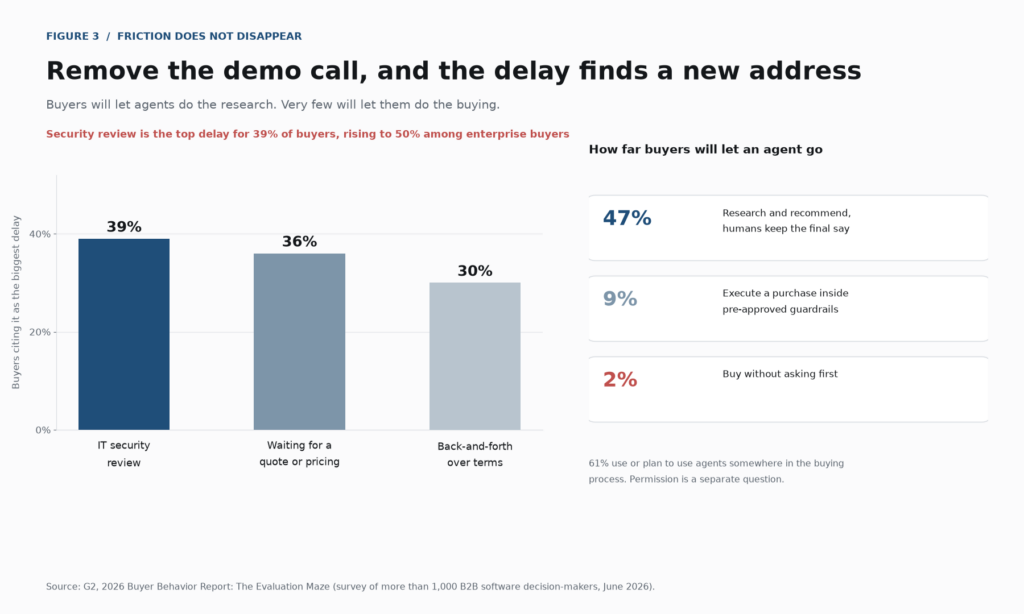
That’s the design constraint for every agent-run demo you build. You are optimising for a buyer who wants a research assistant, not a purchasing proxy. Which means the agent’s most valuable output isn’t a closed deal. It’s a qualified, well-documented handoff.
The uncomfortable parallel: your agents are the pilot project
McKinsey’s State of AI in 2026, drawn from 1,719 respondents surveyed in mid-2026, found that 40% of organisations with more than $1 billion in revenue are scaling AI agents, up from 27% a year earlier. Smaller organisations sat flat at 22%. In marketing and sales specifically, only 8% report scaling agents.
So the function that most wants to deploy agents is among the slowest to actually do it.
MIT’s Project NANDA found something similar from a different angle: roughly 95% of enterprise generative AI pilots produced no measurable P&L impact. About 60% of organisations evaluated AI systems, 20% reached pilot, and 5% reached production. The failure wasn’t model quality. It was that the tools never integrated with how work actually happened.
A demo agent that answers questions from a stale help centre is that failure mode in miniature. It will look impressive in a board deck and quietly route buyers to your competitor.
What this means if you sell SaaS
Stop treating documentation as a support cost. When an agent answers a buyer’s technical question, it answers from your docs, your integration pages, your changelogs. Thin documentation used to cost you a support ticket. Now it costs you the evaluation. If your help centre contradicts your pricing page, an agent will find that out in front of a buyer.
Instrument the trial like it’s a sales floor. Every configuration attempt, every abandoned flow, every repeated search is a buying signal. Teams that treat the trial as a product surface — with its own analytics, its own funnel, its own owner — will out-learn teams that treat it as a checkbox.
Keep a human exactly where trust breaks. Forrester found AI search tools often deliver incomplete or unreliable information, creating mistrust, and that buyers compensate by validating against trusted sources. 69% of Gartner respondents want a rep to confirm what AI told them. That is not a sentimental attachment to human contact. It is a risk-management behaviour, and it tells you precisely where to place your people.
Measure time-to-value, not time-to-demo. The old metric rewarded speed of scheduling. The new one rewards speed of comprehension — how fast a buyer gets to a working setup that resembles their own. If your onboarding takes three weeks after signature, no agent will fix the story your demo told.
Risks worth naming out loud
Hallucination at the worst possible moment. Gartner’s data already shows buyers believe AI is more likely to mislead them than a salesperson is. A demo agent that invents a capability doesn’t just lose a deal. It validates the buyer’s suspicion about AI generally, and it does so during the evaluation they’ll describe to their buying committee.
The handoff, done badly. If the agent has spent forty minutes learning what the buyer cares about and the rep opens with “so tell me about your business,” you have thrown away the entire advantage. Context preservation is the whole product.
The impersonal feel, in accounts that buy relationships. For complex, regulated, multi-stakeholder purchases, the evaluation is political. An agent can inform a champion. It cannot help that champion win an internal argument.
The structural risk: building agents on top of broken process. MIT’s finding is a warning, not a forecast. If your demo motion was incoherent before, automating it produces incoherent answers at machine speed.
The takeaway
The demo call was a bottleneck wearing the costume of a ritual. It was slow to schedule, generic in delivery, constrained by business hours, and often answering questions nobody had asked. AI agents are dismantling it — but not by replacing it with a chatbot. They’re replacing it with something buyers already told us they wanted: a trial they control, guided by something that answers instantly and never gets impatient.
The companies that win the next two years won’t be the ones with the most sophisticated demo agent. They’ll be the ones who noticed that the demo call was never the product, that the trial was, and that an agent is simply the cheapest way to make a trial feel like a conversation.
Everything else — the pipeline, the intent data, the shorter cycle — follows from getting that one thing right.