New-Consumption Brands: The Rise and Treadmill of China’s DTC Wave
Every market gets a moment when a brand seems to appear out of nowhere. In China, that moment arrived twice. First, a generation of “new-consumption” names — Perfect Diary, Genki Forest, Heytea, Florasis and hundreds of others — exploded onto the scene, riding cheap social traffic and even cheaper venture capital. Then, a few years later, a large share of them vanished with a speed that stunned the investors who had funded them.
The story is often told as a cautionary tale about hype. That’s not quite right. The more useful reading is mechanical: these brands bought growth instead of building it, and the moment the inputs (cheap attention, cheap money) got expensive, the whole structure revealed itself to be a treadmill — motion that only continues while you keep paying for it.
Here’s what actually happened, why it happened, and what the survivors did differently.
The short version
China’s new-consumption wave was a DTC boom built on cheap traffic — and a treadmill the moment the traffic got expensive. Brands that rose on ad spend and subsidies, without building real preference, retention or product, collapsed when the CAC curve turned. The survivors did the unglamorous work: real brand assets, owned channels, product truth, and a relentless focus on the one metric that separates a flywheel from a treadmill — how many customers came back.
Section 1 — The rise: China’s DTC gold rush
The playbook that minted a hundred brands
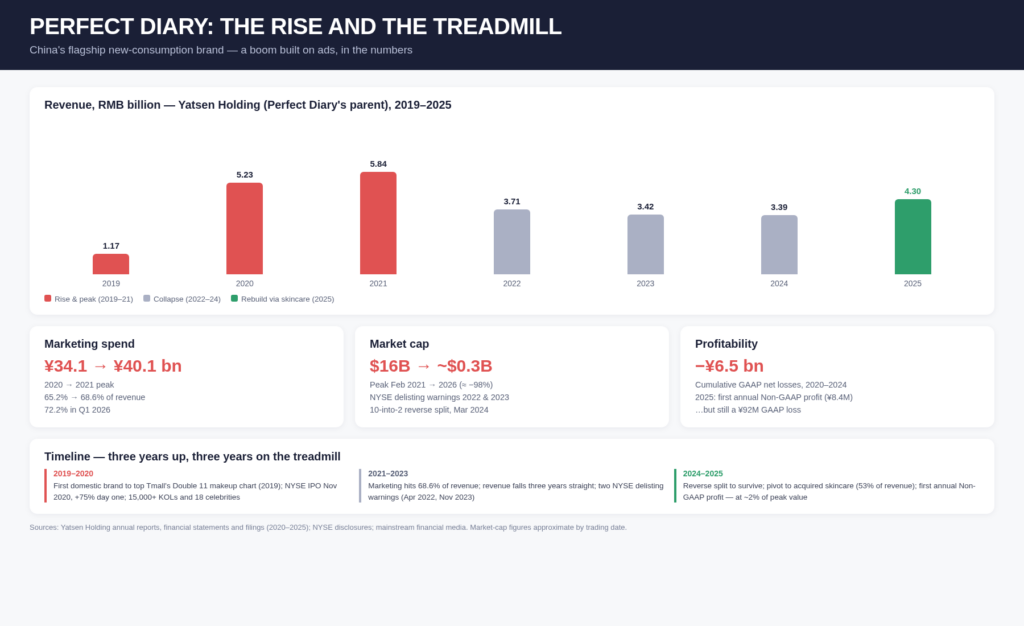
Perfect Diary is the cleanest specimen. Founded in 2017, it rode the Xiaohongshu and Douyin traffic-window of 2018–2019 with a machine-like content operation: top KOLs for buzz, mid-tier beauty bloggers for tutorials, and a sea of real-user posts for authenticity. By the time it listed in November 2020, the company had worked with more than 15,000 influencers and signed 18 celebrities. In 2019, it became the first domestic brand to top Tmall’s Double 11 makeup chart — beating the international giants on their own festival.
The formula was so reproducible that the industry turned it into a meme: “20,000 Xiaohongshu posts + 8,000 Douyin videos + 3,000 Bilibili videos + 150 Zhihu answers + livestreams = a new brand.” It worked because it exploited an arbitrage: attention on those platforms was underpriced, and the brands that moved early captured it for a fraction of what it costs today.
The valuation spiral
Here’s the part that looks like genius and is actually a loan. Revenue grew with ad spend; venture capital funded more ad spend; revenue grew more. Yatsen, Perfect Diary’s parent, listed on the NYSE in November 2020 with a first-day pop of 75%, and by February 2021 its market cap touched about $16 billion. Genki Forest raised at a reported $15 billion post-money valuation in late 2021 (media-reported; the company never confirmed it), with revenue that media estimates put at roughly ¥7 billion that year — up from ¥660 million two years earlier. Florasis hit a peak GMV of ¥5.4 billion in 2021, with the bulk of its discovery flow coming through one man’s livestream.
None of this was fake. It was just un-hedged: growth that depended on the price of attention staying low and the supply of capital staying high.
The question nobody asked
The boom never cleanly answered the question that should have been asked at every funding round: does the brand persist, or just the spend? Bain and Kantar’s tracking of “challenger brands” launched around 2018 found that only about 37% of them (17 of 46) were still growing as category leaders three years later — the rest were stalled or fading. And that’s the generous read: the McKinsey-cited Tmall figure puts first-year survival for new brands at under 30%. The numbers that matter were never the ones being tracked.
Section 2 — The treadmill: when cheap traffic ran out
Why the loop broke
The treadmill has four moving parts, and each one failed in sequence. First, CAC inflation killed the arbitrage. As every new-consumption brand piled into the same channels, the cheap traffic got expensive. Yatsen’s selling and marketing expense went from ¥3.4 billion in 2020 to ¥4.0 billion in 2021 — 68.6% of revenue at the peak. Industry estimates put e-commerce customer acquisition costs up roughly 87.5% between 2019 and 2024; one widely cited estimate has Douyin fan acquisition rising from about ¥8 to ¥45 per fan over that span. When a marketing line eats 70% of your revenue, you are not running a brand — you are a subcontractor for the platform.
Second, what looked like brand was often subsidy. Many new-consumption winners competed on promotion and price, not on preference. Third, the retention gap: the acquisition-obsessed playbook neglected repurchase, so growth was really churn masked by new acquisition. And fourth, the post-subsidy reality: when VC fuel dried up, the brands that were the ad spend were the collapse.
The “brand” that was really a subsidy
Look at how the collapse traveled. Yatsen’s revenue fell three years straight after 2021 (¥5.84 billion → ¥3.71 billion → ¥3.42 billion → ¥3.39 billion), and its makeup business — the thing everyone remembered — dropped 57.7% in a single year. Cumulative GAAP losses from 2020 to 2024 came to roughly ¥6.5 billion. The company received two NYSE delisting warnings (April 2022, November 2023) and survived only via a 10-into-2 reverse split in March 2024. By 2026 its market cap was around $300 million — down about 98% from the peak. No private takeover, no white knight; just a slow walk down a long staircase.
Florasis is the same story with a different trigger. When Li Jiaqi’s “79-yuan eyebrow pencil” outburst detonated in September 2023, the brand’s daily sales fell more than 90% within 48 hours — because its discovery engine was one person. Its online GMV went from ¥5.4 billion (2021) to ¥2.4 billion (2024). And the uncomfortable detail: even at the height, Li Jiaqi’s contribution was largely concentrated in Double 11 traffic, which is exactly the fragility everyone chose not to notice.
The retention gap
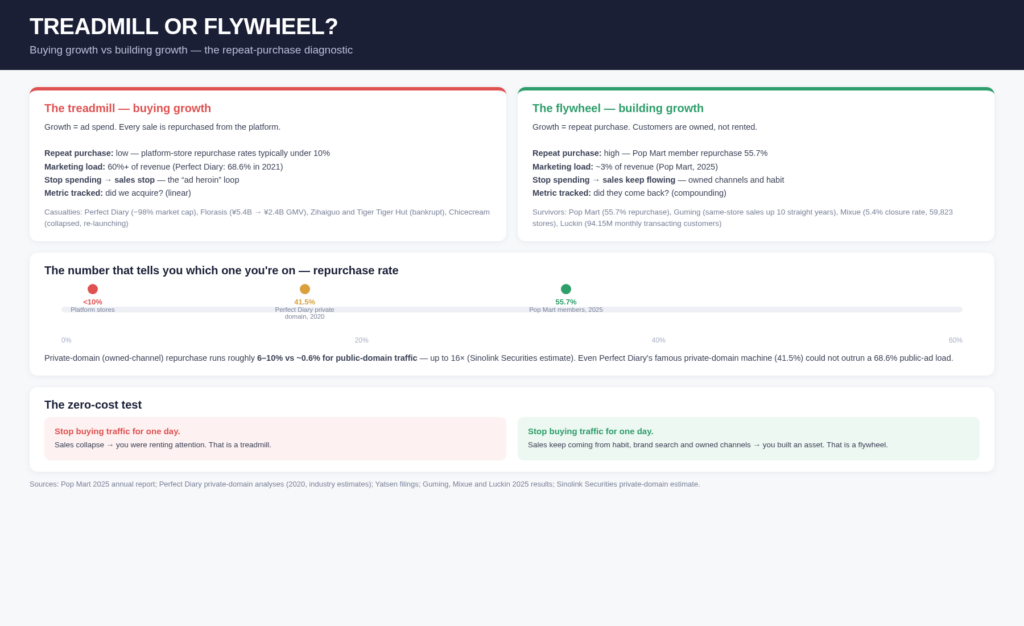
The treadmill’s defining feature is that it only works while you’re on it. Industry analyses put typical platform-store repurchase rates under 10%. Perfect Diary’s celebrated private-domain machine — the “Xiao Wanzi” persona with hundreds of WeChat accounts and communities — achieved a repurchase rate around 41.5% in 2020, roughly double the public-channel rate, and reportedly drove about ¥1 billion in private-domain GMV that year. Yet it didn’t save the model, because the public-domain ad bill (65%+ of revenue) was bigger than anything the private domain could offset. Two ledgers: the marketing ledger grew, the quality ledger didn’t. R&D was ¥142 million in 2021 (2.4% of revenue) and actually fell in absolute terms by 2024, against a global benchmark (L’Oréal) that spends roughly 3.4%.
The post-subsidy reality
Beyond the two flagships, the carnage was broad. Tiger Tiger Hut — the new-Chinese-bakery darling that raised two rounds in 2021 from Sequoia China, GGV and Tiger Global — was declared bankrupt in December 2025 and its liquidation closed in February 2026, with debts around ¥200 million. Zihaiguo (the self-heating hotpot leader) entered bankruptcy review in early 2026 after losing years of money at a 40%+ sales-expense ratio. Chicecream, the “Hermès of ice cream,” collapsed after its price positioning snapped, and quietly reappeared on JD in November 2026. Heytea didn’t die — but it shrank from about 4,610 stores to 3,930 between 2024 and 2025 and paused new franchise applications in February 2025. Even Genki Forest, the rare survivor, saw its sparkling-water share halve from a reported 85% peak and has been waiting out a $15-billion valuation it can no longer justify to anyone — growth slowed to ~26% in 2025, a fifth of its old pace.
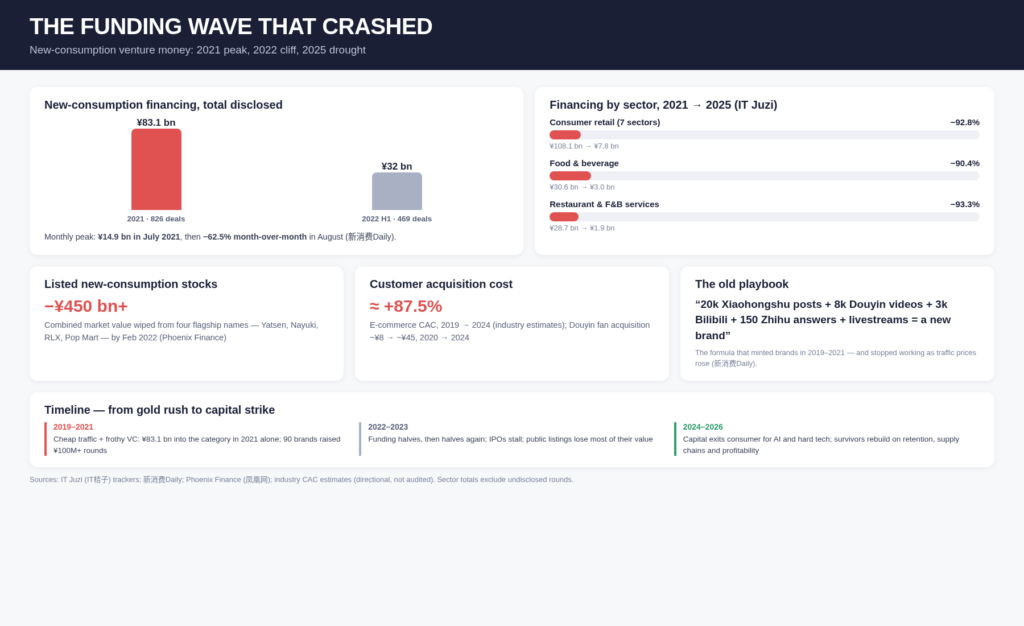
The funding math tells the same story from the other side. IT Juzi counted ¥83.1 billion across 826 disclosed new-consumption deals in 2021 — and just ¥32 billion across 469 deals in the first half of 2022. The monthly peak was ¥14.9 billion in July 2021, followed by a 62.5% month-over-month drop in August. By 2025, the retreat was total: consumer-retail financing across seven tracked sectors fell 92.8% (from ¥108.1 billion to ¥7.8 billion), restaurants fell 93.3%, food and beverage fell 90.4%. And the four flagship listings — Yatsen, Nayuki, RLX, Pop Mart — had already shed a combined ¥450 billion-plus of market value by February 2022. Capital didn’t leave gradually. It left like a tenant who skipped town overnight.
Section 3 — The cycle, distilled: a four-act framework
Strip the names out and the new-consumption wave is a repeatable four-act play that every DTC wave will follow:
- The cheap-traffic window. A channel underprices attention. Early movers scale absurdly fast — 2019–2021 China, with Xiaohongshu and Douyin underpricing attention while KOL supply was still cheap.
- The crowding. Everyone piles into the same channel. CAC rises, the arbitrage closes, and the advantage erodes for exactly the players who depended on it.
- The differentiation collapse. Everyone looks alike — same formats, same influencers, same “design-forward” packaging. The only remaining edge is price, which converts brand preference into a discount war.
- The retention reckoning. Now the question that was never asked gets answered by the market: who has real repurchase? The subsidized brands collapse; the built brands survive. The framework doesn’t just describe Perfect Diary — it predicts the next wave’s winners.
Section 4 — What survived (and what the survivors did differently)
They built real brand, not just spend
The survivors have numbers that look different in kind, not just degree. Pop Mart closed 2025 with 72.58 million registered members in mainland China, members contributing 93.7% of sales, and a member repurchase rate of 55.7% — while keeping advertising and marketing at roughly 3% of revenue. It did the 2019-era thing (cultural content, KOC-driven communities) but attached it to products with collectible, repeatable value. That’s brand as memory and salience, not brand as reach.
They owned the retention layer
The second move was owning the customer. Private-domain repurchase rates run roughly 6–10% versus well under 1% for public-domain traffic — up to 16×, per a Sinolink Securities estimate. Pop Mart’s 55.7% repurchase rate is the compounding outcome of owned channels: mini-programs, communities, membership tiers. Luckin’s 94.15 million monthly transacting customers in 2025 and 31,048 stores are the same principle applied to coffee — habit and convenience, not hero campaigns. When you own the relationship, a rise in traffic cost is a nuisance, not an existential threat.
They had product truth
Mixue is the most underrated case in this whole story. 59,823 stores globally, revenue of ¥33.56 billion in 2025 (up 35.2%), net profit of ¥5.93 billion — on six-yuan drinks. Its closure rate was just 5.44%, and its entire moat is supply chain: self-produced core ingredients and logistics so tight that it can sell at prices competitors can’t touch. That’s product truth expressed as an operating system. Guming, the quiet tea chain, has reportedly grown same-store sales for ten consecutive years — the single most “boring” metric in this entire article, and the one that matters most.
They watched repurchase, not inflow
This is the whole difference in one sentence. The treadmill ran on a linear metric (did we acquire?) and the flywheel ran on a compounding one (did they come back?). The stop-spending test makes it stark: cut the paid traffic for a day. Sales collapse — you were renting attention, that’s a treadmill. Sales keep flowing from habit, brand search and owned channels — you built an asset, that’s a flywheel.
Section 5 — What this means for every DTC brand
Four rules, none of them exotic, all of them ignored during the boom:
- Measure the compounding metric. Repurchase rate is the diagnostic. High retention means you built something; low retention means you bought it, and it’s on a treadmill. Track it before the market tells you.
- Build the traffic-cost hedge during the cheap window, not after it closes. The survivors built private-domain and owned channels while attention was still cheap — the equivalent of building the wall before the flood, not during it.
- Don’t confuse subsidy with brand. Promotion-driven share is a loan against the brand. It’s only durable if the preference — not the discount — is what customers return for. The review wall will tell you the truth eventually.
- Structure for a market that stopped paying for growth. Bain’s 2026 China Shopper Report shows a market where volumes grew 3.6% in 2025 while prices fell 2.6% — value-for-money is the new religion, and channel power (private label, discount retail, O2O) is rising against brands. In that environment, un-owned growth is simply un-defendable.
Section 6 — Risks and honest caveats
A few things worth holding lightly. First, survivorship bias: the “survivors did X” narrative over-credits visible traits and under-credits timing and luck. Pop Mart caught the window early and got a cultural tailwind (Labubu) that no playbook can guarantee. Second, the data problem: many new-consumption brands are private or collapsed, so public figures are partial — funding totals exclude undisclosed rounds, and Genki Forest’s revenue is media-estimated, not audited. Treat the numbers as directional, not precise. Third, not every new-consumption brand was a treadmill; some were genuinely product-led, and the category matured rather than died. And fourth, the counter-narrative deserves respect: a correction is not the same as a failure. The brands that re-fitted — cut CAC, built retention, fixed the product — are still here. The treadmill only kills the ones that never got off.
Conclusion: growth you buy is a treadmill; growth you build is an asset
China’s new-consumption wave was a DTC boom built on cheap traffic, and a treadmill the moment the traffic got expensive. The brands that rose on ad spend and subsidies, without building real preference, retention or product, collapsed when the CAC curve turned — and the numbers are now public, precise and merciless. The brands that survived did the unglamorous work of building rather than buying: real brand assets, owned retention, product truth, and the repurchase rate that separates a flywheel from a treadmill. The lesson for every DTC wave after it — and every market that will have one — is the one China learned to obsess over: it was never about how many you acquired. It was always about how many came back.