Instrument the Room: How AI Turns Event Logistics Into a Pipeline
You have been there. The badge printers worked. The AV didn’t fail. The keynote started on time, the coffee was hot, and someone with a lanyard said “great turnout” as the doors closed. Then the venue emptied, the invoices arrived, and somebody asked the only question that matters: what did we get?
That gap — between a flawless event and a defensible one — is the whole subject of this piece. Logistics is the part everyone can see. Leads are the part that pays for the room.
The number that never closes
Ask a field marketer how the conference went and you’ll usually get two answers. The first is a headcount. The second is a shrug.
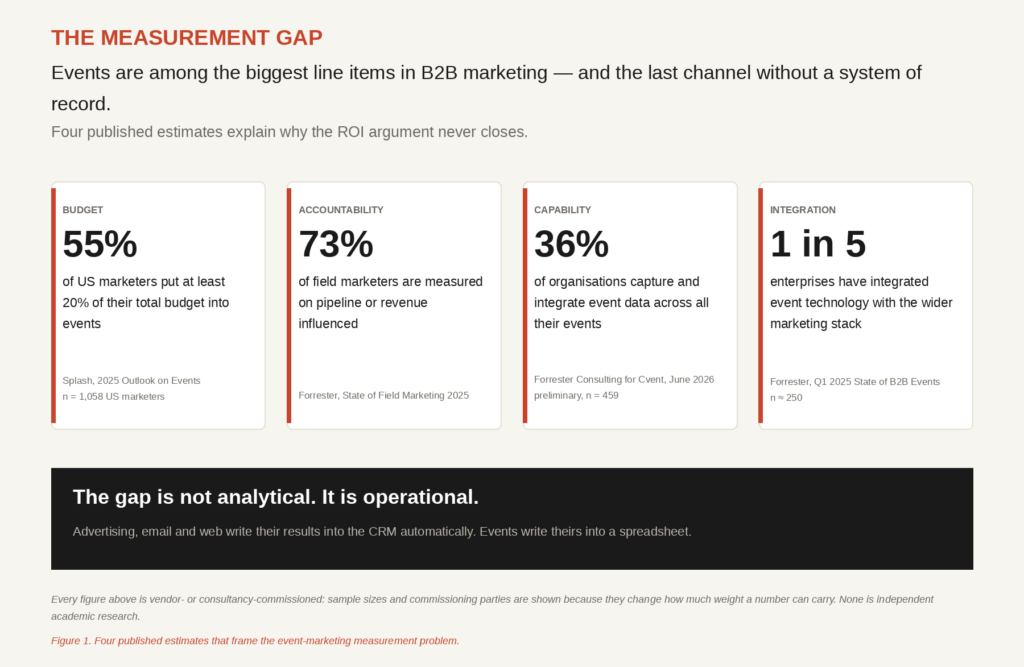
The shrug isn’t laziness. It’s structural. In Bizzabo’s 2026 State of Events Benchmark Report, 40% of organisers said they still struggle to prove event ROI. That is a real improvement on the 70% who said the same a year earlier. It is also still a large share of the market operating without a confident line between spend and outcome. The survey’s sample size isn’t publicly disclosed, and Bizzabo sells event software, so treat the direction as informative rather than definitive.
Meanwhile the money keeps flowing in. Splash’s 2025 Outlook on Events — a survey of 1,058 US marketers, fielded by a Cvent-owned company — found that 55% put at least a fifth of their total marketing budget into events, excluding overhead. That is a lot of capital sitting inside a measurement argument that never quite resolves.
And the people spending it are judged differently now than they were three years ago. Forrester’s State of Field Marketing 2025 found that 73% of field marketers are measured on pipeline or revenue influenced, while only 14% are measured on brand metrics — down from 36% two years earlier. The accountability moved. The plumbing didn’t.
Why events are the last channel without a system of record
Here’s the asymmetry nobody budgets for. A paid social campaign logs its impressions, clicks and form fills, and the form fill lands in the CRM with a source attached. An email send writes opens against a contact record. A web visit ties to a session. None of it is perfect, and all of it is automatic.
Events don’t work that way. A typical programme runs registration in one tool, check-in on a tablet, badge scans inside an exhibitor app, and follow-up notes in a rep’s inbox. The single most valuable artefact of an executive dinner — the list of who actually sat down — often ends up as a spreadsheet in someone’s downloads folder, reconciled by hand days later, if at all.
The numbers bear this out from several directions. Forrester’s Q1 2025 State of B2B Events survey, drawing on roughly 250 event decision-makers, found that only one in five enterprises has integrated its primary event platform into the wider marketing stack. A separate Forrester Consulting study commissioned by Cvent and published in June 2026 — preliminary, 459 director-level respondents — put the figure at 36% for organisations capturing and integrating data across all their events, with 71% saying disconnected tools limit their visibility. Cvent commissioned that research and sells the software, so read it as a vendor making its own case; the direction matches Forrester’s independent survey, which is what makes it worth citing.
The plumbing problem is not an analytics problem
This is where teams misdiagnose themselves. They buy a better dashboard. They hire an analyst. They build a beautiful attribution model on top of data that never arrived.
You cannot model your way out of a missing record. If the attendance list and the deal never share a key, no amount of modelling recovers the relationship. The fix is boring and it is upstream: one identity, one place, one source of truth, before anyone opens a BI tool.
The logistics tax
Now consider the part AI actually does well.
Running an event means absorbing an enormous amount of invisible labour: agenda shaping, room allocation, registration flows, reminder sequences, badge printing, Q&A triage, speaker briefs, exhibitor manuals. Call it the logistics tax. It’s real work, it consumes senior attention, and almost none of it is why anyone bought a ticket.
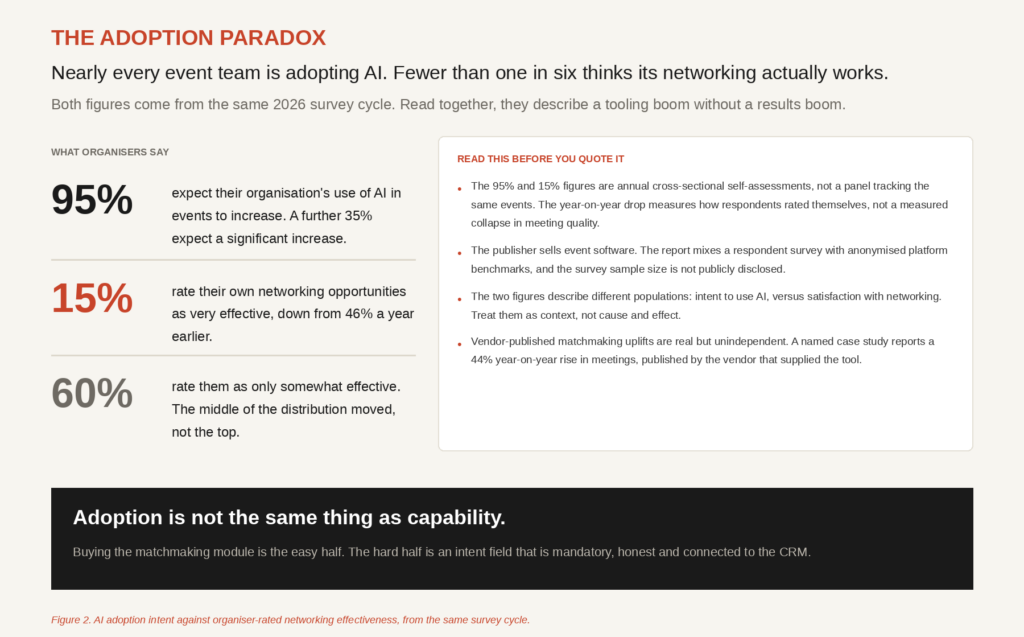
The 2026 benchmark data suggests teams are already redirecting AI here. In Bizzabo’s survey, 95% of organisers expected their organisation’s use of AI in events to increase, with 35% anticipating a significant increase. The stated use cases cluster around analytics and measurement, event marketing and communications, and agenda and content design — in other words, the operational layer.
That’s the right place to start. Automate registration logic, let a system draft the reminder sequence, let a model propose an agenda structure from last year’s session completion data. Your team gets its hours back. But be clear-eyed about what you’ve bought: you’ve made the event cheaper to run. You have not yet made it easier to justify.
Matchmaking is a data problem wearing a feature’s clothes
Networking is where the gap between promise and delivery is widest, so it’s worth slowing down here — this is the claim most likely to disappoint you.
Look at what attendees actually say. Freeman’s summer 2025 trends report found that 51% of attendees consider effective networking reason enough to return to an event, yet 40% of younger professionals — the 23-to-46 cohort Freeman calls NowGen — say networking feels awkward, and 30% admit they struggle to start conversations. Nearly half want curated recommendations about who to meet before they arrive. Compare that with Bizzabo’s 2025 data: 72% of attendees said in-person conferences offer the best networking opportunities, but only 30% felt their most recent event delivered enough of it.
By 2026, organiser sentiment had slid further. Only 15% rated their networking opportunities as very effective — down from 46% a year earlier — while 60% called them merely somewhat effective. That’s a striking drop in self-assessment in a year when AI matchmaking adoption was accelerating, and it should give you pause before you buy the module.
The ceiling nobody puts in the deck
Vendor case studies aren’t lying, exactly. They’re answering a narrower question than the one you’re asking.
The most-cited datapoint here is Clarion Events reporting a 44% year-on-year increase in in-person meetings after rebuilding matchmaking around assisted suggestions, with 195 meetings booked against a target of 135 at one show. That figure is real, and it’s published by Grip — the vendor that supplied the tool — about its own customer. It’s marketing collateral, not independent evidence.
The academic literature is more sober and more useful. Reciprocal recommendation research, the branch of computer science studying matches where both parties have to say yes, has repeatedly found that modelling only one side overstates quality. Pizzato and colleagues showed in 2010 that building reciprocity into the ranking lifted top-10 success from 23% to 42%. Kleinerman and colleagues tested a two-sided approach with 1,204 human participants and found measurable gains from balancing what the recommender wants against what the receiver will accept. Those are genuine improvements — and they describe a ceiling in the tens of percent, not the high nineties.
The cold-start problem compounds it. A first-time event has no behavioural history, so a system that learns from behaviour has nothing to learn from. Feed it a checkbox registration form and it will confidently introduce a buyer to a job seeker because both ticked the same box.
So the ordering matters. Fix the input — make one intent field mandatory, ask what someone wants to buy, sell or solve — and behaviour can refine from the second edition onward. Skip that and you’ve automated the introduction of the wrong people at higher speed.
The one thing AI can’t fix: attendance isn’t demand
Before the playbook, a strategic point that gets lost in the tooling conversation.
As AI floods every channel with synthetic content, in-person presence is becoming scarcer and therefore more valuable. Forrester Consulting, in Cvent-commissioned research, found 70% of business leaders saying events matter more, not less, as AI-generated content proliferates. Separate Censuswide research for Cvent found 81% reporting that audience trust rose after an in-person experience, and 85% saying AI-generated content has made trust harder to build. Both studies were paid for by a company selling events software — so discount accordingly — but the mechanism is intuitive: when everything is cheap to produce, being in the room is the expensive signal.
Which cuts both ways for this article’s argument. The premium on presence raises the cost of wasting it. A room full of people you can’t identify is a more expensive mistake than it was three years ago, not a less expensive one.
From logistics to leads: the four-stage chain
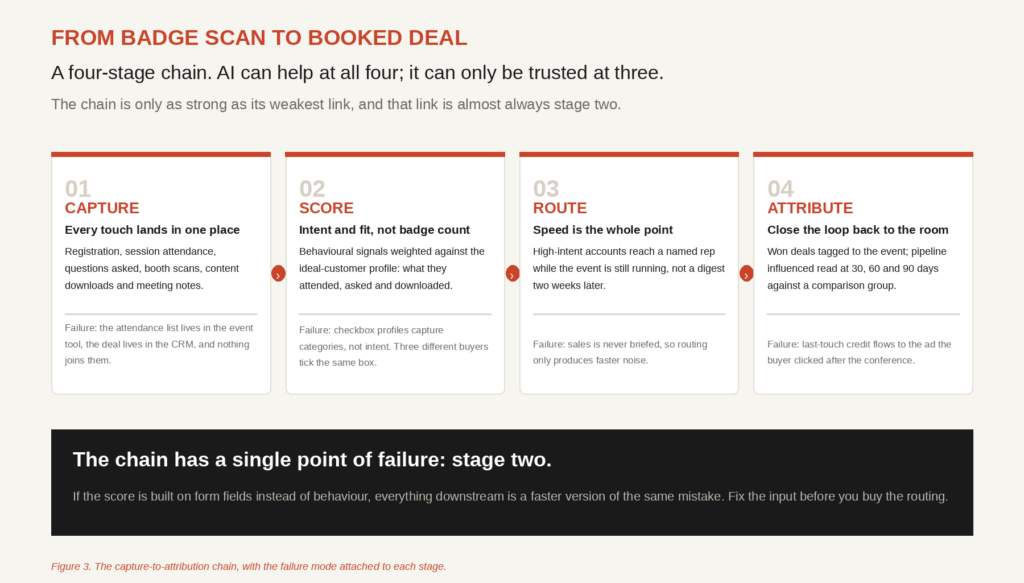
Here is the reframe that makes the whole thing tractable. An event isn’t a marketing moment that produces a lead list. It’s a pipeline that happens to have a venue.
Treat it as four links, and be honest about which one is weakest in your programme.
Capture: instrument the room, not just the door
Every touch is a signal: registration, session choices, questions asked in Q&A, booths scanned, content downloaded, what a rep wrote down after a conversation. The goal is that all of it resolves to one identity in one place. If your event platform and your CRM disagree about who attended, you don’t have a data problem — you have two datasets and no relationship.
Score: intent and fit, not badge count
Scoring on attendance volume measures enthusiasm. Enthusiasm is not readiness. What you want is a weighted read on behaviour against your ideal-customer profile: the CFO who attended one session on consolidation is a stronger signal than the analyst who attended seven.
The design constraint is honesty. If the score is built on self-declared fields, it measures self-declaration. Behaviour is harder to fake.
Route: speed is the entire mechanism
A high-intent account should reach a named rep while the event is still running. Not a digest on Friday. Not a shared spreadsheet the following Tuesday. The reason isn’t enthusiasm — it’s arithmetic, and it has its own section below.
The precondition is unglamorous: sales has to be briefed, staffed and willing before you switch routing on. Route hot leads into a team that isn’t ready and you’ve simply produced faster noise.
Attribute: close the loop back to the room
Tag won deals to the event. Then read pipeline influenced at 30, 60 and 90 days against a comparable set of qualified accounts that didn’t attend. That comparison group is the part most teams skip, and it’s the part that turns a number into evidence.
One discipline worth adopting early: agree the metric with whoever signs the budget before you book the venue. A metric chosen afterwards is a metric chosen to flatter.
The five-minute rule, and the myth stapled to it
If you take one operational change from this article, take this one.
The canonical audit is still Harvard Business Review’s 2011 study by Oldroyd, McElheran and Elkington: 2,241 US companies were each sent a web-generated test lead. Among those that responded within 30 days, the average first response took 42 hours. 23% never responded at all. Firms that replied within an hour were roughly seven times more likely to qualify the lead than firms that waited longer — and more than sixty times more likely than those that waited a day.
The underlying decay curve comes from an earlier study that is widely misattributed. The famous 100x contact and 21x qualification multipliers — for calling within five minutes rather than thirty — come from a 2007 Lead Response Management study analysed by James Oldroyd. The data, however, was InsideSales.com platform data (three years, six companies, 15,000+ leads), not an MIT publication. And it measured contact and qualification odds, not close rates.
More recent work points the same way. XANT’s 2021 study of 5.7 million inbound leads found conversion eight times higher when the first call happened within five minutes rather than after six. It also found that 0.1% of first attempts happened inside five minutes. Drift’s 2017 test of 433 B2B companies found 7% responding within five minutes and 55% taking more than five business days.
Now the myth. You’ve almost certainly seen the claim that 78% of customers buy from the company that responds first. It’s attributed to a “Lead Connect survey” with no published report, methodology, sample or author that anyone has been able to locate; the citation chain terminates in aggregator blogs citing each other. Don’t use it. The verified figures above are stronger precisely because they’re narrower.
For an event, the implication is sharp. A five-minute standard is impossible to hit by hand at scale, and it is exactly what automation is for. Which means real-time routing isn’t a nice-to-have — it’s the only way the speed advantage survives contact with a hundred badge scans an hour.
The playbook
Five moves, in order, with the boring one first.
Set a revenue goal before the venue. One number, agreed with finance, written down before contracts. If the goal is attendance, you’ll optimise for attendance, and you’ll get a full room and an empty pipeline.
Instrument everything into one source of truth. Registrations, sessions attended, questions asked, scans, downloads, notes. One identity, one place. This is 80% of the work and 0% of the glamour.
Score on behaviour, route in real time. Behavioural signals against your ideal-customer profile, pushed to a named rep while the event is live. Same-day beats same-week by a margin that should embarrass most programmes.
Personalise follow-up within 24 hours. Not a template with a first name swapped in. Reference the actual conversation, the actual session, the actual question. Momentum is perishable.
Close the attribution loop. Tag closed-won to the event, read pipeline at 30, 60 and 90 days, keep the comparison group. Next year’s budget conversation depends on whether you did this one.
The honest caveats
Four of them, and none is decorative.
The theatre trap
AI can make logistics so smooth that the event feels effortless — and effortless is seductive. Effortless isn’t effective. The most dangerous outcome of a well-automated event is that everyone leaves impressed and nobody can point to a deal. Keep a human in the room whose only job is the commercial outcome, not the operation.
Privacy, and the Article 22 edge
Scoring attendees means inferring intent from behaviour. That is profiling. Under GDPR, Article 22 gives individuals rights around decisions based solely on automated processing that produce legal effects or similarly significant effects, and the working-party guidance interpreting “similarly significant” reaches decisions about access to opportunities. Whether allocating a meeting slot at a trade show crosses that line hasn’t been settled by a regulator — the application to events is practitioner reasoning, not published EDPB guidance. But the direction of travel is clear enough that a fully automated pairing engine with no human oversight is a compliance question you now own, not a feature you bought.
Practical minimum: tell people what you’re collecting and why, provide a route to object, keep a human in the loop for consequential allocations, and make sure your data processing agreements cover the profiling.
The AI Act calendar moved, and did not move
If you operate in or sell into the EU, get the dates right, because a lot of commentary has them wrong.
The Digital Omnibus on AI, adopted after the European Parliament’s 16 June 2026 vote (423 to 57, with 174 abstentions) and Council approval on 29 June 2026, deferred the high-risk regime. Standalone high-risk systems under Annex III now apply from 2 December 2027 rather than 2 August 2026; product-embedded high-risk systems under Annex I move to 2 August 2028.
That is a deferral of the high-risk regime, not a pause on the Act. Prohibited practices and general-purpose AI obligations were never on the moved calendar. Article 50 transparency duties are the part to watch: commentary diverges on them, because the omnibus introduced a transitional period running to 2 December 2026 for machine-readable marking of certain systems already on the market, while the core labelling duties for synthetic content were not pushed into 2027. Several law-firm readings treat the August 2026 start as still live for most Article 50 obligations. If you generate synthetic media for event promotion, check the current text with counsel rather than relying on a summary — including this one.
The hallucinated follow-up
This is the risk with the least public evidence and the most obvious mechanism. An AI-drafted follow-up can misquote a conversation, invent a capability, or overclaim to the single most valuable lead at the show — and it will do so in confident, fluent prose.
There’s no credible independent dataset quantifying how often that happens in B2B event follow-up; the figures circulating online are vendor-sourced without recoverable methodology. So treat the risk qualitatively and manage it operationally: human-review the warmest 20% of drafts, cap what the model is allowed to assert, and never let it reference a commitment a rep didn’t actually make.
What to do in the next 90 days
Resist the platform migration. Do three things instead.
Pick your next event and write a revenue goal on one page, signed by whoever owns the budget. Then instrument that single event properly — one identity, registrations through scans through follow-up, ending in your CRM. Then run one manual real-time routing pilot: a human watching incoming signals and messaging a rep the moment an account crosses a threshold. Measure the response time.
That pilot will tell you more about whether you need AI than any vendor demo. If the bottleneck turns out to be that nobody was watching, you’ve found a staffing problem, and software won’t fix it. If the bottleneck is genuinely throughput, now you know exactly what to buy.
The verdict
Events have been measured like parties and run like operations, and the two never quite met in the middle. AI doesn’t resolve that by making the operation cheaper. It resolves it by making the room legible.
Automate the logistics so your people can stay in the conversation. Instrument every touch into one record. Score on behaviour, route in real time, follow up inside a day, and close the loop with a comparison group. None of that is exotic. All of it is upstream of the tools.
The uncomfortable truth is this: a flawless event is a cost, and a converted event is a pipeline. The difference isn’t the venue, the keynote or the badge printer. It’s whether anyone was watching the room closely enough to notice who was buying.