INSIGHT — Why the Treadmill Had to Break: The Economics Behind China’s DTC Wave
the “why” behind the trend — the mechanism, not the timeline. Builds on the main case study (Perfect Diary → survivors) by answering the question the numbers raise: why did buying growth have to end this way?
The short version
Perfect Diary’s ending wasn’t a management failure. It was arithmetic. Its growth depended on an input it couldn’t price — attention — and every input you can’t price is an input you can’t control. When cheap attention ran out, the growth ran out with it. Ads are rent; repurchase is ownership. Repurchase rate is the receipt.
The mechanism
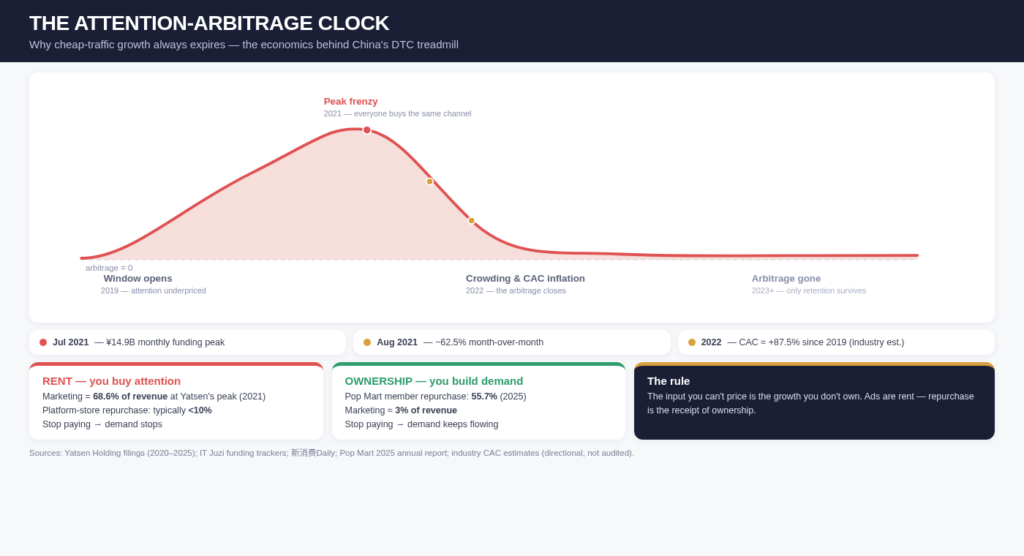
Here’s the uncomfortable math behind the whole new-consumption wave. A brand that scales on paid acquisition is running an arbitrage: it buys attention below the value it converts into sales. That’s fine — until it isn’t. The arbitrage window doesn’t close because anyone makes a mistake. It closes because the market is self-correcting. Money pours into the category, every brand buys the same channels, the platforms raise prices, and the arbitrage flips negative. IT Juzi counted ¥14.9 billion of new-consumption funding in a single month — July 2021 — and the industry fell 62.5% month-over-month in August. Industry estimates put e-commerce customer acquisition costs up roughly 87.5% from 2019 to 2024. The window didn’t close gradually. It closed like a door.
The second half of the mechanism is what nobody wanted to stare at: growth you buy is growth you rent. When your CAC is set by a platform algorithm, your unit economics are someone else’s spreadsheet. Yatsen’s marketing line hit 68.6% of revenue in 2021 — the company was, in effect, a subcontractor for Douyin and Xiaohongshu, paying rent on every customer it served.
Why repurchase is the only number that mattered
The counter-intuitive part: Perfect Diary actually built a private domain, and a good one. Its WeChat community machine hit a repurchase rate around 41.5% in 2020 — roughly double the public-channel rate — and reportedly drove about ¥1 billion of private-domain GMV that year. That’s better than most brands in the world will ever do. It still lost. Why? Because ¥1 billion of owned demand is not enough to carry a ¥4 billion ad bill. The lesson isn’t “they should have done private domain.” The lesson is that a private domain built on top of a rented model is a lifeboat on a sinking ship — it extends the trip, it doesn’t change the destination.
Now compare the survivors. Pop Mart closed 2025 with a member repurchase rate of 55.7% while spending roughly 3% of revenue on advertising — a ratio that is not an accident. The difference between 68.6% and 3% isn’t discipline. It’s the difference between renting customers and owning them. Repurchase rate is the proof of ownership: it tells you what remains after the ads stop.
What this means everywhere
The reason this matters beyond China is that the mechanism is portable. Every market gets its attention-arbitrage window — underpriced social feeds, frothy capital, a KOL economy that hasn’t caught up with its own prices. The actors change; the clock doesn’t. The brand that treats cheap traffic as a loan will always get the call when the loan comes due. The brand that converts cheap traffic into owned, repeatable demand — habit, membership, private channels — is the one still standing when the window closes. Watch the arbitrage clock, not the growth chart. And if you don’t know your repurchase rate, you’re already on the treadmill — you just haven’t felt it yet.