Insight — Why Twenty Listeners Is Enough: The Economics Behind the AI Podcast Flood
Three numbers that should not coexist: a production cost of about one dollar, an audience of twenty, and a profitable business.
Every conversation about the synthetic podcast flood starts in the wrong place. People call it a content problem, which means the fix should be moderation, labels, better filters. It is not a content problem. It is an inventory problem, and inventory problems behave very differently from content problems.
Start with the unit. Inception Point AI, the network behind Quiet Please, runs on eight people, four of them working on content. It produces roughly 3,000 episodes a week, an hour per episode, a dollar or less per episode, using 184 custom AI agents and around fifty synthetic hosts with names like Nigel Thistledown. Because programmatic advertising attaches automatically to each episode, the company says an episode turns a profit at roughly twenty plays. By the middle of 2026 it was running more than 10,000 active shows and had passed ten million downloads since September 2023.
Twenty plays. For a newsletter that is a rounding error. For a feed it is a viable business, because the episode is not the product. The ad slot is. Programmatic buyers purchase impressions in bulk, and impressions do not require anyone to care. The CEO said it plainly: maybe a pollen podcast only fifty people listen to, but that one is already at unit profitability, so maybe make five hundred pollen podcasts.
Now the part that reframes the whole thing. These networks are not competing with your show for ears. They are competing with your show for placement. Titles are stripped to bare search terms. One operator launches five versions of the same topic under different names to see which title wins. The Daily News Now network went further: more than 430 locally branded shows, roughly 11,000 episodes a day, more than 350,000 episodes published in the five weeks after late January 2026, with each episode often appearing fifteen to seventy-five minutes after the local article it was built from. Alexios Mantzarlis of Cornell Tech measured an 86% semantic similarity between source articles and episodes across 101 comparisons, and the network was routinely surfacing above real local newsrooms in podcast search. Torstar’s lawyers sent a cease-and-desist.
Read that as a competitive statement rather than a plagiarism story. The contest is not who makes the better show. It is who occupies the slot when someone types a city name at 7am. Humans lose that contest by design, because it is decided on volume, latency and keyword coverage, and a human is the bottleneck on all three.
Which is why labels under-deliver. Disclosure changes what a listener can believe. It does not change what an ad exchange will buy. Re-registration costs nothing, detection is probabilistic, and a takedown removes an asset that takes a dollar and an hour to rebuild.
Where the model actually breaks is price, not principle.
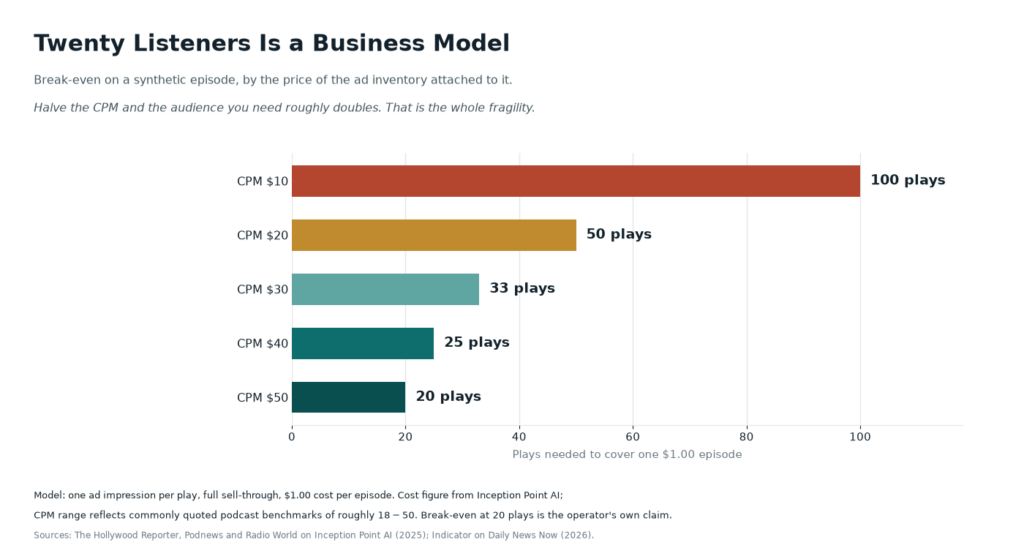
At a $50 CPM twenty plays covers the dollar. At $20 it takes fifty. At $10 it takes a hundred. And here is the trap: supply is multiplying faster than demand, so every new feed dilutes the price of the same impression. The flood is therefore self-limiting in a way nobody planned — it is a leveraged bet on CPM stability taken by the exact behaviour that undermines it. Marginal cost is already at the floor, so there is nothing left to cut when the price of attention falls.
What binds first is the money layer, not the content layer. Ad-market eligibility that requires real listener minimums and human review. Apple’s metadata disclosure at the directory level. Above all, machine-readable marking of synthetic audio under Article 50 of the EU AI Act, in force since 2 August 2026, which converts suspected synthetic into identified synthetic — precisely the input a blocklist needs to work at scale.
If you have ever audited a programmatic supply chain, this will feel familiar. The inventory was never the audience. In audio, that confusion just became audible, and the scarce asset stopped being audio. It is attestation. Expect verified human to become a buyable attribute, the way viewability did, and expect the flood to retreat into whatever nobody bothers to verify.