The Brand Identity Machine: What AI Gets Right and What It Quietly Ruins
Somewhere in the last two years, the most expensive object in branding became the cheapest one.
A founder with a credit card and a paragraph of prompt text can now generate forty logo directions before the coffee goes cold. A marketing manager can resize an entire identity system into nine ratios and four languages on a Tuesday afternoon. A startup that could never have afforded an agency retainer has, for the first time, a visual identity that looks deliberate.
That is genuinely good news. It is also where the trouble starts. Because the thing that got cheap was never the thing that made a brand worth anything. What got cheap was production. What stayed expensive — and stayed stubbornly human — was the decision about what the production should mean.
Keep those two facts apart and most of the noise around AI brand design resolves itself. Collapse them, and you get the failure mode I keep running into in 2026: competent, polished, forgettable identities shipped at volume, by teams who believe the work is finished the moment the file exports.
The production collapse, measured
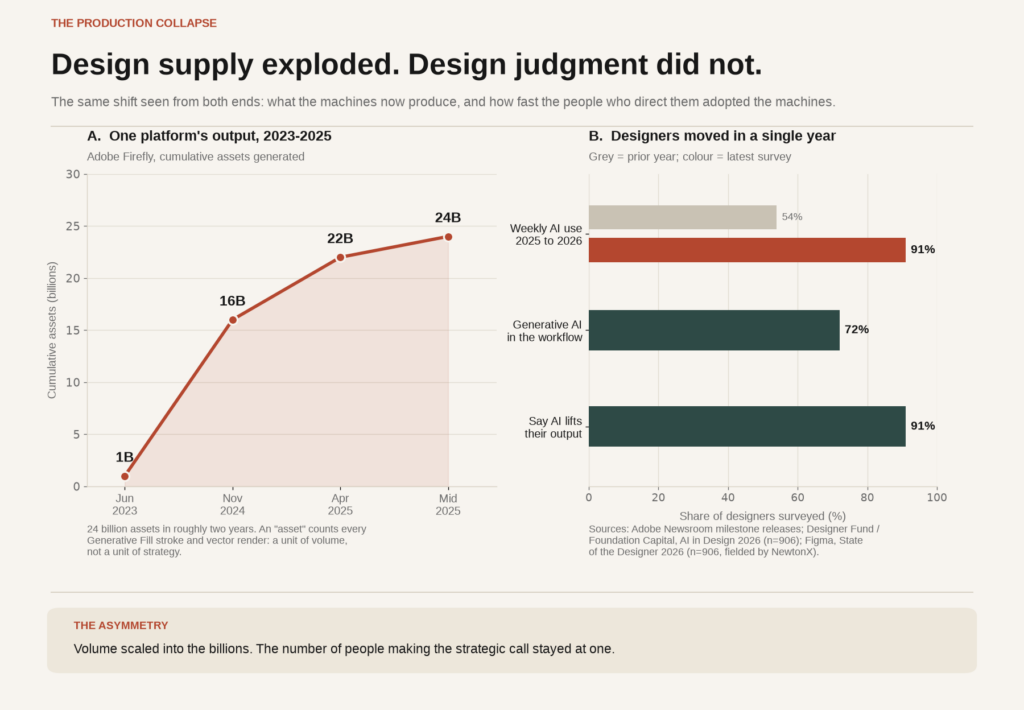
Adobe Firefly is the cleanest illustration of the supply side. One billion generated assets within three months of its March 2023 launch. Sixteen billion by November 2024. Twenty-two billion on 24 April 2025. More than twenty-four billion by mid-2025.
Read that ramp again: two billion new assets in roughly two months. One caveat matters, and Adobe is explicit about it — an “asset” is not an image. It counts every Generative Fill stroke, every vector render, every text effect. Which is precisely why the number is useful. It measures volume of production, and volume of production is the thing that collapsed.
Demand moved just as fast. Designer Fund and Foundation Capital surveyed 906 designers across more than sixty countries for AI in Design 2026 and found weekly AI use for design tasks had jumped from 54% to 91% in a single year, with three in four now using it daily. The average designer’s off-the-shelf AI toolkit went from three tools to seven. Figma’s State of the Designer 2026, a survey of 906 designers fielded by NewtonX, reports 72% using generative AI at work and 98% of those users saying they increased that usage over the previous year.
Both curves went nearly vertical. Designers adopted the machines at something close to the machines’ own speed.
Three things that got cheap, and one that did not
Be precise about which parts of the job AI actually took, because imprecision here is where bad decisions get made.
Exploration got cheap. Mood boards, visual territories, palette experiments, the “what if it were geometric instead of organic” detour that used to eat three studio days. This is unambiguously good. More directions explored early means a better chance of landing on one worth owning.
Production and versioning got cheap. A decided system can now be pushed into every size, ratio, surface, locale and format without a human redrawing anything. The grinding work — the reason junior designers used to exist — is largely automated.
Access got cheap. Solo founders, regional brands, NGOs, small manufacturers: they can afford a baseline identity now. Any argument treating democratised access as a downside is an argument for gatekeeping, not for craft.
And the thing that did not get cheap? Deciding what the brand is for. Why it exists. What it refuses to do. Which of the forty directions could only belong to you. That work has no prompt, because it has no training distribution. It is a set of judgements about a specific market, a specific audience and a specific moment, made by someone who will be held responsible when the judgement turns out wrong.
The sameness problem is older than the models
Here is the part that gets misdiagnosed constantly. The drift toward generic branding is not an AI story. It is a thirty-year story that AI happens to be accelerating.
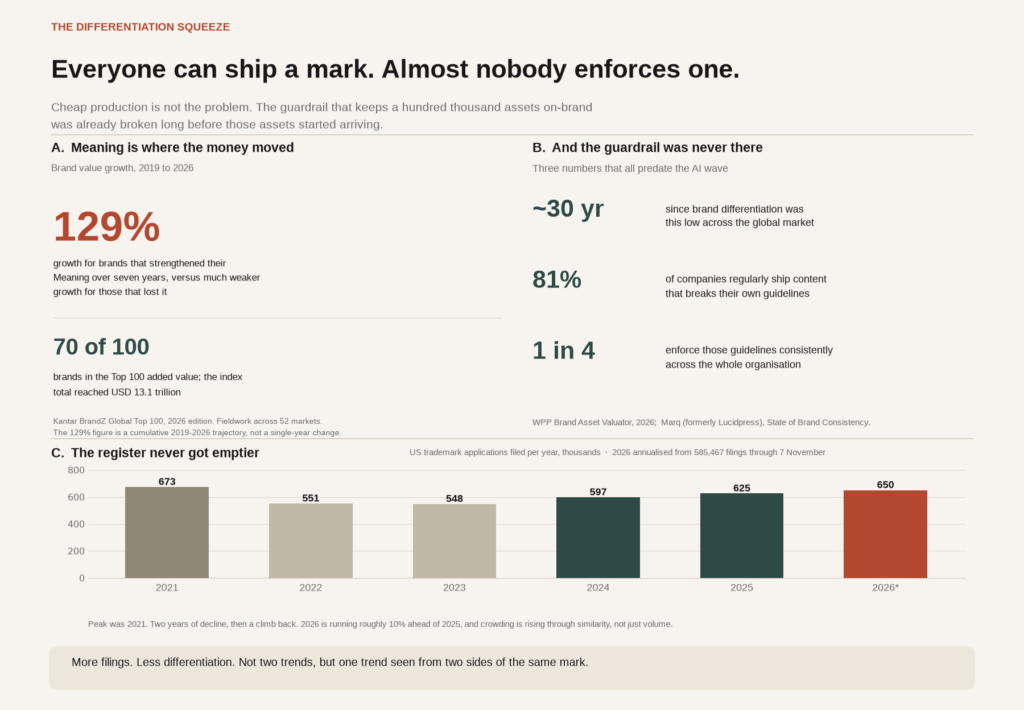
WPP’s Brand Asset Valuator, one of the longest-running brand perception studies in existence, has tracked differentiation across tens of thousands of brands for decades. Its finding, as reported by Ogilvy in 2025: brand differentiation has fallen to a two-decade low, 75% of the world’s most iconic brands have lost measurable distinctiveness over the past ten years, and the revenue written off to that erosion runs to roughly three trillion dollars. WPP Brand & Design’s global chief executive put it more bluntly this year — the number of highly differentiated brands is at its lowest point in about thirty years.
Now add AI to that picture, and understand why it pushes in the same direction.
A generative model is, mechanically, a machine for returning the most probable output given its inputs. Trained on a vast corpus of existing marks, it learns the distribution of what a logo looks like: the safe geometry, the expected gradients, the familiar sans-serif with the clever negative space. Ask for something new and it gives you something plausible, which is to say something near the centre of that distribution. It samples the mean extraordinarily well.
Practitioners have noticed. Bloomberg Law’s April 2026 analysis of AI in trademark practice states it plainly: AI-generated names and logos “tend to produce similar styles, making it harder to develop something truly distinctive.” Not because the models are weak. Because regression to the mean is what they are for.
There is a research parallel worth knowing, offered as analogy rather than proof. Shumailov and colleagues showed in Nature in 2024 that models trained recursively on their own output degrade — they collapse toward a narrower, lower-variance version of the original distribution. You need not claim design is undergoing model collapse to take the structural lesson: systems that keep sampling their own prior output drift toward homogeneity unless something outside the loop injects variance. In branding, that something is a human with taste and a reason.
The enforcement gap nobody budgeted for
If cheap production were the only problem, the fix would be editorial discipline. But the discipline was already missing, and now a hundred times more work arrives to test it.
These numbers have been stable for years, which is exactly what makes them damning. Research from Lucidpress — now Marq — with Demand Metric has consistently found that around 81% of companies deal with content that ignores their own brand guidelines, and only about one in four enforce those guidelines consistently. Nearly everyone owns a guidelines document. Almost nobody owns a system that checks anything against it before publication.
Those figures come from marketer self-reporting across surveys fielded between 2016 and 2021, so treat them as directional rather than precise. The direction, though, is unmistakable, and the enforcement side corroborates it: the same body of research puts the revenue lift from consistent brand presentation somewhere between 23% and 33%. The upside was always there. Nobody built the machine to capture it.
AI does not create that gap. AI widens it — because it multiplies the number of independent decisions made about colour, type, tone and composition, and every one of those small decisions is a chance to drift. A logo made in one tool that does not match a screen built in another. Marketing graphics evolving on a separate track from product UI. Ten thousand assets that are each individually fine and collectively incoherent.
This is why the design-system conversation has turned urgent rather than aspirational. When anyone can generate a plausible asset in seconds, the system stops being documentation and becomes the guardrail. It is the memory the model does not have.
Meaning is the part that resists automation
A brand is not a logo. It is the oldest sentence in the discipline, and somehow still the one people forget once the render looks good.
The most useful framework here comes from the Ehrenberg-Bass Institute, whose work on distinctive brand assets reframed how serious marketers think about identity. An asset — a colour, a shape, a character, a typeface, a sound — earns its keep on two metrics. Fame: what share of category buyers, shown the asset without the name, correctly name your brand. Uniqueness: how much of that association you own rather than share with competitors. Famous but shared is weak. Unique but unrecognised is decoration.
Notice what those metrics require. Fame requires repetition across years. Uniqueness requires deliberate difference from the category, sustained on purpose. Neither is a property of an image file. Both are properties of a system that keeps making the same few decisions in the same recognisable way, across thousands of touchpoints, for a long time.
That is the compounding the whole discipline is built on, and it is exactly what an AI-first workflow tends to interrupt — not by producing bad assets, but by producing plausible, slightly different assets faster than any governing idea can hold them together.
Kantar’s 2026 BrandZ data puts a price on the compounding. Across the Global Top 100, brands that improved perceived Meaning and Difference grew brand value by 129%. Brands that lost Meaning grew 80%. Same market, same year, a forty-nine point spread that no amount of production efficiency closes.
Who owns the mark
Then comes the question most brand teams discover last, usually after they have already built equity in the asset: does anyone actually own this thing?
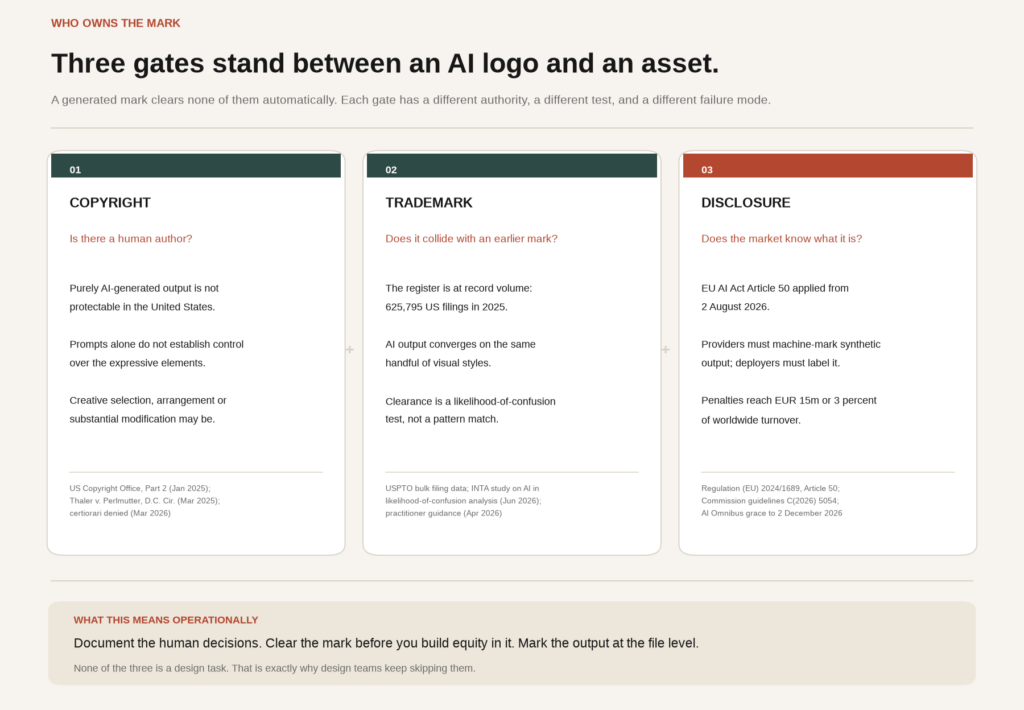
The copyright gate. The US Copyright Office settled the core question in its January 2025 copyrightability report. Protection requires human authorship. Prompts alone do not supply sufficient control over expressive elements. Purely AI-generated material is not protectable. What can qualify is a human-authored work perceptible in the output, creative selection or arrangement of AI material, or substantial human modification. The D.C. Circuit affirmed the human-authorship requirement in Thaler v. Perlmutter in March 2025; the Supreme Court declined to review it in March 2026. A related case involving an image refined through more than six hundred prompts is still moving through the district courts — which tells you the line is not yet bright.
The trademark gate. Trademark law never cared who or what made the mark. It cares whether the mark is registrable and whether using it infringes. So the AI question is not “can I own it” but “has someone already got there first” — and the register has never been fuller. The USPTO recorded 625,795 US applications in 2025, and 585,467 through 7 November 2026, roughly 10% ahead of the same point last year. Meanwhile every team is prompting the same models toward the same visual vocabulary, and AI-assisted clearance tools offer a false sense of security because they match patterns rather than perform a likelihood-of-confusion analysis. The International Trademark Association’s June 2026 study is explicit on that boundary: AI can support examiners, it cannot replace the judgement. Bloomberg Law’s review of practice adds a newer failure mode — filings containing hallucinated citations and fabricated specimens.
The disclosure gate. Article 50 of the EU AI Act has applied since 2 August 2026. Providers of generative systems must mark synthetic output in a machine-readable format; deployers must visibly label deepfakes and AI-generated public-interest content; penalties reach fifteen million euros or three percent of worldwide turnover, whichever is higher. Systems already on the market before that date have until 2 December 2026 for the machine-marking obligation. In practice this arrives through provenance infrastructure rather than legal departments: Content Credentials from the C2PA, now at version 2.3, attach automatically in Adobe’s creative tools, travel with OpenAI’s image outputs, and are read by a growing list of platforms. TikTok alone reports labelling more than three billion pieces of AI-generated content.
What the labour data actually shows
There is a temptation to read the freelance-design data as either a doom story or a non-story. It is neither, and the specificity is the interesting part.
Demirci, Hannane and Zhu, publishing in Management Science in 2025, analysed close to 1.4 million job postings on a leading global freelancing platform. Within eight months of ChatGPT’s release, postings for automation-prone work had fallen 21% relative to manual-intensive work. When image-generation tools arrived, postings for image-creation work fell 17% — graphic design down 18.49%, 3D modelling down 15.57%.
Hui, Reshef and Zhou, in Organization Science, complicate the comfortable version of that story. Studying freelancers after the release of ChatGPT, DALL·E 2 and Midjourney, they found reductions in both employment and earnings for affected occupations — and no evidence that a strong track record protected anyone. Their suggestive finding ran the other way: top freelancers were hit disproportionately.
Put the two papers together and you get a more honest reading than either headline. The routine, standardisable half of design work is being absorbed. What survives is more complex and better paid; both papers note that remaining automation-prone jobs were of greater complexity and commanded higher budgets. The floor moved. The ceiling did not.
Which is why the strategic question for a brand team is not “will AI take our designers’ jobs” but “is our design function organised around the floor or the ceiling?” If your team’s value proposition was throughput, the throughput just became free. If it was judgement, the judgement just became scarce.
Where AI genuinely earns its place
Clear eyes about the risks does not require pretending the tools are useless. Inside the right boundaries, four uses are close to unarguable.
Divergence. Generate wide — forty directions, ten palettes, six typographic registers. The point is not to pick one from the pile. It is to make the space of possibilities visible to the people who then have to choose. Research on design fixation suggests exposure to exemplars can constrain originality, and that generated variations, which transmit underlying design logic without offering a template to copy, can improve both quality and originality relative to showing originals. Used that way, AI expands the option space without collapsing it.
Production and versioning. Once the system is decided, let the machine push it everywhere. This is where the cost collapse is pure gain, and where the 89% of designers in Figma’s survey who report working faster are reporting something real.
Governance. Encode the guidelines so they are checkable rather than readable. Contrast ratios, clearspace, permitted lockups, type hierarchies — rules a system can test are rules that survive scale. This is the highest-leverage investment available to a brand team in 2026, because it converts a document nobody reads into infrastructure that catches drift before publication.
Accessibility and QA. Contrast, legibility at small sizes, alt-text generation, locale-specific text expansion. Work that used to be a final-stage scramble becomes an automatic pass.
And the boundary: AI generates and checks; humans set the strategy and approve the system. Note that the same survey data showing near-universal adoption also shows where the tools still fail. In the Designer Fund study, 62% of designers named inconsistent output quality as their single biggest challenge, and 80% said reliable output is what earns a tool a permanent place in a workflow. The tool that made production cheap also made it slightly unreliable. That is why the human approval step is not nostalgia. It is quality control.
The operating model: split the work
If you take one thing from all of this, take the split. It is more useful than any tool recommendation.
Keep strategy human. Positioning, narrative, architecture, the call about which direction is on-strategy — those stay with people who can be asked to defend them. AI is the render engine that runs after the strategy is set, not the thing that sets it.
Use AI for divergence, humans for convergence. The machine widens the funnel; the human narrows it, and the narrowing is where taste lives. If you cannot articulate why one option beats the other eight, you have not done the work.
Run a distinctiveness audit as a standing gate. Every AI-assisted asset gets one question: does this look like it could belong to a competitor? Kill the derivative, keep the differentiated, and treat distinctiveness as a KPI with a number attached rather than a vibe.
Clear before you launch, not after. Trademark clearance and a copyright-ownership check on any AI-drawn mark, done by a human with access to real databases, before the asset accumulates equity. The order matters: creation, clearance, assessment, registration, protection. Skipping step two is how a rebrand becomes a write-off.
Document the human hand. What did your team contribute? How did they direct the output? What did they change? Under the Copyright Office framework, that record is the difference between an asset you own and an image you happened to generate. It is also the difference between a defensible enforcement position and none at all.
Honest caveats
Three qualifications, because the argument is stronger with them than without.
Consumers do not automatically punish AI-made design. A 2025 study in the Korean journal Brand Design Research found AI-generated product designs were evaluated more favourably on design attitude than expert-designed ones, scoring higher on perceived uniqueness and utility. A separate controlled experiment with a small food business in Indonesia found the opposite: human-designed logos rated higher on simplicity, legibility, brand fit and memorability, with the AI output notably weak on cultural context. Both are small, single-context studies. Together they suggest that “AI-made” is not the variable consumers respond to. Fit and distinctiveness are. That is a more demanding standard, not a more lenient one.
You cannot A/B test your way to a brand. A 2026 paper testing whether synthetic consumers can pre-test visual marketing found that across six canonical experiments, no configuration reproduced more than two of the six human effects, and none captured even half the natural spread of human response. Synthetic panels suit average-effect questions and stay unreliable for anything that depends on how consumers differ. Identity work is the second kind.
Some of this data is directional, and some is vendor-adjacent. The brand-consistency revenue figures come from marketer surveys. The design adoption surveys come from firms with a stake in the answer. The productivity figures often quoted for AI creative tools originate in vendor-commissioned studies. None of that makes them wrong; all of it means you should weight them as evidence of direction rather than as measurements.
And “slop” is now a word people use. Merriam-Webster named it 2025’s Word of the Year, defining it as low-quality digital content produced in quantity by means of artificial intelligence. A Harvard Business Review study of 1,150 US desk workers found 40% had received AI-generated “workslop” in the previous month, spending close to two hours per instance to deal with it, at an estimated nine million dollars a year for a ten-thousand-person firm. Consumers are learning to recognise the texture of the generic. That cuts both ways: it punishes lazy AI output, and it rewards anything visibly unlike it.
The takeaway
AI did not solve branding. It collapsed the cost of producing the artifacts of branding, and left every question about meaning, distinctiveness and ownership exactly where it stood — except that those questions now arrive a thousand times faster.
So the split is not a compromise position. It is the actual structure of the work. Machines generate, version, check and scale. Humans decide what it is for, which version is the one, and whether we are allowed to own it.
The brands that get this right in the next two years will look like they spent more than they did. The ones that get it wrong will look like everyone else — at unprecedented speed, with no legal recourse and no memory left in the market.
In a world where anyone can afford a logo, the scarce thing was never the logo.