The Click Is the Echo. The Intent Is the Voice.
There is a contact in your CRM who has opened nineteen emails, downloaded four guides, sat through two webinars, and visited your pricing page once. That visit was nine weeks ago. Your model adores this person. Your reps have called three times. Nobody has ever replied.
Then there is the account that did almost nothing visible. One senior title-level search. Two colleagues quietly reading your implementation documentation on the same afternoon. A competitor’s name typed into a review site. Your score gives them 41 out of 100. Nobody calls. Six weeks later they sign with someone else, and in the win-loss conversation they mention that you were on the shortlist from the beginning and that nobody ever reached out.
If that story feels familiar, the problem is probably not your model’s accuracy. It is what you asked the model to predict.
Most lead scoring is engagement scoring wearing a lab coat. It rewards the behaviours that are easy to instrument — clicks, opens, dwell time, form fills — and quietly treats their volume as a proxy for wanting to buy. But activity is the echo. Intent is the voice. They come from different organs.
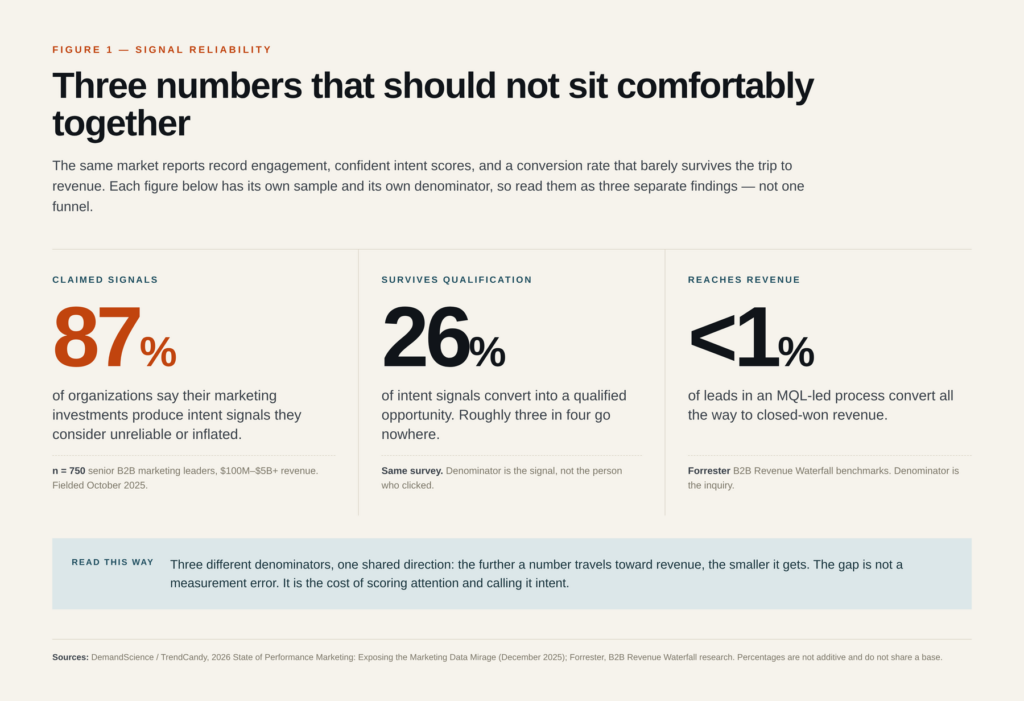
And the signals we call intent data do not survive the trip to revenue much better. In a survey of 750 senior B2B marketing leaders at companies between $100 million and $5 billion in revenue, 87% said their marketing investments generate intent signals they consider unreliable or inflated. Only 26% of those signals turned into a qualified opportunity. Three in four went nowhere.
That is not an argument against scoring. It is an argument for scoring something else.
Why engagement scoring feels right and fails anyway
The metric rewards the spray, not the demand
Engagement scoring has an appealing internal logic. People who interact with us are interested; interested people buy. Tidy. It is also why the same dashboard can report record marketing-qualified lead volume while the sales floor quietly stops trusting the queue.
Watch what happens when you widen the gate. HockeyStack Labs looked at 87 B2B SaaS companies and split them by how they defined a marketing-qualified lead. Forty-eight companies counted only demo requests, pricing-page visits and contact submissions. Thirty-nine counted everything their CRM called an MQL, ebook downloads and webinar registrations included. The first group converted 21.55% of MQLs into sales-qualified leads. The second converted 4.93%.
Same period. Same product category. Same downstream sales motion. The only structural difference was which behaviours were allowed to earn the label.
The cost column makes it worse. $570 per MQL but $2,640 per SQL for the narrow group. $262 per MQL but $5,320 per SQL for the broad one. Cheap leads are expensive, and nobody puts that on a slide.
A scoring model inherits whatever definition you hand it. Define a lead as curiosity, and you will build a model that predicts curiosity with impressive precision — then hand your reps a queue of curious people.
Recency is a campaign artefact, not a buying signal
Engagement scores decay, then spike, then decay again. The spikes line up suspiciously well with your nurture cadence rather than with anything happening inside the buyer’s business.
That is the tell. A score that moves when you send an email is measuring your outbound activity, not their internal urgency. Genuine intent does not need your newsletter to become visible. It surfaces as a pattern: three people at one account, one week, circling the same problem from different angles.
The alignment tax nobody budgets for
There is a quieter cost. Once reps learn that a high score means somebody clicked a lot, they stop working the queue and return to accounts they sourced themselves. That response is rational. It is also how a scoring system dies — not with an error message, but with a spreadsheet maintained on the side.
What intent actually is
Intent is not a feeling. It is a situation: who, at which company, doing what, right now — and whether that activity looks like a decision forming or a person reading on a train.
Four categories are worth separating, because they fail in different ways.
Behavioural intent: what they read around the decision
Not all pages are equal, and the difference has nothing to do with traffic volume. Someone sitting on your pricing page, your comparison matrix, your implementation docs, or typing “best X for Y” into a search box stands inside the decision. Someone reading your post about industry trends is learning a vocabulary. Both register as engagement. Only one is a procurement motion.
Fit gates intent
An in-market account that will never pass your ideal customer profile is a research project, not an opportunity. Fit is the unglamorous half of the score, and it is the half that keeps you from spending a quarter on accounts your product cannot serve. Timing without fit fills the pipeline with deals that stall. Fit without timing fills it with deals that say “not now.” You need both, weighted honestly.
The committee signal
This is the most underused and most predictive structure available to you. Gartner’s research on complex B2B purchasing puts the buying group at six to ten decision makers, each arriving with four or five pieces of independently gathered information. Its 2025 survey of 632 buyers found that 74% of buying teams experience unhealthy conflict during the decision — and that teams reaching consensus are 2.5 times more likely to report a high-quality deal.
Translated into a scoring model: one person downloading three assets is a weaker signal than three people from one account each doing one thing. Forrester has argued this for years through its revenue waterfall, and reports a 50% increase in meeting-to-closed-won conversion when marketing delivers three or more buying-group members to sales. A score that cannot see the group is scoring a person and calling it an account.
External triggers: the why-now
Funding rounds. A new functional leader. Job postings for roles your product supports. Surges of research on a topic. None of these prove intent. They raise the odds that a need which already existed has just become funded, owned by someone new, and urgent.
Stack them and false positives fall. A topic surge on its own is a maybe. A topic surge plus a pricing-page visit from the same account plus a fresh job posting naming your category is a conversation worth having this week.
The uncomfortable math: your label is the model
Two definitions, one pipeline
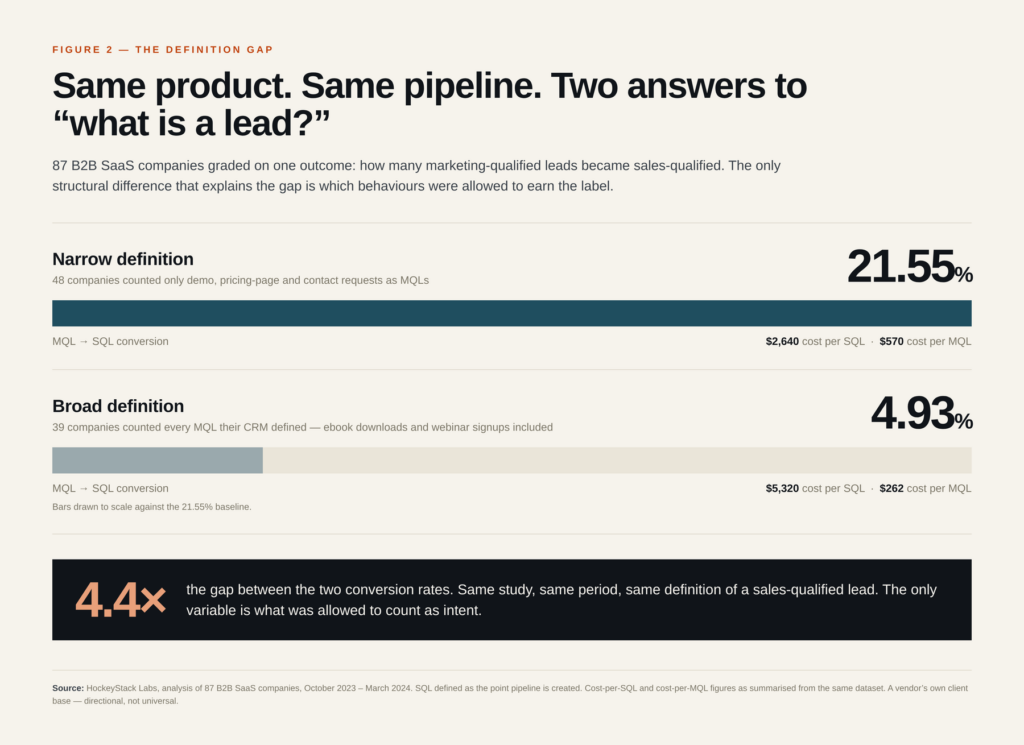
Put the two rates side by side and the ratio is 4.4 to 1. Nothing about the model changed between those groups. Nothing about the channel. The label changed.
This is the least glamorous finding in lead scoring and probably the most consequential: before you invest in a better algorithm, decide what deserves the word qualified. Most teams discover, late, that their scoring problem was a definitions problem wearing a machine-learning costume.
Three in four signals go nowhere
Now combine that with the reliability survey. Most leaders believe their data is clean — the problem is not visibility, it is verifiability. Sixty-six percent said their campaign metrics often look successful without driving revenue, and leaders estimated that roughly a quarter of marketing budget goes to work that looks productive in a dashboard and fails in the pipeline.
We built an industry that can measure attention to four decimal places and still cannot answer the only question the CFO asks.
The score fires too late
Even a well-built score has a timing problem, and the timing problem is structural.
Buyers now do most of their work before they identify themselves. In 6sense’s 2025 study of roughly 4,000 buyers, first contact with any seller happened about 61% of the way through the journey — earlier than the previous year’s 69%, which sounds like progress until you read the next number. In 95% of cases, the vendor that eventually won was already on the buyer’s day-one shortlist. In 94% of cases, buyers had already ranked their preferences before that first conversation.
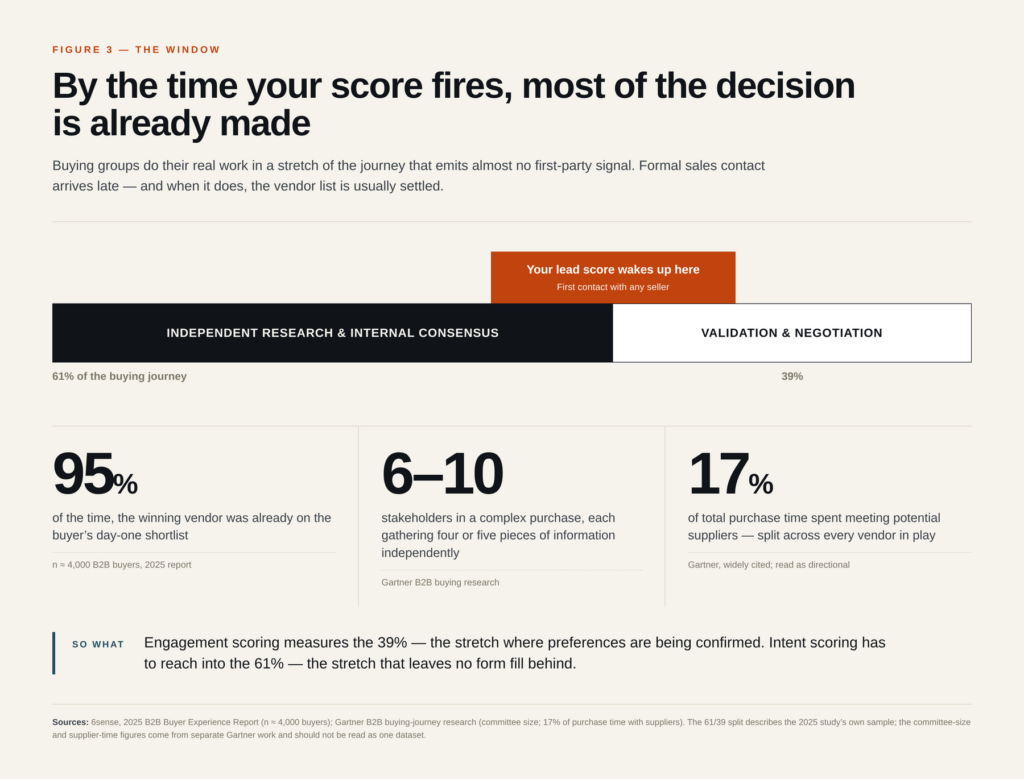
Gartner’s buying-journey work adds the texture: buyers spend roughly 17% of total purchase time meeting suppliers of any kind, which leaves about five to six percent for any single vendor. Treat that figure as directional — it is very widely cited, and the original page carries no published sample or fielding date.
So a score that fires on a form fill is arriving at the validation stage of a decision that was substantially formed weeks earlier. You are not scoring a buyer. You are scoring a buyer’s confirmation.
What AI actually does differently
It learns from outcomes instead of activity
A rules-based score encodes what someone assumed in a workshop. A supervised model learns from what actually happened: which signals, in which combinations, preceded a won deal — and which preceded a loss, a no-decision, or a deal that closed with a competitor.
The peer-reviewed evidence here is thin but real. A 2025 study in Frontiers in Artificial Intelligence built a lead-scoring model on a B2B software company’s CRM data spanning January 2020 to April 2024, testing fifteen classifiers. Gradient boosting won, reaching an average accuracy of 98.39%. In the feature-importance analysis, lead source, lead classification, product and number of responses carried the most predictive weight. That last detail is worth pausing on: the strongest features were contextual, not volumetric. Where the lead came from and what it was interested in beat how many times it blinked.
Note the limit. A single-company case study with a strong accuracy number tells you a model can fit one company’s history. It does not tell you what will happen at yours.
It can afford to love rare signals
Engagement scoring has a built-in bias toward volume, because volume is easy to count. A model trained on outcomes learns the opposite lesson: rarity can be the strongest signal in the set. A pricing-page visit from a named account is rare. A security questionnaire is rarer. A procurement contact appearing in the buying group is rarer still — and dramatically more predictive than the four hundredth email open.
That is the re-weighting that matters. Demote the signals that fire constantly and cannot discriminate. Promote the ones that fire rarely and discriminate sharply.
It re-scores continuously, which is also its maintenance bill
Continuous scoring catches the in-market moment instead of the quarterly review. It also creates a permanent obligation, because models decay. Buying behaviour shifts, a pricing change lands, a new segment enters the funnel, and the relationship between input and outcome quietly stops holding.
The documented failure mode is worth internalising: a churn model built on 8,878 real B2B customers reached an AUC around 0.90 on a held-out test, then collapsed to precision between 0.03 and 0.08 when evaluated on a rolling biweekly basis. Recall held — it still caught the churners — but almost everything it flagged was a false alarm. A backtest is not an operating system. Budget for retraining the way you budget for payroll.
The playbook: five moves from noise to signal
1. Re-weight the score toward fit × intent
Build the score as a product, not a sum. Fit asks whether this account can buy from you at all. Intent asks whether something is happening now. An account needs both to deserve a human’s morning. Demote opens and clicks unless they co-occur with intent signals from the same account, and stop treating one person’s enthusiasm as an account-level fact.
2. Close the loop weekly
Feed won, lost and no-decision outcomes back into the model on a fixed cadence, and record why a high-scored lead died. “Wrong timing” and “wrong fit” are different failures requiring different corrections, and a rep’s two-word note is worth more than another dashboard.
3. Calibrate to pipeline, not MQL count
A lead is only good if it converts. Measure the model by the conversion rate of the leads it puts at the top of the queue, by segment, against a holdout you deliberately route through the old process. Ten to twenty percent held back is enough to learn whether the lift is real, or whether you are taking credit for deals that would have closed anyway.
4. Route on probability and value together
Two numbers, two different conversations. High probability with high value gets a human immediately, because the moment is perishable. High probability with modest value gets a fast, well-automated path. Mid-probability gets nurture with intent triggers attached, so the next signal promotes them. Low-probability and low-fit gets suppression — and suppression is a feature, because every hour a rep spends on a lead that cannot close is an hour taken from one that can. Response speed still decides more than most teams admit; the classic response-time research is old, but the direction has never been contradicted.
5. Keep a human on the exceptions
Strategic accounts sometimes score badly for structurally boring reasons: a new logo, a quiet buying group, a procurement process that leaves no digital trail. Give sellers a documented override with a reason code, and review overrides monthly. If the override rate is climbing, the model has a blind spot. If it is zero, nobody is using the score.
Risks and honest caveats
The data ceiling comes first. A 2025 survey of 602 CRM users and administrators found that 76% said less than half their CRM data is accurate and complete, and 37% reported losing revenue directly to poor data quality. Forty-five percent said their CRM data is not ready for AI. No model rises above its inputs.
Overfitting to the past is the default, not the exception. A model trained on wins learns your last three years of market conditions. If your category shifted — new competitor, new pricing, new buying committee — the model is confidently wrong. Holdouts, drift monitoring and a scheduled retrain are not optional.
The privacy line is real and it has moved. Company-level intent is on much firmer ground than naming an individual. Person-level inference from behaviour sits close to regulated personal data in several jurisdictions. Score on signals you can defend, document your lawful basis, and keep the individual out of the inference wherever you can.
False negatives cost more than false positives, and nobody measures them. A wrongly promoted lead wastes a call. A wrongly suppressed lead is invisible — you never learn it existed. Segment your precision and recall targets: for enterprise segments, bias toward recall; for high-volume low-value segments, bias toward precision. Then check the quiet accounts by hand, quarterly.
The takeaway
Lead scoring has spent twenty years measuring attention and calling it intention. The fix is not a cleverer algorithm bolted onto the same inputs. It is a re-weight: score fit × intent over engagement volume, define qualified narrowly enough that the word means something, train on won and lost outcomes rather than activity, calibrate to pipeline rather than to lead counts, and keep a human on the accounts the model cannot see.
The click is the echo. The intent is the voice. AI does not make the echo louder. It finally lets you hear the voice underneath it.