Agency, In-House, or Freelance? Stop Choosing and Start Dividing.
Most marketing org charts are archaeology.
There’s a team someone hired in 2019 because a consultancy said so. An agency retainer nobody has renegotiated since the pandemic, kept alive by a sentence that starts with “we’ve always.” A freelancer quietly carrying the brand strategy, because she was the only person who could start on short notice — and then she never left.
None of those were decisions. They were defaults wearing a decision’s clothes.
And here’s the uncomfortable part: 2026 is a bad year to run on defaults. The economics underneath all three options — own, rent, flex — have shifted in ways that make the old instinct actively expensive. The question is no longer “agency or in-house?” It hasn’t been that question for a while, and the data is now blunt about it.
The Question Isn’t Which One. It’s Which Work.
Let’s start with the number that should end the argument.
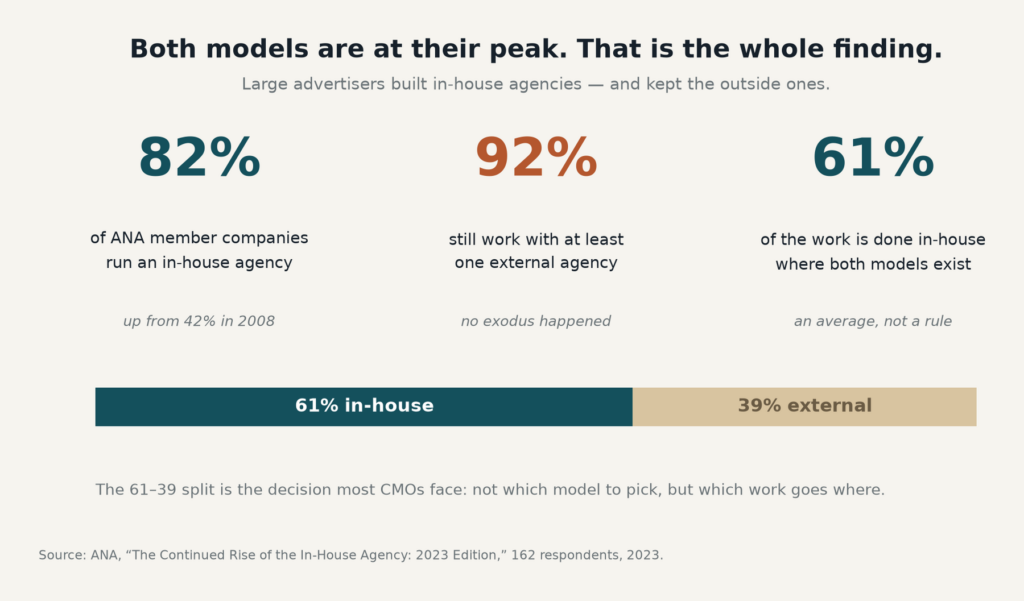
Eighty-two percent of large advertisers run some form of in-house agency. That figure has climbed from 42 percent in 2008, to 58 percent in 2013, to 78 percent in 2018. If in-housing were a trend, it would be a sixteen-year trend — which is another word for “the operating model.”
Now the number almost nobody quotes alongside it. Of those same companies, 92 percent still work with at least one external agency. And where both models exist side by side, the in-house team handles an average of 61 percent of the work.
Read those three together and the “versus” in the title dissolves. Both curves are at their peak, simultaneously. The real decision — the one CMOs actually make, whether they admit it or not — is where the 61–39 line falls, and why.
Three Options, Defined by What They Optimize
Before the framework, a quick stripping-away of the rhetoric. Each model is good at exactly one thing, and it pays for that goodness with a specific cost. Knowing which cost you’re buying is most of the decision.
In-House: You Own It
You own the talent outright — full-time, embedded, inside the building. What it optimizes is compounding: the slow accumulation of brand knowledge, customer data, and institutional instinct that gets better every quarter it stays put. Speed of context is its quiet superpower. Nobody has to be briefed on who the customer is.
What it charges you is fixed cost and a hard ceiling on scale. A ten-person team does ten people’s work, no matter how good the quarter looks, and the retention burden is now permanently yours.
Agency: You Rent It
You rent specialized, scaled capability. Breadth, production volume, category experience, a bench that can absorb a launch without you hiring anyone. An outside partner also buys you something subtler: a perspective that hasn’t been marinating in your own assumptions.
What it charges you is the markup, the context loss, and the briefing overhead. They don’t know your brand the way you do. That’s the point, and it’s also the bill.
Freelance: You Flex It
You flex senior judgment on demand. Not junior hands — senior judgment, which is the distinction most organizations still get wrong. You pay for the work rather than the seat, and you can turn the dial up or down between quarters.
What it charges you is integration. Nobody’s there to hold the thread between engagements, so someone inside has to.
What Actually Changed in 2026
Four shifts, all measurable, all pushing the same direction.
The Budget Line Moved
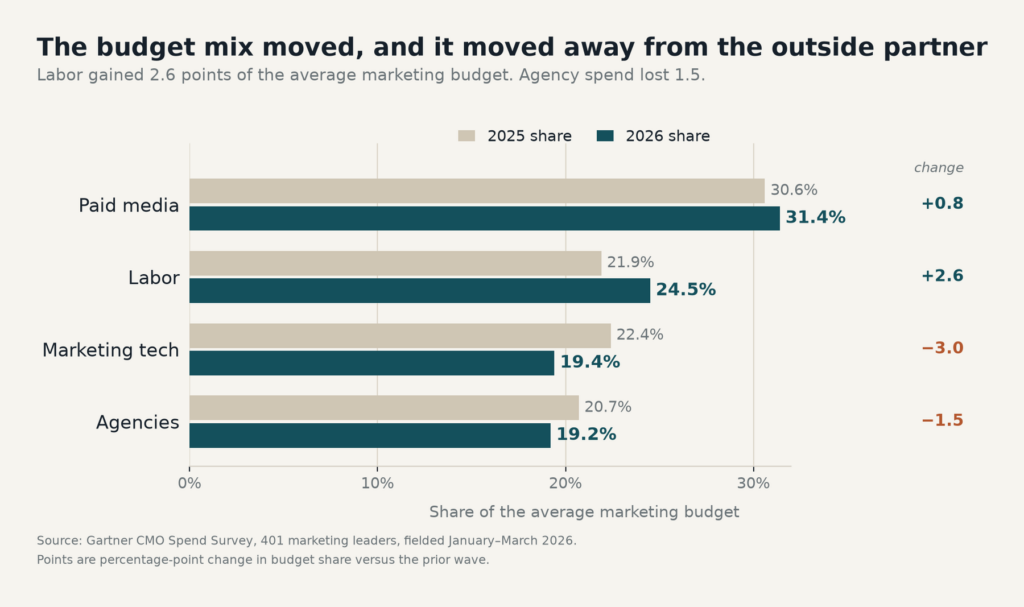
Gartner’s 2026 CMO Spend Survey, drawn from 401 marketing leaders mostly at companies above a billion dollars in revenue, shows where the average budget went: paid media 31.4 percent, labor 24.5 percent, marketing technology 19.4 percent, agencies 19.2 percent.
Compare to the prior wave: media 30.6, labor 21.9, martech 22.4, agencies 20.7.
Labor gained 2.6 points. Agencies lost 1.5. Technology lost 3.
That’s not a rounding error, and it isn’t a story about marketing getting cheaper. It’s a story about what a CMO believes produces output. The line that grew is the one attached to human capability. The line that shrank is the one attached to outside execution. And the line that shrank most is the one attached to tools that were supposed to replace both.
There’s a harder edge to this. In the same survey, 56 percent of CMOs say their organization lacks the budget to deliver its 2026 strategy; 54 percent report insufficient resources. Seventy percent call becoming an AI leader a critical goal. Only 30 percent report mature AI readiness. And 38 percent name a lack of internal AI expertise as the single biggest barrier to AI-driven efficiency.
Read that last one twice. The top obstacle to the AI era isn’t compute, isn’t tooling, isn’t data infrastructure. It’s people who know what to do with it.
In-House Stopped Being a Cost Play
For fifteen years, the argument for bringing work inside was savings. That argument is dead.
In the ANA’s 2026 State of In-Housing research, cost savings as the primary reason for in-housing fell from 30 percent in 2023 to 9 percent. Meanwhile 53 percent now describe the in-house team’s primary role as strategic partner. Thirty-five percent say brands are in-housing more than ever, against 7 percent who see the pendulum swinging back out.
The work moving inside follows a pattern too, and it isn’t the expensive work. Social media at 58 percent, influencer and creator marketing at 37 percent, SEO at 35 percent. Continuous, brand-close, repeatable. What stays outside is the opposite: heavy-infrastructure, deep-specialism, big-idea territory.
If you’re still justifying an in-house team on cost, you’re defending it on the one ground where it’s weakest — and least believed.
The Agency Payroll Already Turned
This is the part that usually gets framed as a forecast. Some of it has already happened, and the government’s own numbers say so.
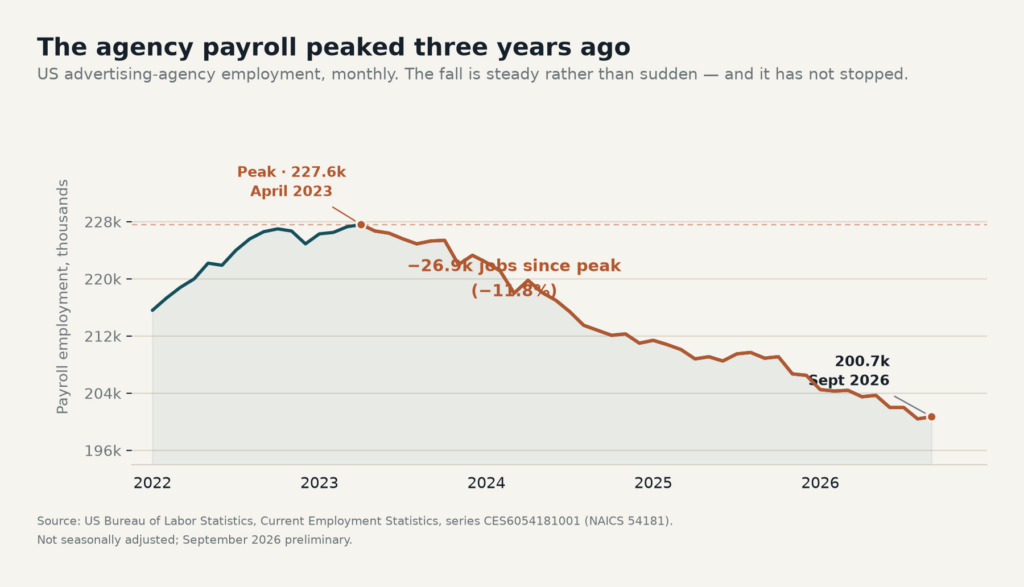
US advertising-agency employment peaked at 227,600 in April 2023. By September 2026 it stood at 200,700 — a loss of 26,900 jobs, or 11.8 percent, and still drifting down. Month by month, quietly, for three years.
Forrester’s forecast is steeper: 15 percent of agency jobs eliminated in 2026, after average headcount cuts of about 8 percent in 2025. Treat that as a forecast rather than a fact — the official counts haven’t fallen that far yet. But directionally, the payroll isn’t waiting for anyone’s permission.
Why is production the part that goes? Because that’s the layer AI actually replaced. And here the evidence gets genuinely interesting.
Forrester’s 2026 research on US marketing agencies found that nine in ten use generative AI in their work, and about half use agentic AI. Sixty-one percent still classify AI as a cost of doing business rather than a revenue line. And when you ask corporate marketers what AI benefit they most want from their agency, 71 percent say cost efficiency. Marketing performance comes in at 49 percent. Revenue growth at 27 percent.
That’s the trap in one sentence. Clients are asking agencies for the exact thing AI made cheap. An agency that answers that request is pricing itself toward zero. The defensible ground isn’t production — it’s judgment: knowing why something worked, for whom, and being willing to put a name on the decision.
The Freelance Pool Got Senior
The third option used to mean cheap hands. Not anymore.
MBO Partners’ 2026 State of Independence study puts the US independent workforce at a record 74.9 million people. The telling number sits inside it: full-time independents have grown 114 percent since 2020, and now represent 22 percent of all full-time US workers — nearly double their 2019 share. Around 5.8 million independents earn over $100,000 a year, roughly twice the 2020 figure. Independent service professionals — the consultants and specialists who sell expertise to businesses — number about 11.9 million, up 61 percent from 7.4 million in 2020. And 78 percent of independents plan to stay independent or build a larger practice.
Translation: the senior judgment layer went independent. The fractional strategist you hire in 2026 is not a stopgap. She’s more likely a former agency lead or a former client-side director who chose portfolio work deliberately.
The CMO Survey shows the same drift at the hiring line, more quietly: of planned marketing hires, full-time employees fell from 82.5 percent in 2019 to 77.9 percent, while full-time independent subcontractors rose from 5.4 to 7.8 percent. Modest — but it’s moving in one direction.
The Two-Question Filter
Here’s where most frameworks fail, because they ask “what kind of work is it?” when the better question is “what does this work do to the business over time?”
Two questions do most of the work.
Does it compound? If the work gets more valuable the longer it stays inside — because it builds proprietary data, brand equity, customer understanding, or an operating advantage a competitor can’t copy — it wants to be owned. If it resets to zero every time it’s delivered, it doesn’t.
Does demand for it move? If you need it every week, steadily, owning it is efficient. If you need it in bursts — a launch, a rebrand, a market entry — owning it means paying for idle capacity.
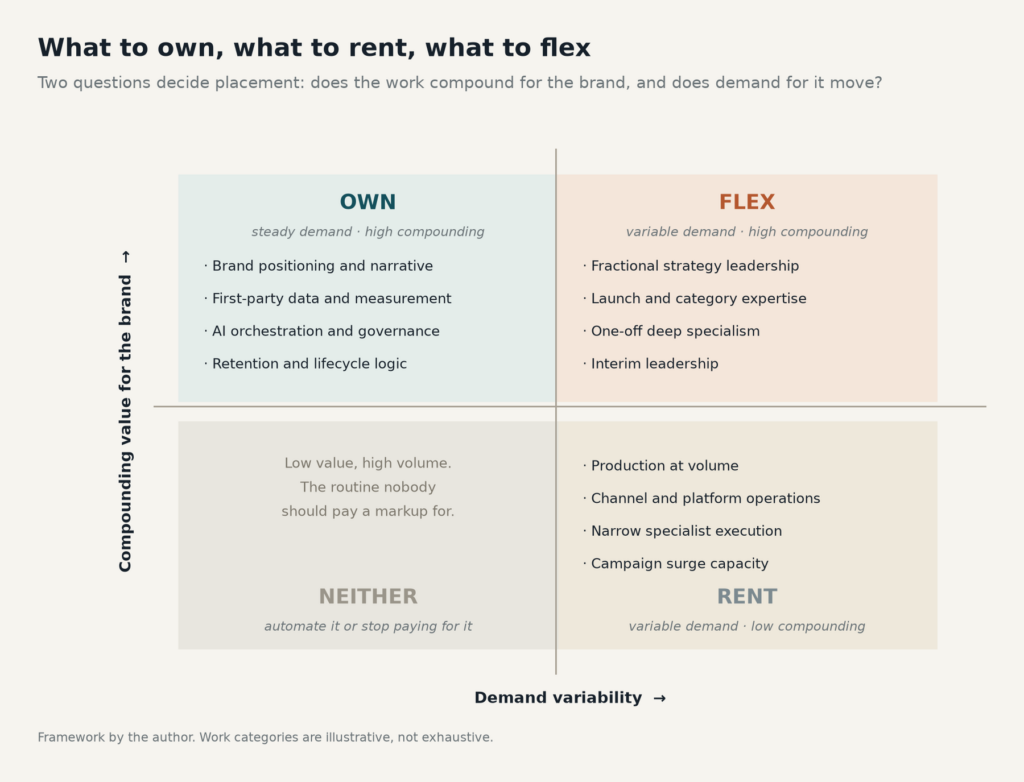
Two questions, four answers. Own. Rent. Flex. And a fourth quadrant most org charts quietly fund: neither.
What to Own
Own the compounding core. That means brand positioning and narrative. First-party data and measurement. AI orchestration and governance — the rules, the evals, the guardrails, the judgment about what models are allowed to touch. Retention and lifecycle logic.
Notice what those have in common: none of them are deliverables. They’re capabilities that get sharper with tenure. Handing them to an outside partner isn’t outsourcing work; it’s outsourcing memory.
The mistake to avoid here is over-owning. Owning everything produces the fixed-cost bloat and under-utilized specialist that in-housing’s critics love to cite. Own the core, not the catalogue.
What to Rent
Rent the commodity and the surge. Production at volume. Channel and platform operations. Narrow specialist execution where the expertise is deep but the need is episodic. Campaign surge capacity when the quarter demands more than the team can physically produce.
There’s one more thing worth renting that rarely gets named: the outside view. An agency that has watched forty brands attempt the same repositioning knows something your team can’t, because your team has only seen one. That perspective is a legitimate reason to pay a markup — as long as you’re honest that it’s what you’re buying.
And the relationship may be more stable than you assume. ANA and 4As research found average client-agency tenure has roughly doubled since 2016, to about seven years. Integrated full-service relationships average 7.3 years; media-only relationships 3.7. Independent agencies outlast holding-company agencies, 7.3 years to 5.8. And the most useful finding of all: clients without mandatory review cycles keep relationships for 8.1 years, against 3.8 for those who review often.
Reviews are not free. The same research program priced a single search and review at about $408,500 for the client side, and $204,461 for the agency pitching. Frequency has a price tag, and most organizations never put it in the comparison.
What to Flex
Flex senior judgment. Fractional strategy leadership. Launch and category expertise you need for nine months, not three years. One-off deep specialism. Interim leadership while a search runs.
The flex layer exists for a specific reason: to keep the owned core thin. Every capability you flex is a fixed cost you didn’t add. That’s the structural argument for freelancers, and it’s a better argument than the hourly rate.
Which brings up the misread that wastes this option. The senior freelancer isn’t cheap per hour. She’s often more expensive per hour than the blended rate you pay an agency. The saving isn’t the rate — it’s the seat you didn’t fund, and the twelve months of salary you didn’t commit to a need that lasted four.
Price It on Total Cost Per Outcome
Most organizations compare options on the wrong unit. They stack the agency’s retainer against the salary line against the day rate, and conclude something. That comparison is close to meaningless, because the three numbers don’t describe the same thing.
Compare on total cost per outcome instead. Four cost lines belong in every column.
The invoice. The management overhead — briefing, reviewing, integrating, chasing. The context cost — what it takes to bring an outsider to the level of understanding an insider already has. And the opportunity cost — what your team isn’t doing while it manages the option you chose.
Do that arithmetic honestly and a few things surface. A fully loaded median US marketing specialist costs roughly $112,500 a year, once you account for the fact that wages are about 70 percent of total compensation in the private sector. An in-house hire isn’t a salary. It’s a salary plus benefits plus seats plus management time plus a recruiting cycle.
An agency retainer isn’t a fee. It’s a fee plus the hours your team spends managing it.
A freelancer isn’t a rate. It’s a rate plus the integration work somebody internal has to absorb.
The Coordination Tax Nobody Budgets For
Here’s a finding that should be printed on the wall of every marketing operations team.
In WFA research on creative in-housing, 43 percent of advertisers said they brief their in-house agency differently from their external agencies. Fifty-two percent admitted they assess the two by different KPIs. And the top KPI used to judge the in-house team was quality of output, at 81 percent — not business performance, which sat at 19.
So the two teams are held to different standards, briefed on different terms, and then compared. That isn’t a management practice. It’s a rigged experiment, and it guarantees the conclusion somebody already wanted.
Coordination cost is the most under-budgeted line in the entire build-or-buy decision. Every option carries one. The agency needs briefing and review. The in-house team needs leadership and air cover. The freelancer needs integration and someone to own the thread.
A mix that multiplies coordination is worse than a simpler structure that costs more on paper. Complexity has a payroll of its own.
Four Ways This Goes Wrong
You own everything. Fixed costs ratchet up, utilization drops, and the flex layer that was supposed to protect you gets cut first because it looks discretionary. The team grows. The output doesn’t.
You rent everything. Nothing compounds. You’ve rented execution for a decade and own no memory of it. The brand knowledge walks out the door every time the account team rotates.
You treat freelance as cheap labor. You get what you paid for, conclude freelancers are unreliable, and never discover that the good ones were never competing on price.
You never re-price the mix. The calculus moved this year. It’ll move again. A structure that was correct in 2022 is a legacy cost in 2026, and nobody will flag it, because the person who built it got promoted.
Re-Audit Quarterly, Not Annually
The mix is a living decision. Three things move it: AI capability, talent flows, and budget pressure. All three moved substantially in the last twelve months.
Once a quarter, ask four questions. Which line item grew without a corresponding outcome? Which capability are we paying a markup for that now compounds for us? Which strategic load is being carried by someone who shouldn’t be carrying it? And what did we flex last quarter that we’re now quietly treating as permanent?
That last one catches more leakage than the other three combined.
The Takeaway
The 2026 answer isn’t agency, isn’t in-house, isn’t freelance. It’s a thin owned core, a specialist rental layer, and a senior flex layer — priced on total cost per outcome, and re-audited as the ground shifts.
Own what compounds: brand, data, AI orchestration. Rent what scales: production, platform operations, narrow deep expertise. Flex what needs judgment without a headcount: fractional leadership, launch expertise, one-off specialism. And refuse to fund the fourth quadrant — the routine, low-value work nobody should be paying a markup for.
The wrong answer is still the unexamined one. The agency kept because you always have. The full-time hire for work that happens twice a year. The freelancer carrying a strategic load you should own.
None of those are decisions. Which is exactly the problem.