Why the Answer Graph Works (and the Pillar Page Stalls)
The same page that ranks first for a keyword can go completely uncited by AI. And a page that ranks nowhere can end up as the only source in the answer. That asymmetry is not randomness — it is the output of an incentive structure that flipped.
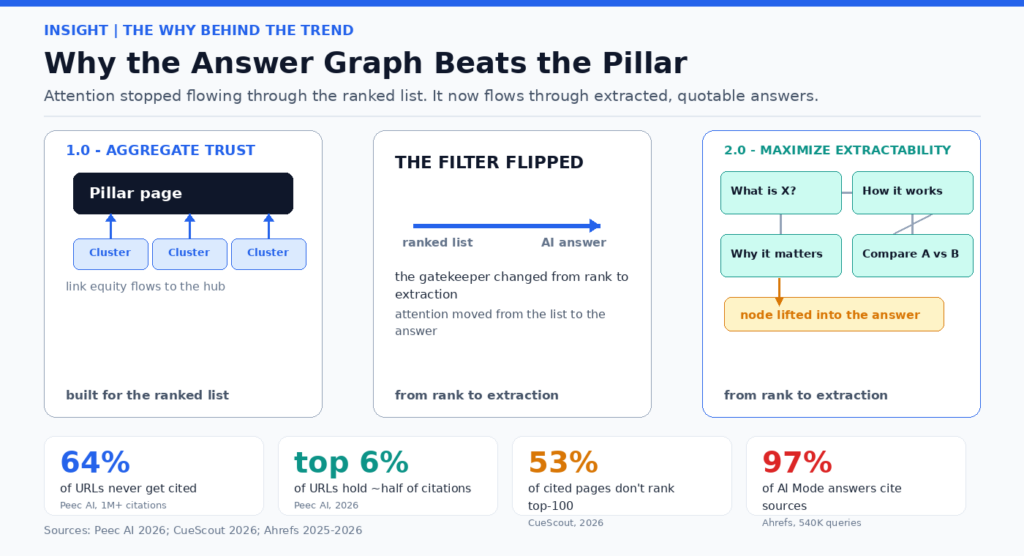
Attention stopped flowing through the list. Pew Research found that when an AI summary appears, users click a traditional result on 8% of visits, versus 15% without one. People read the answer, not the results. The gatekeeper changed from rank to extraction: Google AI Mode cites sources in 97% of its answers. Visibility now comes from being extractable, not from outranking.
Retrieval economics are winner-take-most. Peec AI’s analysis of more than a million citations found that 64% of URLs never get cited at all, while the top 6% capture nearly half of all citations. Retrieval pulls a passage, not a page. The pillar concentrated value in one hub; retrieval distributes value across every question. A graph of self-sufficient nodes beats a single comprehensive page, because the engine lifts the node, not the hub.
Rank is a legacy proxy. More than half of the pages AI cites for a buying question do not appear in the first 100 organic results for that same question. And the engines disagree: AI Overviews and AI Mode cite the same URL just 13.7% of the time. Link equity aggregated trust across pages — a signal the extraction system does not use. The test changed from “how much trust did you aggregate” to “how much utility does this unit deliver when read alone.” Different test, different winners.
And being cited pays. Seer Interactive found cited brands earn about 120% more clicks per impression than uncited brands, and Semrush puts AI referral conversion at roughly three times the channel average. The answer is the new top of funnel: intent-rich, already filtered, and free of the list-scanning the old model depended on.
The pillar was built for a system that priced trust by aggregation. The answer graph is built for a system that prices utility by extraction. This is not a feature update — it is an incentive change. Teams that rebuild for the new incentive stop chasing rank and start building the node the engine must lift.