Asking Twice: Why the Same Question Gets Two Different Answers in China’s AI Search and Google’s
China’s AI Search vs Google’s: Same Questions, Different Answers
Ask the same question twice. Ask it properly, not as a keyword string but the way a real person would.
Open ChatGPT or Google and type: what’s the best phone for someone in their seventies who mostly makes video calls? Then ask Baidu’s AI the same thing, in Chinese, the way someone in Chengdu actually would. You will not get the same answer. You probably won’t even get the same shortlist. One market points you at editorial reviews, comparison sites, maybe a YouTube video. The other points you at a Q&A thread, an encyclopedia entry, and a branded article published on the search company’s own platform.
That’s not a bug in either system. It’s the single most predictable thing about both of them.
The comforting lie: that one question has one answer
Here’s a belief so widespread nobody bothers to state it: AI search will finally settle arguments. One objective machine, reading the whole internet, giving everyone the same well-sourced answer. Facts, at last, without the filter of a publisher’s politics or an editor’s mood.
It was a nice idea. It was also backwards.
AI search isn’t a window onto the web. It’s a mirror held up to a particular shelf of it. Every answer you get is a synthesis of whatever the retrieval layer could reach, and ranked by whatever authority signals that system was trained to respect. Change the shelf and the synthesis changes, even when the question is identical.
And there are at least two shelves. Not two languages of the same internet — two different internets, with different contents, different owners, and different rules about what may exist at all. Ask both the same question and you are not comparing two models. You are comparing two civilisations’ worth of publishing decisions.
That distinction matters enormously if you sell into both markets. Because it means you don’t have one reputation in AI. You have two, and they are being written independently, right now, by machines you have never audited.
Two internets, two evidence shelves
Start with the plainest possible measurement: when an AI answer cites something, whose website is it pointing at?
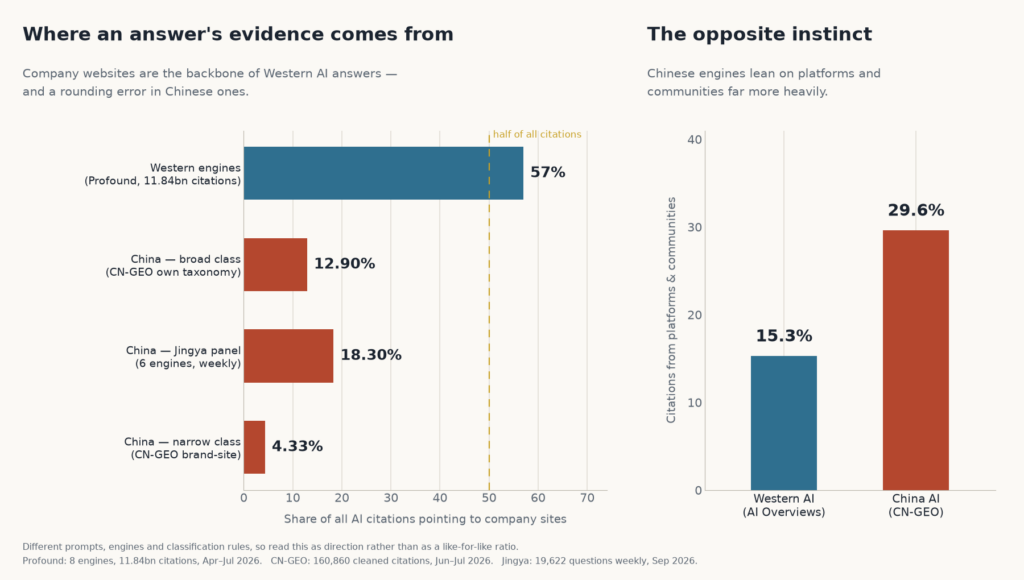
On the Western side, the answer is mostly companies. Profound classified 11.84 billion citations across eight engines between April and July 2026 and found that roughly 57% of them went to corporate and brand-owned properties — documentation, product pages, company blogs. ChatGPT leaned least on them at 47%; Gemini leaned hardest at 69%.
Now run the same question in China. The largest open dataset on Chinese generative search — 160,860 cleaned citations from eight platform interfaces, 614 queries, three replications each, gathered in June and July 2026 by researchers at Beijing’s Aidso Wendao institute — found brand and corporate sites made up 18.9% of the sources in the pool but captured only 4.33% of the citations actually used. Content platforms were 4.68% of sources and captured 29.63% of citations.
Read those two sentences again, because they’re doing a lot of work. In the West, a company’s own website is the backbone of the answer. In China, a company’s website is abundant and nearly ignored — present in the index, absent from the answer.
Why Baidu’s answers read like a house magazine
There is a mechanism behind that asymmetry, and it’s worth understanding precisely because it’s the thing most Western GEO advice gets wrong about China.
Baidu’s answer engine inherits Baidu’s search index. The index is twenty-plus years of accumulated preference for properties Baidu owns or hosts: Baijiahao (its own publishing arm), Baike (its encyclopedia), Zhidao (its Q&A), Wenku (its document library). When the model goes looking for something to cite, it finds those first, and it finds a lot of them.
How much? A June 2026 test by the GEO vendor MaxAEO ran 200 real user prompts across consumer goods, electronics, local services and B2B software through Baidu’s ERNIE Assistant and counted every cited source. Baijiahao came in at 38%. Zhidao 19%. Baike 14%. Wenku 8%. Add them up and Baidu-owned properties supplied about 79% of citations. The brand’s own website: 9%.
Treat that with the caution vendor research deserves — one month, one prompt set, one commercial interest in showing you that Baidu’s ecosystem is where the traffic is. Independent panels land all over the map: a Tencent Cloud developer community test of 45 fixed Chinese questions across 11 engines, collecting 7,317 citations, put ERNIE’s Baidu-ecosystem share at 22%. Other published estimates reach 44%. Nobody credible says the number is small.
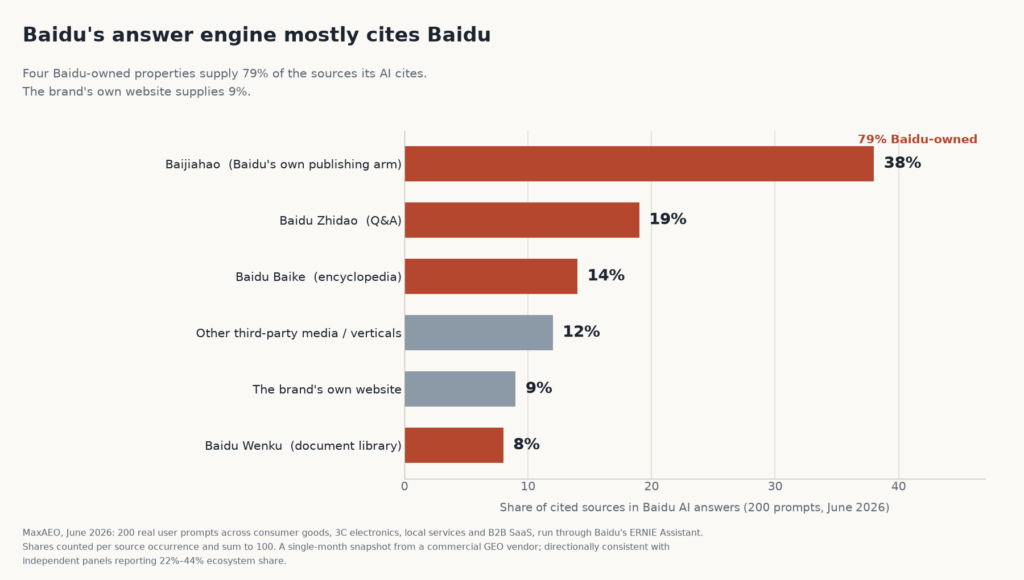
Now consider what that does to an answer. If four of every five sources are drawn from one company’s publishing network, the answer isn’t merely “Baidu-flavoured.” It is structurally inside a walled garden. A well-documented brand with a beautiful English-language site and zero Baijiahao presence is, for this engine, approximately invisible — not because it ranked badly, but because it never entered the conversation.
And there’s a second-order effect. That same CN-GEO study found that roughly 13% of brand mentions in answers couldn’t be matched to anything in the contemporaneous citation pool at all, and about 71% of contact-information mentions couldn’t be matched to the crawled page text. The model is sometimes naming things it did not cite. Which means the citation list is an incomplete confession, not a full accounting.
The same prompt, two different people
Regulation and platform ownership explain where the evidence comes from. They don’t fully explain something stranger: the same model, answering in a different language, behaves like a different person.
This is no longer anecdote. In June 2025, Nature Human Behaviour published a study by Jackson Lu, Lesley Song and Lu Doris Zhang — 100 English and 100 Chinese responses per task, more than 10,000 responses in total, tested on GPT and on Baidu’s ERNIE. Prompted in Chinese rather than English, both models shifted toward an interdependent social orientation and a holistic cognitive style: they explained a person’s behaviour by pointing at context rather than personality. Same model, same question, two different theories of why humans do things.
Then the finding that should worry every marketer: when the researchers asked the models to pick the most effective marketing slogan for a fictional startup, the recommendations changed — purely because the prompt language had changed. English prompts favoured slogans about individual wellbeing. Chinese prompts favoured slogans about collective wellbeing.
Here’s the trap. If you write one campaign in English, approve it, and translate it for China, you haven’t localised anything. You’ve let the English-language answer become the strategy, and then asked a model to render it in characters. The model will happily oblige, and the campaign will read as slightly off to everyone who actually lives there — the precise failure mode that no A/B test catches, because both versions were generated inside the same cultural frame.
Two honest caveats, because this study gets over-quoted. The models tested were snapshots — GPT-4-1106-preview and ERNIE-3.5 — that have since been superseded, and the published effect sizes aren’t visible in the secondary coverage, so treat the direction as solid and the magnitude as unsettled.
What the Chinese web simply doesn’t contain
The cultural layer is the polite explanation. The blunter one is that a great deal of Western web content does not exist on the Chinese side, and some Chinese content does not exist on the Western side, because the two jurisdictions enforce different content rules.
China’s generative AI rules have been explicit since August 2023. The Interim Measures for Generative AI Services require providers to uphold “socialist core values” and prohibit generating content that incites subversion of state power, endangers national security, damages the national image, or undermines national unity and social stability. In March 2025, four ministries added the labelling regime — the Measures for Labeling AI-Generated Synthetic Content, effective 1 September 2025, paired with mandatory national standard GB 45438-2025, requiring both visible labels and machine-readable metadata, with tampering or removal prohibited.
Whatever you think of that regime, its effect on retrieval is mechanical. A model cannot synthesise from sources it is not permitted to hold. Ask both markets about a contested historical event and you are not measuring two models’ reasoning; you are measuring two different libraries. Neither answer is “the objective one.” Both are products of a jurisdiction.
This is the part of the divergence that no optimisation strategy fixes, and it’s the part most cross-border marketing decks quietly skip. You cannot GEO your way into a corpus you were removed from. What you can do is know which questions are load-bearing for your category, and plan around the ones that are structurally unanswerable rather than pretending a content refresh will do it.
Where the divergence actually bites
Abstractions are cheap. Here’s where a brand feels it.
Category recommendations. A “best phone” answer is a shortlist, and shortlists are made of whatever the retrieval layer trusts. Chinese engines draw heavily on platform content and domestic review ecosystems; Western engines draw on editorial comparison sites and, increasingly, YouTube and Reddit. Different shelves, different winners. Your product can be the obvious choice in one market and simply not present in the other’s answer.
Brand facts. This is the one that should keep you up at night. If four-fifths of a Chinese engine’s citations come from one ecosystem, then your brand’s description in that market is written largely by whoever published about you there — a distributor, a marketplace listing, a reseller’s press release, a competitor’s comparison page. Precise, current, first-party facts may never surface. Meanwhile your Western answer is built from your own documentation and your review profile. Two different companies sharing your name.
How-to and cultural framing. Identical questions about marketing, hiring, or family finances get answered with local case studies and local authorities. That’s correct behaviour and it still produces two different realities for the same query.
Contested topics. The widest gap, and the least tractable. Regulation sets the boundary of the answerable.
The citation is the whole argument
Before you conclude that this is a fight over who gets mentioned, look at what a citation is actually worth.
Pew Research Center tracked the real browsing of 900 US adults through March 2025 — 68,879 distinct Google searches, 91,121 visits to results pages. Where an AI summary appeared, people clicked an ordinary result on 8% of visits. Where it didn’t, 15%. And the links cited inside the summary? Clicked on 1% of visits. Browsing sessions ended on 26% of summary pages versus 16% without one.
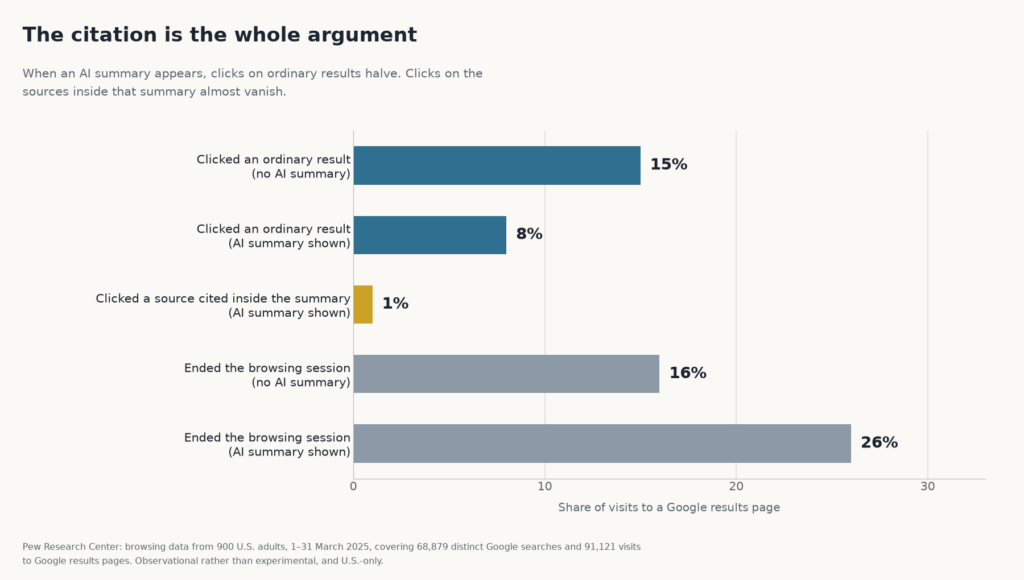
So the traffic value of being cited is close to zero, and the persuasive value is close to total. You are not buying visitors. You are buying the sentence that forms in someone’s head before they ever visit anything.
That reframes the whole exercise, and it also raises the stakes on accuracy. A study posted to arXiv in October 2026 tested how easily this system can be gamed: across 10 AI-search platforms and 17,211 citations, eight of ten platforms cited a fabricated concept within seven days of it being published on a preferred domain. A $14 GEO purchase produced 13 posts, and one platform cited the planted content within an hour. In a world where 1% of people check the sources, the cost of a poisoned citation is borne entirely by the reader.
Two footprints, not one
Now the practical consequence, stated plainly: you do not have an AI presence. You have two, and they are unrelated.
Your Western footprint is built from your own documentation, your third-party reviews, your YouTube and Reddit presence, and the trade press. Your Chinese footprint is built from Baijiahao, Baike, Zhidao, WeChat Official Accounts, and whichever domestic platforms your category lives on. These are not the same assets translated. They are different assets entirely, on different domains, with different editorial gatekeepers.
Which produces four uncomfortable conclusions.
One. A single global GEO strategy is not a strategy. It’s one market’s strategy with a second market’s budget attached.
Two. The authority graph you’re optimising for differs by market. In the West, that means first-party documentation and earned editorial — being the best-sourced version of your own facts. In China, it means ecosystem density: a verified Baike entry, a sustained Baijiahao cadence, Zhidao answers that actually address buyer questions. A brand with a superb English site and no Chinese ecosystem presence has done half the job and will be told so by the answer engine, bluntly and in public.
Three. Audit both, separately, and expect different failures. Run your real buyer questions through Google and Bing and through Baidu and the major Chinese assistants. Record whether you were mentioned and whether you were cited — they are different outcomes with different fixes. Which brings us to the sharpest finding in the whole literature.
Four. Citation breadth and citation influence are not the same thing. A 2026 arXiv study of 602 prompts and 21,143 citations across ChatGPT, Google and Perplexity found the platforms behave almost inversely. ChatGPT cited the fewest sources per prompt — 6.88, against Google’s 12.06 and Perplexity’s 16.35 — yet its average per-source influence score was roughly four times theirs. Fewer chairs, but sitting in one of them actually shapes the answer. Gemini 3’s arrival pushed AI Overviews the other way: sources per answer rose from 11.55 to 15.22, and 42.4% of previously cited domains lost their place. Meanwhile Ahrefs found the share of AI Overview citations coming from top-10 organic results collapsed from 76% in July 2025 to about 38% by March 2026.
The lesson: being listed is cheap and unstable. Being absorbed is the asset. And a citation that vanishes next quarter because a model was retrained was never an asset at all.
What nobody can actually prove yet
Here is where I have to be more careful than most articles on this topic, because the honest answer is uncomfortable: there is no large-scale peer-reviewed study directly comparing the content of AI answers to identical questions across Chinese and Western systems in commercial categories. Not one I could find.
What exists is adjacent. There are rigorous cross-lingual health-communication studies — the Journal of Medical Internet Research published a bilingual evaluation of consumer health answers in English and Chinese in 2026, and Intelligent Medicine ran a cross-sectional comparison of US- and China-developed models on coronary heart disease patient education in 2025. Those are real, and they consistently find meaningful divergence. But they’re medicine, not marketing. The Lu et al. slogan finding is the closest thing to a commercial result, and it’s a cultural-psychology experiment rather than a market study.
So the argument in this piece rests on three legs, and you should know which is which. The source composition leg is measured — billions of citations, open datasets, replicable. The cultural tendency leg is peer-reviewed but based on superseded model snapshots. The answer divergence leg is, for commercial queries, inferred rather than demonstrated.
That gap is itself the story. We have built an entire discipline — GEO — on top of a system whose output differences we have barely measured. The instrument is running. The calibration is missing.
How to actually run both markets
If you’re operating in both, here’s what survives the uncertainty.
Map questions, not keywords. Take forty real questions your buyers ask, in each language, written the way people actually type them. Run them through both engines monthly. Log mentioned and cited as separate columns — the gap tells you which problem you have. Mentioned but never cited means you’re renting visibility from someone else’s page. Cited but never mentioned means you’re doing free research for a competitor’s slot.
Build the ecosystem you can’t publish yourself into. In the West that means documentation good enough to be the best available evidence, plus reviews and communities you don’t control. In China it means the platform layer: a complete, verifiable Baike entry; a Baijiahao cadence aimed at buyer questions rather than company announcements; Zhidao answers with actual substance.
Write for extraction, not for reading. Answers are assembled from passages. One claim per paragraph. Real numbers, in tables. Self-contained sections that make sense lifted out of context. Definitions and comparisons early, because those are the genres models lift.
Stop translating your strategy. Generate the Chinese campaign from a Chinese brief, with the model prompted into the local frame, then review it with someone who lives there. Translating an approved English strategy is how you end up with a campaign that is grammatically flawless and culturally mute.
Accept the questions you can’t win. Some queries are unanswerable in one market for reasons no content plan touches. Knowing which ones is worth more than a quarterly report that pretends otherwise.
The takeaway
AI search was sold to us as a unifier. One answer, objectively sourced, for everyone.
What we got is an amplifier. It takes the pre-existing gap between two internets — different owners, different libraries, different laws about what may be said — and it automates it, at a speed and a scale no search engine ever managed. The same question now produces two coherent, confident, well-cited answers that disagree, and almost nobody clicks through to check.
For a marketer, that’s not a reason to despair. It’s a reason to be precise. Two footprints. Two authority graphs. Two audits. Two content programs sharing a single fact base. The brands that run both will be described accurately in both. The brands that assume one answer travels will discover, eventually, that they have been quietly rewritten in the market they never checked.