Why the CMO Title Vanished but “Growth” Didn’t
Two rebrands, a decade apart, aimed at the same problem. One is now being deleted from America’s largest companies at a rate that should alarm anyone who holds the title. The other quietly built a four-study empirical record showing it improves firm performance. The difference between them is not creativity, not timing, and certainly not which one had the better name.
Read the two side by side and a rule falls out of the comparison. A rename that changes vocabulary gets absorbed. A rename that changes accountability gets funded.
The CMO rebrand changed nothing structural
Start with the strange arithmetic. Forrester’s third annual Fortune 500 analysis, published in July 2026, found the CMO title in use at 36 per cent of companies — down from 49 per cent the year before. That is more than a quarter of the title’s remaining presence gone in twelve months. Marketing leaders on the executive team or reporting to the CEO fell to 52 per cent, the third consecutive decline.
Set that against the C-suite’s other officers. General counsel report directly to the CEO 77 per cent of the time, up from 64 per cent in 2018. CIOs report directly 65 per cent of the time, up from roughly 41 per cent a decade ago. Marketing is the only function whose line to the CEO got longer while everyone else’s got shorter.
Here is what makes that damning rather than merely sad. Nothing about the CMO title ever promised a structural change. It promised a description — “the person who owns the brand and the funnel” — and descriptions are free. When a CEO cannot get a clean read on what brand spend returns but can get an immaculate read on what revenue returns, folding marketing under whoever owns revenue costs the CEO nothing and settles the argument on paper. A vocabulary-only rebrand has no defence against that move, because it never took anything away from anybody.
The growth rebrand took something away from somebody
Now the contrast, and it is sharper than I expected when I went looking.
A 2025 Journal of Marketing paper by Atefi, Hohenberg, Janani and Zhou did something nobody had done: it treated the growth department as an object of study rather than a buzzword. Job-ad text mining across functions, twenty interviews with chief growth officers, then two quantitative tests. In startups, drawing on 1,256 Crunchbase observations, firms that hired a growth leader in 2017 advanced through more funding rounds during that leader’s tenure than firms hiring a marketing or a sales leader — and the growth leaders were, if anything, less experienced, which weakens the obvious objection. In public firms, a powerful growth department was associated with higher Tobin’s Q, better return on assets and stronger cash flow.
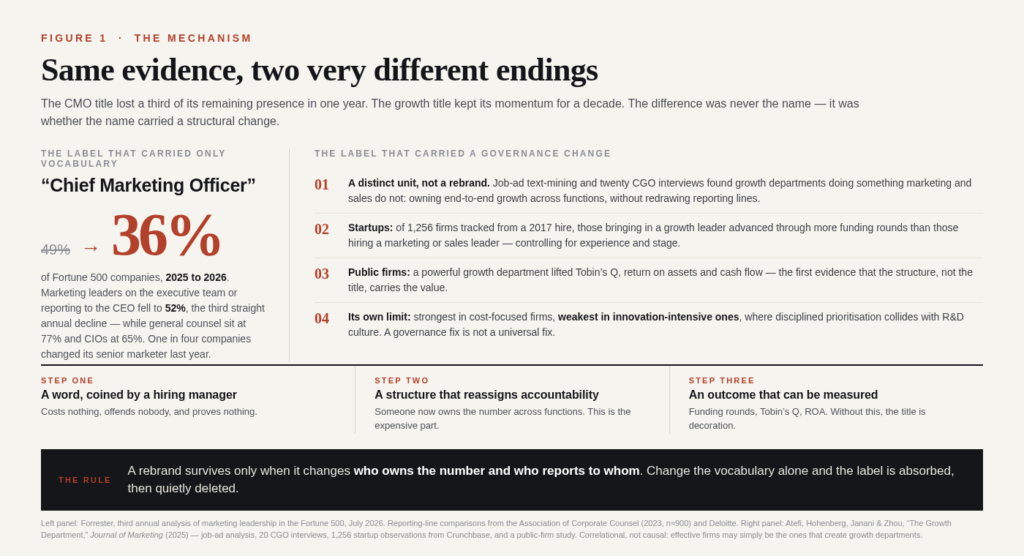
Notice what the qualitative half of that study found. Growth departments are distinct from marketing and sales, and they operate by orchestrating across functions without redrawing reporting lines. That is the mechanism. The label arrived attached to a reassignment of who answers for the number, which meant somebody lost territory when it was adopted. Structural changes generate resistance, and resistance is what makes a change real.
One caveat worth stating plainly: this is correlational. Effective firms may simply be the ones that create growth departments. And the effect has a boundary — it is strongest in cost-focused firms and weakest in innovation-intensive ones, where disciplined prioritisation fights R&D culture. No governance fix is universal.
The test for the next label
So when the next title arrives — and something with “agent” in it is already on the way — the question is not whether the name is good. It is whether anyone loses a decision. If the answer is nobody, you are watching a vocabulary event, and vocabulary events get absorbed, then deleted, then forgotten. The growth label earned a decade because it moved a number from one person’s scorecard to another’s. The CMO label is being deleted because it never moved anything except the wording on a door.
Ask which one you are being sold. Most of the time, it is the door.