Why the Demo Call Survived Its Own Obsolescence
The number worth staring at isn’t 67. It’s 61.
67% of B2B buyers told Gartner in 2026 that they prefer a rep-free buying experience. That figure gets quoted in every deck. The one that actually explains the demo call’s stubborn survival is quieter: 61% of roughly 5,000 B2B SaaS websites still lead with “Book a Demo” as their primary call to action. Only 18% offer an interactive demo.
Buyers say they don’t want the meeting. Vendors keep selling the meeting. Both are behaving rationally — which means the meeting is doing a job nobody has bothered to name.
The Demo Was Never an Information Product
6sense’s 2025 survey of more than 4,000 buyers found that 94% had already ranked their preferred vendors before contacting a seller, and 77% eventually bought from the vendor they had ranked first.
If a demo were an information exchange, that behaviour would be irrational. You do not need a thirty-minute walkthrough of a product you have already chosen. But the buyer isn’t purchasing information. They’re purchasing a signature.
The modern deal runs through 13 internal stakeholders and nine external influencers, with procurement sitting as a decision-maker in 53% of cycles, according to Forrester. Now think about what that demands of the champion — the one person inside the company who has to stand up in a room and say this is the right choice. If it fails, whose fault is it?
A demo call answers that question. The rep saying “yes, it does what you need” is a name attached to a claim. That’s transferable. The champion can carry it into the committee, and the committee can accept it without having to trust a stranger’s judgment.
An agent can answer faster, more precisely, at 2 a.m., drawing on better sources. What it cannot produce is a name. That’s the real ceiling — and it isn’t a capability ceiling. It’s an accountability one.
The Ladder Is a Liability Curve
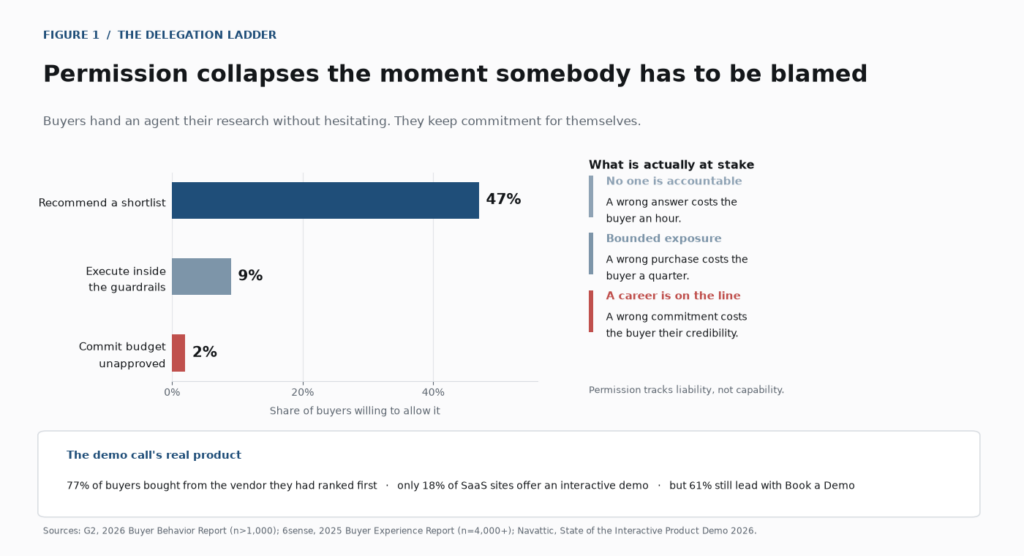
Look again at what buyers will actually delegate. 47% would let an agent recommend a shortlist. 9% would let it execute a purchase inside pre-approved guardrails. 2% would let it commit budget without asking first.
That collapse gets read as trust accumulating slowly. It isn’t. It tracks what happens to the buyer when the answer is wrong. A bad recommendation costs an hour. A bad execution costs a quarter. A bad commitment costs a career.
Which is also the correct way to read the near-even split in Gartner’s data — 51% of buyers saying they’re more likely to hit misleading information from generative AI, 49% saying the same about sales reps. That is not a technical verdict on accuracy. It’s a statement about who absorbs the consequence.
What This Means If You Sell Software
Stop building the agent to be impressive. Build it to be quotable — every claim traceable to a document the buyer can forward to their security team without editing it first.
Then protect the handoff, because it’s where the value sits. The human’s job is no longer explaining the product. It’s being the name on the decision. If an agent has spent forty minutes learning exactly what the buyer cares about and your rep opens with “so tell me about your business,” you have automated the cheap half and broken the expensive one.
The demo call survived for one reason: it sold insurance, not information. Automate the information. Don’t pretend you’ve automated the insurance.