The Ceiling Behind AI Sentiment Analysis: Accuracy Was Never the Model’s Problem
Every vendor in this category sells accuracy. “94% accurate.” “Outperforms human raters.” It sounds like a hardware question — get a bigger model, get a better number.
Then you read the paper that set the framework for how anyone should think about this, and the whole framing falls apart. The limiting factor on AI sentiment analysis was never the model. It is how much the humans disagree with each other.
The study that nobody in marketing quotes
In 2016, three researchers at the Jožef Stefan Institute in Ljubljana did something unglamorous: they hired 83 native speakers to hand-label 1.6 million tweets across 13 European languages, a job that consumed an estimated 38 person-months. Then they trained six classifiers on that data and asked a simple question.
Does machine performance depend on the algorithm? Or on the labels?
The answer was blunt. The quality of the classifier depended much more on the quality and size of the training data than on the type of model trained, and there was no statistically significant difference between the top classifiers. Meanwhile the human labels weren’t clean either. When the team duplicated about 15% of tweets to be labelled twice — by the same person, and by different people — they found self-agreement (one person against themselves) consistently higher than inter-annotator agreement (two people against each other).
Which means the disagreement isn’t just vocabulary. The same person, reading the same tweet twice, reaches different conclusions. And the paper’s central hypothesis, stated plainly, is that inter-annotator agreement provides an upper bound for classifier performance.
Where the numbers actually land
Look at the four datasets where both a human agreement score and a classifier score exist.
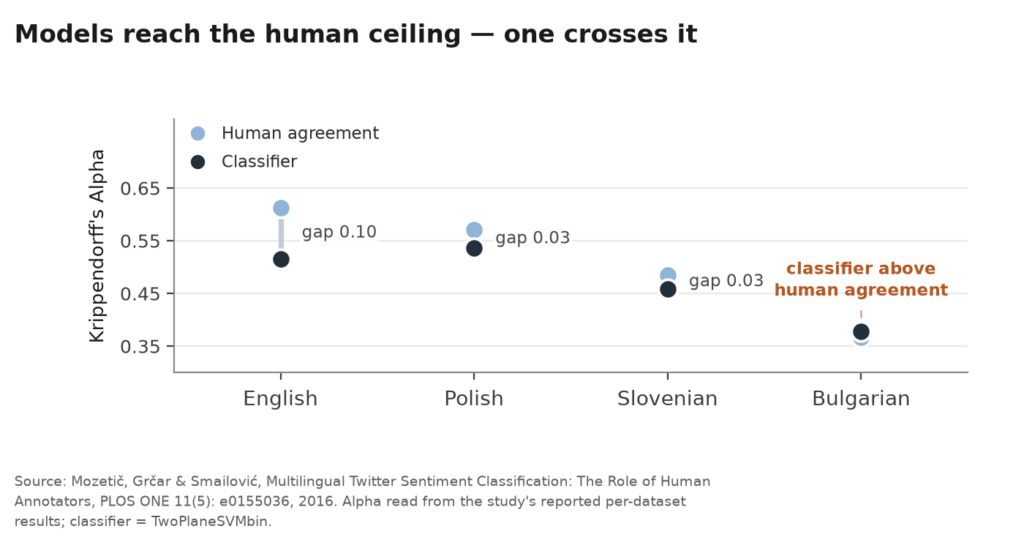
English is the most instructive case. Human agreement sits at 0.613. The classifier reaches 0.516 — and the authors note the gap is 0.097, still open even with roughly 90,000 labelled tweets thrown at it.
Polish closes almost all of it: 0.571 human, 0.536 model. Then something interesting happens. The classifier peaks at about 150,000 labelled tweets and after that stops improving, even dips slightly. The authors draw the obvious conclusion — past the point where the model is “close enough” to human agreement, labelling more tweets is wasted money.
The case that breaks the story, and proves it
Bulgarian is where this gets genuinely strange. Human agreement is 0.367. The classifier hits 0.378. The model is above the human ceiling.
That sounds like a triumph. The authors treat it as a warning instead. Their rule of thumb is explicit: when Alpha falls below 0.4, the inter-annotator agreement is too low to be a reliable estimate of task difficulty at all. Low agreement doesn’t mean the task is hard. It can mean the annotators were bad, or the guideline was ambiguous, or the categories didn’t fit the language.
So the ceiling isn’t a property of human cognition. It’s a property of your labelling operation. And that is the part almost nobody wants to hear, because it reframes an engineering problem as an operational one.
Why this should change how you buy
Three consequences, and they’re not subtle.
Your “94% accuracy” number has no referent. Accuracy against what? One annotator’s opinion? A majority vote of three underpaid crowd workers? A taxonomy with four overlapping negative codes? The paper’s whole point is that these produce different ceilings. A vendor quoting accuracy without disclosing the labelling protocol is quoting a number that measures their test set, not your customers.
More data stops helping at a specific point. Polish found it at 150,000 tweets. You will find yours earlier, because your taxonomy is probably narrower. The moment marginal return hits zero, additional annotation spend is pure waste — and nobody in the procurement chain will tell you.
Sarcasm is not a model failure. It is a definition failure. This is where the two threads connect. SARC, the standard sarcasm benchmark, is self-annotated — labels come from the author declaring their own comment sarcastic, not from independent raters. So the ground truth is one person’s introspection. When a model scores 0.57 against it, you are not measuring how well machines understand sarcasm. You are measuring how well they reproduce one stranger’s self-report.
What this actually means for a marketing team
The practical implication is smaller and stranger than “buy a better model.”
Spend your effort on the label definition, not the model selection. Write down what “negative” means for your brand, in your category, in each market, with examples of edge cases. Then measure how often two of your own people disagree on 200 items. That number is your real ceiling. It is also the only number that will tell you whether your dashboard is measuring customers or measuring noise.
And when a model matches your human agreement, stop. That’s not underperformance. That’s the top.