The Incentive Behind the 44%: What AI Matchmaking Optimises, and What It Costs
Two numbers from the same twelve months should not both be true.
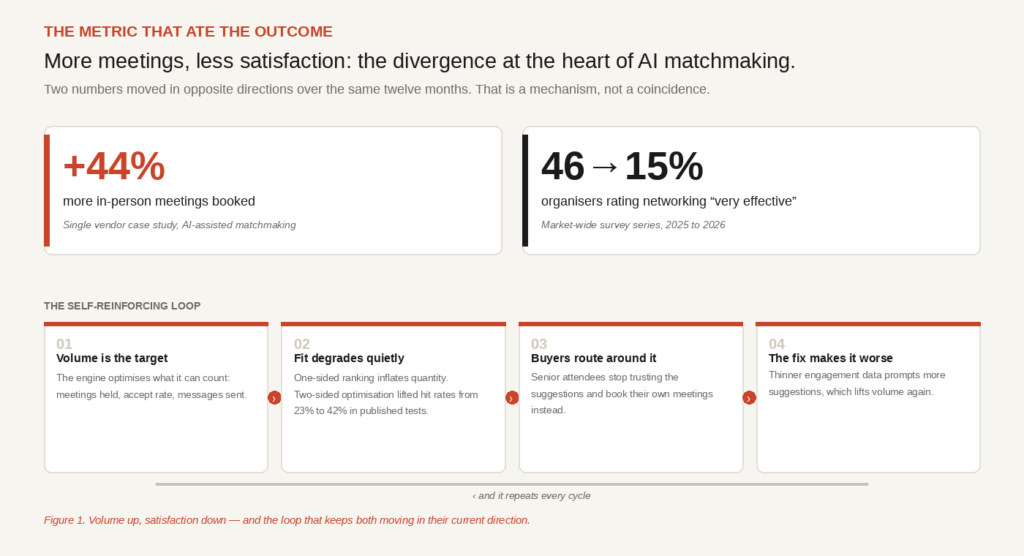
A hosted-buyer programme rebuilt around AI-assisted matchmaking reported a 44% year-on-year rise in in-person meetings: 195 booked against a target of 135. In the same period, the share of organisers rating their own networking as “very effective” fell from 46% to 15%. Volume rose. Confidence collapsed.
Vendors explain the first number. Nobody explains the second, because it is the awkward one. Yet they are not contradictory. They are one mechanism seen from two positions.
Meetings are the metric the machine can see
Ask what a matchmaking engine optimises and the honest answer is: whatever produces a clean number. Meetings held is clean. Accept rate is clean.
Fit is not. Fit is whether two people should spend forty minutes together, and that does not resolve into a count. So between a metric that reports neatly and a quality that does not, volume wins the internal argument every time. Not because anyone decided quality did not matter, but because volume is what can be measured on a Monday morning.
Once volume is the target, quantity rises almost by definition. The 44% is not a lie. It measures the thing being optimised.
Why fit has to fall
Reciprocal recommendation, meaning matches where both parties must independently agree, has a consistent finding: optimising one side’s preferences overstates match quality. Pizzato and colleagues showed it in 2010, lifting top-10 success from 23% to 42% by modelling reciprocity. Kleinerman’s team tested a two-sided approach with 1,204 participants and found gains of the same bounded shape.
Read that again. Doubling the hit rate from 23% still leaves two-thirds of suggestions missing. A system ignoring reciprocity does worse while confidently producing more introductions. Volume rises, quality falls, and because each attendee gets more suggestions at a lower hit rate, the product feels worse even as usage grows.
Buyers route around it
Almost nobody models what senior attendees do when suggestions stop being useful.
They do not complain. They quietly revert, checking the agenda in the app and then arranging meetings by message or through a colleague. The system logs the meeting as booked, but not as system-assisted. Attribution looks healthy while matching migrates back to humans.
That is why satisfaction falls as meeting counts rise. The attendees least tolerant of a wasted half-hour defect first. Those still accepting every suggestion have the most time and the least leverage. The average meeting then looks fine on paper and disappointing in the diary.
The loop that keeps it stuck
Volume is the target, so more suggestions are generated. More suggestions at lower fit mean senior buyers disengage. Disengagement thins the behavioural signal. Thinner signal means the engine defaults to broader, safer, higher-volume suggestions. The loop closes in the wrong direction: every remedy that raises output deepens the input problem.
Which is why the fix is not a better algorithm. It is a decision about what the system may call success. Until an intent field is mandatory, honest and connected to the CRM, the richest signal available to any engine is not being collected.
The uncomfortable conclusion
The 44% and the 15% describe the same programme. One measures output; the other measures whether the output was worth having. Both are accurate. Only one predicts whether anyone books again.
So ask what the demo will not answer: what does this system do when the best outcome for an attendee is fewer meetings, better chosen? If it cannot express that, the ceiling is not in the model. It is in the metric.