The Incentives Behind Why Agent Checkout Stalled
There is one number that explains this entire story, and it is not a forecast.
Forrester’s Emily Pfeiffer put the count of Shopify merchants actually completing transactions through in-chat checkout at roughly thirty as of February 2026. Not thirty thousand. Thirty. Against a public pipeline routinely described as over a million connected merchants.
Thirty is not a channel. It is a pilot someone forgot to end.
The stated reason is wrong
The polite explanation is that agents were not ready — hallucinated prices, wrong variants, phantom stock. Convenient, and mostly true. But it does not explain why the retreat happened at the checkout specifically, when the same agents were demonstrably good at discovery. Search-side shopping answers kept improving all year.
The real reason is that the parties responsible for closing the sale had a much better option available to them, and it was further upstream.
Follow the cost of being the cashier
Whoever completes the transaction inherits the unglamorous half of commerce: fraud and chargeback liability, sales tax and VAT remittance across jurisdictions, returns, disputes, post-purchase service. Owning checkout means owning the parcel that goes missing.
Now look at what each party actually did. Google built an entire protocol whose most-quoted FAQ line is that you remain the Merchant of Record for all transactions. You retain full ownership of your customer relationships, data, and the post-purchase experience. That is not a technical constraint. That is a positioning decision, stated plainly in official documentation, and it tells you exactly what Google wanted: the discovery surface, not the liability.
OpenAI went further and simply stepped back, narrowing in-chat checkout in early 2026 toward product discovery with merchant-led completion. It did not lose the war for the checkout button. It looked at the margin and declined it.
The asset worth defending is not the cart
Follow the same logic to Amazon and things get sharper. Advertising brought in $68.6 billion in 2025, up 22%, and functions as the company’s profit engine — far higher-margin than retail. Every one of those dollars depends on a human eye landing on a rendered page. An agent that reads the catalogue, compares on facts, and skips the placements does not just compete with Amazon’s storefront; it quietly deletes a line item.
That is why the response was a block, not a build. Meta’s shopping agent was cut off. A competitor’s browser went to litigation. When an incumbent blocks a rival’s agent instead of copying it, you have stopped watching a technology debate and started watching a revenue defence.
Which suggests the shortlist — not the checkout — is the real contested ground. Being chosen for five options is worth more than being the button someone presses, because the shortlist decides which brands are still in the room when the human looks up.
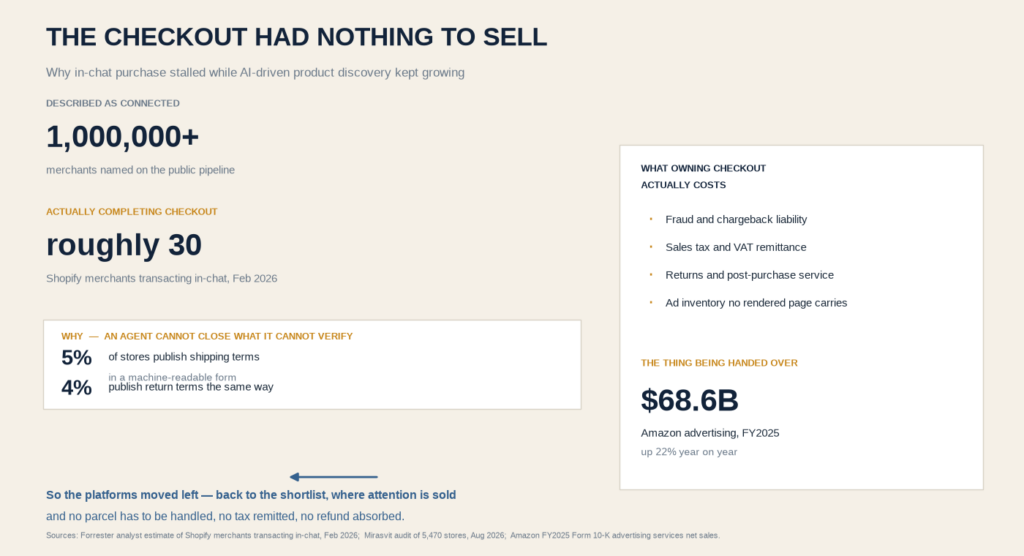
The uncomfortable implication for brands is that the gate that decides their quarter was never the button. It is the data that determines whether a machine can put them on the list in the first place. The platforms moved their investment left, toward the shortlist, for reasons that are entirely rational from where they sit. Brands that keep optimising for the moment of purchase are optimising for a screen that increasingly nobody sees.