AI Can Keep the Member. It Can’t Make Them Belong.
The machine can learn everything about a member and still never make her feel like one. That is not a failure of the model. It is the model working exactly as instructed.
1. A Tuesday Inbox
Open a member’s inbox on a Tuesday. Three emails, one push, a banner that follows her across four sites.
One of them is, statistically, well aimed. The subject line has her first name. The offer matches her last purchase. The send time matches her last click. Somebody’s model did its job.
And still, the feeling she gets is not recognition. It is attention — the specific, slightly uncomfortable attention of being tracked. She is known the way a vending machine knows her: by her coins.
That gap between being accurately targeted and being genuinely known is where AI-powered loyalty has quietly parked itself. Not failing. Plateauing.
Here is the argument in one line: AI wins the operational floor of loyalty and cannot buy the emotional ceiling, and most programs have spent five years mistaking the first for the second.
2. What AI Loyalty Actually Delivers
Start with credit where it is due, because the operational layer is real and it works.
Antavo’s Global Customer Loyalty Report 2025 — 2,600 executives, 10,000 consumers, 230 million member interactions — found 83% of program owners reporting positive ROI, with an average of 5.2x. Churn models are no longer toys either: a 2025 peer-reviewed study in Scientific Reports built a telecom churn model that reached 95.1% accuracy and an AUC of 0.89 on held-out data, and found customer-service calls among the strongest predictors of defection.
That last detail is the useful one. What predicts churn is not taste or preference or “sentiment”. It is friction. Four calls to support and the customer is halfway out the door. AI spots the pattern earlier than any human team could, and that is a genuine, bankable win.
So the machine is good at three things: making redemption frictionless, aiming an offer at the moment it might land, and catching the member who is about to leave. Call it the operational floor. It is measurable, it compounds, and it is worth paying for.
3. The Ceiling Shows Up in the Data
Now the uncomfortable part. If personalization worked the way the decks say, satisfaction should be climbing. It is not.
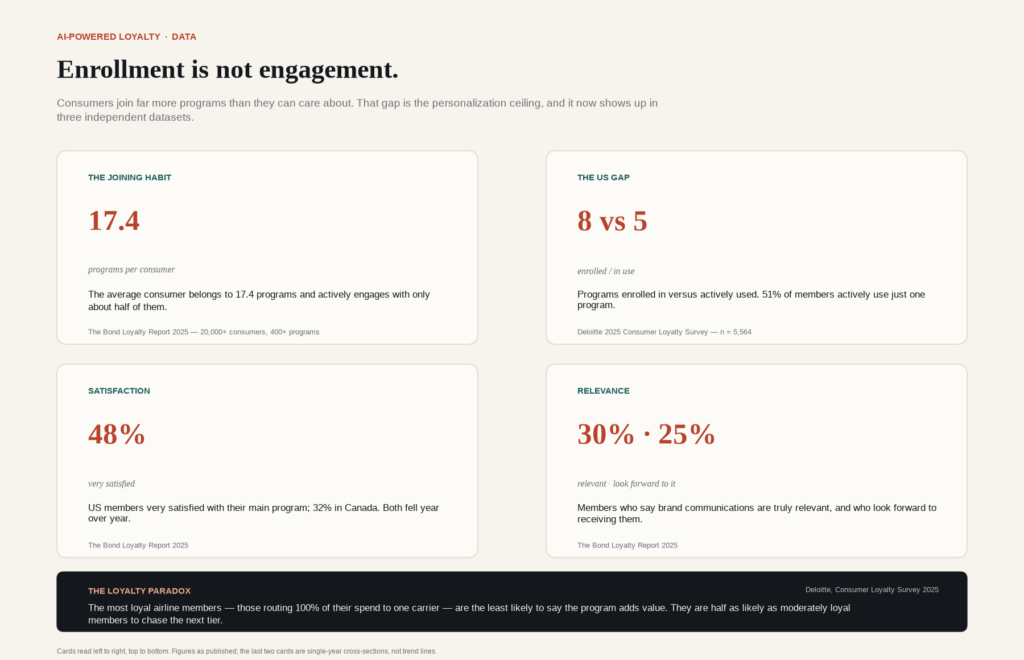
Bond’s 2025 Loyalty Report — 20,000+ consumers, 400+ programs, 20+ sectors, 7 billion transactions analyzed — found members enrolled in 17.4 programs and actively engaged with about half. Only 48% of Americans and 32% of Canadians described themselves as very satisfied with their main program, and that share fell year over year. Just 30% said brand communications are truly relevant. Only 25% looked forward to receiving them.
Deloitte’s 2025 Consumer Loyalty Program Survey, 5,564 US adults, tells the same story from a different angle: eight programs enrolled, five actively used, and 51% of members actively using exactly one program in a given industry.
Read the two datasets together and a pattern appears. Purchase behavior is being shaped: 72% of Deloitte respondents say a program makes them more likely to spend, 56% say it increases what they spend. But the relationship is not deepening. Members are buying more and caring the same amount, or less.
4. The Most Loyal Members Are the Least Convinced
The sharpest evidence comes from airlines, where a loyalty program is the business rather than a marketing annex.
In the same Deloitte survey, the most loyal flyers — the ones routing 100% of their annual airline spend to a single carrier — were the least likely to say the program adds value. They were also half as likely as moderately loyal members to chase the next tier.
Sit with that. The people with the deepest behavioral loyalty report the shallowest emotional return. They keep flying. They have stopped expecting the program to matter.
That is what a ceiling looks like in a survey: not anger, not churn, just quiet indifference from the people you can least afford to lose.
5. Why Personalization Plateaus: A Category Error
The industry’s habit is to treat this as a data problem — more signals, better models, cleaner identity resolution — and to assume the curve will bend upward again.
It won’t, and the reason is structural rather than technical.
Loyalty is a relationship. A points balance is a transaction ledger. AI was pointed at the second one, because the second one is measurable. So it optimizes what it can see: the next purchase, the next redemption, the next discount that clears the hurdle rate.
McKinsey’s consumer research found 71% of people expect personalized interactions and 76% get frustrated when they don’t happen. Personalization at scale is worth roughly 10–15% revenue lift by the firm’s own estimate. Note what that number is: revenue. Not depth of relationship. Not willingness to forgive a mistake. Not the decision to stay when a competitor is 8% cheaper.
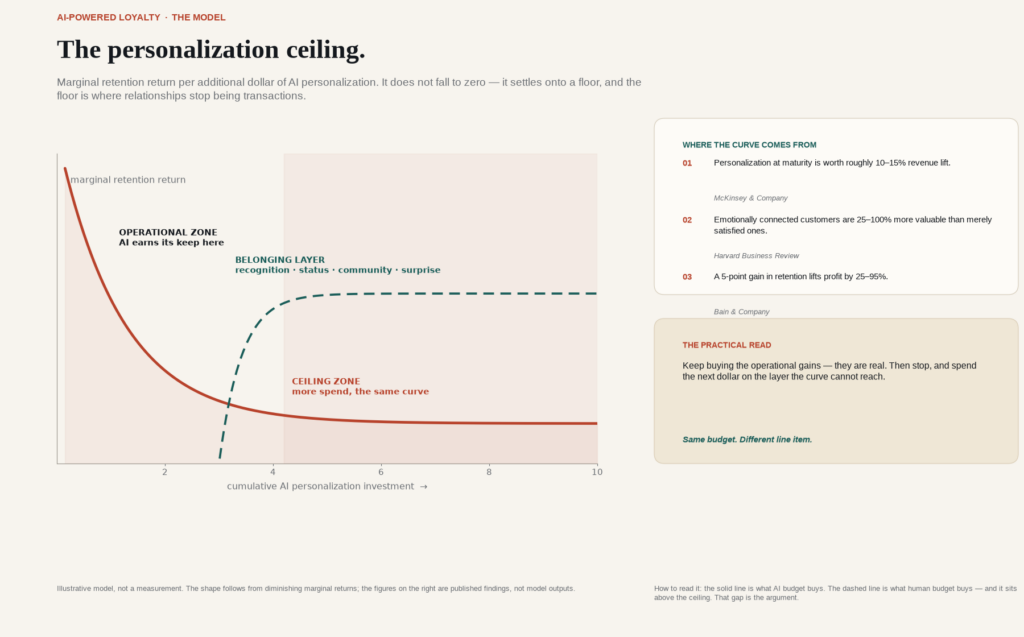
Then set it beside the older finding that keeps refusing to go away. Harvard Business Review’s research across hundreds of brands found emotionally connected customers are 25–100% more valuable than merely highly satisfied ones — more than twice as valuable on a lifetime basis. In one brokerage study, emotionally connected clients were six times more likely to consolidate assets with the firm. In one apparel case, lifting emotional connection from 21% to 26% of customers cut attrition from 37% to 33%, raised advocacy from 24% to 30%, added 15% more active customers, and increased the rate of same-store sales growth by more than half.
Both numbers are true. That is the whole problem. The 10–15% is available to anyone with a decent CDP and a patient CFO. The 2x is not on the price list.
6. Three Mechanisms That Flatten the Curve
Why does more personalization stop producing more loyalty? Three mechanisms, each visible in current data.
One: inference without warmth reads as surveillance. Salesforce’s State of the AI Connected Customer, drawn from more than 16,500 consumers and business buyers across 18 countries, found that 73% now feel treated as individuals rather than numbers — up from 39% in 2023. Real progress. But only 49% believe companies use their data in ways that benefit them, down from 60% in 2022. 71% say they are more protective of their personal information than a year ago, and 64% call companies reckless with customer data. Trust in ethical AI use fell from 58% to 42%.
So the same period that produced the biggest jump in perceived personalization produced the biggest drop in perceived trust. Members can tell they are being modeled. What they cannot tell is whether anyone cares.
Two: you are training members to wait. Incentives have a shorter half-life than most loyalty teams assume. A 2024 study from UNLV, published in the Gaming Research & Review Journal, cut free-play allocations by up to two-thirds and found no measurable decline in visit frequency or spend per visit. Only removing the reward entirely moved behavior, and only by about 20%.
Read that again: two-thirds of the money was doing nothing. That is the shape of a mature incentive program, and it is the shape most loyalty budgets are in.
Three: the AI-authorship effect. This one bites hardest, because it attacks the exact asset loyalty is supposed to build. In seven preregistered experiments published in the Journal of Business Research in 2025, consumers who believed an emotional marketing message was written by an AI rather than a human reported lower positive word of mouth and lower loyalty. The researchers traced it to two mediators: perceived authenticity, and something they call moral disgust.
The finding is narrow, and worth stating precisely. The effect faded for factual messages, faded when AI only edited rather than wrote, and reversed when the content was understood as reused. But it held, robustly, for the thing loyalty programs send most: warm, personal, emotional copy.
7. The Difference Between Known and Processed
There is a version of this argument that gets misread as technophobia, so let’s be clear about what is and isn’t being claimed.
Nobody is saying the data is useless. Members will trade it — Deloitte found 89% of Gen Z and 87% of millennials willing to share personal information for tailored offers, against 64% of baby boomers. And 51% of Gen Z and 53% of millennials say they would spend more at a brand offering a personalized experience, against 38% of Gen X and 19% of boomers.
The claim is narrower and nastier: personalization is a format for attention, not proof of it. A perfectly targeted offer still says “you are a wallet”. That is why the same members who reward personalization with more spending can simultaneously report that the program adds no value. Both responses are rational. They are answering different questions.
Being known produces loyalty. Being processed produces convenience. Convenience is worth money, and it is not the same money.
8. What Breaks Through: The Belonging Layer
If the ceiling is real, the strategic question changes. It stops being “how do we personalize more?” and becomes “what does personalization fail to buy, and who is going to buy it?”
Five levers. One division of labor.
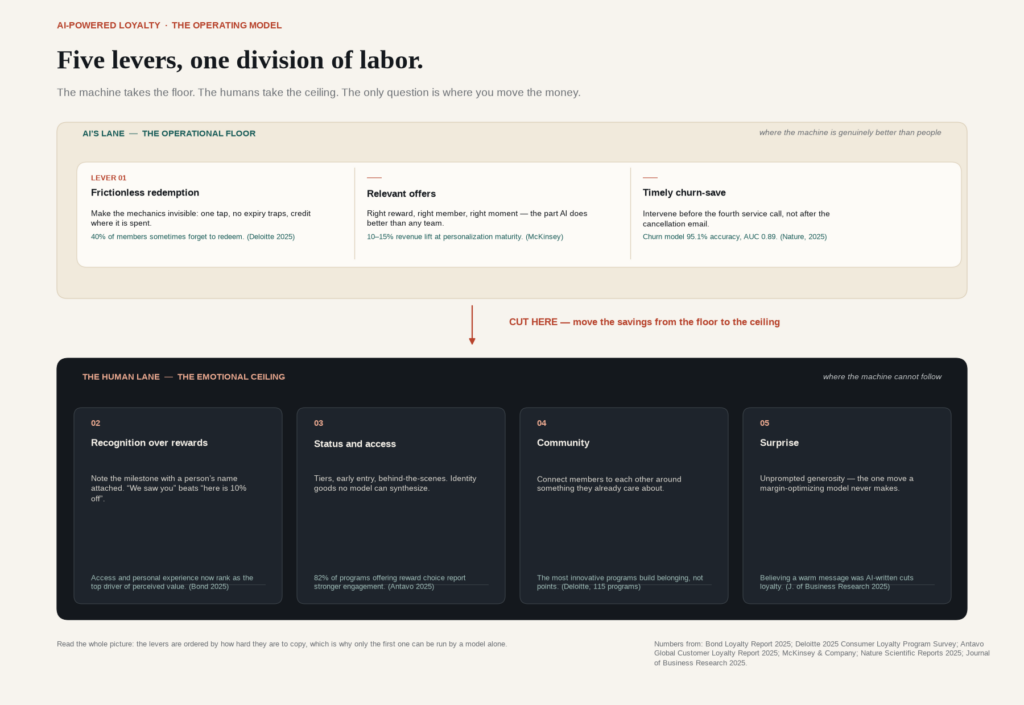
Lever 1 — Operational loyalty: give the machine the friction. Redemption in one tap. Offers that arrive at a plausible moment. A save-intervention when the support queue hits four calls. This is the only one of the five levers AI can run alone, and it is also the cheapest. Deloitte’s finding that 40% of members sometimes forget to redeem is not a generosity problem, it is a friction problem — and friction is exactly what a model can fix.
Lever 2 — Recognition over rewards. Note the milestone with a person’s name attached to it. “We saw you” beats “here is 10% off”, and it beats it at a fraction of the margin cost. Recognition is the one currency that gets more valuable the more specifically it is spent.
Lever 3 — Status and access. Tiers, early entry, the room behind the room. Bond’s 2025 data marks a genuine inflection point here: for the first time in a long while, special access and personal experiences overtook financial value as the top driver of perceived value. Members are not asking for bigger discounts. They are asking to be let inside.
Lever 4 — Community. Connect members to each other around something they already care about — the running club, the repair forum, the studio critique — and the relationship stops routing exclusively through your brand. Deloitte’s study of 115 loyalty programs across 15 industries found the most experimental ones building exactly this: ecosystems, recognition moments, and belonging.
Lever 5 — Surprise. Unprompted generosity: the upgrade nobody earned, the note nobody scheduled. It is the one move a margin-optimizing model never makes, because it cannot price the return. That is not a defect of the tactic. It is the entire mechanism.
9. Where the Money Should Move
The arithmetic is less exotic than it sounds.
Bain & Company’s classic retention research — Frederick Reichheld’s work, the same body of work that produced Net Promoter — found that a five-point gain in retention lifts profit by 25% to 95%, depending on industry. Small input, huge output, but only when the retained customer is retained for a reason other than the coupon.
Which gives you a clean test for every line item in next year’s loyalty budget: does this dollar make the relationship harder to leave, or does it make the discount easier to send? The first is an investment. The second is a subscription to your own churn.
There is a budget reality check, too. Gartner’s 2026 Market Guide for Loyalty Program Vendors put average spending on loyalty program management at just 4.3% of the marketing budget, down 22% year over year, with CMOs shifting money toward demand generation. Read that as pressure: the personalization build-out has to pay for itself now, and it will not pay for itself by getting 3% better at targeting.
10. How to Measure a Ceiling You Cannot See
Ceilings persist because dashboards are built from the things AI can move. Redemption rate. Email click-through. Churn probability. All operational, all flattering, none of them a measure of relationship.
Three additions fix most of it.
Split the scoreboard. Track behavioral loyalty (repeat rate, share of wallet, recency) and emotional loyalty (advocacy, willingness to forgive, community participation, NPS with a verbatim attached) separately, and stop averaging them into one number. HBR’s data suggests the gap between them is where the money hides.
Run the personalization-margin check. For each additional increment of personalization spend, plot the marginal retention it bought. The curve should look like the one earlier in this piece. When it flattens, the next dollar should not go into the same model.
Instrument the exit interview. Ask churned members what the program would have had to do for them to stay. Not “was the reward valuable”, which produces polite noise. “What would have made leaving unthinkable?” That answer is a product brief.
11. Four Ways This Goes Wrong
Surveillance creep. The same signals that make an offer relevant make a member feel watched. Salesforce’s numbers on data benefit and trust are the early warning, not the edge case.
The discount race. Incentive programs decay quietly, as the free-play study shows, and the decay is invisible on a dashboard that reports redemptions rather than incremental loyalty.
Metric myopia. A team measured on redemption will build redemption. It will not build belonging, because belonging doesn’t show up in the weekly report until it is already working.
Synthetic intimacy. AI-written birthday notes, “handwritten” messages with a model behind them, anniversary emails nobody signed. The AI-authorship research is unambiguous about where this lands: lower word of mouth, lower loyalty, and a plausible explanation involving disgust. If a warm message is going to be automated, don’t automate the warmth.
12. A Ninety-Day Sequence
If you want this operational rather than philosophical, here is a sequence that fits inside a quarter.
Audit the last twelve months of loyalty spend and tag every line as floor or ceiling. Most teams discover 80% floor.
Find the three friction points members complain about most and hand them to the model. Redemption friction first; it is the cheapest win in the category.
Pick twenty members at your top tier and have a human being contact each of them for no commercial reason at all. Track what they say. That conversation is your research budget.
Kill one automated “personal” message and replace it with a signed one. Measure the delta on the next cohort.
Then set the next budget with a rule: no new personalization spend without an equal line for recognition, access, community, or surprise.
13. Conclusion: Personalization Is a Ceiling. Belonging Is the Door.
AI-powered loyalty is not a failed project. It is a finished one, and that is the problem. It has done the work it was hired to do: fewer points of friction, better-aimed offers, earlier warnings about defection. The floor is solid. The building stops there.
What the machine cannot produce is the reason someone stays when staying costs more. That reason is still manufactured the old way: someone remembers your name, someone lets you in early, someone hands you something you did not earn, and a group of people you recognize recognizes you back.
The strategic move is not to personalize harder. It is to stop paying for personalization past the point of return, and to spend the difference on being human on purpose.
Personalization is a ceiling. Belonging is how you get through it.