Why Enablement Keeps Funding the Half That Doesn’t Decide Deals
Why companies keep buying the half of enablement that doesn’t decide deals
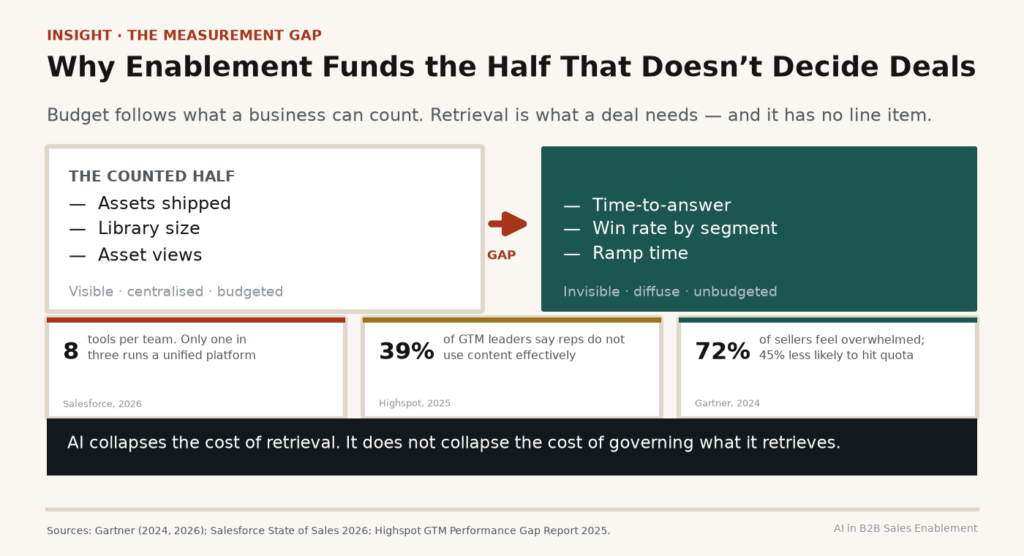
Ask an enablement leader what they’re accountable for, and you’ll get a list of things that can be counted: assets shipped, library coverage, adoption rate, views per asset. Ask them what actually decides a deal, and the answer is different — whether a rep could answer a buyer’s specific question in the ninety seconds it mattered.
Those two lists barely overlap. That’s not a strategic oversight. It’s a structural feature of how the function gets funded, and it explains almost everything about why the category has been stuck for a decade.
Budget follows the audit trail, not the outcome
Here’s the mechanism. Every budget request needs evidence. Evidence means artifacts. A deck that shipped, a portal that launched, a usage report with a number on it.
A retrieval failure produces nothing. The buyer asked a question, the rep said “let me check,” and the moment passed. No asset was created, no view was logged, no dashboard moved. The single most expensive event in the sales process — the lost moment — is also the only event with no paper trail.
So the organization funds the half it can photograph. Not because anyone decided that’s the right allocation, but because the other half literally cannot be invoiced.
This is Goodhart’s law applied to enablement: once asset utilization becomes the measure, producing assets becomes the work.
The ownership vacuum
There’s a second force, and it’s organizational rather than economic.
Content has an owner: marketing. The channel has an owner: sales ops. But the moment of retrieval — the rep, mid-meeting, needing one specific answer — belongs to nobody. It lives in the gaps between the CRM, the inbox, the shared drive, and the rep’s memory.
Things without owners don’t get fixed; they get escalated to whoever is nearest. Which is why the standard response to a retrieval problem is to buy another tool. Salesforce’s 2026 research found teams running an average of eight standalone tools, with only about one in three on a unified platform. Eight tools is eight attempts to solve a problem that has no owner.
And the pressure is real: Gartner found 72% of sellers feel overwhelmed by the required skills, and those sellers are 45% less likely to hit quota. Adding a ninth system to a team already at capacity doesn’t read as enablement. It reads as more work.
Risk aversion finishes the job
The third force is the most subtle. A missing answer is invisible. A wrong answer is visible, quotable, and arrives in front of a buying committee.
Faced with that asymmetry, a rational enablement team optimizes for “no wrong artifact” rather than “fast right answer.” Producing more approved content feels like risk reduction, even when it lengthens the path to the answer.
Which is why the widely repeated claim that 65% of sales content goes unused has survived so long — it’s unfalsifiable folklore, traceable to a 2013 conference slide with no published methodology. It gets repeated because it justifies the intuition without requiring anyone to measure the thing that actually matters.
What AI actually changes
AI collapses the cost of retrieval. It does not collapse the cost of governing what gets retrieved.
That distinction is the whole story. Once assembly is cheap, the binding constraint moves from can we find it to are we allowed to say it, and is it still true? The new budget line isn’t a search box. It’s ownership, expiry, entitlements, and a named human who signs off on pricing and security claims.
The teams getting results aren’t the ones that bought the most capable model. They’re the ones that finally gave the retrieval moment an owner — and then measured time-to-answer instead of asset views.
Gartner’s forecast that AI-driven enablement will reach 40% faster stage velocity by 2029 is a projection, not a promise. But the direction is unambiguous: the money has to move from production to retrieval, and it will only move when someone is made accountable for the invisible half.