Why Gen Alpha Campaigns Stall Between the Feed and the Kitchen Table
Here are two measurements of the same generation, taken months apart, both defensible.
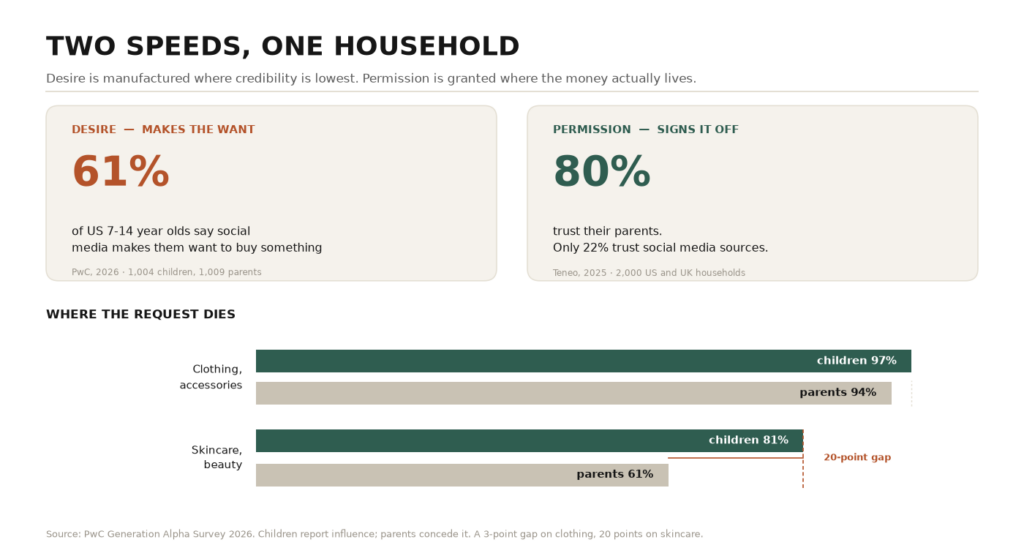
In PwC’s 2026 survey of 1,004 American children aged 7 to 14, 61 percent said social media makes them want to buy something — more than peers at 56, shelf browsing at 53, or television at 48.
In Teneo’s 2025 study of 2,000 households in the US and UK, 80 percent of Gen Alpha said they trust their parents, and 22 percent said they trust social media sources.
Put those side by side and you get the mechanism almost every plan misreads: the demand for your product is manufactured in the one channel where your credibility is weakest, and it is approved in a channel you never bought.
A household runs on two clocks
The feed works in seconds. A creator demonstrates, a child wants, a screenshot gets sent. The kitchen table works in days. A parent looks up the price, reads a review, checks whether the thing is appropriate for a nine-year-old, and decides.
Nobody in the chain is being difficult. The two stages simply run at different speeds, in different rooms, measured by different systems — or rather, one is measured and the other is not. There is no tracking pixel on the conversation that happens between a request and a yes.
Which is why the leak is invisible in reporting. Reach looks healthy. Consideration, the stage that lives at home, is unaudited.
The migration nobody budgets for
The most under-reported finding in Teneo’s data is a direction, not a level. Between ages 11 and 15, Gen Alpha’s trust in advertising from companies rises by 11 percentage points, while their trust in people they see on social media falls slightly.
Read that twice, because it inverts the standard playbook. The younger the child, the more the creator carries. The older the child, the more the institution carries — provided the institution can be checked. Teneo’s own reading is that children grow more confident in organisations they can verify and more sceptical of faces they cannot.
So the creator asset you built for a nine-year-old is decaying by fourteen, and the asset that survives is the boring one: a page that substantiates a claim, a review written by adults, a materials list with no adjectives. Most brands fund the first and leave the second to an intern.
Where the request actually dies
PwC’s parent–child pairs are the useful instrument here, because the same household gets asked twice. On clothing and accessories, children and parents nearly agree: 97 percent of children claim some influence, 94 percent of parents concede it. Three points of daylight.
On skincare and beauty, children claim 81 percent and parents concede 61 percent. Twenty points.
That gap is not a measurement error to be averaged away. It is a permission deficit. In the first category, the request arrives with permission already attached. In the second, one in five claimed influences never lands, and the brand’s attribution model books the loss as unexplained.
Which suggests a metric nobody currently owns: request survival rate — the share of child-initiated requests that convert into a purchase decision inside the household. You cannot tag it. You can approximate it, by category, with branded search from adult devices, “where to buy” page traffic after kid-facing content runs, and the parent-child concession gap itself.
What this changes on Monday
Three moves, none of them creative.
Give every claim a child might repeat at home a page that proves it in forty seconds. Brief creators to demonstrate, not endorse — a demo survives the parent’s check, an endorsement does not. And measure the concession gap by category, because that number tells you where your media spend is being converted and where it is evaporating.
The feed will always be faster than the kitchen table. That is not a problem to solve; it is a sequence to design. The brands that win Gen Alpha are not the loudest in the feed. They are the ones whose requests survive the drive home.