Codified Knowledge Was the Product. AI Made It Free.
The syllabus is not badly taught. It teaches the half of the job that is being automated, and skips the half that isn’t.
The interview that goes wrong
Picture the room. A graduate with a strong transcript and a fluent command of the marketing mix is asked why a campaign’s customer acquisition cost doubled while return on ad spend held perfectly flat. They reach for a framework. There isn’t one. What the question actually wants is the ability to sit inside a messy dataset, form a hypothesis, and say out loud which of four possible explanations they would bet a quarter’s budget on.
They can’t. Not because they’re lazy, and not because the lecturer was bad. Because nobody has ever asked them to.
That gap, between what a diploma certifies and what the first year of the job demands, is the subject of this piece. It is wider than most graduates expect, and it is closing more slowly than the industry likes to claim.
Why the canon lags the craft
The half-life of a framework
Every discipline has a canon, and the canon always lags. Marketing’s canon is unusually exposed to that lag, because so much of it was built for mass media, limited shelf space and one-way broadcast.
The 4Ps were codified in the 1960s. The purchase funnel describes a consideration path that predates super-apps, creator commerce and algorithmic discovery. And the case method, whatever its virtues, teaches retroactively. A case study explains a decision in a market that has already closed. Students are rewarded for reconstructing yesterday.
The job runs the other way. It rewards the person who can make a call about next quarter on incomplete information, and be roughly right often enough to keep their budget.
How tool training crowds out judgment
There is a commercial reason courses over-index on software. Tools are teachable, examinable, and easy to put on a brochure. Judgment is none of those things.
The trouble is that the tool layer has a known expiry date. The 2025 martech landscape counted 15,384 solutions, up 9% on the year, after adding 2,489 companies from more than 11,000 candidates and removing 1,211. That is an 8.6% churn rate. The detail worth pinning above a curriculum committee’s desk: roughly two-thirds of the products that vanished were built between 2010 and 2020, not the AI-native cohort. The previous generation of tools wasn’t replaced by something shinier. It was absorbed or switched off.
Teach someone to operate one platform and you have handed them a skill with a shelf life. Teach them to reason about what a platform is for, and you have given them something that outlives it.
What the labour data actually shows
Here is where the argument stops being a matter of taste.
The Federal Reserve Bank of New York tracks outcomes by college major, using Census data and O*NET classifications to decide whether a job genuinely requires a bachelor’s degree. Its February 2026 release, built on 2024 data, puts marketing majors at a 49.3% underemployment rate. Nearly half of working marketing graduates hold jobs that typically don’t require the degree they paid for. The reference line across all majors is 39.4%.
The number that gets quoted, and the one that gets ignored
Before that figure becomes a headline, note what it does not say. Unemployment among marketing majors is 4.4%. These graduates work. Their mid-career median wage of $100,000 sits near the top of the business majors, and they reach it while holding graduate degrees less often than accounting peers, 19.7% against 33.7%.
So the degree is not a bad investment. It is an unfinished one. It reliably gets people into employment, less reliably into the work the credential was meant to unlock, and it pays off over a decade rather than on graduation day. That claim is both more defensible and simply truer than the fashionable one about degrees being worthless.
The shortage sits in old disciplines, not new ones
This next detail dismantles the standard excuse. The usual defence of a lagging curriculum is that nobody can keep up with AI. Then look at where employers say the deficits are.
The American Marketing Association’s 2025 research, drawing on more than 1,200 marketers, over 450 job postings and interviews with practitioners, found the widest competency gaps in digital marketing, data and analytics, proving return on investment, and data privacy and compliance. Marketing Week’s 2025 survey of over 3,500 practitioners put performance marketing at 56.9%, social media at 46.1%, ecommerce at 41.3% and content and copywriting at 40.6%.
Not one of those is a new discipline. Performance marketing is two decades old. So novelty explains nothing. What we are looking at is a gap between knowing and doing, and doing is the one thing a lecture theatre cannot supply.
A 2025 paper in the Journal of Marketing Education makes the academic version of this point. Grewal, Guha, Beccacece Satornino and Becker reviewed 121 articles across five themes and concluded that employers expect entry-level marketing hires to arrive fluent in sustainability, digital marketing, big data, analytics and the role of AI, and that educators must rebuild how courses are run, what they cover and how assignments are set. The admission is gentle, but it is an admission.
Five things nobody puts on a module list
Strip the job back to what separates a good second-year marketer from a mediocre one, and five capacities recur. None appears in a module handbook.
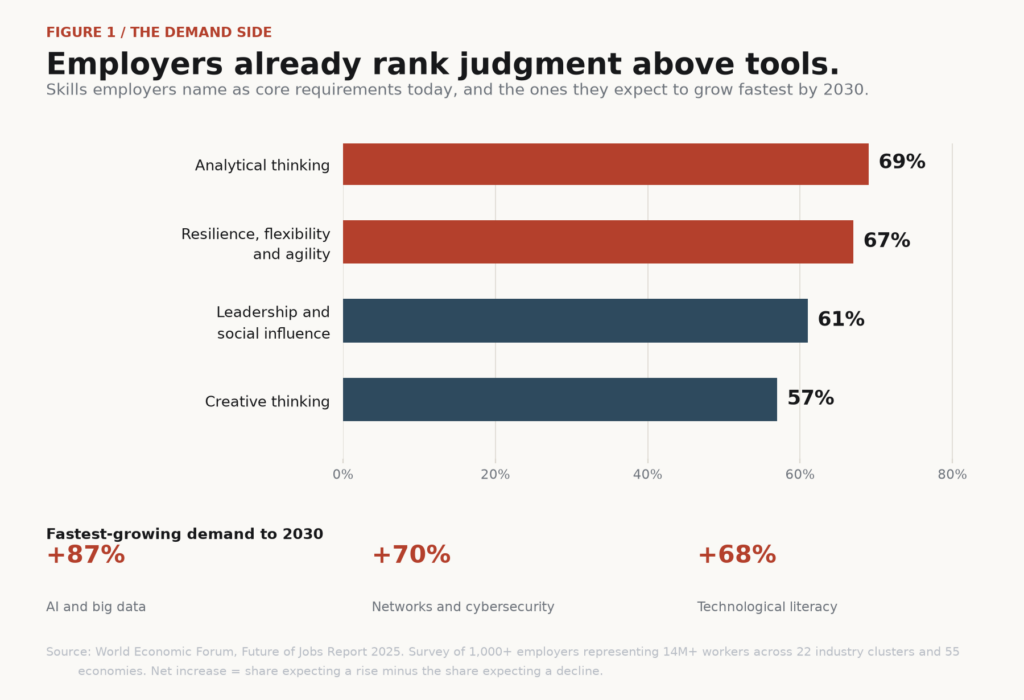
Judgment under uncertainty. Most of the work is deciding. Which bet, how much, when to kill it. Employers rank analytical thinking the single most in-demand core skill, cited by 69% in the World Economic Forum’s 2025 survey of more than 1,000 employers representing some 14 million workers. No exam measures it, because exams have answer keys and judgment doesn’t.
Orchestration instead of competition. Directing AI has become a meta-skill: specifying the task, judging the output, sensing when the output is confidently wrong. Courses that ban the tools and courses that fetishise them both miss the point.
Taste. The editorial instinct that says this headline is clever and wrong for this brand. It travels by apprenticeship, not by rubric.
Data sense, distinct from data production. Statistics modules teach the mechanics of a regression. They seldom teach the instinct that a 12% lift on a 400-person sample is noise, or that the metric being celebrated is the one that moves when nothing has happened.
A compounding mindset. Assets rather than campaigns. Almost every curriculum is organised around the campaign: discrete, dated, disposable. That is exactly the mental model that produces marketers unable to build anything that accumulates.
The entry-level squeeze
Now the evidence that changes the shape of the argument, and it is uncomfortable.
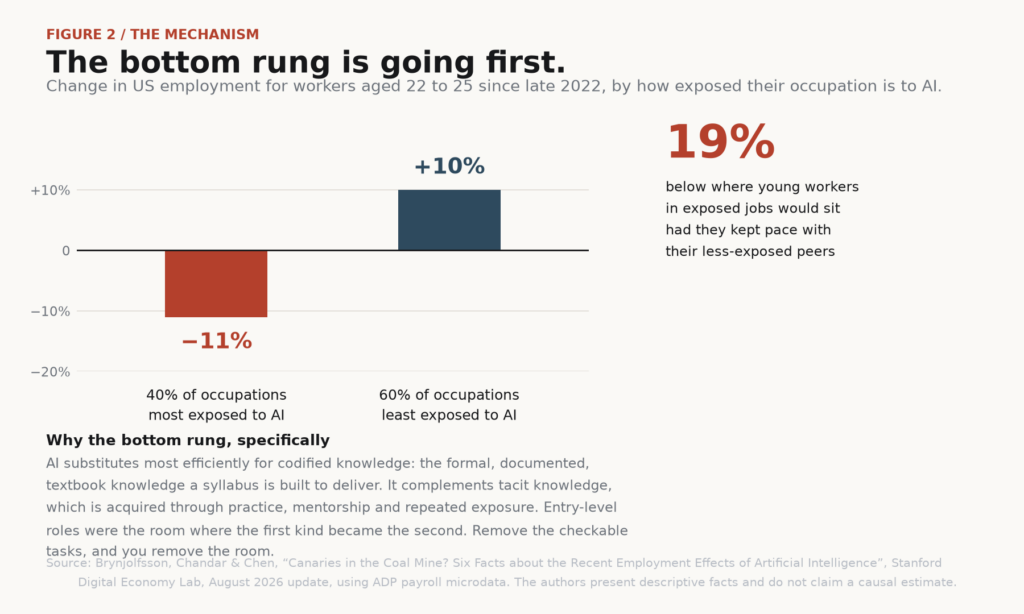
Economists at Stanford’s Digital Economy Lab, working from ADP payroll microdata covering millions of workers, tracked employment by age and by occupational exposure to AI. In the top 40% most exposed occupations, employment of 22-to-25-year-olds has fallen roughly 11% since late 2022; in the least exposed 60% it has grown about 10%. Set against a counterfactual where young workers in exposed roles kept pace with their less-exposed peers, they sit around 19% lower. Older workers in the same occupations show no comparable gap. The authors are careful to call these descriptive facts rather than a causal estimate, and so should we be.
Codified knowledge is the part AI eats
Their proposed mechanism is the interesting part, and it lands squarely on curriculum design. AI, they argue, substitutes most efficiently for codified knowledge: formal, documented, textbook knowledge, the kind a syllabus exists to transmit. It complements tacit knowledge, the kind built through practice, mentorship and repeated exposure to real situations. Occupations heavy in codified knowledge show slower entry-level growth. Occupations heavy in tacit knowledge show faster growth among senior workers.
Now reread that with a course handbook open. A syllabus is, almost by definition, codified knowledge. It is the formalised, written, teachable residue of a practice. Which means the part of the job education does best is precisely the part automation now does cheaply, while the part it barely touches is the part that has become scarce.
Why this breaks the sequence
Entry-level roles were the room where codified knowledge turned into tacit knowledge. Automate the checkable tasks and you don’t merely delete a job title. You remove the room.
This is not an argument that degrees are obsolete. It is something more specific and more inconvenient: the traditional sequence, learn the theory, take the junior role, absorb the craft, has a broken link in the middle. And the theory half is the half whose price has collapsed.
What employers actually removed
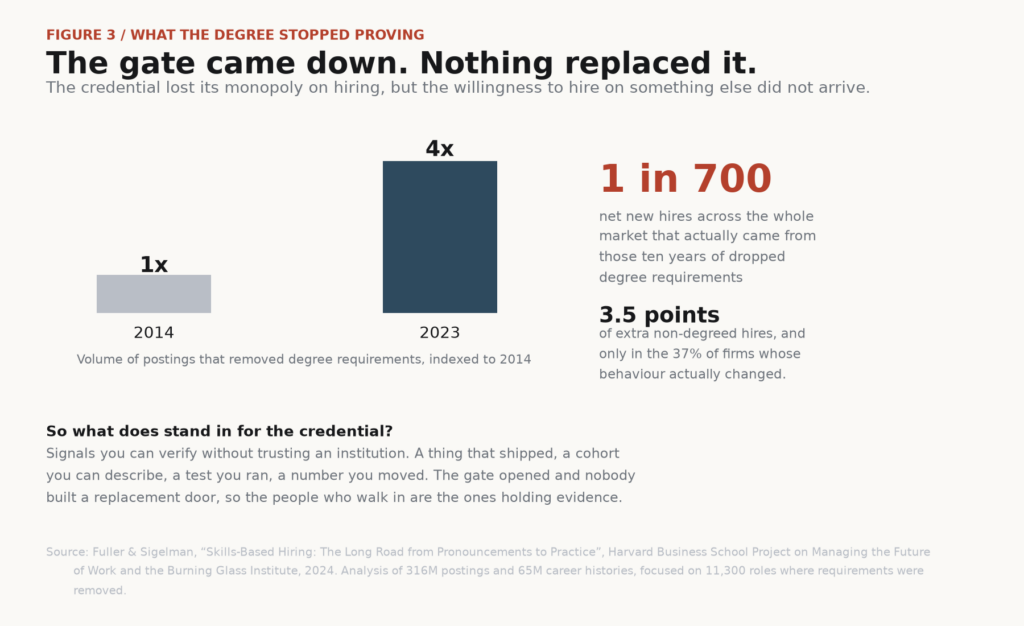
There is a story people tell, that employers stopped caring about degrees and so proof of work now rules. Half of that is documented. The other half isn’t.
Harvard Business School and the Burning Glass Institute analysed 316 million job postings and 65 million career histories, narrowing to 11,300 roles where employers had formally dropped degree requirements between 2014 and 2023. The volume of such postings rose roughly fourfold. Actual hiring of non-degreed candidates rose 3.5 percentage points inside those roles, which across the whole market amounts to fewer than 1 in 700 hires. Nearly all of the real movement came from 37% of firms. Something like 45% changed the wording and nothing else.
Lightcast, meanwhile, finds degree requirements down about 14% since 2019 in US roles that traditionally demanded them, while postings asking for AI skills are more likely to insist on a degree, not less.
Why a portfolio is not a magic fix
The tempting conclusion, that the credential is dead and anyone who ships something will be fine, is the conclusion the data refuses to support.
What actually happened is that employers removed a gate and installed no replacement. They didn’t start hiring on evidence; they carried on hiring on instinct while feeling mildly guilty about it. That is the precise opening for a portfolio, and the precise reason a portfolio alone often isn’t enough: the manager reading it was never trained to evaluate it.
Said plainly, proof of work beats a diploma in a fair comparison. Most comparisons are not fair, and the advantage accrues fastest to people who already have mentors, access and a budget to experiment with.
If you are the student
The NACE figures are blunt. Among US bachelor’s graduates in the class of 2026, 55% of those with a paid internship had at least one job offer before graduation, against 43% of graduates overall, and their average starting salary was $69,521 against $61,747. Among employers running formal programmes, 63.1% of eligible interns converted to a full-time offer, 88.3% of those offers were accepted, and more than three-quarters of converted interns were still with the firm a year later, against under half of hires who never interned. An older but still-cited study in the Journal of Marketing Education found former interns landed their first job faster, earned more and reported higher satisfaction.
Notice what the internship is doing there. It is not magic, and the correlation is partly selection: motivated students get internships. But the mechanism it supplies is real. It manufactures evidence.
Which means the instruction is not get an internship. It is produce evidence, and an internship is only the cheapest machine for doing so. If you can’t get one, build the machine. Run a real campaign for a real business on a real budget, however small. A café, a friend’s newsletter, your own side project. Write down what you expected, what happened, and why the two diverged. That document outranks a transcript, because it shows the one thing a transcript cannot: that you formed a judgment and were wrong in public.
Two constraints worth respecting. Pick something with a number attached, so the outcome is arguable. And keep the losses. A portfolio of only wins reads as a portfolio of things you never measured.
If you are hiring
Deleting a degree requirement from a job ad costs nothing, which is why so many firms did it and so few changed anything. The 45% who edited the wording are not villains. They simply discovered that a manager under time pressure defaults to the credential, because it is a cheap proxy and nobody handed them a better one.
So hand them one. A structured work sample drawn from your actual workflow, scored against a rubric written before you meet anyone. A portfolio review where the candidate must defend a decision rather than display an outcome. A first-round question that cannot be answered with a framework.
And budget for the gap. In a survey of 552 recruitment decision-makers conducted for Regent’s University London, 91% of those hiring for marketing and advertising roles said traditional university education does not adequately prepare candidates, 82% prioritised practical experience, 91% had extended probation periods for graduates, and one in five had rejected a graduate over a skills gap. Handle those numbers with care. Regent’s is a private university selling a learning-by-doing proposition, so it has a stake in the finding, and the marketing-specific subset of those 552 respondents has an undisclosed size. But the direction is consistent with everything else here, and the operational implication is dull and unavoidable: whichever way you hire, you are running a training programme in year one. Price it in.
If you are teaching
The structural problem is that faculties are rewarded for theory mastery while the market rewards shipping. No new module on generative AI fixes that, and you should be suspicious of anyone proposing one.
What you can do is invert the order. Make the doing the curriculum and the theory the supporting layer. A student-run agency with genuine client work. Assessment that consists of a live brief, a real budget and a post-mortem. A reading list that arrives after the first attempt has failed, so the framework lands as an explanation of something the student has already felt.
What that looks like in practice
There is a working example, and it is unglamorous. The University of Portsmouth’s marketing programmes rebuilt assessment around live client work, using an industrial advisory board to review module content and partners including local authorities and regional businesses to feed real challenges into student teams. Nassar and Busoi presented the model at the European Conference on Education in 2025; by 2026 the programme had extended it into a Marketing Agency running across every undergraduate level, with projects sourced through a city partnership and matched to student teams. No exams, in one campus variant. Live briefs embedded in assessment across all marketing modules.
That is the shape of the answer: real clients, real outcomes, theory arriving as commentary on experience rather than as preparation for it. It is slower to administer than a lecture. It is also the only structure in which tacit knowledge has somewhere to form.
Three honest caveats
The degree is not worthless. It supplies vocabulary, history, consumer psychology and a peer network, which is the scaffolding practice hangs on. The problem is incompleteness, not fraud. Supplement it; don’t replace it.
The self-taught story carries survivorship bias. You hear from the ones whose side projects worked. You do not hear from autodidacts with confident opinions built on no fundamentals and nobody to correct them. The degree fills the self-teacher’s structural hole; a portfolio fills the degree’s. Neither is sufficient alone.
Blaming lecturers is lazy. The lag is structural. Nobody can teach a practice that hasn’t stabilised, and marketing has been destabilising continuously since roughly 2007. The fix is to change what a course is made of, not to work existing staff harder.
The takeaway
Marketing education is incomplete rather than fraudulent. It teaches the theory of a market that has closed and skips the judgment the current one demands. The gap is measurable, and it is widest exactly where the syllabus is strongest: in codified knowledge, which automation now handles cheaply, and away from tacit knowledge, which only forms by doing.
The credential certifies the lag. The job demands the forward. Nobody will reconcile those on your behalf: not a university, not an employer, and certainly not a job posting that quietly dropped its degree requirement and changed nothing else.
So the useful question isn’t whether your degree was worth it. It’s what you have shipped that someone else can check.