Content That Expires and Content That Appreciates: The Arithmetic Behind the Choice
For fifteen years, the content calendar was the right tool. If your problem was “nobody in this company knows what to publish next week,” a calendar solved it. If your problem was “we have no rhythm, no accountability, no way to show the boss we did something,” a calendar solved that too. It was a project-management artifact wearing a marketing hat, and it worked because the constraint it managed was real: attention was scarce, publishing was expensive, and a steady drip of decent posts genuinely built an audience.
None of that is true in the same way now. The constraint moved. Publishing became almost free, so the scarce thing is no longer output. It is the handful of pages that will still be doing work for you in three years. The calendar, bless it, has no idea that this is what you need. It counts the wrong thing, on the wrong clock, and reports the result in a number that flatters everyone in the room.
So the question worth asking is not how to run a better calendar. It is what you would build if publishing were free and only durability mattered.
What the calendar actually optimised for
Volume as a proxy for value
A calendar is a schedule, and schedules produce units. Four posts this week. Twelve assets this quarter. The units are countable, which is precisely why they became the metric. Somewhere along the way, “we published four posts this week” started to sound like an achievement rather than a description of activity.
It is worth sitting with how strange that is. Nobody in finance reports “we issued four invoices this week” as a strategic win. The invoice count is a byproduct. Content teams inverted the relationship and made the byproduct the goal.
The metric nobody questioned
Cadence metrics survive because they are unfalsifiable in the short term. You cannot prove that this week’s post was worthless, and you cannot prove it was valuable, so the count stands in for the verdict. The count always goes up. Everyone stays employed. The arrangement is comfortable and quietly expensive.
Then supply went to infinity and demand got thinner
Two curves crossed, and the calendar was standing where they crossed.
The flood, in one measurable number
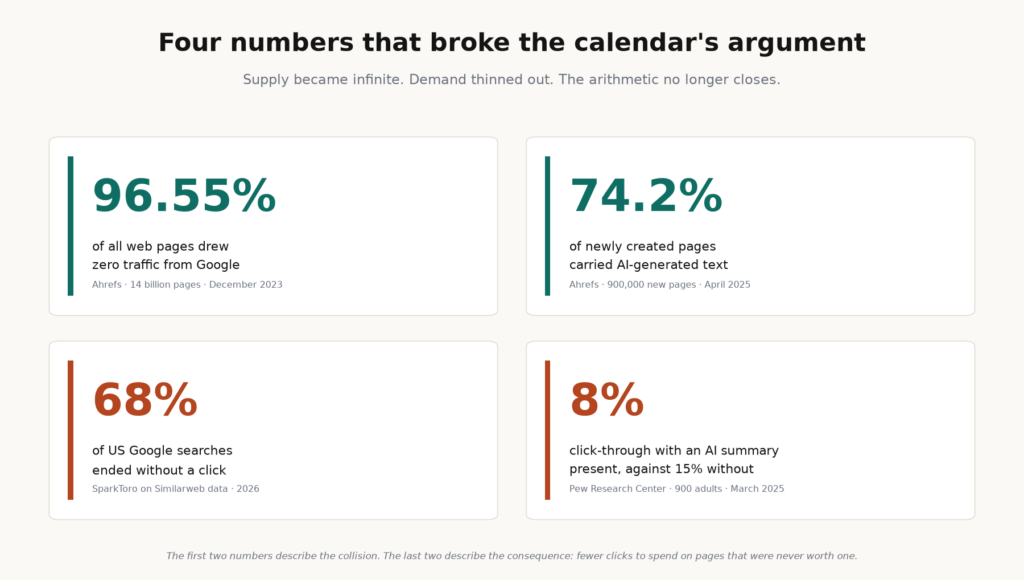
In April 2025, Ahrefs ran 900,000 newly created English-language pages through its AI-content detector, one page per domain. It found that 74.2% of them carried at least some AI-generated text. Only about a quarter were entirely human-written. The detector cannot cleanly separate AI drafts that a person edited, so if anything the true figure is higher, and Ahrefs says as much in its own write-up.
Now put that beside an older number of theirs. Ahrefs crawled roughly 14 billion pages and found that 96.55% of them received zero traffic from Google. The index skews toward the higher-quality end of the web, and traffic figures are modeled estimates rather than measured clicks, so treat both as directional. The direction, though, is unmistakable: the overwhelming majority of everything ever published is invisible, and the pile is now growing faster than any human team can contribute to it.
The click, in another
On the demand side, SparkToro’s analysis of Similarweb panel data put United States zero-click searches at 68% in 2026, against 60.45% in 2024. The two figures come from different panels, so the comparison is not clean, but the shape holds. Pew Research Center, tracking the actual browsing of 900 American adults through 68,879 searches in March 2025, found something sharper: when an AI summary appeared, users clicked a traditional result 8% of the time. When it did not, they clicked 15% of the time. Barely 1% of searches ended with someone opening a source cited inside the summary itself.
So the calendar’s promise was: publish more, and the rising tide lifts you. The tide went out. Publishing more now means adding to a flood in which 96.55% of pages are invisible, while the click that was supposed to reward you has roughly halved.
What an AI summary does to the page you ranked
Here is the part that surprises people who assume ranking is still the game. Ahrefs measured, in February 2026, that the presence of an AI Overview correlates with a 58% reduction in click-through for the top-ranking page, up from the 34.5% it had measured in April 2025. The page did not lose its rank. The results page changed shape above it.
Worse for the old logic: the overlap between pages cited in AI Overviews and pages ranking in the organic top ten fell from roughly 76% in mid-2025 to 38% by February 2026 across 863,000 keywords, as reported by Search Engine Journal from Ahrefs’ data. Being number one no longer reliably means being quoted. Those are two different selection problems now, and the calendar only ever trained you for one of them.
What a compound asset actually is
I want to be precise here, because “evergreen content” is the phrase people reach for and it has been so thoroughly diluted that it now means “a blog post with a long keyword in the title.”
A compound asset is a page whose value rises or holds after publication without you paying again for the traffic. That is the whole definition. It has to keep earning discovery, keep earning quotation, and keep being worth sending to a prospect. If it does those three things, it is capital. If it does none of them, it is a receipt for work performed.
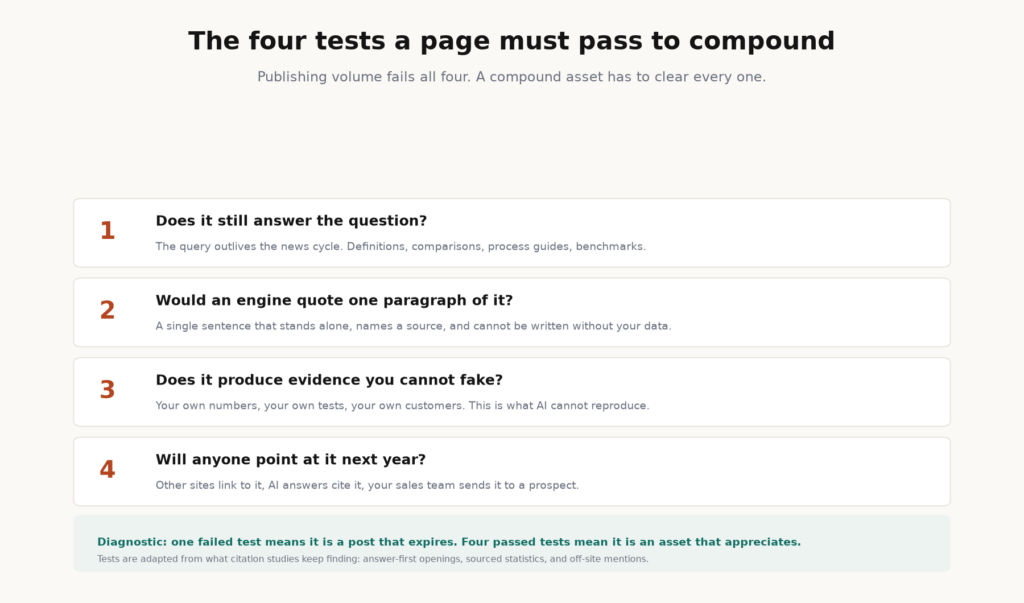
The useful way to operationalise this is as a set of tests rather than a vibe.
Test one: will it still answer a question next year?
Evergreen demand is not a content format, it is a property of the query. A study of Spanish-language search results, published through the CUVICOM research project and covered by Search Engine Journal, found that 75.2% of AI Overviews drew on evergreen material rather than time-sensitive news. The same study found AI Overviews appearing in 34.6% of evergreen searches against 1.1% of breaking-news searches.
Read that second number again. Generative summaries barely touch news, because news resists compression: it is conditional, contested, and often valuable precisely for the details a summary strips out. Meanwhile the boring, always-true question about how a process works gets answered in the results page, and the summary is built from whatever page best states the settled answer.
If your publishing plan is a sequence of “this week in our industry” posts, you are producing the one category generative search reliably ignores. That is not a moral failing. It is a mismatch between what the calendar rewards and what the machines actually use.
Test two: would an engine quote a single paragraph of it?
This is where the length argument dies, and I am glad it does, because the length argument wasted years of everyone’s budget.
Ahrefs analysed 174,048 pages cited across 560,346 AI Overviews in December 2025. The average cited page ran 1,282 words. The Spearman correlation between word count and being cited was 0.04, which is a polite way of saying “none.” More than half of all citations, 53.4%, went to pages under 1,000 words. Only 16% went to pages over 2,000.
The caveats matter. The sample contains only pages that were cited, so it can show that short pages do get cited, not that a longer version of the same page would do worse. Text could only be extracted from about a tenth of the cited URLs, and Ahrefs does not explain how that filter shaped things.
Even so, the operational conclusion is safe: stop inflating word counts, and start making sections that survive being lifted out of context. One paragraph, one claim, one source, one complete answer. A section that needs the two paragraphs before it to make sense is a section that will never be quoted.
The decay is slow enough to hide
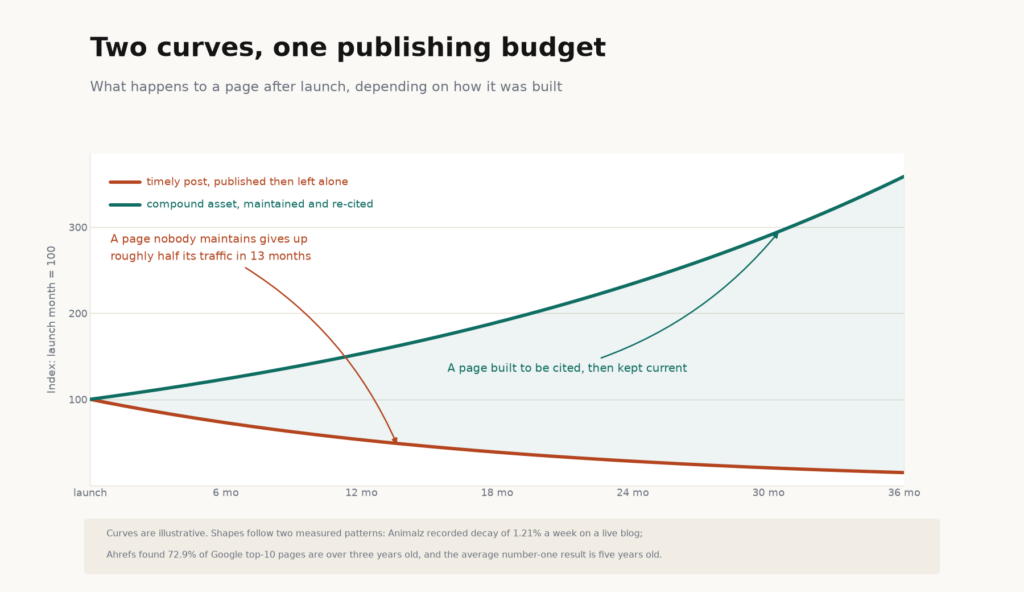
Animalz measured an average traffic loss of 1.21% a week on a real company blog in 2018. Compound that and a page loses roughly half its organic traffic in about thirteen months. Compound it silently and nobody notices, because a 1% monthly decline looks like noise on a dashboard that is refreshed every morning.
What fills the vacuum is not nothing. Ahrefs’ 2025 study of 1.3 million keywords found that 72.9% of pages in Google’s top ten are more than three years old, up from 59% in 2017, and that the average number-one result is five years old. Old pages win. Which is either encouraging or terrifying, depending on whether anyone is maintaining yours.
Test three: does it contain evidence you cannot fake?
This is the test the calendar fails hardest, and it is the one that has become commercially decisive.
Orbit Media’s 2026 blogging survey of 1,042 content marketers found that just 14% said their blog delivered strong results, the lowest reading in twelve years and down from 26% in 2022. AI adoption in the same sample hit 92.4%, and it had no relationship at all with reported success. The average post now takes three hours and twenty minutes, down from over four hours in 2022. So teams got meaningfully faster at producing something that worked less well.
The practice with the strongest link to success was collaboration with outside experts: marketers who regularly worked with them were 2.6 times more likely than the benchmark to report strong results. Adoption of that practice fell from 25% in 2017 to 7% this year. That is the whole tragedy in one stat pair. The thing that works got rarer while the thing that is easy got cheaper.
Orbit’s respondents are self-selected bloggers, mostly from one network, and the results are self-reported. Directional, not gospel. But it lines up with everything else: what you know that others do not, and can prove, is the only input that does not commoditise. Your own test data. Your own customer numbers. Your own failed experiments, written up honestly. A summary can restate the consensus view of your category in two sentences. It cannot invent the survey you ran.
Test four: will anyone point at it next year?
Links used to be the scoreboard. They still are, partly, but the correlation has been rewritten.
Across 75,000 brands, Ahrefs found branded web mentions correlated with presence in AI Overviews at 0.664, while backlinks sat at 0.218. That is roughly three times the strength, and it produced an entire cottage industry of “mentions are the new backlinks” posts. Hold the enthusiasm for a second: this is an observed association, not a causal test. Nobody has run a controlled experiment isolating mentions as the variable. It could be that brands worth mentioning are also brands worth citing, and the mentions are a symptom.
What survives the caveat is the practical implication. If AI systems learn what your brand is by reading what other people say about it, then off-site presence is content infrastructure, not PR garnish. Get quoted in the places your category gets read. Answer the real questions in the communities where they are asked. Both feed the same pool the models draw from, and neither requires you to publish another 1,200-word listicle.
The freshness signal nobody expects
If assets are supposed to be durable, why does Ahrefs find that content cited by AI assistants is 25.7% fresher than content ranking in organic search? Across 16.975 million citations, AI-cited pages averaged 1,064 days old against 1,432 for the organic top ten. ChatGPT was freshest at 958 days; Google’s own AI Overviews averaged 1,432, essentially identical to the organic results below them.
Here is the resolution, and it is the most practical thing in this article. A smaller study from Seer Interactive dated 7,683 pages cited by ChatGPT, Gemini and Perplexity across 47,097 citations between March and June 2026, separating first-published dates from last-modified dates. It found 75% of cited pages had been updated within the past year, while only 42% had been published in it. Four brands, so a narrow sample, but a large signal.
The freshness the machines reward is manufactured by maintenance. The durable asset is not a monument. It is a page somebody keeps touching.
Maintenance is the compounding mechanism
Which reframes the whole argument. Compounding is not something that happens to content because it is old. It happens because someone keeps the thing current, and the cost of doing that is a fraction of the cost of starting over.
HubSpot’s internal programme is the canonical case. It found that 76% of its monthly blog views and 92% of its monthly leads came from posts published in earlier months. When it deliberately updated old posts, organic views on those posts rose by an average of 106% and the leads they produced roughly tripled. Thirty posts out of roughly 6,000 generated 46% of the leads.
Be careful with these numbers. They come from one company, using its own analytics, published years ago, and the sample of updated posts was chosen by the team. They are an existence proof, not a benchmark. But the structural insight is solid and it recurs in every content library large enough to measure: a small number of pages produces most of the results, and those pages are exactly the ones decay attacks first.
That changes the job description. The calendar’s job was to fill the top of the funnel. The actual job is to defend and extend the small set of pages that already carry the funnel. In practice that is a shorter, less glamorous, far more defensible work queue.
What changes on Monday
Retire cadence as the headline metric
Not as an input, as the headline. No executive should be able to describe your content programme by counting posts. If you need one number, use the share of organic and AI-driven sessions landing on pages that are more than twelve months old. That figure rises when you build assets and falls when you feed a calendar.
Give the archive a budget line, not a good intention
Refresh work competes with net-new work for the same hours and always loses, because net-new has a launch date and refresh has none. Reserve a fixed share of writing capacity for it. Ahrefs’ own content team has described quadrupling its refresh pace by semi-automating the boring parts, and Buffer reported a similar pattern after putting LLM agents on the task. The bottleneck is never the writing. It is the two to four hours of analysis per page that gets skipped the moment a deadline appears.
Build for quotation, not for length
Answer the question in the first sentence under the heading. Name the source and the sample size. State the number plainly. Then move on. A page that answers eleven specific questions cleanly is worth more than a page that gestures at one topic for 3,000 words.
Do the off-site work, and treat it as content
The mention data is a correlation, but the mechanism it implies is not mysterious: models describe your brand using language they found elsewhere. If the only thing written about you is your own website, that is the whole of what they know. Interviews, expert commentary, community answers, being quoted in the roundups your buyers actually read. None of it is publishing. All of it is asset building.
Separate the two clocks
Timely content is not dead. It is a tactic with a short half-life: launches, commentary, seasonal spikes, the reactive post that gets shared on the day. Let AI draft most of it, ship it fast, and expect nothing from it after a fortnight. The asset work is the long clock, and it should never be judged on the short one.
Three objections worth taking seriously
“Retention work pays next year and I am measured this quarter”
Fair, and not answered by pretending otherwise. But note what the quarter-over-quarter frame hides. Gartner’s 2026 CMO Spend Survey, across 401 marketing leaders mostly at billion-dollar-plus companies, put marketing budgets at 7.8% of revenue, essentially flat, with 15.3% of that budget now going to AI. Budgets are not coming back to 2016 levels. Under a flat budget, the cheapest marginal traffic is a page you already own and already rank for. Refusing to fund maintenance is not discipline. It is paying full price for the harder version of the same outcome.
“Assets only is overreach”
It is. Some content is legitimately perishable, and a brand with no timely voice looks asleep. The claim is not that everything should compound. The claim is that compounding should be the strategy and timeliness should be the tactic, not the reverse. Right now most teams have it exactly backwards: a cadence strategy with occasional depth, which is the expensive way round.
“A bad asset is a permanently bad asset”
True, and it is the strongest argument for restraint. A mediocre post decays and disappears. A mediocre page that ranks keeps misinforming people for a decade, and now it feeds summaries too. Compounding is truth-conditional. If the underlying claim is wrong, maintenance just keeps the wrongness alive and makes it quotable. This is why the pre-publication bar has to rise as the publication volume falls, not the other way round.
Conclusion
The content calendar was a volume machine built for a world where publishing was expensive and attention was the bottleneck. AI inverted both conditions. Publishing is now nearly free, and 74.2% of new pages carry machine-written text while 96.55% of all pages earn nothing from search. The click that was supposed to reward the effort has roughly halved.
That does not make content worthless. It makes undifferentiated content worthless while making a specific kind of page more valuable than it has ever been: the page that answers a durable question, states a quotable claim, carries evidence nobody else has, and gets maintained so the machines keep treating it as current.
The shift is not from publishing to not publishing. It is from counting units to defending assets. Ask next quarter’s planning meeting a different question. Not how much are we shipping, but which three pages will be worth more in twelve months because of what we did to them this quarter.
That question has an uncomfortable property. It cannot be answered with a calendar.