Why 257 Million Members Didn’t Save the Stores
Three numbers came out of Chagee’s second-quarter 2026 report, and they are usually read as two strengths and one weakness. The chain holds 257 million registered members. More than 78 per cent of its orders come from customers buying at least a second time. And same-store gross merchandise value in Greater China fell 16.1 per cent.
Read them again in that order and the story looks like a brand with loyal customers and a soft market. Read them as one fact and you get something more useful: the base and the business have decoupled, and the reason is a cost curve nobody was watching.
Start with what actually changed at the counter. When enrolment moved from a plastic card to a QR code, the marginal cost of signing up a customer fell to roughly zero. Free sounds like pure upside. It isn’t. When capture costs nothing, capture stops being a decision — and anything that isn’t a decision produces no information. A base of 257 million is not 257 million relationships. It is 257 million rows, most of which hold one transaction and no stated intent.
Now the asymmetry that explains the whole pattern. The handoff has two halves, and only one of them got cheap.
Capture is a one-time labour cost you can automate: print a code, point a screen, hand over a coupon. Cadence is a recurring judgement cost you cannot automate cheaply: what to send, to whom, at which point in the consumption cycle, with what reason to come back — and it has to be restaffed every time a store manager quits. So chains industrialise the half with a falling cost curve and underfund the half whose cost rises with every new store. Registration compounds. Attention doesn’t.
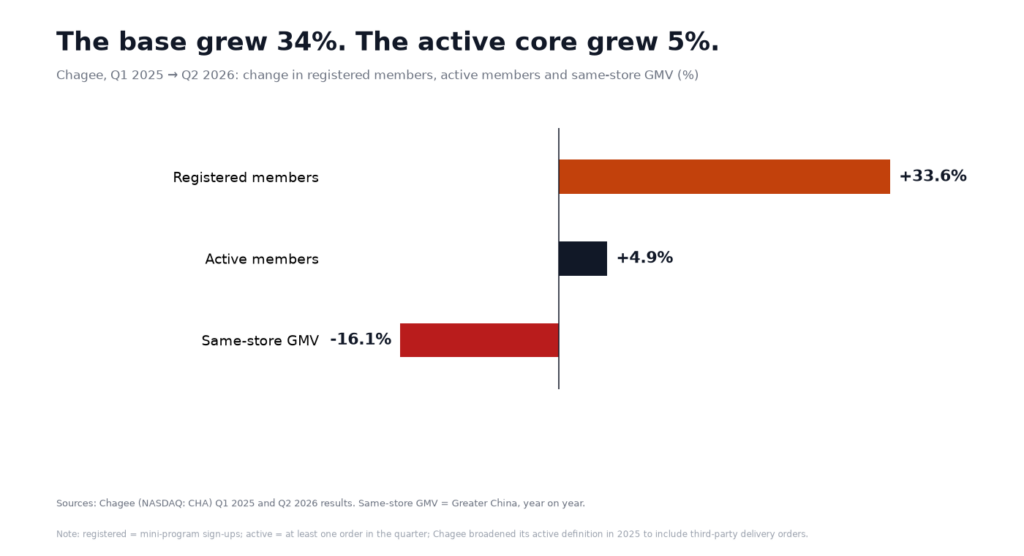
The active core is the tell, and it is remarkably consistent across operators. Chagee’s 257 million resolves to 47.1 million quarterly actives — about 18 per cent. Starbucks China’s 160 million members carry roughly 25 million 90-day actives, about 16 per cent. That second number is the one that pays rent: Starbucks took about 74 per cent of its China revenue from members in the December 2024 quarter, and it took it from the thin slice, not the headline. Worth adding that Chagee widened its definition of “active” in 2025 to include orders placed on third-party delivery platforms, so even the denominator is doing some work it shouldn’t.
The contrast that proves the mechanism is Luckin. It doesn’t ask. Ordering runs through its own container, so every purchase is identified by default rather than by persuasion; around 100 million people transact in a given month, and same-store sales at company-operated stores rose 7.5 per cent in fiscal 2025 after falling 16.7 per cent the year before. When identification is structural instead of optional, the active share is large enough to target — and targeting is where the money is.
Which brings us to the uncomfortable conclusion. The scan was never the asset. The scan is a receipt. The asset is the Thursday message that arrives with a specific reason and a plausible time, and that message costs money to write, test, defend and keep sending after the novelty wears off. Measured honestly, the health of a handoff is not member count. It is active share multiplied by cadence cost — the share of people who still transact, and what you are willing to spend to give them a reason.
Registration is free. Attention is not. Chains that confuse the two end up with a country-sized list and a corner-shop P&L.