From Footfall to Phone Number: The Digital Handoff That Makes One Visit Compound
It is 8:40 on a Monday morning in Shanghai, and the queue at the Luckin counter runs four deep. The woman ahead of you pays with her phone, waits ninety seconds, takes the cup, and starts to turn away. Then the barista does something that would look odd in most American chains: she swivels the payment screen around and points at a QR code. Join the membership, take a coupon, save five yuan on the next cup. The woman scans. Eleven seconds.
By the time she reaches the door, the brand is holding her phone number, her order history, her usual store, her sugar preference, a coupon with a seven-day clock on it, and a scheduled message for Thursday afternoon.
In a Western chain, that same eleven seconds is where the relationship ends. In China, it is where the relationship starts — and that single difference explains a lot about why the two markets produce such different retail economics.
The visit that ends at the door
The traditional chain store treats a visit as a terminal event. You walk in, you buy, you walk out. The receipt is the last artifact the store ever creates about you, and the store’s plan for your return is a hope plus a plastic loyalty card that lives in a wallet and dies there.
Sit with how little a terminal visit actually teaches you. Someone came. They bought something, roughly. You do not know who they are, whether they will return, what would bring them back, or which of your four nearby stores they actually prefer. Footfall gets counted; identity does not. The visit is a data void with a sales figure stapled to it.
That used to be an acceptable trade, because traffic was cheap and repeat purchase could be left to the product. It is no longer acceptable, for two measured reasons.
First, the traffic itself is thinning. The China Chain Store & Franchise Association’s 2024 survey of life-services chains found only 48 per cent reporting in-store footfall growth, down from 66 per cent a year earlier, while the share reporting declines jumped from 3 per cent to 19 per cent. Rents rose about 5 per cent in the same period, and 71 per cent of those chains increased digital spending.
Second, the basket is thinning too. Bain & Company’s 2025 China Shopper Report, produced with Worldpanel, recorded fast-moving consumer goods volume up 3.8 per cent across the first three quarters of 2025 while average selling prices fell 2.4 per cent.
Put those together and you get the operating problem in one sentence: you are selling more units for less money, in a channel whose rent went up. The scarce input is no longer the product. It is the identifiable customer who comes back without being paid to.
The handoff, move by move
What China’s chains built is not a loyalty programme with better graphics. It is a handoff protocol — five moves that fire in sequence at the counter, and it can be described precisely enough to copy.
One, the trigger. A QR code appears at the counter, the table, or the door. The timing is the whole trick: the scan happens when the customer has already committed — basket built, queue endured, payment open. That is the highest-intent moment retail ever gets, and it beats every ad impression you will ever buy.
Two, the bait. A benefit with a deadline attached. A first-order coupon, a member price, a birthday allowance, a priority slot on a new release. The deadline is not decoration; it is the reason the scan becomes a visit rather than a subscription.
Three, the enrolment. The destination is deliberately light. A mini-program inside WeChat, a membership account, a group chat. No download, no password, no app-store detour. An app install is a thirty-second ask and most people decline it. A mini-program is a three-second ask.
Four, the re-engagement. The nudge arrives on a channel the brand controls — reorder reminder, replenishment prompt, member-only drop — rather than inside a feed it rents by the impression.
Five, the loop. The return visit updates the profile, the profile sharpens the nudge, the nudge produces the next return visit. The store stops being an endpoint in a journey and becomes a node in a cycle.
There is a cleaner way to say it. A terminal store is a vending machine with a door. A handoff store is a door with a hinge — it can be pushed open again from the outside.
Four member bases, four different definitions
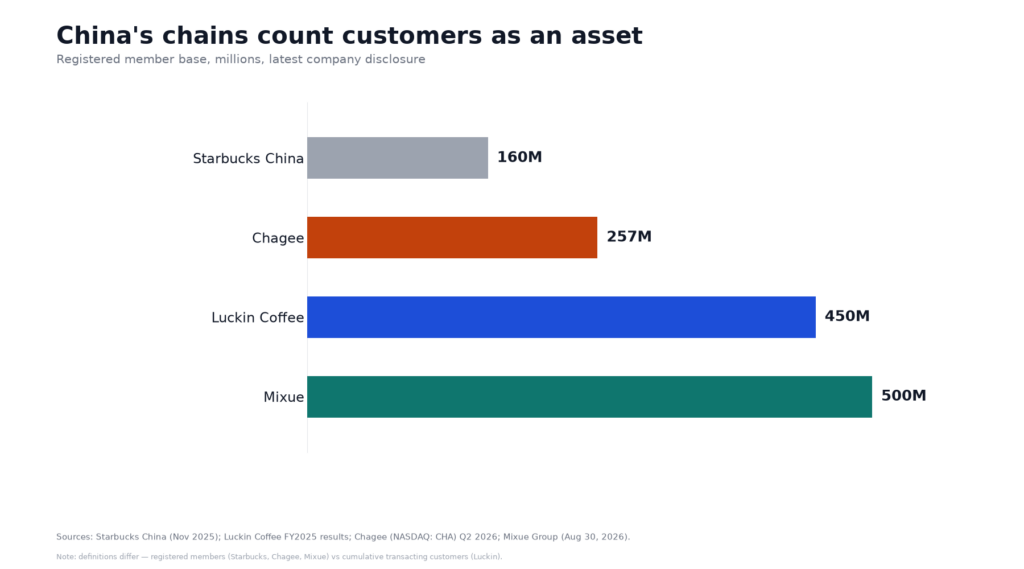
The numbers are the kind that make Western retail executives reach for a calculator. Mixue reports 500 million members. Luckin counts 450 million cumulative transacting customers, with 94.15 million transacting in an average month during 2025. Chagee’s mini-program carries 257 million registered members. Starbucks China passed 160 million members in November 2025, of whom roughly 25 million had ordered in the previous 90 days.
Read those carefully, though, because the definitions are doing different work. Mixue, Chagee and Starbucks count registrations. Luckin counts anyone who has ever transacted. The comparison tells you about intent, not accounting.
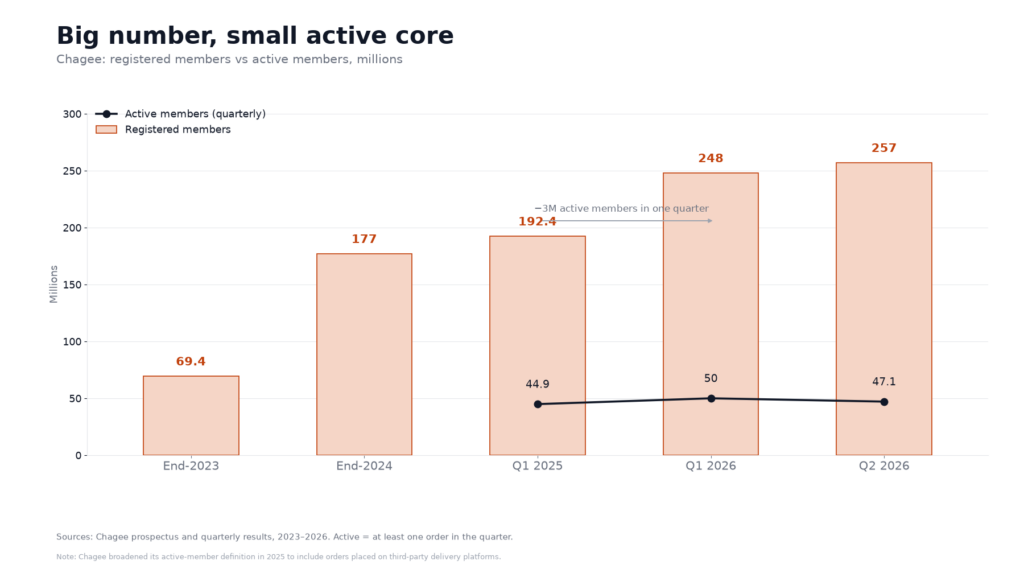
And the intent is visible in a second number that almost nobody quotes: the active core. Starbucks’ 160 million registrations come with about 25 million 90-day actives — roughly 16 per cent. Chagee’s 257 million resolves to 47.1 million quarterly actives, about 18 per cent. The headline number measures reach. The active core measures whether the handoff is actually working. Confuse the two and you will build a member base the size of a country and a P&L the size of a corner shop.
Starbucks China: 160 million members, one habit
Starbucks is the clearest case of a Western brand running the China playbook, and the clearest case of how far the playbook can carry you.
In the quarter ended December 2024, member sales accounted for about 74 per cent of Starbucks’ China revenue — a figure that makes the membership the business rather than a promotion attached to it. By the close of fiscal 2025 in September, 90-day active members had reached 25.5 million, a record for the market, on 8,011 stores and full-year revenue of 3.105 billion US dollars.
The mechanics drifted upward over time, from discount to status. The programme expanded to four tiers in June 2024. It was cross-linked with China Eastern Airlines, creating a combined pool of roughly 200 million members, and with the hotel group Atour in January 2026. The brand also invented a recurring event: the seventeenth of every month, when members’ reward stars multiply, occasionally by up to a hundred.
Notice what that calendar does. It converts an open-ended loyalty scheme into a scheduled reason to visit — a cadence, not a blast.
Then, in April 2026, the structure changed. Starbucks completed a joint venture with Boyu Capital, which took 60 per cent of the China retail business while Starbucks kept 40 per cent, the brand and the intellectual property. Roughly 8,000 company-operated stores move to a licensed model, under a stated long-term target of 20,000 stores and a plan to reach 1,500 county-level districts within three years.
That transaction is worth reading twice. A member asset of 160 million people does not grow into lower-tier cities on its own; it needs a local operator with local property access and local cost discipline. The handoff is a marketing mechanism, but scaling it is an ownership question.
Luckin: the handoff that is not optional
Luckin’s version is structurally different, and more instructive for anyone trying to copy it.
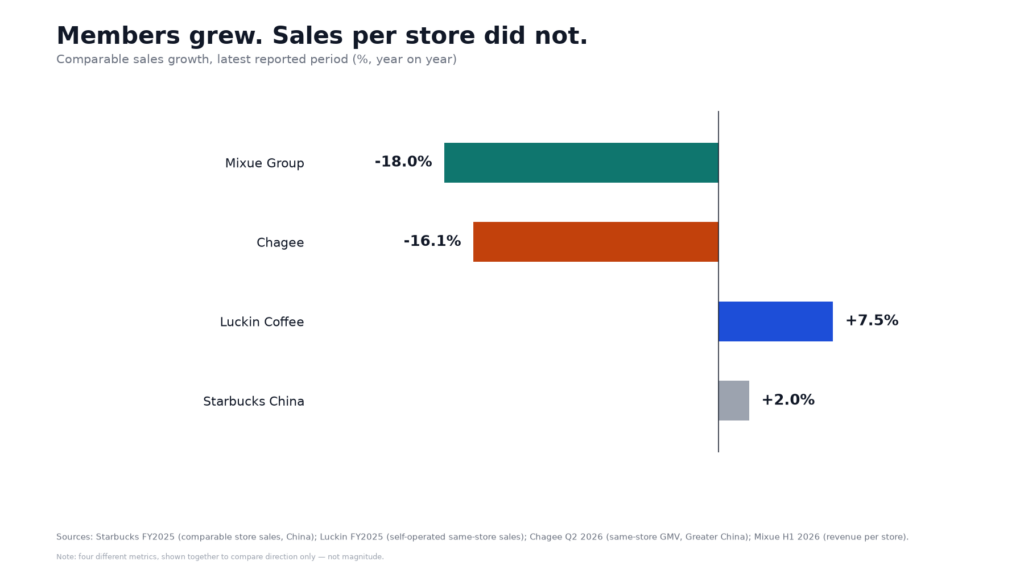
Fiscal 2025 closed with 31,048 stores, 49.29 billion yuan in revenue — up 43 per cent — and 450 million cumulative transacting customers. Average monthly transacting customers hit 94.15 million, and from June 2025 the company ran five consecutive months above 100 million. Same-store sales at company-operated stores swung from minus 16.7 per cent in 2024 to plus 7.5 per cent in 2025.
But the number that matters for this argument is not any of those. It is that ordering runs through the brand’s own digital container by default. There is no counter conversation in which a cashier must remember to ask. Identity is captured before the drink exists. The handoff has no friction to overcome because it is the only path to purchase.
Most Western chains have built the opposite: a POS that takes any card, a loyalty programme that asks politely, and an opt-in rate in the single digits. You cannot fix an opt-in problem with better signage. You fix it by making the identified path the easy path.
Chagee: 78 per cent of orders from repeat buyers, and stores down 16 per cent
Here is the uncomfortable case, and the one I would put in front of any board that believes member growth is a strategy on its own.
Chagee finished the second quarter of 2026 with 257 million registered members and 7,639 stores. Its active members repurchased at above 43 per cent, and more than 78 per cent of orders came from customers buying for at least the second time. Those are extraordinary loyalty numbers by any standard.
Same-store gross merchandise value in Greater China still fell 16.1 per cent in that quarter, after a 16 per cent decline in the first.
Both things are true at once, and the explanation is not mysterious. Chagee declined to join the 2025 delivery-platform subsidy war, arguing it would not buy market share with price. Traffic moved to discounted channels. Its member base kept growing anyway, from 69.4 million at the end of 2023 to 257 million now — a number that grew even while quarterly actives slipped from 50 million to 47.1 million.
So the handoff bought Chagee something real: a repeat-order share most brands would trade a year of margin for. What it did not buy was immunity. Loyalty is a permission slip, not a shield. It earns you the right to ask for the next visit. It does not guarantee the visit when a competitor is selling the same category at ten yuan.
Mixue: 500 million members, thinner stores
Mixue is the extreme case, and it clarifies where the handoff stops working.
In August 2026 the group announced 500 million members — roughly one in three people in China. It also runs 63,987 stores, 58 per cent of them in tier-three cities and below, and it closed the first half of 2026 with revenue up 2.3 per cent to 152.16 billion yuan while net profit fell 14.7 per cent, the first half-year decline since it listed. Average revenue per store dropped about 18 per cent, and the overseas store count actually shrank by 355.
At four to six yuan per cup, with a store roughly every 300 metres in dense districts, a member base stops behaving like a relationship and starts behaving like a distribution asset. The handoff still exists — the QR code is there, the membership is there — but its economics come from density and supply chain, not from intimacy.
Which is the useful warning: the handoff amplifies whatever your store economics already are. If your unit economics are good, it compounds them. If you are opening stores faster than demand can support, it broadcasts that too.
The shopping centres say the same thing
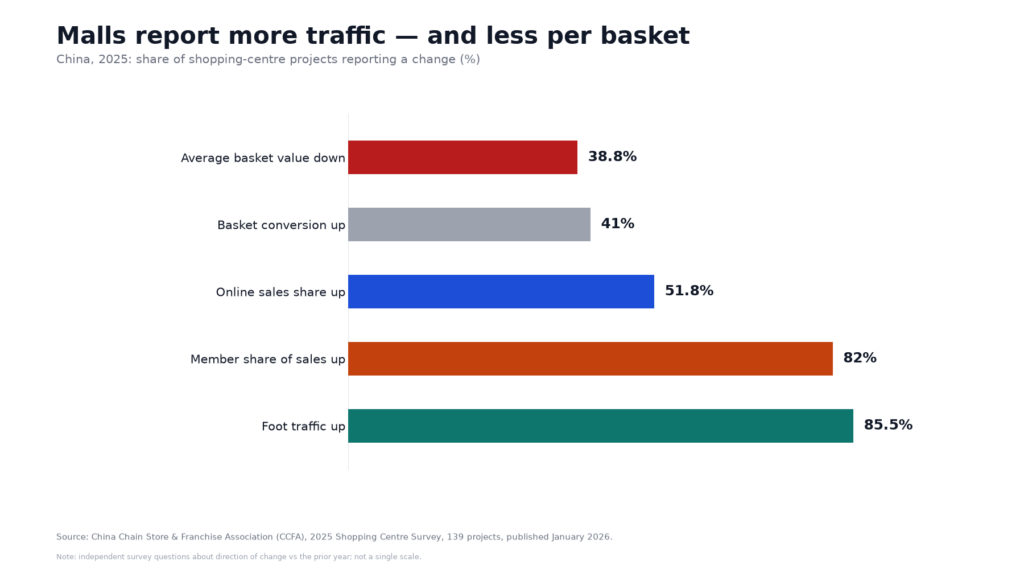
If you want the pattern without the brand narratives, look at what mall operators reported for 2025 in the China Chain Store & Franchise Association’s annual survey of 139 projects.
Foot traffic rose at 85.5 per cent of them. Member share of sales rose at 82 per cent. Online sales share rose at 51.8 per cent. Basket conversion rose at 41 per cent. Average basket value fell at 38.8 per cent.
That is the handoff described as an income statement. Traffic came back, spend per visit fell, and membership absorbed the difference. The association’s own conclusion was blunt: precise member segmentation, credible member value and repeat-purchase programmes are now core operating strategy, not marketing garnish. When an industry body starts talking like that, the mechanism has already moved from experiment to infrastructure.
The counter is a compliance surface
None of this is free, and the bill arrives in a place most marketing teams never audit.
On 18 June 2025, China’s national network-security notification centre published findings on 64 mobile applications tested between 23 May and 11 June. The list included Starbucks, Chagee, Cotti, Chayan Yuese, Heytea GO and Guming — in other words, the best-run chain operators in the country. The findings were unglamorous and specific: no route for users to withdraw consent, no convenient withdrawal mechanism, and no encryption or de-identification safeguards.
Read that as a design verdict rather than a scandal. The handoff is a personal-information collection event, and it is executed by a part-time barista at rush hour, in front of a queue, with a script that was probably written by the promotions team. If consent language, purpose limitation, retention periods and deletion paths are not built into that eleven-second flow, the flow is non-compliant by default — no matter how good the creative is.
The rules now in play are not vague. The Personal Information Protection Law sets the baseline; a four-ministry special campaign on personal-information protection ran through 2025; and the Regulations on the Administration of Network Data Security have applied since 1 January 2025. Testing is routine, and the results are published by name.
So treat consent as a feature of the funnel, not a legal appendix. One-screen consent at the scan. Separate opt-ins for separate purposes. A visible deletion path. Encryption and de-identification as defaults. Retention caps you can actually explain to a regulator.
Four ways Western chains get the handoff wrong
The app-install dead end. You build an app because apps feel serious, then spend the whole budget begging for downloads. The handoff dies at the store entrance. A mini-program or a lightweight web flow gets you the identity; the app can come later, for your best 5 per cent.
The permanent discount. If the scan is always worth five yuan off, you have not acquired a member, you have recruited a price shopper and taught her that your list price is fiction. Chagee’s 2025 experience is the cautionary version: refusing to discount cost it traffic, and its loyal core still showed up in large numbers — but the margin math was brutal either way.
The orphaned data. The till knows what was bought. The CRM knows who was messaged. Nothing connects them. You end up with a member base nobody can act on and a store team that never sees the customer’s history.
The blast where a cadence belongs. A handoff earns the right to a rhythm — replenishment timing, category seasons, a monthly event — not the right to send everything to everyone on Friday.
The playbook: six decisions
1. Instrument the visit. Three scan points — entry, table, payment — plus a staff script and a staff incentive. If the barista gains nothing from the handoff, the handoff does not happen.
2. Design the bait as a benefit with an expiry. Something the customer would want even if you were not watching: a member price, a priority slot, a birthday allowance.
3. Pick a destination you can genuinely operate. A mini-program, a membership account, a service group. The container matters less than whether your team can publish into it weekly without a vendor.
4. Engineer the second visit, not the second message. Schedule re-engagement against consumption cycles — the coffee runs out in four days, the milk tea in two, the shampoo in six weeks.
5. Measure the handoff, not the footfall. Handoff rate at the counter, 30-day repeat rate of captured customers, member share of revenue. Traffic tells you the weather; these tell you the business.
6. Build consent into the flow. Because the flow is now tested, published, and named.
The infrastructure to do this is already cheap in China, which is part of why the gap exists. WeChat reported 1.418 billion combined monthly active accounts in 2025, with mini-program daily actives above 650 million and annual mini-program transaction value above four trillion yuan; its enterprise-messaging tool serves more than 12 million organisations. Tencent does not publish these figures consistently across documents, so treat them as directional — but the direction is unambiguous.
What the handoff cannot do
It cannot fix a product nobody wants. It cannot outrun a price war, as Chagee and Mixue both demonstrate with numbers. It cannot give you ownership of an asset that lives inside someone else’s platform — your WeChat relationship is owned within WeChat, which is a hedge, not an escape. And it cannot run at 60,000 stores without training, tooling and a data layer that survives staff turnover.
The handoff is a multiplier. Multipliers do not rescue bad inputs; they enlarge them.
Where this goes next
Four things are already visible.
AI moves the handoff from manual to automatic. Recommendation, timing, message drafting and next-best-offer now run without a human in the loop. The risk is symmetrical: more messages, thinner consent, and a regulator that has already demonstrated it can name brands.
The mini-program is becoming the storefront. Ordering, membership and re-engagement are collapsing into one container, which means the handoff and the shop are no longer separate systems.
Instant retail extends the handoff past the door. Thirty-minute delivery turns the store into a node in a network, and the member profile becomes the routing table.
The chain and the corner shop are diverging. A 40-store group can now afford the tooling; a four-store group cannot. The handoff widens a gap that product quality alone used to narrow.
And one structural lesson from Starbucks’ joint venture: global brands increasingly need local operators to carry a member asset into 20,000 stores. Marketing built the mechanism. Ownership decides how far it travels.
The takeaway
China’s chain stores stopped treating a visit as a transaction and started treating it as a handoff — the one moment when a customer is physically present, already buying, and willing to spend eleven seconds becoming identifiable.
The mechanics are remarkably unglamorous: a QR code, a coupon with a deadline, a lightweight container, a nudged return, a profile that sharpens with each loop. What made it compound is that China’s operators ran it at every store, on every visit, as infrastructure rather than campaign.
The arithmetic is honest about the limits. Chagee holds 257 million members, takes more than 78 per cent of its orders from repeat buyers, and still watched same-store sales fall 16 per cent. Mixue holds 500 million members and still gave up 18 per cent of revenue per store. A member base is not a moat. It is a permission slip — valuable, revocable, and only as good as the next reason you give someone to come back.