The Economics Behind China’s Ingredient War: Why Mandatory Disclosure Made Every Claim Worth Less
There is a contradiction sitting in the middle of China’s beauty numbers, and almost nobody explains it.
Domestic brands hold 57.4% of a market that passed CNY 1.1 trillion in 2025 — their fifth straight year of gains. In the same year, Proya and Botanee, the two companies that built that dominance, both posted their first revenue declines since listing.
The easy read is that competition got tougher. That is true, and it explains nothing. Competition always gets tougher. The question is what kind.
The mechanism starts with a filing requirement most Western brand teams treat as paperwork.
Under the Cosmetics Supervision and Administration Regulation, an efficacy claim in China cannot be a sentence. It has to be a substantiated document — a summary of the evaluation, uploaded to the regulator’s platform before the product is allowed to sell. That one rule changed the economics of the category in three moves.
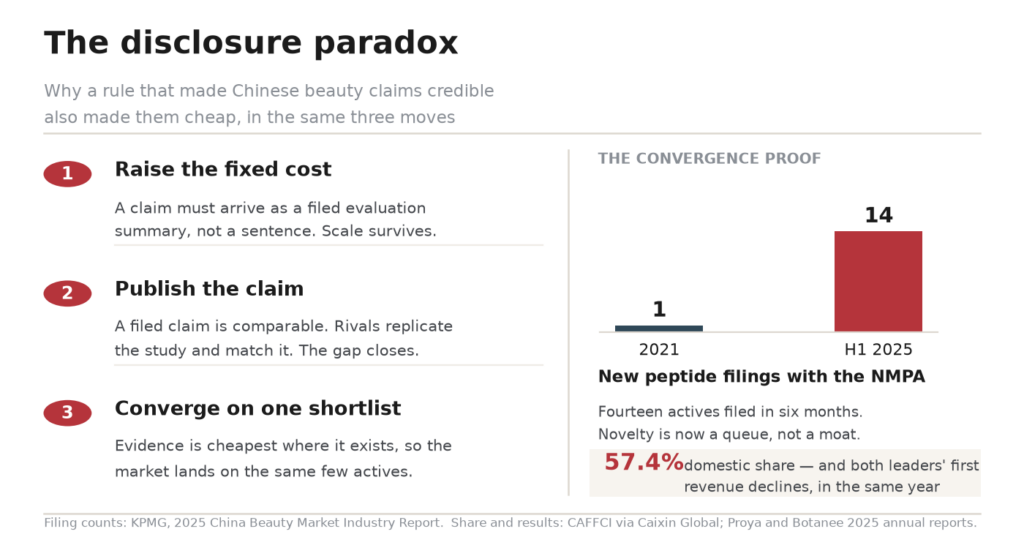
First, it raised the fixed cost of making a claim. You cannot test a headline in a focus group and ship it. You fund a study or you say nothing. Fixed costs favour scale, which is why share consolidated toward funded players — 57.4% domestic, and only about 12% of brands founded between 2016 and 2020 still standing after five years.
Second, it turned the claim into a public artefact. A filed claim is comparable. A competitor reads what you substantiated, commissions the equivalent study, and matches it. Information asymmetry — the ordinary source of margin in consumer goods — gets legislated out. The claim stops being an edge and becomes a licence to compete.
Third, it pushed the entire market toward the same molecules. Evidence is cheapest where it already exists. Niacinamide, retinol, ceramides, a short list of peptides: these are the actives with published literature and affordable endpoints. So a thousand brands converge on a shared shortlist, and differentiation collapses into a checklist.
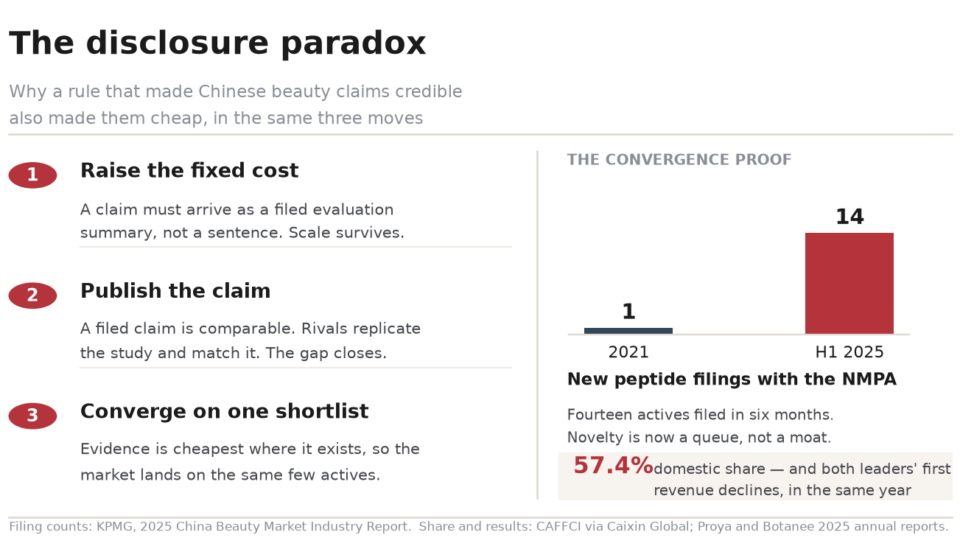
The filing data is the tell. China has recorded roughly 122 new cosmetic ingredient filings in total, and peptide filings alone went from 1 in 2021 to 14 in the first half of 2025. Novelty is no longer a moat. It is a queue.
Which produces the strange outcome: a regulation designed to make claims credible also made them cheap. The market became more honest and less profitable in the same movement. Those two things were never in tension — they were the same policy.
The escape route is visible in the same dataset. If claims are copyable, the only defensible inventory is evidence nobody can replicate: a proprietary molecule, a clinical endpoint specific to your formulation, outcomes measured over twelve months instead of four weeks. That is what 3.24% of revenue going into R&D, and municipal subsidies of CNY 1–2 million per newly filed ingredient, are actually buying. Not marketing material. Scarcity.
For a global brand, the strategic question inverts. It is no longer “what is our claim for China?” It is “what do we know that a competitor cannot file within eighteen months?”
In a disclosure regime, the only asset that appreciates is proof nobody else can produce.