200 Million People a Month Ask Xiaohongshu What to Buy
Xiaohongshu Is Becoming the Place Chinese Consumers Ask Before They Buy
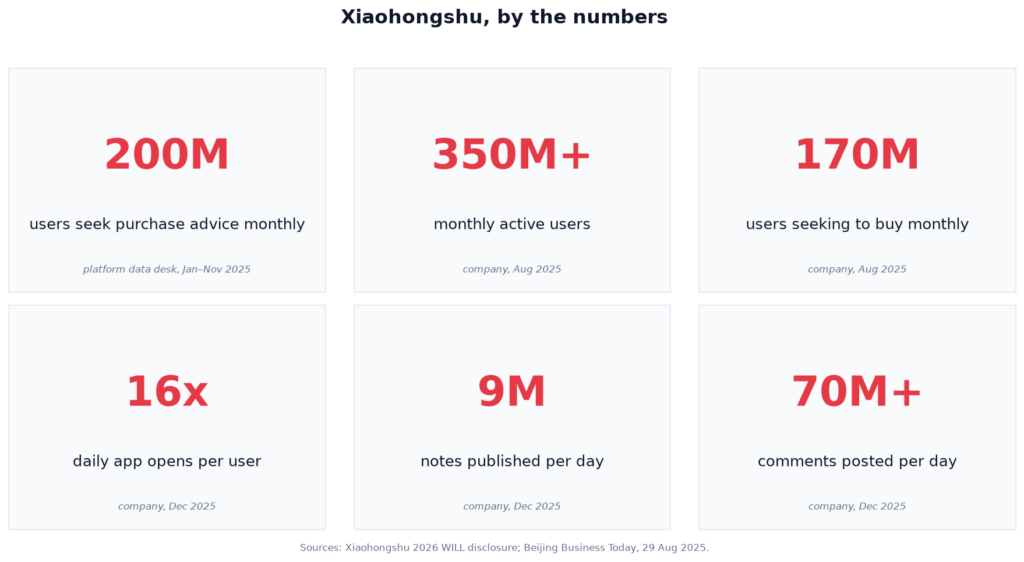
About 200 million people a month open Xiaohongshu to ask what to buy. Not to admire someone else’s holiday, not to post lunch. To ask. The figure comes from the platform’s own internal data and covers January to November 2025; it was shown on stage at the company’s 2026 WILL conference in Shanghai in late December 2025.
The same briefing added a few other habits. Users open the app 16 times a day. The community is organised around more than 2,500 interest categories. Nine million notes are published every day, and those notes collect more than 70 million comments.
Put those four numbers next to each other and the argument makes itself. Call it a decision engine with a social feed attached, because that is what the usage pattern describes. Most budgets still treat it as the feed.
What the platform actually put on stage
| Metric | Figure | Period | Who said it |
|---|---|---|---|
| Monthly active users | More than 350 million | August 2025 | Company, to Beijing Business Today |
| Users seeking to buy each month | 170 million | August 2025 | Company, same briefing |
| Users seeking purchase advice each month | About 200 million | Jan–Nov 2025 | Platform data desk, WILL 2026 |
| Daily opens per user | 16 | December 2025 | Company, WILL 2026 |
| Notes published per day | More than 9 million | December 2025 | Company, WILL 2026 |
| Comments per day | More than 70 million | December 2025 | Company, WILL 2026 |
| Share of monthly users who search | 70 percent | December 2023 | COO, public remarks |
| Daily opens during Double 11 | 16.6, first among e-commerce apps | November 2025 | QuestMobile |
The user count is the least interesting number
It is also the softest. Xiaohongshu is a private company and publishes no audited user counts. The 350 million figure in August 2025 came from the company itself, which makes it the best number available — though still an unaudited one. Third-party trackers will give you different totals on different days, and none of them explain their panels.
That is why the purchase-intent figures matter more. A monthly active user is someone who installed the app and opened it. A person asking where to buy a stroller for a nine-kilogram toddler is someone in the middle of a decision, with a wallet already open. Two hundred million of those a month is a far more consequential number.
The composition is worth holding in mind too. QuestMobile measured the platform’s users in October 2025 and found 54.2 percent under 30, with 37.2 percent living in tier-one or new tier-one cities. Young, urban, and unusually willing to spend time deciding. Every downstream claim about where the money is inherits those two numbers.
China lost 96 million search-engine users in twelve months
Here is where the story stops being about one app.
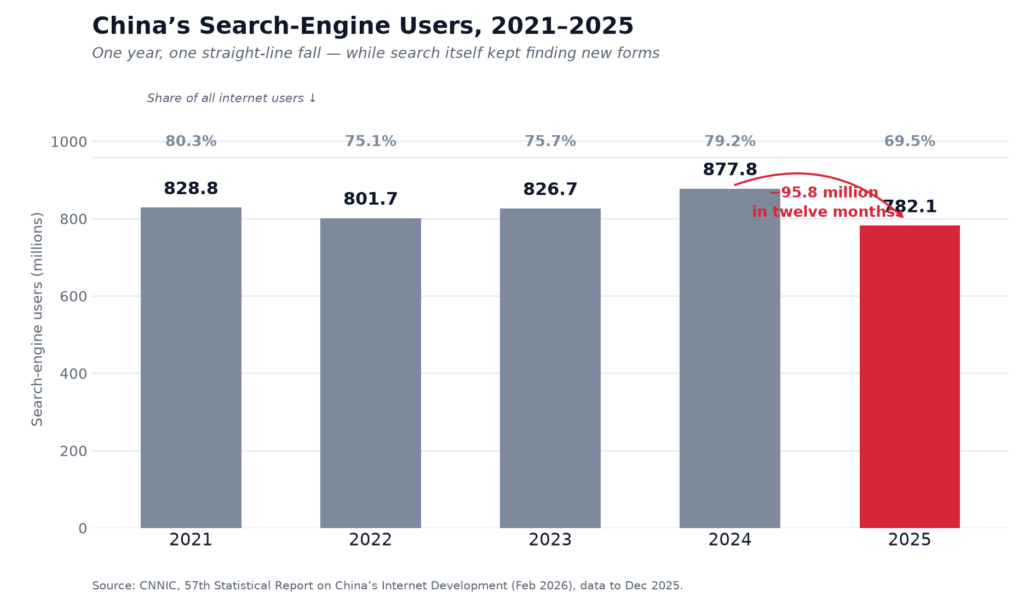
CNNIC, China’s internet statistics body, published its 57th national internet report in February 2026, covering December 2025. China had 1.125 billion internet users, 80.1 percent of the population. And the search-engine category, which the same survey had recorded at 877.8 million users a year earlier, came in at 782.1 million. A fall of 95.8 million people, or 9.7 percentage points of penetration, in a single year.
| December | Search-engine users | Share of internet users |
|---|---|---|
| 2021 | 828.8 million | 80.3 percent |
| 2022 | 801.7 million | 75.1 percent |
| 2023 | 826.7 million | 75.7 percent |
| 2024 | 877.8 million | 79.2 percent |
| 2025 | 782.1 million | 69.5 percent |
Set that against the social figure in the same report: 1.114 billion social-network users, 98.9 percent of everyone online, up 12.4 million on the year. In China, social is not a channel. It is the floor.
A definition that is collapsing in real time
Read the search drop with care. CNNIC counts a product category, and product categories wobble when the products change shape. The report itself notes that search firms spent 2025 rebuilding around AI answers, that smart-search tools now reply instead of listing links, and that the old advertising model underneath keyword search is running into trouble.
So the honest reading is narrower than the headline. Chinese users did not stop needing answers. The place they go for answers stopped looking like a search engine, and the survey’s label stopped catching them. Treat the 96 million as evidence that the category is being redefined, not as a body count.
How a feed teaches the words people later type
Now go back to the 200 million. What are they typing?
Mostly not brand names. They type the sentence the feed taught them. A note about a serum for a compromised skin barrier gives a reader a phrase; three weeks later that reader types the phrase into the same app, because the phrase now feels like something they know. The note did the naming. The search bar collects the result.
This is why the 70 percent figure, first stated publicly by the platform’s chief operating officer in December 2023, has held up so well. Searching is not a separate job users do on the side. It is the second half of the same behaviour: encounter, save, verify.
Three machines, three kinds of intent
| Layer | What the user brings | What the system returns | What it is good for |
|---|---|---|---|
| Feed | Nothing but attention | A guess about who you are becoming | Creating demand |
| In-app search | A category plus a constraint | Notes ranked on saves and completion | Validating a shortlist |
| AI answer | A full question | A summarised recommendation | Closing, or killing, the idea |
A web search box is asked open questions: what is this, how do I fix it, which one is cheaper. In-app search gets narrowed ones, because the person arriving has usually seen something already. Their queries read like category plus constraint, or brand plus verdict. That difference is where the content work lives, and most brand teams are still writing for the open question.
Why “seeking purchase advice” is not “search volume”
Three numbers get mixed up constantly, and the mix-up produces bad planning.
Search users are people who typed something at least once. Search volume is how many times they typed it. Purchase-advice seekers are people who arrived with a decision in front of them. The third is the smallest and the most valuable, and it is the only one this platform has actually disclosed.
Which brings up a related trap. The August 2025 figure of 170 million purchase-seeking users and the December 2025 figure of about 200 million purchase-advice seekers are not the same metric, measured twice. One counts intent to buy, the other counts requests for advice, and one is a point estimate while the other averages eleven months. Do not plot them as a growth line. Plot them as two readings taken from different instruments.
The commercial layer built on the search bar
Xiaohongshu has spent two years wiring the query to the checkout, and the results show up in its own numbers.
Advertising now runs on direct links that carry a reader from a sponsored note to a purchase page without a detour through an external app. The company said at the December briefing that the number of merchants using those links during the Double 11 festival was 109 percent higher than during the 618 festival, the mid-year shopping event. It also said more than 2,100 brands now share first-party data with the platform, which is the unglamorous plumbing behind retargeting that actually matches a person rather than a device.
Independent measurement of attention points the same way. QuestMobile put Xiaohongshu’s daily opens per user at 16.6 during Double 11, higher than any other shopping or content-commerce app in its panel. People were not browsing a mall. They were reading about things to buy in a mall.
What the numbers cannot tell you
Three gaps are worth naming before anyone turns these figures into a forecast.
There is no published series for in-app search volume, so any claim about search growth on this platform is storytelling. There is no audited audience figure. And there is no disclosure of how many of the 200 million convert, which means the distance between advice and revenue stays unmeasured from the outside.
What can be measured is behaviour that precedes a purchase. Whether a note is saved. Whether the comments contain questions rather than compliments. Whether brand-name queries rise in the weeks after a seeding push. Whether a sale lands four weeks after the click, in a window wide enough to see it.
The global picture: search still wins, but not where brands look
None of this is uniquely Chinese in its mechanics, and the newest global data says so plainly.
DataReportal’s Digital 2027 overview, built on Kepios and GWI analysis with figures current to October 2026, puts 6.15 billion people online, 73.9 percent of the world, and 5.81 billion social media user identities, equal to 69.9 percent of the population. About 2.17 billion people remain offline, which is to say the growth is nearly finished.
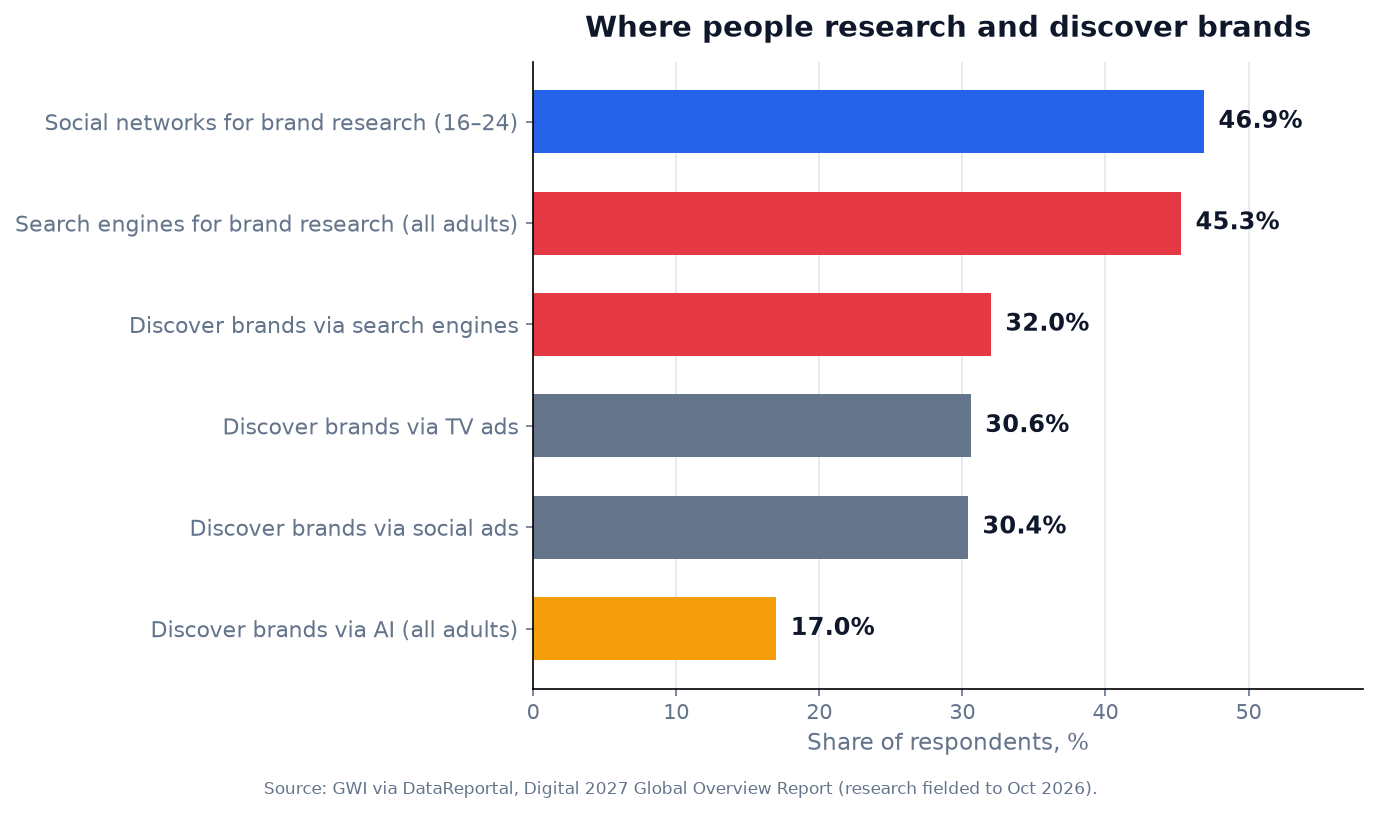
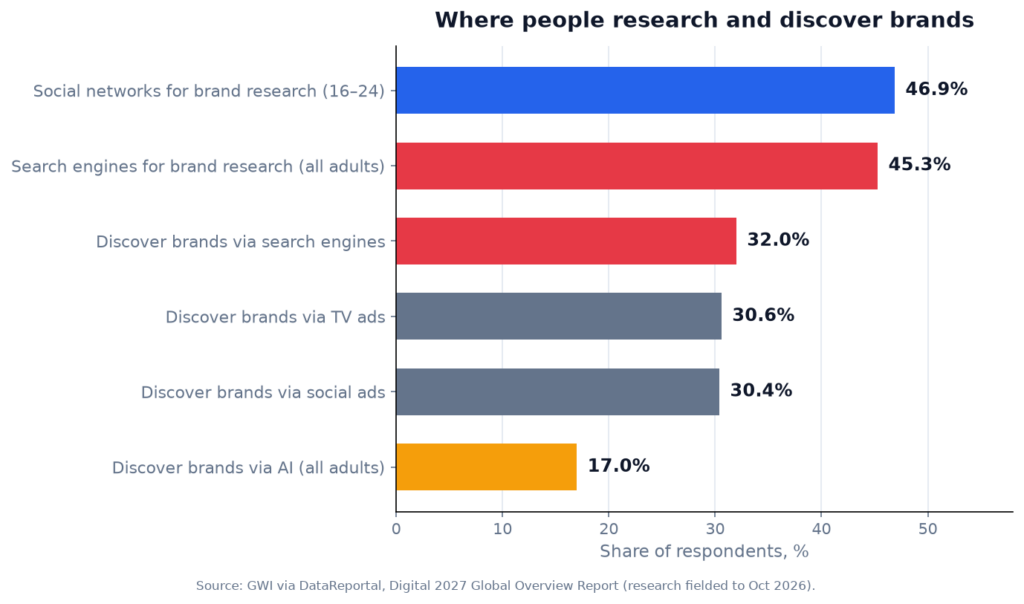
Inside that saturated market, search is not dying. It is still the top destination for researching a brand: 45.3 percent of online adults name search engines, ahead of every other channel. Search engines are also the top source of brand discovery at 32.0 percent, with television ads at 30.6 and social ads at 30.4. Four in five internet users, 80.3 percent, used a search platform in the past month.
But that last figure has slipped from 82.8 percent two years earlier, and the gap between “search is winning” and “search is growing” is where the whole strategic argument lives.
Age is the fault line
Split the same survey by cohort and the picture inverts.
Among internet users aged 16 to 24, social networks are the first place they go to research a brand, named by 46.9 percent. For users aged 65 and over, social ranks sixth. The feed-first habit is not a global norm. It is an age gradient, and the gradient is climbing.
That has a boring but useful implication for anyone selling outside China. You do not need a Chinese app to inherit this behaviour. You need an audience that came online after the feed did.
What AI does to the confirmation step
The AI story is usually told as a land grab. The data is less dramatic than the pitch.
Only 17.0 percent of online adults say they encounter new brands through AI, and among 16-to-24s the figure is 20 percent, which is not enough to place AI inside their top ten discovery channels. As a discovery layer, it is still small.
As a confirmation layer, it is something else. Answer engines summarise the notes, reviews and product pages that a person would otherwise read one by one, and they do it at the exact moment the old search bar used to be consulted. The question a marketer should be asking has moved accordingly: not whether this page ranks, but whether there is a clean, quotable claim inside it that a model can lift without distorting it.
Write paragraphs a model can lift
The practical version of that advice is unromantic. Say what the product is. Say who it suits. Say what it costs. Say what it does badly. Put a number in the sentence where a number belongs.
A page built from slogans gives a summariser nothing to work with, so it gets summarised into nothing. A page that answers the four questions above survives compression. That is not a new craft. It is the old craft, rewarded more directly.
Four things to watch in 2027
The next twelve months will settle most of the open questions in this brief, and each of them has a public number attached.
First, whether CNNIC’s search-engine series stabilises or falls again. A second consecutive drop would confirm that the category, not just the year, has moved.
Second, whether Xiaohongshu publishes audited audience figures. Any move toward a public listing would force the disclosure, and the 350 million number would finally get a footnote.
Third, whether AI’s share of brand research crosses a quarter of online adults. At 17 percent it is a side channel; at 25 it becomes the front door, and content formatting becomes a distribution decision.
Fourth, whether the direct-link commerce push holds its growth. A single festival comparison is a signal. Two years of it is a business model.
Frequently asked questions
How many people use Xiaohongshu each month?
The company told Beijing Business Today in August 2025 that monthly active users had passed 350 million. No audited figure exists, so treat it as company-reported scale rather than a measured population.
How many of them actually search?
The platform’s chief operating officer said in December 2023 that 70 percent of monthly users search. What the company disclosed more recently is narrower and more useful: about 200 million people a month arrive looking for purchase advice, per its own internal data for January to November 2025.
Did Chinese search-engine use really fall by 96 million people?
CNNIC recorded 782.1 million search-engine users in December 2025 against 877.8 million a year earlier. The report ties part of the pressure to AI-driven search products reshaping the category, so read the fall as a reclassification signal as much as a behaviour change.
Is this just influencer marketing with a Chinese name?
No. Influencer marketing buys reach against an audience. This model buys credibility inside a decision, and the unit of work is a note specific enough that a stranger saves it. The save is the metric, not the impression.
Does any of it transfer outside China?
The mechanism does, the platform does not. Wherever a feed is the front door and a search bar is the back door, the same sequence runs. DataReportal’s figures show the front door widening fastest among 16-to-24s, which is where the transfer will happen first.