Every few weeks, someone drops a new leaderboard into the team chat. This model scored 93 on some reasoning benchmark; that one topped a coding arena. And every few weeks, a content lead somewhere quietly asks the only question that matters: fine, but which one should write our product descriptions?
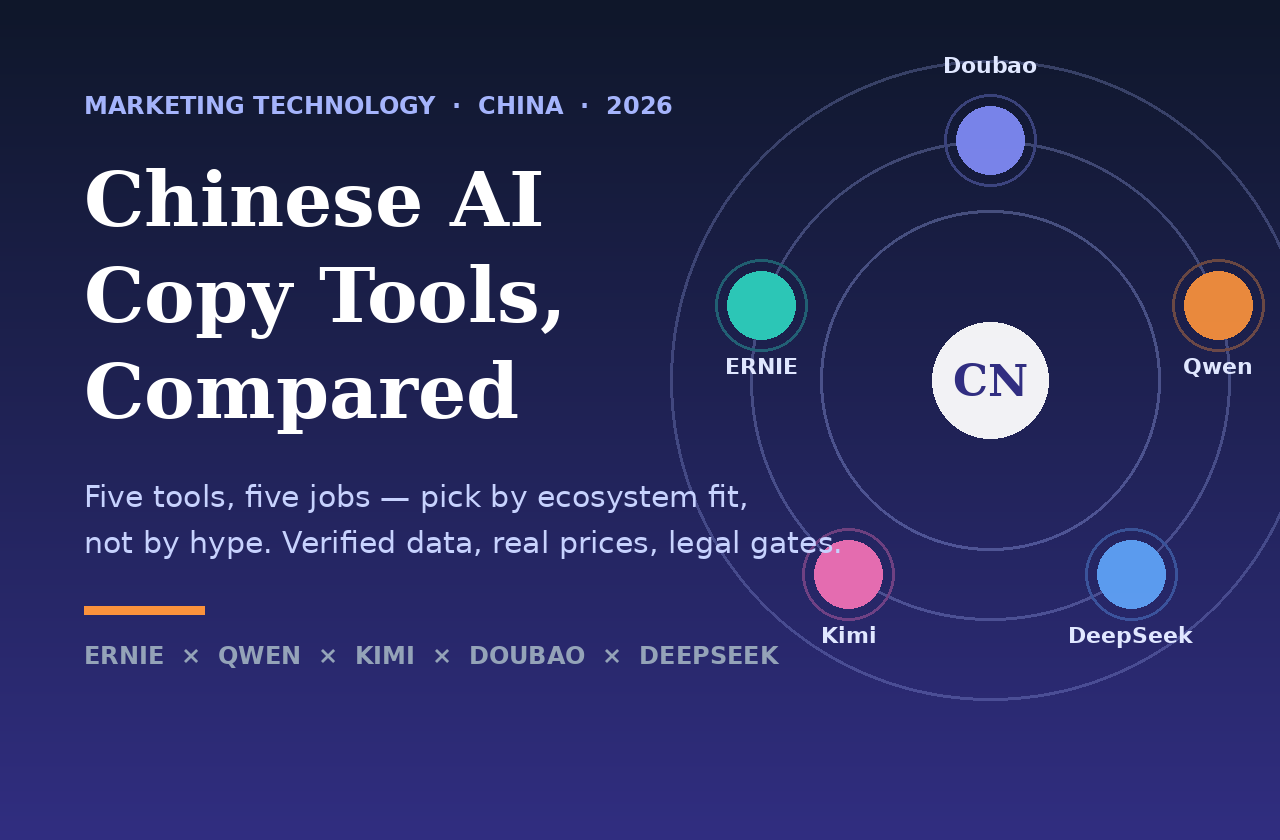
Here is the uncomfortable truth about China’s AI writing market in late 2026: it is not one leaderboard. It is five tools with different gravitational fields. Each is wired into a different ecosystem — search, commerce, documents, short video, developer APIs — and that wiring shapes your workflow far more than any benchmark score. Pick by the job and the ecosystem, and the tools feel like superpowers. Pick by hype, and you get fluent drafts that die at the compliance gate.
This piece gives you the map: verified scale data, a job-based decision matrix, real November 2026 prices, and the review workflow that makes any of these tools safe to ship.
The Market Behind the Hype
Start with size, because scale tells you where each vendor is investing. According to QuestMobile’s autumn 2026 report, released November 3, AI-native apps in China reached 546 million monthly active users in September — up 82.1% year over year. Doubao led with 419 million MAU (up 143.6%), Alibaba’s Qwen app hit 158 million (a staggering +5076.6% off a small base), and DeepSeek held 123 million, down 15.2% as casual users consolidated elsewhere.
Zoom out further and the picture gets bigger. CNNIC — China’s state internet registry — reported in September 2026 that generative AI users passed 700 million by mid-year, over 50% penetration. One in two Chinese citizens now uses these tools. And they are not just chatting: 37.6% use them for text work, and 32.5% for summaries, meeting minutes and slide decks. Writing is already a mass behavior, not an early-adopter toy.
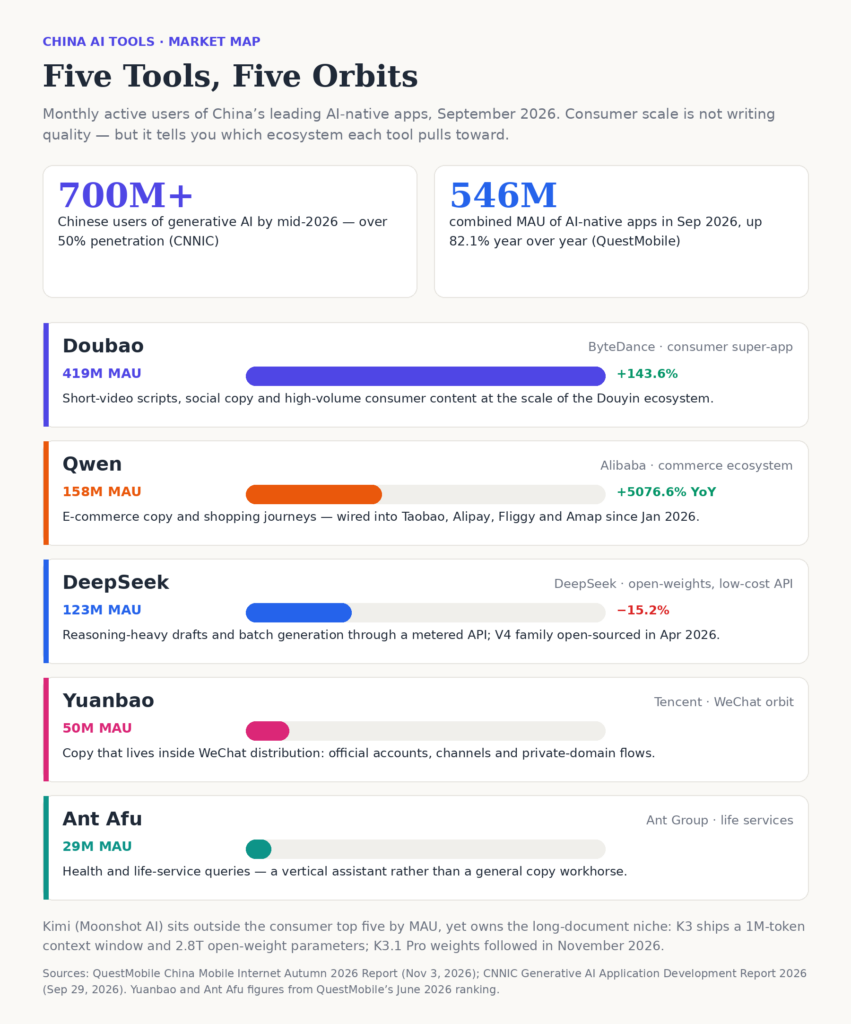
One caution before we go on: MAU measures consumer reach, not writing quality. DeepSeek’s app audience shrank while its API and open-weight models kept spreading through developer channels. Kimi barely registers in the consumer top five yet owns the long-document niche. Scale is context, not a verdict.
Five Tools, Five Gravitational Fields
ERNIE (Wenxin): the formal-register specialist
Baidu shipped ERNIE 5.0’s official release on January 22, 2026 — a 2.4-trillion-parameter, natively omni-modal model, following a November 2025 preview. Consumers meet it through the Wenxin app and website; enterprises call it through the Qianfan platform. Its center of gravity is Baidu’s search-and-knowledge orbit, and its house style leans toward polished, formal Chinese — which is exactly what press releases and official documents need.
Qwen (Tongyi): the commerce native
Alibaba’s consumer Qwen app went into public beta in November 2025 and crossed 100 million MAU within roughly two months. On January 15, 2026, it plugged into Taobao, Alipay, Fliggy and Amap with more than 400 task features; on May 11, it fully merged with Taobao, letting users select, compare and order from a catalog of over 4 billion listings inside a conversation — a launch Xinhua and People’s Daily both covered. For e-commerce teams, no other tool sits this close to the transaction.
Kimi: the long-document machine
Moonshot AI’s Kimi built its identity on lossless long-context reading — PDFs, Word files, entire research packs. The K3 model, launched July 17, 2026, carries 2.8 trillion total parameters (about 104 billion active) and a 1-million-token context window, with open weights released that July. In November 2026, Moonshot opened the full K3.1 Pro weights — per People’s Daily, the largest open-source model by parameter count. When your job is digesting 300 pages and producing a structured brief, this is still the specialist.
Doubao: the consumer-scale content engine
ByteDance’s Doubao is the volume king — 419 million MAU and, per Volcano Engine’s own June 2026 disclosure (vendor-reported, so treat as directional), 180 trillion tokens processed daily, a 1,500-fold rise in two years. The Doubao 2.1 Pro and Turbo models arrived June 23, 2026. Doubao lives in the same orbit as Douyin and Jianying (CapCut’s Chinese sibling), which makes it the shortest path from script idea to edited short video.
DeepSeek: the cost-efficiency workhorse
DeepSeek released and open-sourced its V4 preview family on April 24, 2026, and kept its reputation for aggressive pricing. It is the tool you reach for when you want reasoning-heavy drafts or batch generation through a metered API — and when you would rather own the pipeline than rent an app.
The Job-Based Decision Matrix
So which writes what? Here is the routing table we would actually hand a content team. These picks reflect ecosystem fit and documented strengths — not invented benchmark scores.
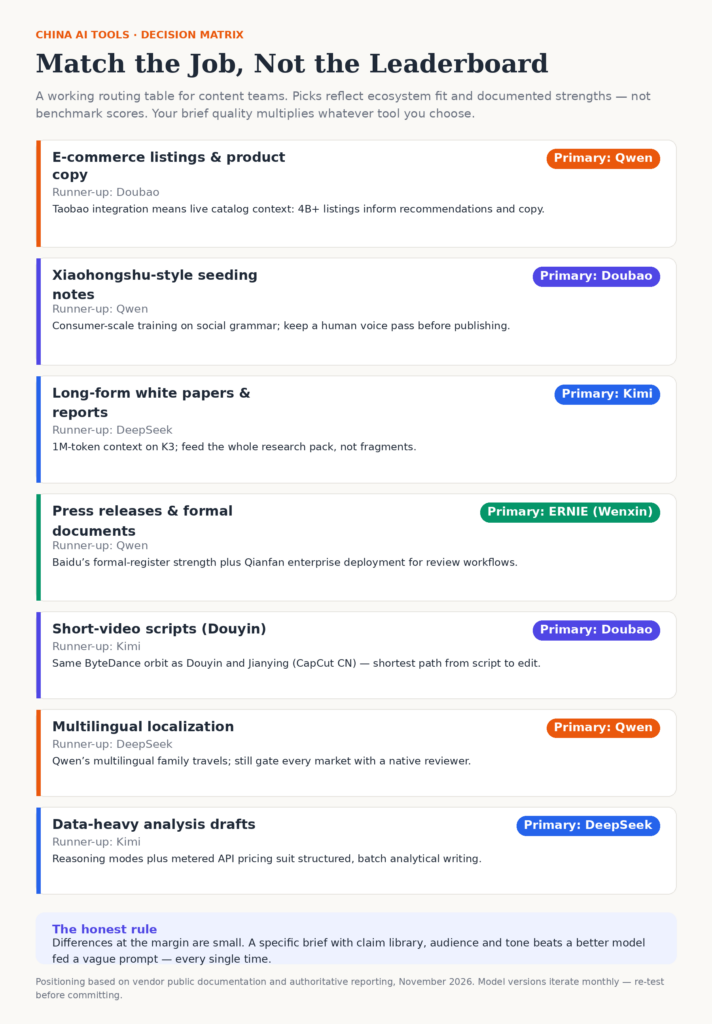
E-commerce listings go to Qwen first, because catalog context beats generic fluency. Xiaohongshu-style seeding notes and Douyin scripts go to Doubao, whose training diet is consumer social grammar. White papers and research syntheses go to Kimi, with DeepSeek as runner-up for reasoning-heavy analysis. Formal press releases favor ERNIE’s register. Localization leans on Qwen’s multilingual family — with a native reviewer in every market, no exceptions.
And here is the honest rule underneath the whole matrix: differences at the margin are small. A specific brief — audience, claim library, tone, banned words — fed to a mid-tier model beats a vague prompt fed to a frontier model, every single time. The brief is the multiplier. The tool is just the amplifier.
Ecosystem Integration Is the Real Product
Notice what actually differentiated those picks. Not prose quality — plumbing. ERNIE flows into Baidu’s marketing and enterprise stack through Qianfan. Qwen is fused with the Taobao–Alipay transaction loop. Doubao sits one app away from Jianying’s editing timeline. Kimi swallows your document folder whole. DeepSeek hands you an API and gets out of the way.
For an operations lead, integration depth beats raw writing quality, because it deletes steps. A slightly better sentence that requires three copy-paste hops costs more than a good-enough sentence that lands directly in your publishing flow. Map your pipeline first; choose the tool that shortens it.
The Compliance Layer Every Tool Shares
Now the part the leaderboards never mention: all five tools produce fluent Chinese that can fail China’s legal gates without human review. Two gates matter most.
Gate one: the Advertising Law
Article 9(3) of the PRC Advertising Law bans absolute superlatives — “national-level”, “highest-grade”, “best” and their equivalents. Article 57 sets fines of RMB 200,000 to 1,000,000. The State Administration for Market Regulation’s 2023 enforcement guide (Announcement No. 6 of 2023) softened the edges — narrow, provable, clearly scoped claims can survive — but the burden of proof sits with you. Language models love superlatives because superlatives are statistically persuasive. That is precisely the failure mode: an LLM will happily write the sentence that costs you a fine.
Gate two: AI-content labeling
Since September 1, 2025, the Labeling Measures issued by the Cyberspace Administration of China with three co-signing ministries — plus the mandatory national standard GB 45438-2025 — require explicit visible labels and implicit metadata tags on AI-generated content. Platforms verify; publishers must declare AI-generated material and use the platform’s labeling tools. Quietly stripping labels is itself a violation. Your workflow needs a labeling step, not a labeling afterthought.
The fix is tool-agnostic: maintain a claim library of pre-approved, evidenced statements; route every draft through a human gate that checks claims, register and banned words; log the review. None of the five vendors will do this for you.
The Cost Model: Tokens Are Cheap, Gates Are Not
Let’s put real numbers on the table. From DeepSeek’s official pricing page, read November 21, 2026: the deepseek-flash model (V4.1-Flash) costs $0.30 per million input tokens (cache miss) and $1.20 per million output tokens at peak — half that off-peak, where off-peak covers weekends, Chinese public holidays, and most hours outside Monday–Friday 01:00–04:00 and 06:00–10:00 UTC. The bigger V4 Pro runs $1.32 in / $3.96 out at peak. Doubao 2.1 Pro lists at RMB 6 per million input tokens and RMB 30 output (about $0.85 / $4.20), with the Turbo tier at half.
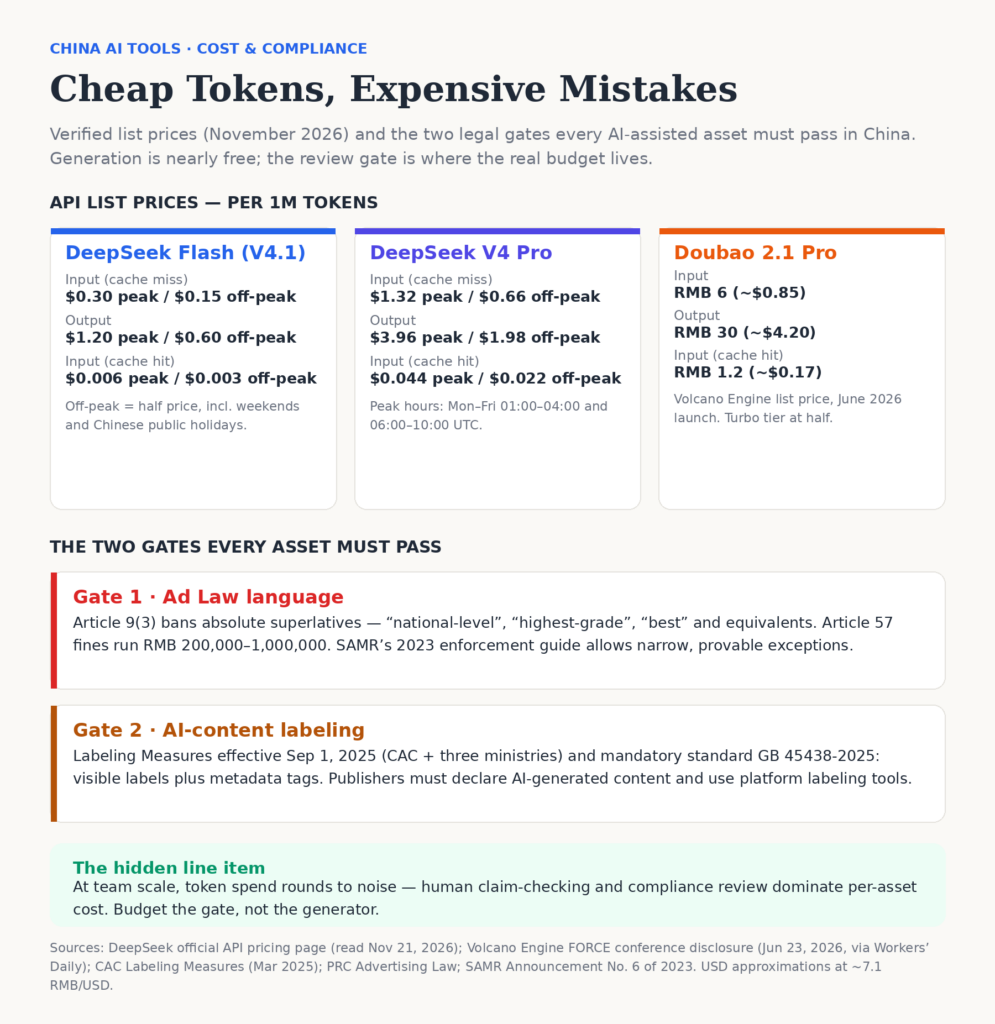
Do the per-asset math. A 1,500-character product description with a 3,000-token brief costs well under one US cent in tokens on DeepSeek Flash, off-peak. Even a hundred variants a day rounds to pocket change. The real line item is the human gate: if a reviewer spends six minutes checking claims and compliance on each asset, your per-asset cost is dominated by salary, not silicon. Budget the gate. Batch cheap drafts, schedule reviews, and measure gate throughput — that is where the money hides.
Consumer apps, meanwhile, remain largely free at the point of use, with paid tiers for heavier context and priority access. For most teams, start free, prove the workflow, then pay only where the API or a paid tier removes a real bottleneck.
The Multi-Tool Stack That Actually Works
The pattern we see across mature 2026 teams is not tool monogamy. It is a small, boring stack: one primary tool chosen for ecosystem fit, Kimi parked for long-document jobs, and a DeepSeek API key for batch generation and anything you want to script. Three seats, a routing table, done.
What you should not do is chase every release. Model versions now iterate monthly — DeepSeek shipped V4 in April and a Flash refresh by October; Moonshot went K3 to K3.1 Pro in four months. A team that re-platforms on every launch spends its year migrating prompts instead of shipping content. Lock the stack for a quarter; re-evaluate on a schedule, not on a headline.
Run a Bake-Off Before You Commit
Before locking anything, test on your own work. Take ten real tasks from your backlog — two listings, two seeding notes, a white-paper section, a press release, two scripts, a localization pair, an analysis draft. Feed each tool the same brief and the same claim library. Score four things: factual accuracy against your claims, voice fit, compliance gate pass rate, and turnaround speed.
Note what is absent from that scorecard: public benchmarks. An arena Elo tells you nothing about whether a model can hold your brand’s register while avoiding Article 9(3) landmines. Your ten tasks will. And re-run the bake-off whenever you consider switching — the market moves too fast for last year’s verdicts.
Honest Boundaries
A few things this article deliberately does not do. It does not rank writing quality with invented scores, because no credible head-to-head copywriting benchmark exists for these five tools. It timestamps every scale figure, because MAU tables from even six months ago are already stale — the Q1 numbers circulating in older decks have been superseded twice. And it flags vendor-disclosed metrics, like ByteDance’s token volumes, as self-reported. Prices were checked against current official pages on November 21, 2026; re-verify before you budget, because DeepSeek alone repriced four times in one spring.
The Verdict
China’s AI copy market rewards a simple discipline: choose by job, integrate by ecosystem, gate by human. Qwen if you sell on Taobao. Doubao if you live on Douyin. ERNIE if formality is the product. Kimi if the input is a mountain of documents. DeepSeek if you want cheap, scriptable horsepower. Then wrap whichever you pick in the same claim-library-plus-human-gate workflow — because in this market, fluency is free, and trust is the only thing you actually manufacture.