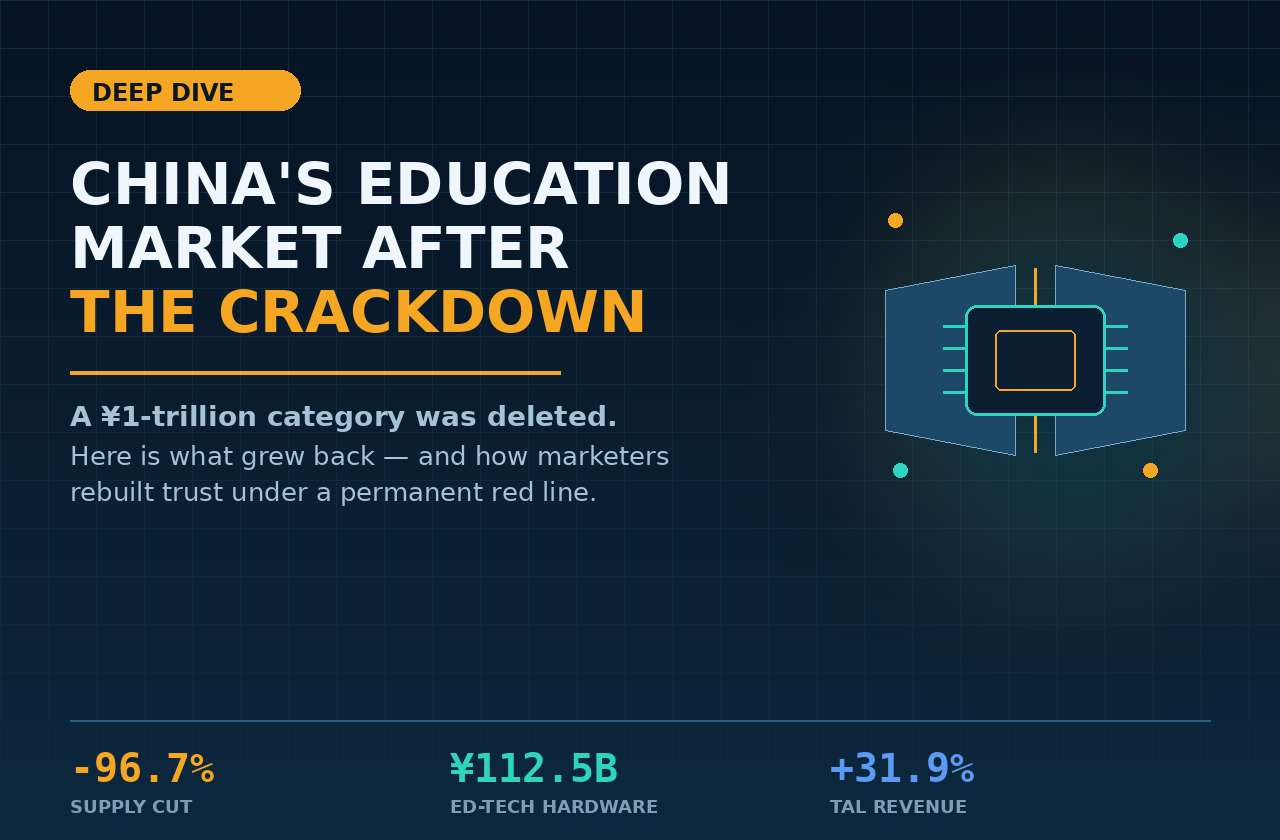
In July 2021, a policy memo did something regulation almost never does. It did not tax an industry, or cap it, or nudge it toward better behavior. It deleted the industry’s core product in a single stroke. Overnight, selling academic tutoring to a nine-year-old became illegal. Not expensive. Not discouraged. Illegal.
Here is the strange part: the demand did not disappear. Chinese families did not suddenly stop wanting their children to get ahead. Per-capita spending on education, culture and entertainment actually rose to ¥3,489 in 2025, up 9.4% year on year, according to the National Bureau of Statistics. The money merely changed doors. It slipped into art classes, coding camps, learning tablets, vocational credentials, and AI-assisted study tools.
That migration is the whole story of education marketing in China today. If you sell to parents, students, or lifelong learners here, you are not operating in the same market that existed before the crackdown. You are operating in its sequel — a smaller, more heavily policed, more trusting — and more profitable in places. This piece walks through what was banned, where the money went, who survived, and what any marketer can learn when a category is switched off by fiat.
1. What Double Reduction Actually Banned — and What It Left
The policy’s official name is the “Double Reduction” opinion, issued by the Communist Party’s Central Committee and the State Council. Its target was the twin burden of homework and off-campus tutoring on children in compulsory education — grades one through nine.
The bans were surgical. Providers of academic subjects in grades K-9 could no longer operate as for-profit companies. They could not raise outside capital. They were forbidden from advertising, from promising score gains, and from organizing classes on weekends, public holidays, or school breaks. Pre-paid fees, long a source of abuse, were pulled into escrow-style supervision.
But notice what the memo left standing. High-school tutoring. Non-academic training — sports, arts, coding, language enrichment. Adult education. Vocational programs. Educational hardware. None of these were outlawed. That distinction is the hinge everything else turns on. The state did not kill the desire to learn. It outlawed one specific, anxiety-fueled version of selling it.
2. The Supply Cut: The Largest Deliberate Market Shrinkage on Record
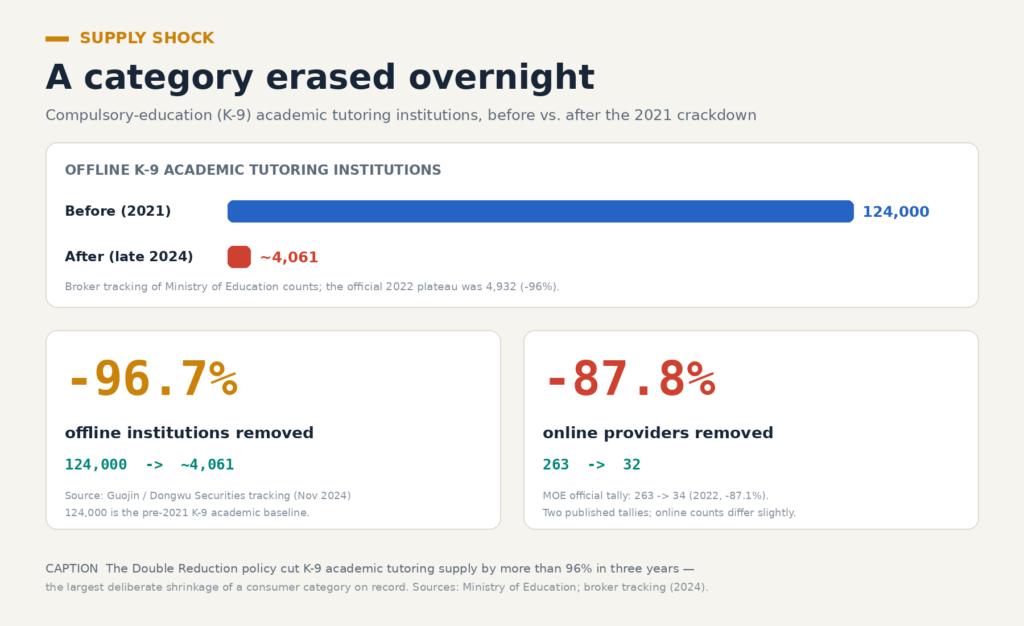
Then came the clearing. Nationwide, offline K-9 academic tutoring institutions fell from about 124,000 before 2021 to roughly 4,061 by late 2024 — a reduction of roughly 96.7%, according to broker tracking by Guojin and Dongwu Securities. The Ministry of Education’s own published count had already shown the collapse: down to 9,728 providers by early 2022, then 4,932 by that autumn. Online, the official tally fell from 263 licensed providers to 34, a drop of 87.1%.
Let that sink in for a second. In three years, more than 119,000 physical storefronts vanished. No war, no depression, no technological obsolescence did this. A regulation did. Economists do not have a tidy name for it, so let us simply call it the great clearing-out.
One caution, because numbers here are messy. The 96.7% figure comes from broker tracking, not a ministry press conference, and online counts differ slightly by source (34 in the official tally, 32 in the broker one). Industry figures in this market are estimates unless an official body says otherwise. We will keep flagging that.
3. Where the Demand Went
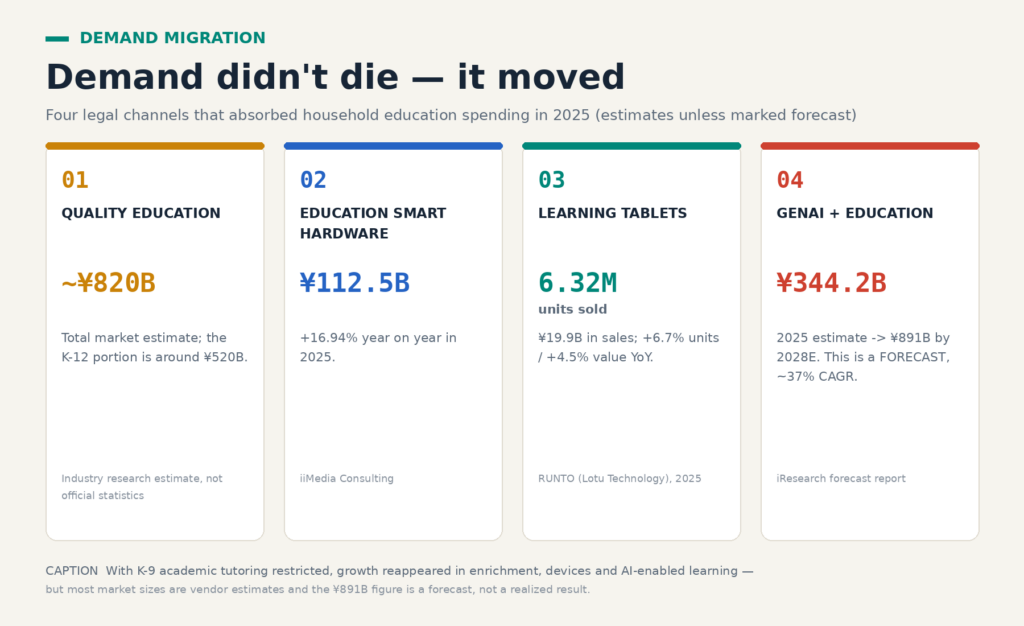
Demand is like water. Block one channel and it finds another. Four legal channels absorbed the money that used to flow into K-9 academic tutoring.
First, quality education — the catch-all for non-academic enrichment: English, logic and thinking skills, art, music, sports, coding, and study tours. Industry research firms put the 2025 market at roughly ¥820 billion, with the K-12 slice around ¥520 billion. Treat those as vendor estimates, not government statistics. Sports programs got a particular boost as physical education gained weight in the high-school entrance exam; study-tour and camp operators reported double-digit growth.
Second, high-school academic tutoring. It remained legal, and it is where a large share of the surviving demand concentrated. Pre-crackdown, iResearch estimated the K-12 academic tutoring market at ¥394.7 billion in 2019. The post-crackdown number is far smaller and almost impossible to pin down cleanly — which is itself the point. The transparent, licensed market shrank dramatically, even if private, informal arrangements never fully disappeared.
4. The Hardware Escape Hatch: Tutoring’s Legal Cousin
If you cannot sell a tutoring session, sell a machine that delivers one. That is the logic behind China’s education smart-hardware boom, and it is arguably the sharpest pivot in the entire industry.
The market for education smart hardware reached ¥112.5 billion in 2025, up 16.94% year on year, according to iiMedia Consulting. Within it, learning tablets are the biggest battleground. RUNTO (Lotu Technology) counted 6.32 million units sold across all channels in 2025, generating ¥19.9 billion in sales, up 6.7% and 4.5% respectively. The top eight brands — including Zuoyebang, Xueersi, and iFlytek — controlled 88.4% of the market.
A learning tablet is, in a very real sense, tutoring with a circuit board. It offers explanations, practice problems, and AI feedback without sending a teacher to your living room on a Sunday — the exact activity the regulation forbids. Regulators appear comfortable with that distinction. Marketers should understand why: a device is a product, not a service, and it does not sell the promise of a score.
One reality check before you get excited. The hardware market cooled sharply in 2026. Memory-chip prices climbed, the government subsidy that had pulled demand forward faded, and online sales during the June “618” festival fell about 18%. Growth is no longer guaranteed. A forecast from iResearch puts the broader “GenAI plus education” product-and-service market at ¥344.2 billion in 2025, compounding toward ¥891 billion by 2028 — but that is a forecast, not a result.
5. The Survivors’ P&Ls: Recovery, With an Asterisk
The listed education companies that made it through posted eye-catching numbers. Read them carefully.
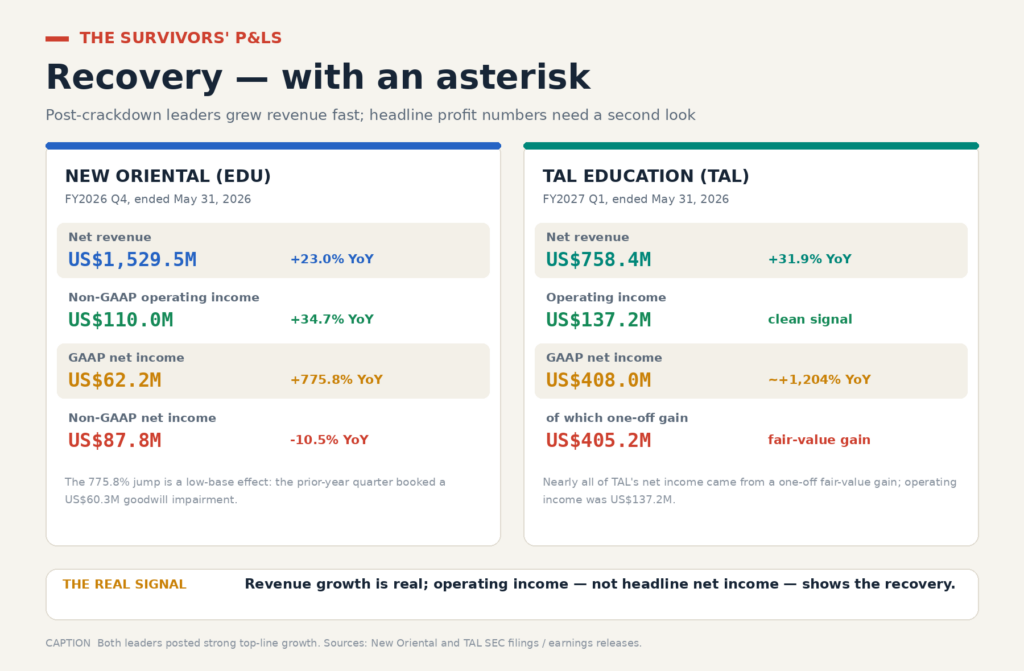
New Oriental’s fiscal fourth quarter ended May 31, 2026 brought net revenue of US$1,529.5 million, up 23.0% year on year. Non-GAAP operating income rose 34.7% to US$110.0 million — that is the clean signal of an operating recovery. The headline that made headlines, though, was net income “up 775.8%” to US$62.2 million. That jump is mostly an illusion: the year-ago quarter had booked a US$60.3 million goodwill impairment, creating a tiny base. Strip out one-offs and non-GAAP net income actually fell 10.5%, to US$87.8 million.
TAL Education’s fiscal first quarter tells a similar story with a different costume. Revenue grew 31.9% to US$758.4 million, and operating income was a healthier US$137.2 million. But the US$408 million net income figure — roughly 1,204% higher than a year earlier — was overwhelmingly driven by a one-off US$405.2 million fair-value gain on investments. Its quarterly report later swung back to a net loss when that gain reversed. Meanwhile, TAL’s learning devices crossed two million weekly active units, with about 80% weekly activity — a genuine product milestone buried under the accounting noise.
The lesson for marketers: top-line growth tells you the strategy is working; operating income tells you whether it is paying. Headline net income, in this sector, often tells you what the stock market did last quarter.
6. The New Funnel: From Anxiety Ads to Trust Ops
Before the crackdown, the education funnel ran on a fuel called fear. Ads showed a child falling behind, a parent failing their duty, a future slipping away. The message was simple: buy now or your kid loses. It worked brilliantly, until regulators decided it had worked too well.
Today the fuel is different. With advertising to K-9 students banned and score promises outlawed, the survivors rebuilt around trust. Private-domain communities — brand-owned WeChat groups and mini-programs — replaced mass media buys. Referrals from existing parents became the cheapest acquisition channel. Effect-proof content — visible learning outcomes, transparent teaching credentials, honest product demos — replaced hype.
The unit economics changed with the funnel. When you cannot buy a click with a fear-based ad, customer acquisition cost stops being a lever you can pull with money. It becomes something you earn through reputation, slowly, one satisfied parent at a time. That is a worse growth curve in month one and a far more durable one in year three.
7. Compliance as Strategy: The Permanent Cage
Do not mistake the current calm for deregulation. The cage is permanent, and the rules are only getting more precise.
Academic tutoring on weekends, holidays, and school breaks remains banned as a standing provision, not a temporary campaign. Summer enforcement drives now run annually, and in June 2026 twenty-seven provinces rolled out a new round of pre-paid-fee supervision rules. Non-academic providers are not merely “registered”; under the 2022 thirteen-ministry opinion they must be licensed in a “certificate first, license second” process, with education, sports, culture, and science authorities all weighing in.
Then there is the new frontier. In April 2026, five ministries — led by the Ministry of Education — jointly issued the “AI plus Education” Action Plan, the first document of its kind under the fifteenth five-year plan. It promises AI literacy in teacher training and a national education network. For marketers, this is both permission and a boundary: AI in education is encouraged, but claims about it must stay inside the truth.
Compliance here is not a legal chore to outsource. It is a moat. Every rule that made small, sloppy operators quit made the disciplined survivors stronger.
8. AI + Education: Enhance, Don’t Replace, Don’t Overclaim
Artificial intelligence is the industry’s most seductive story and its biggest trap. The opportunity is real: adaptive practice, instant feedback, and tutor copilots can genuinely improve learning, and the government’s new action plan gives the field a nod.
But the narrative that AI replaces teachers does not sell in China, and it would not be allowed to. The approved story is augmentation — AI as the teacher’s assistant, not the teacher’s substitute. Brands that shout “AI will replace tutors” are describing a future the regulator has no intention of green-lighting.
The marketing discipline is simple: demonstrate, don’t declare. Show the specific function — an error analysis, a speaking score, a study plan. Avoid the sweeping promise. In a market still nursing trust deficits after the crackdown and after years of exaggerated edtech claims, overclaiming is not just a legal risk. It is a brand risk.
9. Vocational and Silver-Market Education: The Blessed Adjacencies
Not every corner of education carries the same regulatory weight. Vocational training and education for older adults are the two areas the state actively encourages.
Vocational programs — from exam prep for civil-service posts to new-tech skills — sit under a policy umbrella that wants them to grow. The pull is real: PwC’s 2026 Global AI Jobs Barometer found that jobs requiring AI skills grew 69% over five years, versus 9% for the overall labor market, with a 62% wage premium attached. When the skills change that fast, adults pay to catch up. Market-size estimates for Chinese vocational training vary widely and are mostly vendor figures, so treat them as directional.
The silver market is quieter but stubborn. Senior universities and lifelong-learning programs for retirees are expanding, supported by policy and by a generation with time and savings. It is not glamorous, but in a marketing world obsessed with Gen Z, an underserved, trusting, cash-holding audience is worth a second look.
10. The Anxiety-Marketing Autopsy
It is worth asking what actually got the industry regulated. It was not tutoring itself. It was a particular kind of selling: manufactured fear, aggressive ads, debt-like pre-payments, and a public impression that a handful of companies were profiting from parental panic while children suffered.
That pattern is not unique to education. Any category built on fear — certain health products, financial services, parenting gadgets — can attract the same scrutiny. The lesson travels: when your growth engine is anxiety, regulation is not a risk you can insure against. It is a liability sitting on your balance sheet, waiting for a political moment.
The companies that survived Double Reduction were the ones whose value proposition could survive the removal of fear. That is a useful test for any brand, in any market.
11. Global Mirrors: Seoul, Silicon Valley, Bengaluru
China is not alone in using regulation to reshape a category. South Korea spent decades trying to cap its hagwon culture, imposing curfews and midnight shutdowns on private tutors. The results were mixed, because demand kept finding workarounds — a familiar story.
The United States saw the opposite in the 2020s: a tutoring boom, supercharged by pandemic learning loss and, later, by AI. India’s edtech sector swung from a funding frenzy to a painful correction when growth failed to match the valuations. Each market shows the same underlying truth: policy and capital shape the supply of education, but the demand is remarkably persistent. What changes is who gets to meet it, and under what rules.
12. The Playbook: Five Moves for Post-Crackdown Marketing
If you are marketing education in China now, or in any market heading down this road, here is the short version.
Lead with compliance. Treat licensing, fee supervision, and advertising limits as design constraints, not afterthoughts. Build effect-proof content. Outcomes, credentials, and demos beat promises. Own a private-domain channel. A brand community you control is worth more than rented reach. Bundle hardware, content, and service. Machines plus curriculum plus human support is the legal, durable version of the old tutoring session. And above all, sell relief, not fear. The anxiety funnel is the thing that drew the regulators in the first place.
Conclusion
Double Reduction deleted a product, not a desire. The academic-tutoring machine that once defined Chinese edtech is gone, and good riddance to its worst instincts. But the energy behind it flowed into enrichment, devices, vocational skills, and AI tools, creating a market that is smaller in one place and larger in others.
The marketers who win here are not the loudest. They are the most trusted, the most scrupulous, and the most patient. In a category where one policy memo can erase your product, trust is the only asset that cannot be regulated away.