Let’s start with a puzzle. Here is a market that crossed 476.9 billion yuan last year. It serves 411 million people online. It produced a company — JD Health — doing 73.4 billion yuan in annual revenue with 218 million active customers. By any normal business logic, that is a marketer’s dream.
Except it isn’t. Because in Chinese healthcare, the default setting is disbelief. Consumers assume the claim is a lie until somebody proves otherwise. We are not talking about healthy skepticism here. We are talking about a reflex, trained over a decade of hospital scandals, fake doctors in white coats, and supplement ads that promised the moon and delivered nothing.
So the real question is not how to reach these consumers. It is what you have to become before they will believe you. And in 2026, the answer changed in a way that would make most Western health marketers uncomfortable. Because the rules decided that in this category, trust is not something you communicate. It is something you are licensed, audited, and staffed to be.
The Trust Deficit Was Learned, Not Inherited
You cannot understand Chinese health marketing without understanding how the suspicion got installed. Older consumers remember the era when a search result could buy you a hospital bed, when a “doctor” in a promotional video was an actor, and when a bottle of health supplements claimed to cure everything from diabetes to baldness. The监管机构 cracked down, repeatedly. But the memory stayed.
The result is a consumer who verifies everything. Who cross-checks a health claim against three apps. Who trusts a pharmacist in a physical store more than a branded ad. Who assumes “natural” means “unproven” and “miracle” means “scam.”
For a global brand, this flips the usual playbook upside down. In a low-trust category, persuasion is almost worthless. The more you push a claim, the more you trigger the defense mechanism. What works instead is boring and expensive: visible credentials, traceable supply chains, a real human being in a white coat who can answer a question at 11 p.m.
That is not a creative problem. It is an infrastructure problem. Which is exactly why the winners here are not the best advertisers. They are the best operators.
The Numbers Are Real. So Is the Ceiling.
Let’s separate the solid figures from the noise, because this topic floats on a lot of recycled statistics.
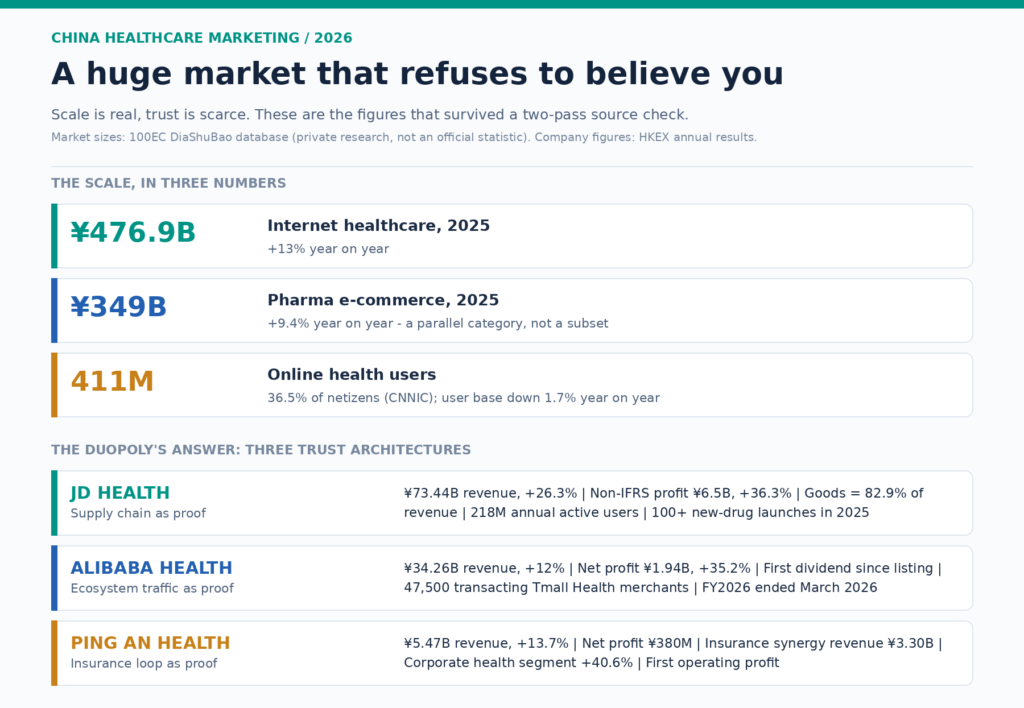
On scale: the 476.9 billion yuan internet-healthcare figure is a 2025 reading from 100EC, a private digital-economy think tank using its own DiaShuBao database. It grew 13 percent, but that growth rate has been sliding for years — from roughly 44 percent in 2021. A separate 349 billion yuan pharma e-commerce figure from the same source is a parallel category, not a subset of the first. Mixing them into one number is a common and lazy error.
On people: around 411 million people used online health services by late 2025, about 36.5 percent of China’s internet population, according to CNNIC, the country’s official internet regulator. Here is the detail everyone glosses over — that number actually fell slightly, about 1.7 percent year on year. The growth story has a ceiling, and we just hit it.
Here is what that means for you: the era of grabbing new health consumers is ending. The era of keeping the ones you have, by being provably trustworthy, has begun.
Three Companies, Three Trust Architectures
The platforms that won did not win on messaging. They won by building different kinds of proof.
JD Health: Supply Chain as Proof
JD Health’s 2025 results were the strongest in its history: 73.4 billion yuan in revenue, up 26.3 percent, with non-IFRS net profit of 6.5 billion yuan, up 36.3 percent. Goods — meaning actual medicine and health products sold — made up 82.9 percent of revenue. It launched more than 100 new drugs domestically, up from about 30 a year earlier.
Why does that matter for marketing? Because JD’s pitch is not “trust our ads.” It is “trust our warehouses.” Self-operated supply, controlled cold chains, over 300 owned pharmacies, and a traceability system that can prove where a box came from. In a market where counterfeit drugs are a genuine fear, logistics becomes a trust asset. The company spent years building something a marketing campaign cannot fake.
Alibaba Health: The Ecosystem Bet
Alibaba Health took a different route. Its fiscal year ending March 2026 brought 34.3 billion yuan in revenue, up 12 percent, with net profit of 1.94 billion yuan, up 35.2 percent — and its first-ever dividend since listing. It counted about 47,500 transacting merchants on Tmall Health.
The proof here is choice and infrastructure: a vast marketplace, an ecosystem that connects prescriptions, payments, and delivery, and the sheer gravitational pull of Alibaba’s consumer relationship. If JD says “we own the drug,” Alibaba says “we own the journey around the drug.”
Ping An Health: Insurance as the Loop
Ping An Health — formerly Ping An Good Doctor — is the smallest of the three but the most structurally interesting. Revenue of 5.47 billion yuan, up 13.7 percent, with net profit of 380 million yuan. Its insurance-synergy business alone brought in 3.3 billion yuan, and its corporate health segment grew over 40 percent.
This is theloop that Western marketers keep trying to build and rarely manage: insurance pays, the platform delivers care, and the patient never has to think about the bill. Trust here is not a feeling. It is a payment relationship.
O2O: The 30-Minute Trust Shortcut
Now consider the channel that quietly rewrote consumer expectations: buying medicine on demand and getting it in half an hour.
Meituan’s medicine delivery arm commands roughly 70 to 80 percent of China’s O2O drug market by most broker and industry estimates, working with more than 250,000 pharmacies. Night orders — roughly a third of demand — are not an edge case; they are the point. Someone sick at midnight does not want a brand story. They want a pharmacy that answers.
This matters because speed, in this context, is a trust signal. A 30-minute delivery from a licensed store with a real pharmacist feels more verifiable than a slick product page. Industry data also suggests only a tiny slice of online drug sales — around 3 percent by one widely cited channel breakdown — flow through hospital-affiliated pharmacies that complete a genuine consult-to-prescription-to-purchase path. B2C accounts for roughly 56 percent, O2O about 34 percent.
Let me be precise, because this gets misreported constantly. That 3 percent is a channel share, not a conversion rate. It does not mean 97 percent of consultations fail. It means most online drug buying is retail, not care. That distinction is the whole story of Chinese healthcare marketing in one statistic.
The May 2026 Rule That Rewrote the Funnel
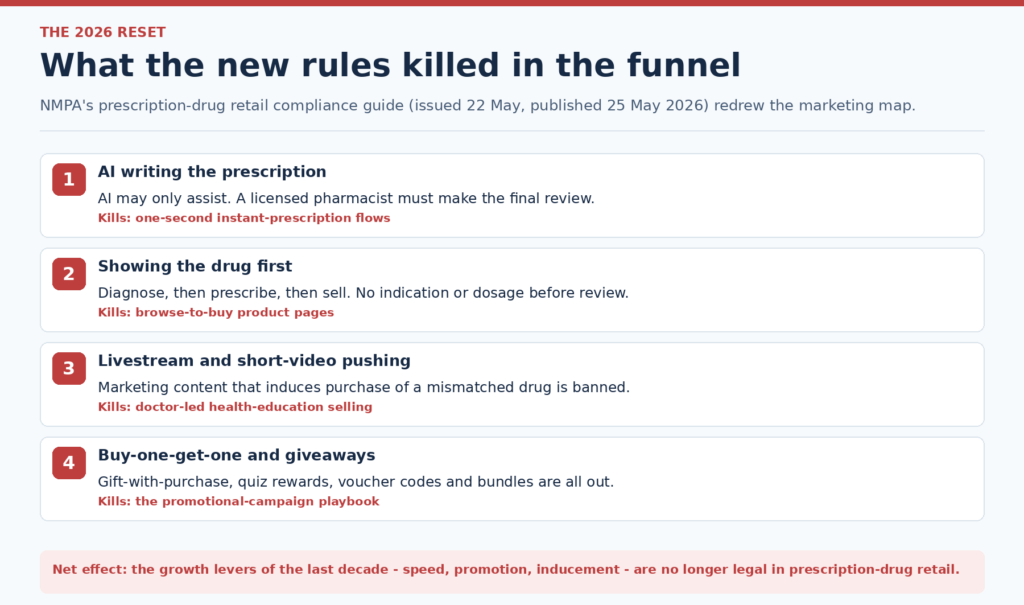
Then came the rule that changed everything. In late May 2026, China’s National Medical Products Administration published the Compliance Guide for Online Retail of Prescription Drugs — four chapters, 42 articles, issued on 22 May and released publicly on 25 May. It has a formal document number ( Drug Administration Letter [2026] No. 282 and it is not a suggestion
AI Out of the Review Room
The headline provision: prescription review must be done by a licensed pharmacist. Other staff cannot do it. Artificial intelligence cannot do it. AI may assist — screening, risk flags, efficiency — but the final decision belongs to a named human being.
This killed the “one-second prescription” flow outright. Platforms that generated prescriptions in seconds and used AI to rubber-stamp them are now out of compliance. Legal experts interviewed around the release made the reasoning plain: an AI can produce an opinion that looks reasonable and is fatally wrong, and someone has to own that risk.
Diagnosis First, Drug Second
The guide enforces a strict sequence: diagnose, then prescribe, then sell. Drug packaging and product pages cannot be displayed before the prescription is reviewed; indications and dosage cannot be shown ahead of that review. Interface design itself is regulated — the drug and the prescription must visibly come from different parties.
For marketers, this is the big one. The browse-to-buy product page, so central to Western e-commerce, is illegal for prescription drugs here. You cannot lead with the product. You cannot lead with the benefit. You lead with the careful, human process.
The Promotion Ban
Buy-one-get-one. Gift-with-purchase. Quiz rewards. Voucher codes. Bundles. Livestream flash sales. Short-video product pushes. Private-domain selling. All of it, banned for prescription drugs. The guide also requires platforms to detect and block AI-generated prescriptions and to pause suspicious repeat purchases.
The Advertising Draft
A second document, a draft released by the State Administration for Market Regulation in mid-May 2026, tightened rules on advertising for drugs, devices, health supplements, and medical foods — including livestream advertising. It specifically targeted the trick of dressing a sales pitch up as health education, and it required platforms to monitor, warn, limit, or pause offending streams. Important caveat: it was still a draft when released, with a feedback window closing in mid-June. Do not cite it as settled law.
Compliance as the Only Defensible Moat
Here is the strategic twist that most coverage missed. These rules do not punish everyone equally. They punish the businesses that were already cutting corners — and they reward the ones that were already compliant.
Think about what compliance now requires: licensed pharmacists on staff, real-time prescription review with logged decisions, traceability codes verified on inbound and outbound stock, platforms re-checking merchant licenses at least every six months, and enough human capacity to handle review without rushing it.
Who can afford that? The giants. JD Health was already talking about self-operated supply chains and full-process traceability years before the rule landed. Alibaba and Ping An have the capital and the compliance functions. Smaller online-only sellers — the ones with one registered storefront and dozens of virtual shops — face costs they cannot absorb. Industry commentary after the release was blunt: a lot of operators simply were not doing what the document now requires.
And the enforcement has teeth. Alibaba Health’s pharmacy unit was fined 280,000 yuan in late October 2025 over unauthorized and misleading advertising, then placed under investigation again in December over claims that a product could cure eczema outright. These were reported via official credit records and state media. The message is not subtle: in health, the marketing budget is not your biggest risk. The compliance gap is.
AI’s Two Doors
Here is where the story gets genuinely strange, and genuinely Chinese.
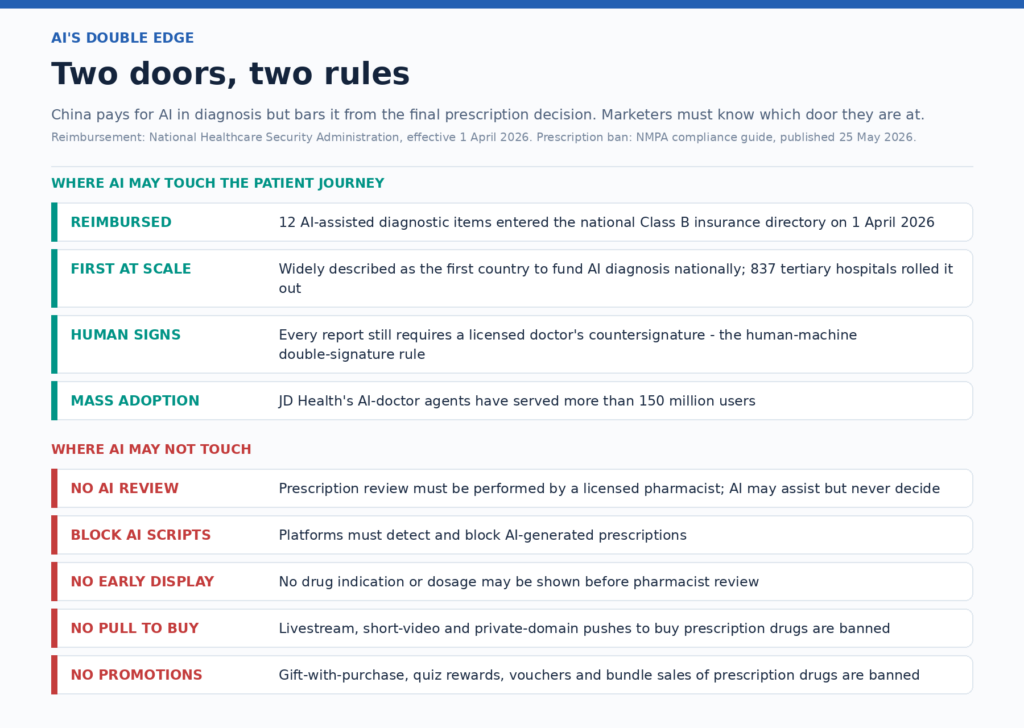
In one room, China is paying for AI. In late March 2026, the National Healthcare Security Administration added 12 AI-assisted diagnostic items to the national Class B reimbursement directory, effective 1 April, with pilot rollout across 837 tertiary hospitals. Patients pay roughly 10 to 30 percent up front; insurance covers the rest. It has been widely described as the first country to fund AI diagnosis at national scale, and state media ran with that framing. A “human-machine double signature” rule keeps a doctor’s name on every report.
In the other room, China barred AI from the prescription decision. Same patient journey, opposite regulatory logic.
Why? The distinction is about responsibility, not capability. A diagnostic suggestion can be reviewed and signed by a doctor. A prescription that gets a drug into a body needs a licensed human to own it. AI can support judgement; it cannot hold a license.
The numbers show the appetite. JD Health says its family of AI-doctor agents has served more than 150 million users. But here is the line marketers must never cross: helping a clinician decide is encouraged. Helping a consumer buy is restricted. Confusing the two is now a legal problem, not a creative one.
The Wellness Gray Zone
If prescription drugs are the locked vault, supplements and functional foods are the minefield. This is where most global brands get into trouble.
China’s health-food regime uses a “blue hat” approval mark. Only products with that registration can make regulated function claims, and only within approved wording. Ordinary foods — including most imported wellness products — cannot claim therapeutic effects at all. Saying a product lowers blood pressure or repairs a liver is not edgy copy; it is a violation.
Compare that with Europe, where Regulation 1924/2006 forbids health claims on foods unless the European Commission authorizes them and places them on a permitted list — a process backed by EFSA scientific review. The logic is similar: a claim is not speech, it is a regulated thing that has to earn its place.
For a wellness brand entering China, the practical advice is uncomfortable but simple. Choose your regulatory identity first — blue-hat health food, ordinary food, or drug — and let that identity determine every word of your copy. Do not write the copy and then hope to fit the category later.
What the West Gets Wrong
Western marketers tend to assume China is simply a looser version of home. It is the opposite in healthcare.
Direct-to-consumer advertising of prescription drugs is permitted in only two developed countries: the United States and New Zealand. Even in the US, where a television viewer sees, on average, roughly nine drug ads a day, the FDA does not pre-approve most ads — accuracy sits with the manufacturer, and enforcement happens after the fact. China bars that model almost entirely for prescription drugs, and the May 2026 guide closed the last loopholes around livestreams and inducements.
So if your instinct is to lead with a bold benefit claim, a celebrity, and a call to action, you are reaching for the exact levers this market has outlawed. The fantasy of the same campaign working everywhere dies fastest here.
The Playbook: License First, Prove Everything
So what do you actually do?
License first. Decide your regulatory category before you write a single line. Prescription drug, OTC, blue-hat health food, ordinary food — each has a completely different creative sandbox. Getting this wrong invalidates everything downstream.
Evidence second. Have the science ready and the registration documents in order. In this market, proof is not a support asset. It is the campaign.
Make the pharmacist visible. Put the human expert in the flow. Show the review, the licensing, the consultation. A named professional is the highest-converting creative element you have, precisely because your audience is scanning for reasons to disbelieve.
Educate, do not induce. Health education content is legitimate — chronic disease management, doctor IP, patient support. But the moment content is designed to push a specific purchase, especially for a prescription product, you cross the line.
Treat compliance as the brand. This is the consolidation play. The rules favor the operators who already invested in doing it right. If you are compliant and your smaller competitors are not, the regulation is doing your marketing for you.
Bottom Line
Chinese healthcare marketing is not a puzzle about attention. It is a puzzle about credibility, and the price of credibility keeps going up. The market is enormous but mature, the users are plateauing, the platforms have built trust out of supply chains and insurance loops, and the 2026 rules converted a dozen growth tactics into violations overnight.
The uncomfortable truth is that the best marketing move in this category is not a campaign at all. It is hiring the pharmacist, building the traceability system, and letting the regulator’s red tape become your competitive advantage. In a market that assumes you are lying, the only durable strategy is to become the kind of company that cannot lie.