Every referral deck opens with the same line: 83% of happy customers say they would refer, but only 29% ever do. That 54-point gap is presented as the founding problem of the discipline. It is worth knowing where it came from, because the origin changes the diagnosis.
The figure comes from the 2010 Economics of Loyalty: Anatomy of a Referral survey, run by Advisor Impact, Charles Schwab Advisor Services and researchers at Texas Tech University. It polled 1,034 investors who work with a financial advisor, and it was released in December 2010. It was a study of wealthy people talking about their money manager — not of consumers, not of software, not of e-commerce, and not peer-reviewed. Some later retellings upgrade the 83% to 91% or 92% by blending in a different Nielsen wave. If you want a general consumer statistic, this is not it.
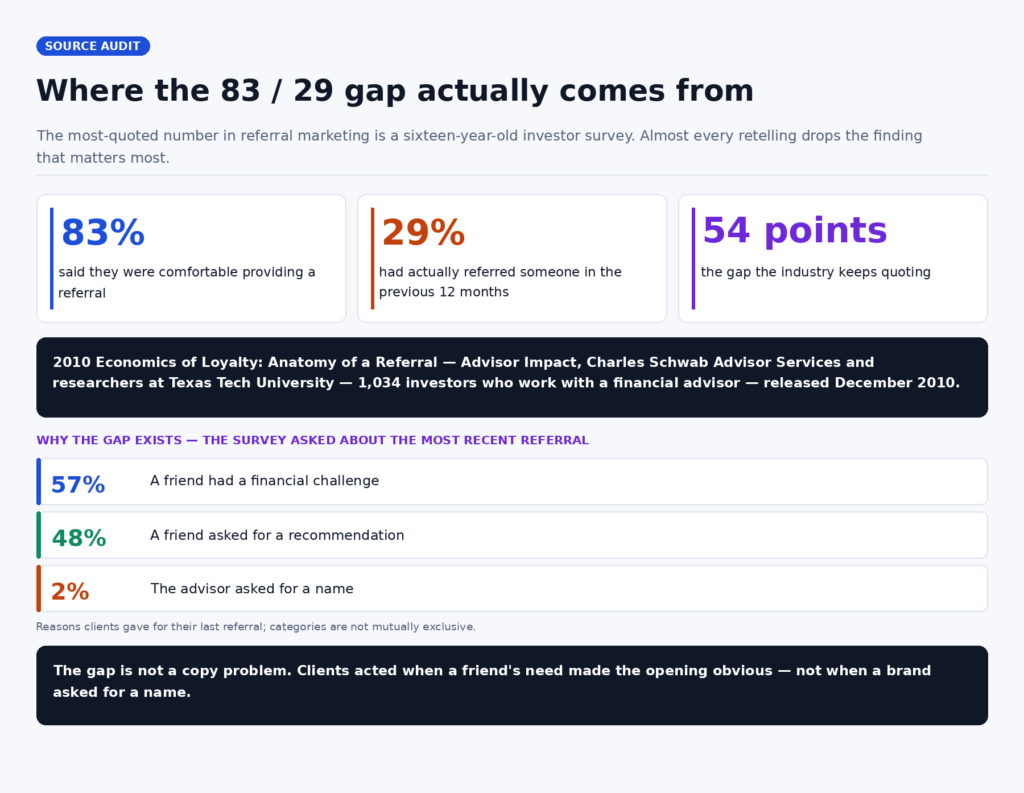
Here is the part that almost never survives the retelling. When the survey asked clients why they had made their most recent referral, 57% said a friend had run into a financial challenge, 48% said a friend asked them for a recommendation, and just 2% said the advisor had asked for a name. Clients did not act on a prompt. They acted when a friend’s need made the opening obvious. The gap is not a copy problem, and it is not really an incentive problem either. It is a timing and context problem: the ask has to arrive at the moment the friend has a reason to listen.
That single finding is more useful than a decade of “tell a friend” button redesigns.
Why referred customers genuinely are worth more
The good news is that the value claim survives proper scrutiny — because it has been measured in peer-reviewed research rather than vendor blogs.
In Referral programs and customer value (Schmitt, Skiera & Van den Bulte, Journal of Marketing, 2011, 75(1):46–59), the authors tracked roughly 10,000 customers of a German bank for almost three years and compared referred customers with non-referred ones matched on demographics and acquisition month. Referred customers were worth at least 16% more over a six-year horizon — about €40 on a €253 baseline — and nearly 25% more after acquisition costs. Two mechanisms drove it, and they decay at different speeds. The contribution-margin advantage — referred customers fit the product better — erodes over time. The retention advantage persists. Put plainly: better matching fades, the social bond sticks. The bank paid referrers a €25 voucher for each new customer, and treating that fee as the investment produced a return of approximately 60% over six years. Because the new customer only had to open an account, with no minimum balance and no minimum stay, the program was wide open to abuse — which makes a positive result more convincing, not less.
The 2018 follow-up in the Journal of Marketing Research — Van den Bulte, Bayer, Skiera & Schmitt, How Customer Referral Programs Turn Social Capital into Economic Capital, 55(1):132–146, DOI 10.1509/jmr.14.0653 — explains why. It separates better matching (which drives margins) from social enrichment (which drives retention), and it adds the condition the industry ignores: the daily churn rate of referred customers is about 30% lower than that of matched non-referred customers, but only for as long as their referrer stays. Once the referrer leaves, the referred customer’s advantage disappears. The study works with 1,799 referred customers and 1,788 matched non-referred customers acquired between January and October 2006. Lose the advocate and you lose the stickiness you paid for, so recruit referrers with at least six months of tenure, healthy margins and low churn risk.
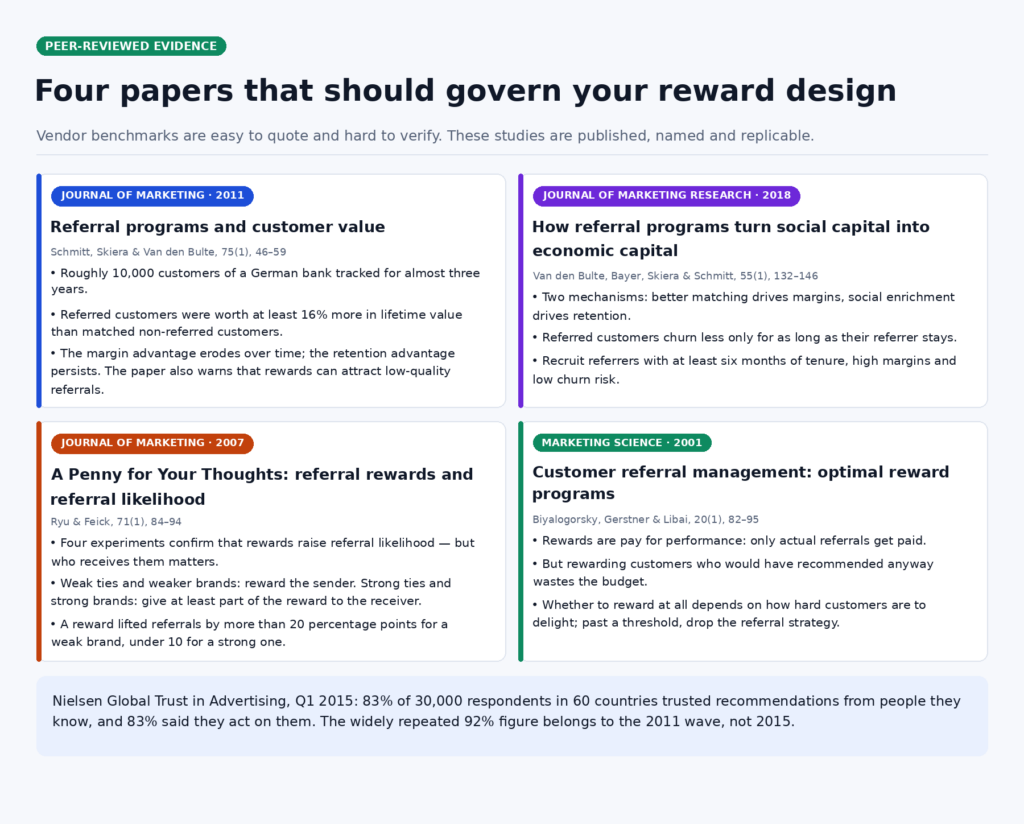
The trust mechanism behind all of this is also properly sourced. Nielsen’s Global Trust in Advertising survey, fielded 23 February to 13 March 2015, polled more than 30,000 online respondents in 60 countries: 83% completely or somewhat trusted recommendations from people they know — the highest of any format measured — and 83% said they always or sometimes take action on those recommendations. Two date disciplines matter. The 2013 wave reported 84% across 58 countries, and the widely repeated 92% belongs to the 2011 wave, not 2015. Nielsen also notes the obvious caveat: these are self-reported behaviours, not metered data.
A note on the benchmarks I am not going to give you
If you search for referral benchmarks you will find a tidy table: median program converts 3–5%, top programs 8%+, double-sided rewards double or triple share rates, asking within two hours of a satisfaction peak beats a monthly batch by 3×, single-CTA emails lift CTR 28%, a reward confirmed within an hour produces 40% more repeat referrals, two or more touchpoints move share rate from 4% to 12%, seasonal bursts add 30–50%.
I checked all of them. None traces back to an independent study, a published dataset, a named sample or a reproducible method. They trace to SaaS vendor blogs and content-marketing listicles, each citing the last one. Per the rule I set for this piece — academic, official, government or large research institutions only, delete anything that cannot be verified — they are gone. Not softened, not labelled as estimates. Gone.
That is not a loss. It clears the ground for the evidence that is actually load-bearing: the papers above, official program terms and first-party company statements. A design rule you can source beats a percentage you cannot.
Double-sided rewards, with the condition nobody mentions
“Give both sides a reward” is the most repeated design advice in referrals, and the peer-reviewed version is more interesting than the slogan.
Ryu & Feick, A Penny for Your Thoughts: Referral Reward Programs and Referral Likelihood (Journal of Marketing, 2007, 71(1):84–94, DOI 10.1509/jmkg.71.1.084), ran four experiments and confirmed that rewards raise referral likelihood. The allocation, though, depends on the relationship and the brand. For weak ties, rewarding the sender works best — in one experiment a large reward raised referral likelihood to 81.1% from 52.6% among casual acquaintances, while making no difference among close friends. For strong ties and strong brands, giving at least part of the reward to the receiver works better, because someone recommending a well-known product to a close friend is already managing a social risk, and being seen to profit from it feels awkward. A reward lifted referral likelihood by more than 20 percentage points for a weaker brand but by less than 10 for a stronger one. The authors’ practical conclusion is almost counterintuitive: strong-tie referrals tend to happen first and would happen anyway, so the referrals that actually need encouragement are the later, weaker-tie ones.
So the honest rule is: reward both sides, but let the friend’s share grow as the brand and the tie get stronger. Dropbox is the clean illustration. Its program gave 500 MB of extra storage to the inviter and 500 MB to the invitee — the reward was the product itself, so paying it cost marginal storage, not cash, and using it reinforced the habit that made the referral valuable. Growth went from 100,000 registered users in September 2008 to about 4 million within 15 months, with roughly 35% of daily signups coming from referrals. Two boundaries are worth keeping. Storage was capped at 16 GB on Basic and 32 GB on paid plans, so even the most famous double-sided program had a ceiling. And a bare signup was never enough: the friend had to install the desktop app, sign in from it and verify a new account before either side got anything.
The counterweight comes from theory, not a case study. Biyalogorsky, Gerstner & Libai, Customer Referral Management: Optimal Reward Programs (Marketing Science, 2001, 20(1):82–95), models rewards as pay for performance: only actual referrals get paid, which is efficient. But it also shows the waste — you end up paying customers who would have recommended you anyway. Whether to reward at all depends on how hard your customers are to delight; past a certain threshold of satisfaction, the model says drop the referral strategy entirely and let word of mouth run unpaid. If your product is already good enough that people volunteer, a bounty is just a transfer.
Pay for the scarce side, not the loud side
Airbnb is the clearest recent lesson, and the official terms settle a debate that secondary sources keep muddling.
Guest referrals are gone. Airbnb’s own help pages state that no travel credit is offered for referrals made after 1 October 2020, and the open “Airbnb Associates” affiliate program closed on 31 March 2021. What survives is the Host Referral Program, whose terms were updated on 11 November 2026. It pays for new supply — a first-time host who publishes an experience, service or entire-home listing and completes a qualifying booking of at least USD 100 for homes or USD 50 for experiences and services, never cancelled, booked and paid through Airbnb. The booking must be completed within 180 days, the payout arrives within 30 days, rewards are limited to the first 25 referred hosts per category, and travel credit is capped at 15% of a booking.
That asymmetry is the whole strategy. Demand finds Airbnb on its own; hosts are the constrained side of the marketplace, so Airbnb pays for hosts and stops paying for guests. If you run a two-sided business, copy the logic rather than the reward: spend your referral budget on whichever side is hard to acquire, and be willing to shut the other side off even when it is still “working”.
Read the terms, not the landing page
The most reliable design document in referrals is a company’s program terms, because that is where it defines exactly what counts before it pays. Six official programs, read side by side, converge on one rule.
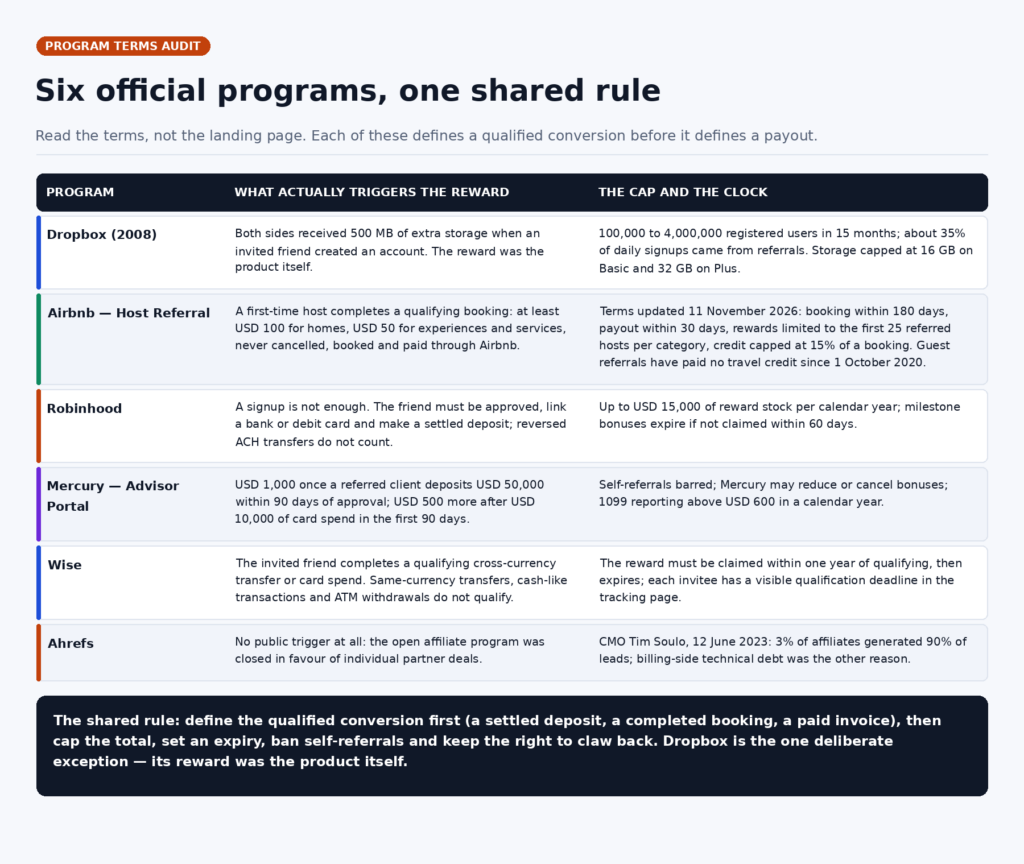
Robinhood is emphatic that a signup is not a conversion: the friend must be approved, link a bank account or debit card and make a settled deposit, reversed ACH transfers do not count, and rewards are capped at USD 15,000 of reward stock per calendar year with milestone bonuses expiring if unclaimed within 60 days. Mercury’s Advisor Portal pays USD 1,000 once a referred client deposits USD 50,000 within 90 days of approval, plus USD 500 after USD 10,000 of card spend in the first 90 days; self-referrals are barred, Mercury reserves the right to reduce or cancel bonuses, and rewards above USD 600 in a calendar year get 1099 reporting. Wise ties its reward to a qualifying cross-currency transfer or card spend — same-currency transfers, transfers between a customer’s own Wise balances, cash-like transactions and ATM withdrawals explicitly do not qualify — the inviter must claim the reward within one year of qualifying or it expires, partners face a 30-day conversion window, and Wise reserves the right to withhold rewards for self-invites and abuse. Airbnb uses 180 days. Dropbox used storage caps instead of cash caps.
Then there is the program with no trigger at all. Ahrefs closed its public affiliate program and said why in a first-party post by CMO Tim Soulo on 12 June 2023: 3% of affiliates generated 90% of leads, and the billing-side technical debt of maintaining the program was the other reason. Ahrefs moved to individual deals with top partners. No public trigger, no public rate card, no self-serve signup — a deliberate graduation from referral into partnerships.
The shared rule writes itself. Define the qualified conversion first — a settled deposit, a completed booking, a qualifying transfer, a paid invoice — then cap the total, set an expiry, ban self-referrals and keep the right to claw back. Dropbox is the one deliberate exception, and it is the exception that proves the logic: when the reward is the product itself and the friend has installed and verified the app, a signup is already a qualified conversion, because a new account is a new user of the thing you are giving away.
Fraud is a design input, not an afterthought
The academic literature flagged this before the terms did. Schmitt et al. (2011) note that referral programs are prone to abuse: when a reward is conditional on recruitment and screening is imperfect, customers are paid for referring low-quality customers — a moral hazard that unpaid word of mouth does not create. In their bank’s case, the new customer did not even need a minimum balance, which is precisely the condition that makes the 60% return conservative rather than flattering. Modern terms are essentially a catalogue of defences against it.
Ban self-referrals and same-household loops. Require the friend to fund, book, transfer or pay. Set a window — 60 days, 90 days, 180 days, one year — long enough to be fair and short enough that you are not carrying an open-ended liability. Cap the total per advocate and per calendar year. Reserve clawbacks for reversals and abuse. Then watch the tail, because the tail is where the money goes: Ahrefs’ 3%-produced-90% is the same shape as the broader partner-concentration pattern, in which a small head of partners generates most of the revenue. That is not a failure of the program; it is a signal to graduate those few into a managed partnership track instead of paying everyone else to do nothing.
Instrument the loop you can actually see
You cannot manage a referral program on share rate alone, and you definitely cannot manage it on a vendor benchmark. Build the funnel from the terms outward: invite sent, friend clicks, friend signs up, friend hits the qualified conversion you defined, friend is still active at 90 and 180 days. The 2018 JMR finding is the reason the last step is not optional — the retention premium exists only while the referrer stays, so both sides of the pair belong in the same report.
For the economics, use your own numbers rather than an example case from a blog. Compute the first-year gross profit of a referred customer, express the reward as a share of it, and compare referral cost-per-acquisition against your paid CAC using the same attribution window. Then run a holdout: a slice of equally satisfied customers who never see the ask. Referred customers are pre-selected to be better matches, so without a holdout you will credit the program for value that better matching created on its own. That is precisely the confound the 2011 and 2018 papers untangle, and it is the difference between a program that looks profitable in a dashboard and one that is profitable in the P&L.
One more design consequence of the 2010 advisor survey: since the triggering event is usually a friend’s need rather than your campaign calendar, put the ask where a need becomes visible — a delivery confirmation, a milestone reached, a positive review submitted, a support ticket resolved well — and keep it to a single action. Surface it in more than one place, because a single settings-page link is invisible to almost everyone. And when a referral does convert, confirm the reward promptly to the advocate: the loop closes on the person who spoke up, not on the person who signed up.
What to do on Monday
- Write down the qualified conversion before you write a single line of copy. If you cannot name the event that moves money, you do not have a program yet.
- Pay the scarce side. If you are a marketplace, that probably means supply, the way Airbnb decided it meant hosts.
- Reward both sides, but shift the friend’s share upward as your brand and your customers’ ties get stronger.
- Put a cap, an expiry, a self-referral ban and a clawback clause into the terms on day one.
- Recruit advocates among customers with real tenure, not among your loudest new signups. The 2018 research says tenure, margin and referrer retention predict program ROI.
- Report the pair, not the click: advocate status and referred-customer retention at 90 and 180 days, against a holdout.
- Keep a partnership track ready for the 3% who produce 90%, and be willing to close the public program when it stops being worth the technical debt.
- Delete any benchmark you cannot source to a named study. If a number has no sample and no method behind it, it is decoration.