Picture the worst version of your quarter. You ship the best content in your category — original data, clean structure, expert bylines. A buyer asks ChatGPT which vendor to choose. The assistant has never heard of you. Not because your content lost an argument. Because it never entered the room.
That is what a failed technical check does. It is not a ranking penalty you can watch in a dashboard. It is an absence. And here is the uncomfortable part: when researchers finally measured how many ordinary websites can pass the basic checks that decide whether AI engines can read them at all, the answer was roughly one in five.
This article walks through that measurement, the crawler taxonomy behind it, the llms.txt hype cycle collapsing in real time, and a repair route you can finish in a month. Nine checks. Two firewalls’ worth of bad news. One file everybody writes and almost nobody reads.
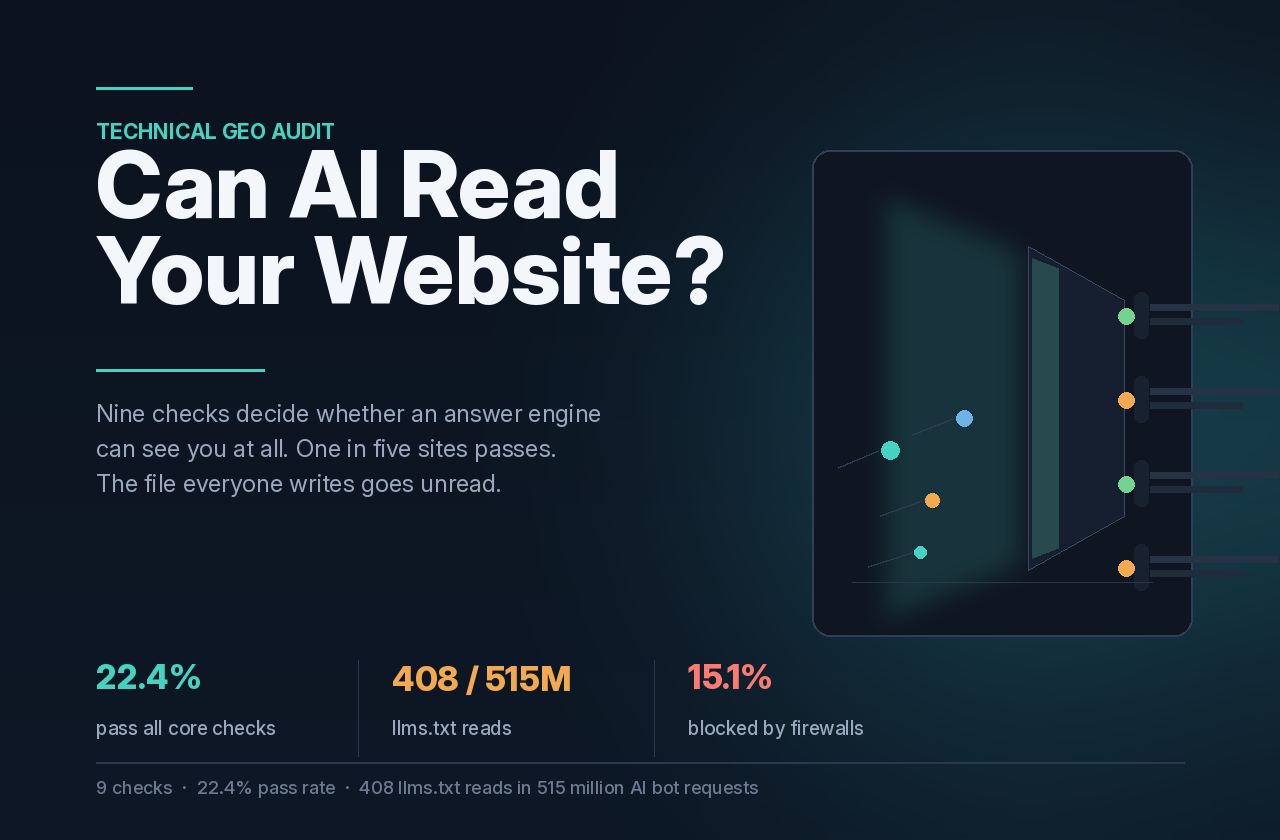
The 22.4% Pass Rate: A Nine-Check Report Card
In October 2026, Bugviso — a GEO audit-tool vendor, so note the commercial interest — tested 219 homepages drawn at random from the Tranco list, ranks 1,001 to 50,000. The method matters: one plain HTTP request with no JavaScript, compared against a fully rendered browser DOM. That difference is the whole story, because most AI crawlers read what the plain request returns.
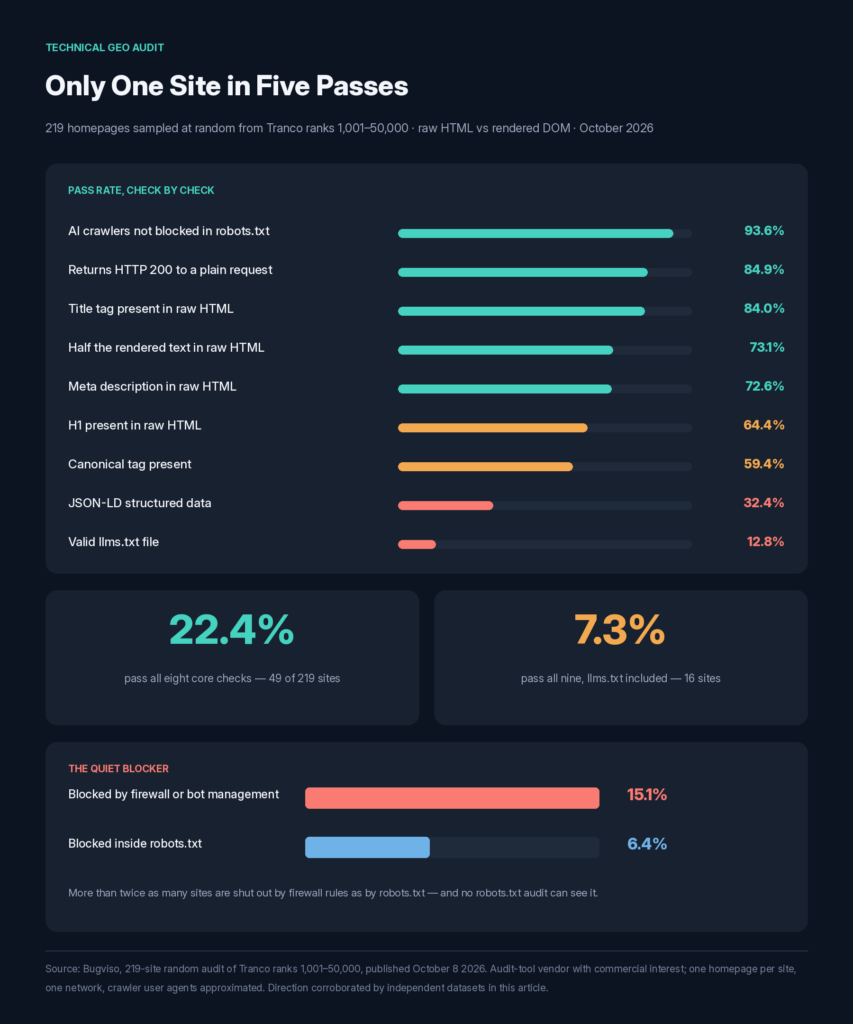
The results, check by check: 84.9% of sites returned HTTP 200. 93.6% had robots.txt rules that allowed AI search crawlers. 84.0% carried a title tag in the raw HTML. 73.1% had at least half their rendered text present in that raw HTML. Meta descriptions: 72.6%. An H1 in the source: 64.4%. A canonical tag: 59.4%. JSON-LD structured data: just 32.4%. And a valid llms.txt: 12.8%.
Only 49 sites — 22.4% — passed all eight core checks. Add llms.txt as a ninth and the club shrinks to 16 sites, 7.3%. Look at what failed most: not exotic AI machinery, but canonicals, H1s and structured data. The boring plumbing. Most sites don’t fail AI search on AI-specific tricks. They fail on HTML basics that predate ChatGPT.
One honesty label before we go further: this is one homepage per site, one request from one network, and user-agent tests that only approximate real crawlers. A vendor study, not an academic census. But its direction is corroborated by every other dataset we’ll meet below.
The Quiet Blocker: Firewalls Out-Block robots.txt
Here is the finding that should reorder your backlog. 15.1% of sites failed the plain HTTP request — most of them with a 403 from a firewall or bot-management rule. Only 6.4% blocked an AI crawler in robots.txt. The security layer nobody in marketing audits is blocking more than twice as many sites as the file every SEO checklist tells you to read.
You will never find this by reading your own robots.txt. The file says welcome; the WAF says prove you’re a browser. A crawler that doesn’t execute challenge scripts gets the door, not the content.
A second dataset makes the same point at larger scale. In November 2026, Black SEO Analyzer — an independent operator who sells an audit tool, and who published a corrected version with a full changelog, which earns trust — fetched robots.txt, llms.txt and homepages for the Tranco top 2,500 domains. Of the 1,254 that served an HTML homepage to a plain client, 1,071 published robots.txt. Among those, 23.7% blocked at least one AI crawler site-wide. And of 1,253 measurable homepages, 14.5% returned almost no text — though only two could be confirmed as bot walls from titles alone, so don’t let anyone tell you all thin pages are firewalls. Half the Tranco list simply didn’t answer a non-browser client usefully. Read that denominator carefully whenever someone quotes a scary blocking percentage.
A third, softer triangulation: Stradiji, an SEO and GEO consultancy, audited 100+ client and prospect sites across seven countries through September 2026 and found roughly three in four gave AI crawlers no explicit access in robots.txt, 87% had no Wikidata entry, and about half had no independent reputation signal. Nearly nine in ten had at least one of their three doors — reach, recognize, believe — closed. It’s a practitioner sample, self-published, not random. Port the direction, not the decimals.
Crawler Taxonomy: Three Jobs, Three Policies
The most expensive mistake in this whole domain is treating “the AI bots” as one thing. Each major operator runs several crawlers with separate tokens and separate purposes, and the vendors document them as independent switches.
Training crawlers — GPTBot, ClaudeBot, CCBot, Meta-ExternalAgent — collect content for model training. Blocking them is a content-licensing decision. Retrieval crawlers — OAI-SearchBot, Claude-SearchBot, PerplexityBot — index pages for AI search answers. Blocking them is a visibility amputation. OpenAI’s documentation is blunt: sites opted out of OAI-SearchBot will not be shown in ChatGPT search answers. User-triggered fetchers — ChatGPT-User, Claude-User, Perplexity-User — read a page when a person asks the assistant to. Block those and “summarize this page” returns nothing.
The top-2,500 scan shows the market has half-learned this lesson. Training bots get blocked about three times as often as OpenAI’s search bot: GPTBot on 15.6% of sites versus OAI-SearchBot on 4.6%. That’s the correct pattern — block training, allow search — and 119 sites execute it precisely. But 45 sites block all three OpenAI content tokens at once. That is not a licensing position. That is a voluntary exit from ChatGPT visibility, usually written by someone who copy-pasted a blocklist.
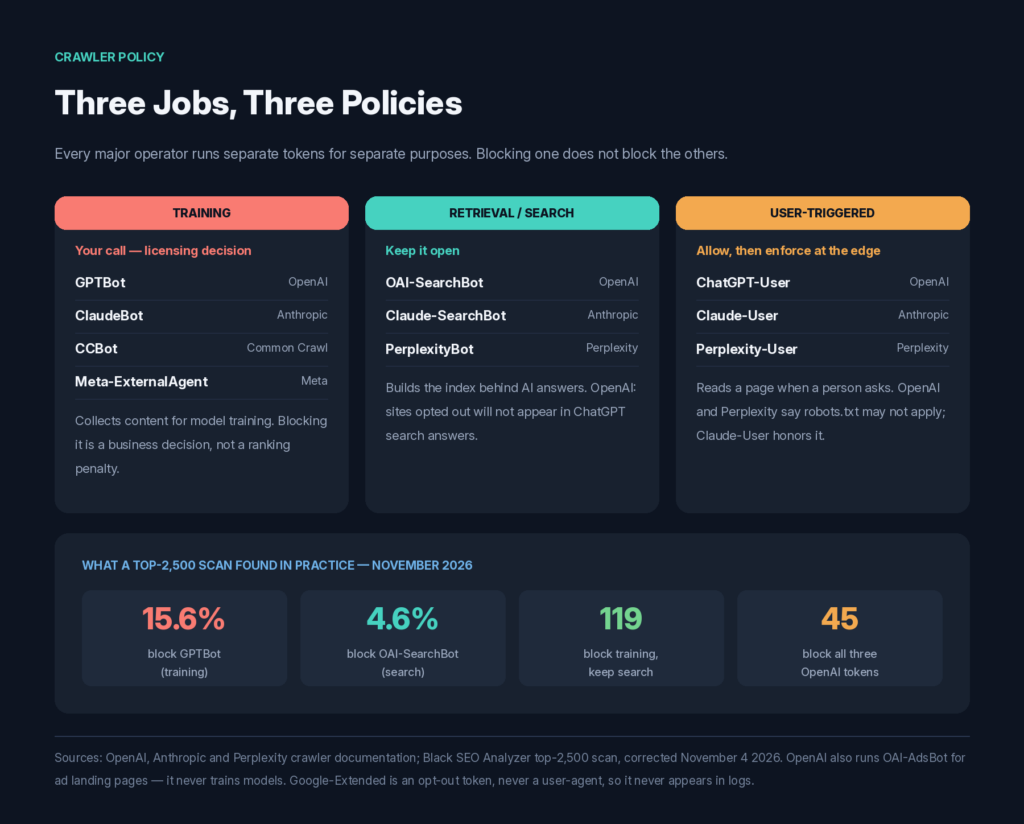
Two footnotes for the careful auditor. Google-Extended is not a crawler at all — it’s a robots.txt opt-out token governing Gemini training and grounding, with no user-agent of its own, so it will never appear in your logs. And OpenAI’s docs now list a fourth token, OAI-AdsBot, which only visits pages submitted as ChatGPT ads and never trains models — irrelevant to your editorial visibility unless you buy those ads. Meanwhile ByteDance’s Bytespider has a documented reputation for ignoring the rules it’s given; a Disallow line aimed at it is a hope, not a control.
User-Triggered Fetchers Ignore robots.txt — Enforce at the Edge
Now the nuance most audits miss, straight from the operators’ own documentation. OpenAI says robots.txt rules “may not apply” to ChatGPT-User, because a human initiated the visit. Perplexity says its user fetcher “generally ignores robots.txt rules” for the same reason. Anthropic is the exception: it documents that Claude-User honors robots.txt directives.
Read that asymmetry again, because it changes what your policy file actually is. For two of the three major vendors, a Disallow aimed at user-triggered fetches is a statement of intent, not enforcement. If you genuinely need those fetches stopped — paywalled content, regulated material — the rule has to live in your server or CDN configuration, and you verify it in your logs. Writing it in robots.txt and walking away is security theater with extra steps.
One Line to Say No: The Shared Training Opt-Out Arrives
One genuinely new development belongs in your policy file. On October 30, 2026, Google, OpenAI and Microsoft each announced they will honor a shared robots.txt policy token — __usage_ai-training — proposed in an IETF draft written by Anthropic’s standards lead, with Anthropic already implementing support. Instead of maintaining a blocklist of every vendor’s training bot, publishers can state a training preference in one group. OpenAI says “coming months,” Microsoft targets February 1, 2027, Google aims for 2027. It is an individual draft, not a finished standard.
Three traps before you celebrate. First, the token governs use, not access — it is not a crawl directive, so your per-bot access rules still do the actual gating. Second, a wildcard User-agent: * group does not count as a training preference; the token must be named. Third, and most consequential: Google plans to read a shared opt-out as a Google-Extended disallow unless you name Google-Extended separately — and Google-Extended also governs grounding in Gemini apps. A lazy “no training” line could quietly remove you from Gemini’s cited answers. Want out of training but in the answers? Write the shared opt-out and an explicit Google-Extended allow, and keep your retrieval tokens open.
The llms.txt Reckoning: 408 Reads in 515 Million Requests
llms.txt was a genuinely good idea. Proposed by Jeremy Howard of Answer.AI in September 2024: a curated Markdown map at your site root, so language models could skip the navigation-and-cookie-banner soup and go straight to your best pages. The spec is clean. The problem is the consumption side, and in 2026 the logs finally arrived.
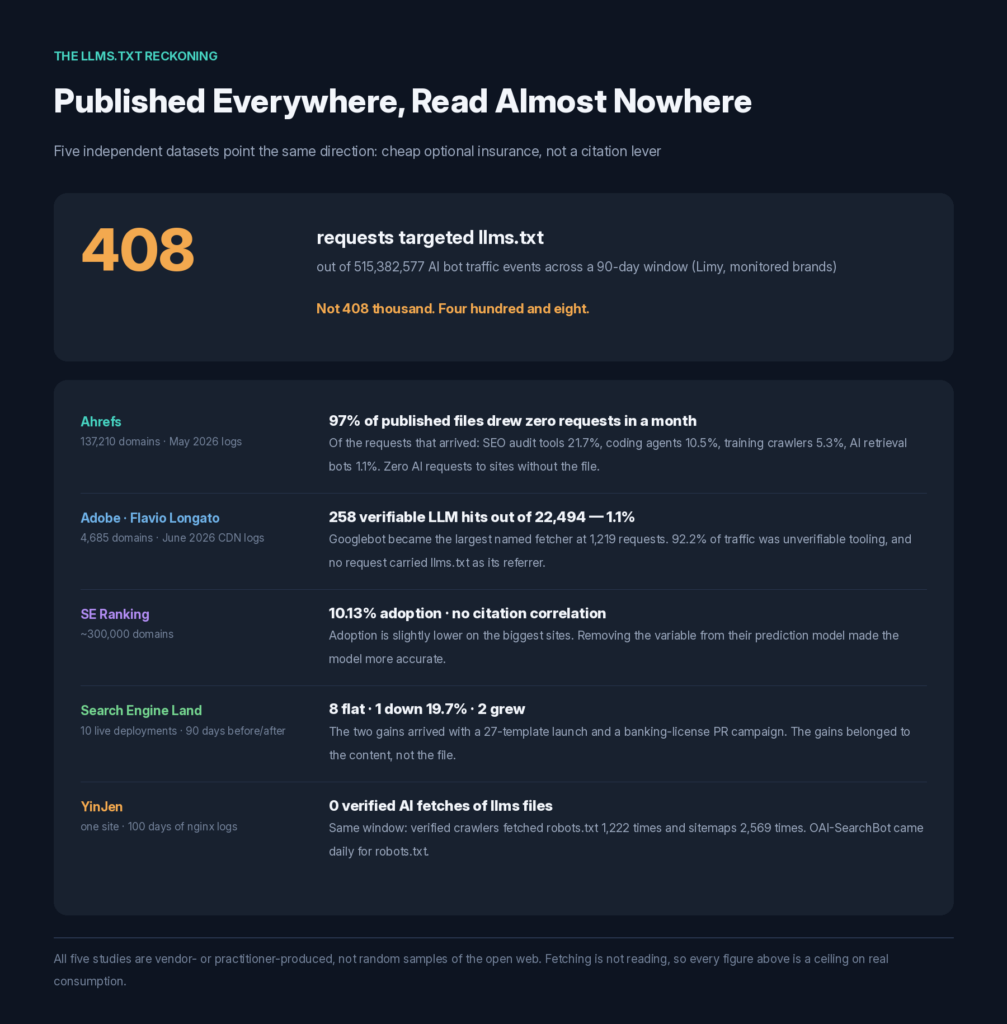
Start with the number that ended the debate for me. Limy, a GEO vendor with the usual interest caveat, analyzed 515,382,577 AI bot traffic events across a 90-day window. Requests that targeted /llms.txt directly: 408. Not 408 thousand. Four hundred and eight, against half a billion events from the exact bots that drive citations.
Ahrefs came at it from the file side, using its Bot Analytics logs across 137,210 domains in May 2026. About 28% of those domains publish an llms.txt — an upper bound, since Ahrefs’ customer base skews technical. Of the published files, 97% received zero requests in a full month. Of the requests that did arrive, SEO audit tools sent roughly 21.7%, coding agents about 10.5%, training crawlers 5.3% — and AI retrieval bots, the ones whose fetching could plausibly become a citation, just 1.1%. A further 12% came from tools whose entire job is auditing llms.txt itself. The industry is mostly studying its own homework. The cleanest finding in the dataset: zero AI bots requested llms.txt on sites that didn’t have one. No crawler goes looking. Publishing the file puts you on nobody’s radar.
The enterprise evidence agrees. Flavio Longato, an LLM-optimization strategist at Adobe, audited 30 days of CDN logs across 1,000 Adobe Experience Manager domains in August 2025: no GPTBot, no ClaudeBot, no PerplexityBot at the file, with Googlebot accounting for about 95% of hits — ordinary indexing, not special interest. His June 2026 follow-up is the most interesting update in this space: across 4,685 domains and 22,494 requests to the file, verifiable LLM crawlers accounted for 258 hits — 1.1%. Googlebot had become the largest named fetcher at 1,219 requests, and 92.2% of traffic came from unverifiable tooling. His sharpest observation: not a single request in the logs carried llms.txt as its referrer. Whatever crawlers do with the file, they do not visibly navigate onward from it. They enter at the homepage and follow links, like classical crawlers always have.
Then the outcome studies. SE Ranking analyzed roughly 300,000 domains: 10.13% adoption, flat across traffic tiers — actually slightly lower on the biggest sites — and no correlation between having the file and AI citation frequency. Removing llms.txt from their prediction model made the model more accurate. The variable was noise. And Search Engine Land tracked ten live deployments for 90 days before and after: eight sites saw no measurable change, one declined 19.7% for unrelated reasons, and the two that grew had a banking-license PR campaign and a 27-template content launch in the same window. The gains belonged to the content, not the file.
A single-site log study rounds it out with unusual methodological honesty. The team behind YinJen, a GEO monitoring tool, published 100 days of their own nginx logs — 104,645 lines. Their llms files drew 210 requests; zero came from identity-verified AI crawlers, and at least 124 were the team’s own tests. In the same window, verified crawlers from OpenAI, Anthropic, Perplexity and Amazon fetched robots.txt 1,222 times and sitemaps 2,569 times. OAI-SearchBot came for robots.txt every single day. GPTBot came for the sitemap every single day. The machines tell you what they read. It isn’t the file you spent a week writing.
Publishing Isn’t Consuming: The Vendor Position Map
So why does every GEO checklist still push the file? Because the supply side and the demand side get confused. Google, OpenAI, Anthropic and Perplexity all publish llms.txt on their own documentation sites. That is them acting as website owners serving coding tools — not their search crawlers reading yours.
The stated positions diverge, and precision matters here. Google is the clearest no: Gary Illyes said in July 2025 that Google doesn’t support llms.txt and isn’t planning to; John Mueller compared it to the long-dead keywords meta tag; and Google’s AI optimization documentation stated you don’t need new machine-readable files or Markdown to appear in its generative AI features — the file will neither harm nor help. OpenAI’s crawler docs simply don’t mention it. Anthropic is the warmest: it asked its docs platform to implement llms.txt and llms-full.txt, and its crawler has been observed fetching files — but it has never committed to using them for citations. Perplexity publishes both formats and shows the most browse-mode interest, still without a production commitment.
The file’s real audience today is the agentic developer stack. Cursor, Claude Code and their kin genuinely fetch llms.txt when a developer points them at documentation; in the Ahrefs data, Claude’s coding agent out-fetched every AI retrieval bot combined. And Mintlify, a docs-hosting vendor, measured with Profound across 25 companies over seven days that llms-full.txt drew roughly four times the traffic of llms.txt — a small, self-selected, docs-heavy sample, but consistent with the agent story. If you ship developer documentation, publish both files; they serve real users in real workflows. If you sell insurance or pet supplies, the honest recommendation is: generate one if it’s free, never write it into a KPI, and put your key facts in server-rendered HTML where the crawlers actually look. Not dead. Misfiled.
The Rendering Gap: One in Four Sites Is Half-Invisible
Access granted? Second failure mode: the crawler arrives and finds a loading spinner. The foundational measurement is the Vercel and MERJ crawler study from December 2024 — dated, and from a company that sells server rendering, so hold both caveats — which logged 569 million GPTBot fetches and 370 million ClaudeBot fetches in a month and found no evidence that any major dedicated AI crawler executes JavaScript. They download your scripts (11.5% of ChatGPT requests, 23.8% of Claude’s) and never run them. The documented exceptions are Google’s crawlers, whose rendering pipeline Gemini shares, and Applebot.
The 2026 audits show what that means in the field. In the 219-site study, 26.9% of sites failed the content check — unreachable, or less than half their text in the raw HTML. The fix list is unglamorous and decisive: server-render or prerender the facts that matter (product copy, prices, headings, answers), keep the answer near the top of the document, and use semantic HTML a parser can trust. Client-side rendering stays fine for view counters and chat widgets.
One more budget leak from the same study: ChatGPT and Claude spent about 34% of their fetches on 404 pages, against 8% for Googlebot. AI crawlers give you less crawl attention and waste more of it. Clean redirects and a current sitemap are not hygiene theater — they are how you protect a small, precious budget.
Schema’s Real Job: Index-Time Grounding, Not a Citation Shortcut
Time to break with GEO folklore. The best causal evidence we have says structured data does not lift citations on pages AI already cites. Ahrefs — again, a vendor — tracked 1,885 pages that added JSON-LD between August 2025 and March 2026, matched each against control pages with similar prior citation levels, and ran a difference-in-differences analysis across 30 days before and after. AI Mode: +2.4%, statistically indistinguishable from zero. ChatGPT: +2.2%, same verdict. AI Overviews: −4.6%, small but statistically significant, with both groups already declining. Four separate tests, one story.
The caveat is the interesting part: every page in that dataset already had 100+ AI Overview citations. The study cannot speak to pages nobody has seen — where schema may still help crawling, parsing and indexing in the first place. And a searchVIU experiment explains the mechanism from the other side: when five major AI systems fetched a page live to answer a question, they extracted only visible content. JSON-LD and hidden Microdata or RDFa were ignored by every system; markup woven into visible text was read simply because it was visible. Schema works upstream, in indexes and knowledge graphs, not at the moment of answering.
So deploy it as plumbing, with the right expectations. Meanwhile, don’t chase the retired prize: FAQ rich results, restricted to government and health sites in 2023, were deprecated entirely in May 2026. The markup remains valid and harmless; the rich-result payoff is gone. Keep FAQ-shaped prose because answers are extractable. Drop the fantasy that tags alone get you quoted.
The Entity Graph Four-Pack
If schema’s payoff is entity grounding, the priority order follows. Organization first: a stable @id, alternateName, knowsAbout, and sameAs links to your real profiles — this is the node everything else hangs from. Person second: named authors with jobTitle, sameAs, and worksFor pointing back to the Organization by @id. Article third: author and an honest dateModified you actually maintain. WebSite with SearchAction to close the loop. The lever isn’t more types; it’s connecting the ones you have into one traversable graph instead of a pile of disconnected blocks. And heed Mueller’s standing warning about schema bloat: mark up what explains the content, validate against what’s visible, move on.
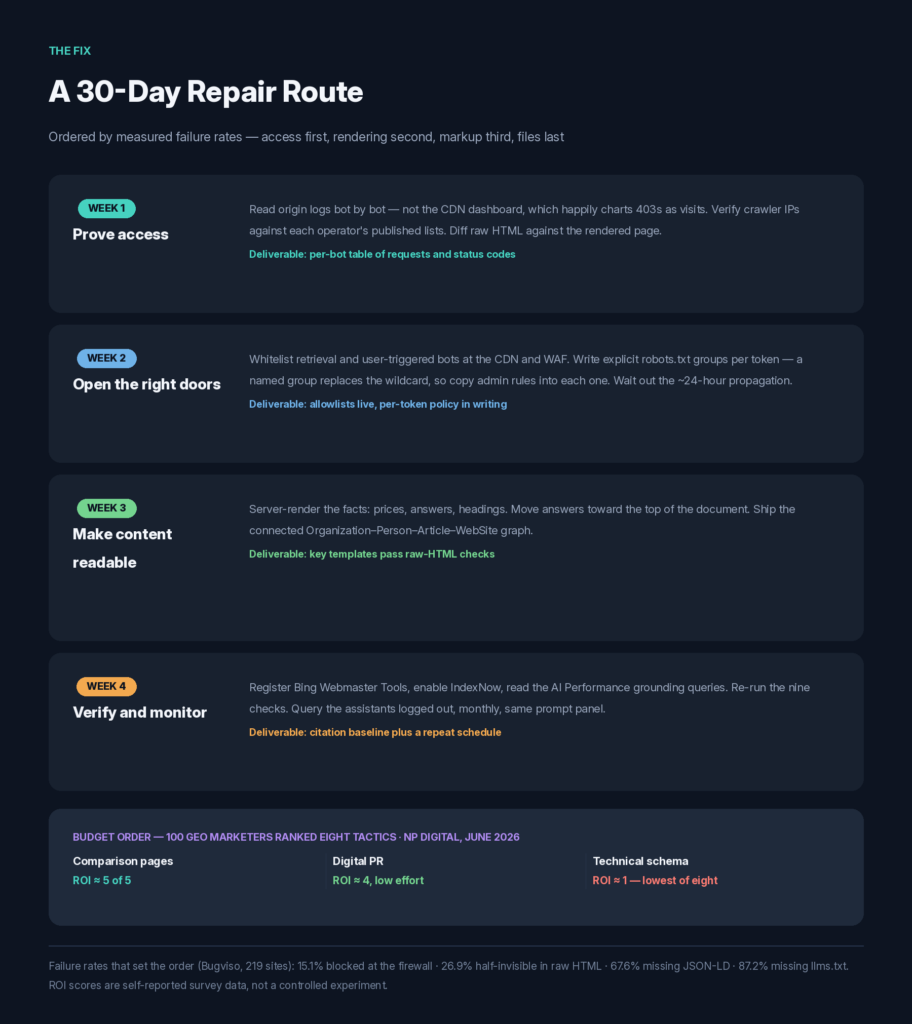
The market’s own ROI ranking backs the discipline. In NP Digital’s June 2026 survey of 100 GEO-focused marketers — self-reported scores from an agency’s panel, not a controlled experiment — technical schema improvements scored the lowest ROI of eight tactics, roughly 1 out of 5, against moderate effort. Comparison pages scored near 5. Digital PR near 4 at low effort. Spend accordingly.
IndexNow and Bing: The Upstream Nobody Registers
Here’s a free win most teams skip: the plumbing upstream of the answers. Bing Webmaster Tools launched its AI Performance dashboard in public preview in February 2026 — total citations, average cited pages, page-level citation activity, and “grounding queries,” the actual phrases the AI used when retrieving content that got cited. In June it added Citation Share, Intents, Topics and period comparison. It is, as of this writing, the only first-party window any major platform offers into AI citation behavior. It covers Microsoft’s surfaces, not the whole market — but grounding queries alone justify the ten-minute setup: export them, run them in ChatGPT and Google, and watch who gets cited instead of you.
Pair it with IndexNow, the URL-notification protocol Bing, Yandex, Naver, Seznam and Yep honor: a key file at your root, a POST when content changes, and participating engines crawl within minutes instead of discovering you next cycle. Register the site, submit the sitemap, wire the ping into your CMS.
One correction to a claim you’ll see everywhere, including in older versions of this advice: “ChatGPT search runs on Bing” is no longer the clean equation it was in 2024. OpenAI now runs its own search crawler and index; Bing remains a documented search provider in some ChatGPT enterprise contexts, and Microsoft says its infrastructure powers grounding for both Copilot and ChatGPT — but the exact blend is not public. The safe strategy is unchanged: be properly indexed in both Google and Bing, because every AI surface builds on one or both of those foundations plus its own crawling. Upstream coverage is cheap insurance with no downside.
One Hour vs One Week: Budget Discipline
The developer Tw93 published a single-site account of spending about one hour on structural cleanup — crawler policy, a curated llms.txt, sitemap registration — and seeing his open-source projects described more accurately in AI answers. It’s a useful existence proof with a hard limit: one site, no control group. The lesson to port is the ratio, not the promise. An afternoon of access checks beats a week of file polishing, because the audit data tells you where the failures actually live: 15.1% blocked at the firewall, 26.9% half-invisible in raw HTML, 67.6% missing structured data — and 87.2% missing a file almost nobody fetches. Fix in order of impact, not in order of hype.
The 30-Day Repair Route
Week one: prove access. Read origin logs bot by bot — not the CDN dashboard, which happily charts 403s as visits. Verify crawler identities against the IP lists each operator publishes, because user-agent strings are trivially spoofed. Fetch your key templates with crawler user-agents and diff the raw HTML against the rendered page. Deliverable: a per-bot table of requests and status codes.
Week two: open the right doors. Whitelist retrieval and user-triggered bots at the CDN and WAF. Write explicit robots.txt groups per token — and remember the named-group trap: a group that names a bot replaces the wildcard group entirely, so copy your admin restrictions into every group you add. Decide training opt-outs in writing, separately; if you adopt the new shared token, pair it with an explicit Google-Extended allow. Wait out the documented ~24-hour propagation before judging anything.
Week three: make content readable. Server-render the facts; move answers toward the top; ship the connected Organization–Person–Article–WebSite graph and validate it against visible content.
Week four: verify. Register Bing Webmaster Tools, enable IndexNow, read AI Performance. Re-run the nine checks. Ask ChatGPT, Claude, Perplexity and Google’s AI Mode a question your content answers, logged out, and write down what gets cited. One run is a lead, not a finding — keep the same prompt panel monthly, because a firewall update or a plugin change can quietly undo last month’s work.
Conclusion: Crawlable Before Citable
The whole audit in one breath: most sites fail on HTML basics, not AI tricks; firewalls block more than robots.txt does; the bots are three different animals and only one of them is safe to block; llms.txt is cheap optional insurance with a near-zero readership among citation-driving crawlers; a quarter of sites hide half their text behind JavaScript; schema grounds entities at index time but won’t lift citations on pages already cited; and the upstream registries take ten minutes and pay rent forever. None of this earns a citation by itself — content quality and third-party authority do that. All of it decides whether your content is even eligible to try. Open the door first. Then go earn the answer.