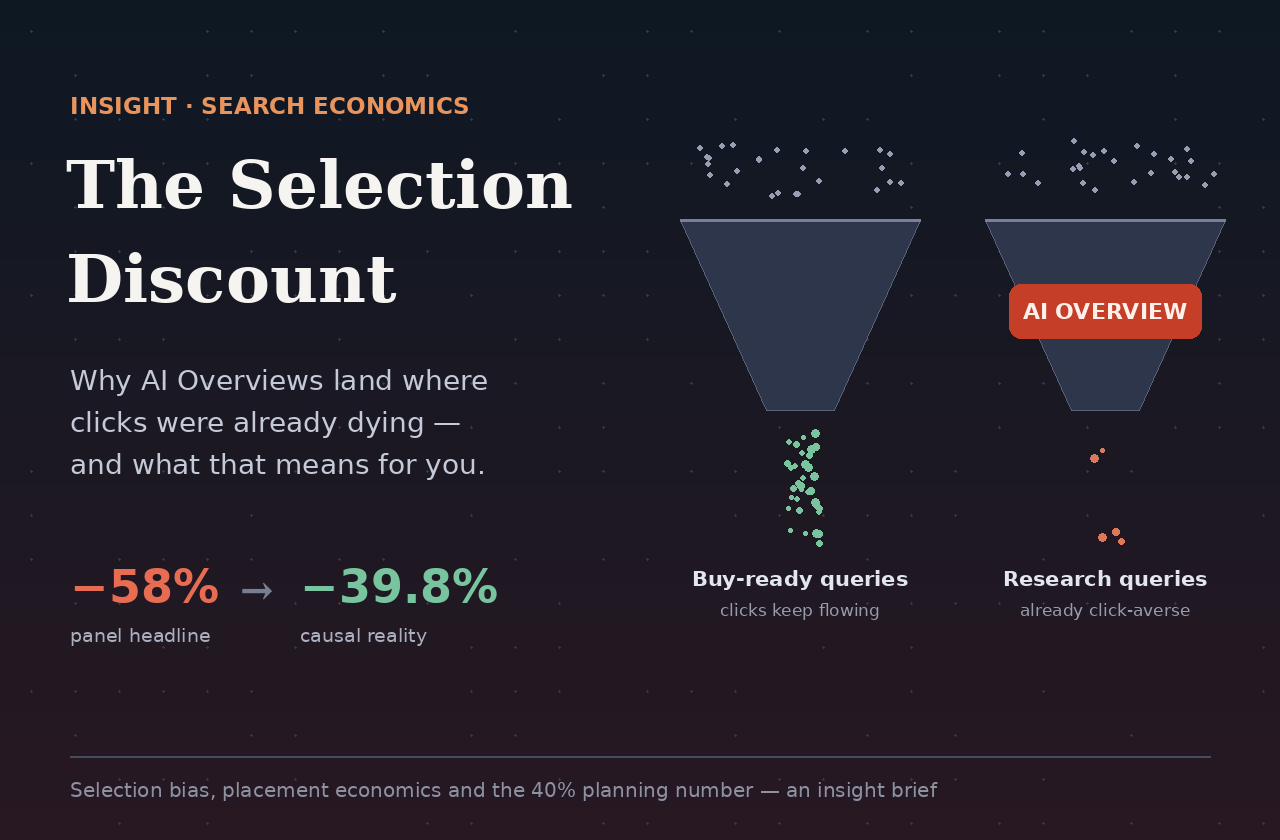
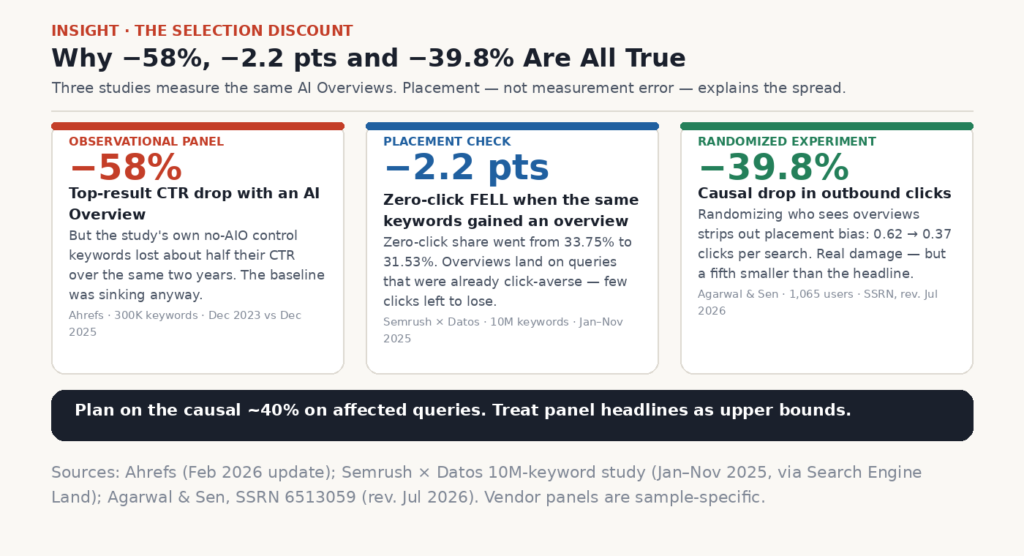
Here is a puzzle nobody in the AI-search panic bothers to solve. Ahrefs says AI Overviews cut top-result clicks by 58%. Yet when Semrush tracked the same keywords before and after they gained an overview, zero-click rates went down — from 33.75% to 31.53%. And a randomized experiment lands in between at −39.8%. Three rigorous studies, three answers. The resolution isn’t measurement error. It’s placement.
Google doesn’t sprinkle AI Overviews randomly. It deploys them where users were already satisfied without clicking: definitional lookups, symptom questions, quick facts. Ahrefs’ 146-million-SERP scan shows the pattern plainly — 57.9% of question queries get an overview, but only 3.2% of shopping queries and 7.9% of local searches do. The machine parks itself on the queries with the least click inventory left to destroy.
That’s the selection discount. When a vendor panel compares AIO queries against non-AIO queries, it’s partly measuring Google’s targeting, not the overview’s damage. The tell is buried in Ahrefs’ own update: its control keywords — no overview at all — lost roughly half their CTR over the same two years. The baseline was sinking before the AI arrived.
Randomization removes the discount. Agarwal and Sen assigned 1,065 users to see or not see overviews, and outbound clicks fell from 0.62 to 0.37 per search — a causal 39.8% loss. Real damage, but a fifth smaller than the headline. A second preregistered experiment (N=1,100) found hiding overviews restored 8.8 points of click-through. The causal floor is somewhere around 40%, not 60%.
Why does Google place them this way? Follow the incentive. An overview on a buy-ready query intercepts a click Google can monetize downstream — or annoys a user who needed a store, not a summary. An overview on a research query saves the user a click they didn’t value and keeps them in the ecosystem. Semrush’s six-month study shows the boundary holding: commercial-intent coverage grew 71%, but transactional coverage fell 5%. Google is expanding aggressively right up to the checkout — and mostly stopping there.
For operators, the discount cuts both ways. It means the apocalypse forecasts built on panel data overshoot. But it also means the queries you kept were kept because they still convert clicks — the no-AIO pool’s CTR rose from 2.8% to 3.8% in Seer’s year-long panel. Fewer clicks, better clicks. Plan on ~40% causal loss where overviews appear, treat panel headlines as upper bounds, and spend your defense budget where placement economics say Google won’t follow: brand, local, and the buying moment.