Here is a result that should bother you. Give two teams the same brand, the same budget, the same creative brief. One publishes a Reel, one a carousel. The Reel reaches roughly a third more people. The carousel wins the engagement column. Then every dashboard on the planet calls the carousel the better post.
That verdict is not wrong. It is just answering a question nobody asked. The real question is why winning reach and winning engagement keep landing on opposite formats, quarter after quarter. The answer is not creative quality. It is a distribution contract, and one of them quietly charges a tax.
The Two Pools Instagram Actually Runs
Instagram does not have one audience. In a January 2025 video series, Adam Mosseri, head of Instagram, split ranking into two kinds of reach: connected reach, content shown to people who already follow you, and unconnected reach, recommendations surfaced to people who do not. He named three Reels signals — watch time, likes per reach, sends per reach — with likes mattering slightly more for connected reach and sends slightly more for unconnected. Slightly was his word. No multiplier has ever been published, so any exact weighting you read elsewhere is folklore.
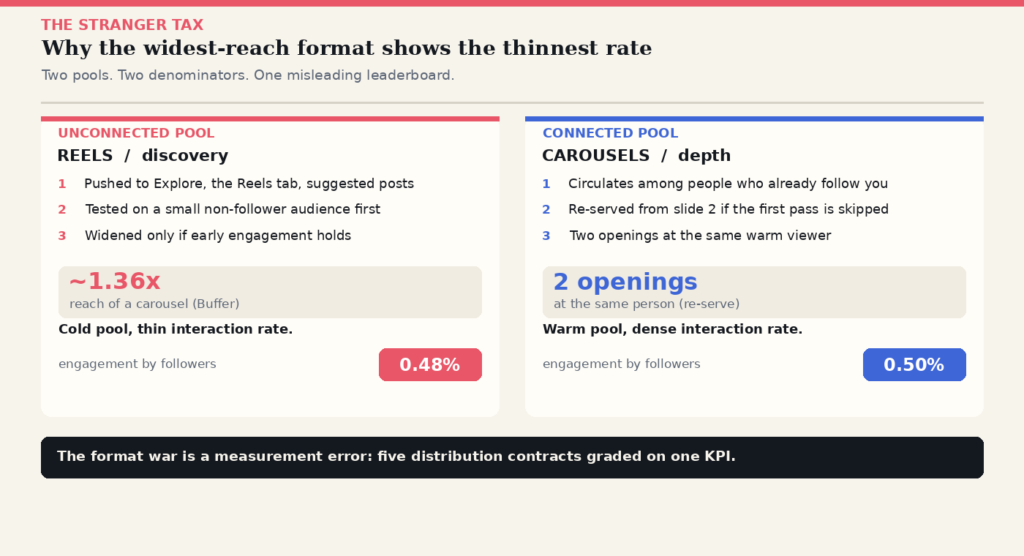
Reels are the front door into that second pool. The Reels tab, Explore, and suggested posts are, by the platform’s own description, inventory collected and ranked for people who have never heard of you. An early 2025 official explainer described the loop plainly: show a Reel first to a small group of non-followers, then widen it in stages only if early engagement holds. Carousels mostly never leave the first pool. They circulate among people who already chose you.
So the leaderboard is comparing a cold room with a warm one.
Why Reach Dilutes the Rate
This is the mechanism I would call the stranger tax — this piece’s coinage, an analytical frame, not a penalty anyone at Instagram has confirmed or coded.
Engagement rate is a fraction, and reach is its denominator. Push a Reel to a large, indifferent audience and the small number of likes, comments, and sends it earns gets divided across every cold impression. Push a carousel to your own followers and the same handful of interactions divides across a far smaller, pre-qualified base. Nothing about the creative has to change. The rate falls simply because the room got bigger and colder.
Now line up the numbers that keep getting quoted as contradictions. Socialinsider, which sells social analytics and therefore benefits from being the yardstick, tracks likes plus comments divided by followers: carousels 0.50%, Reels 0.48%, single images 0.35% in Q3 2026 across 67.5 million posts. Buffer, itself a scheduling tool, divides by reach instead and reports a 6.90% carousel median against 3.31% for Reels — while noting Reels reach about 1.36 times as far. Quid’s 2026 all-industry median sits at 0.30% because it counts a wider interaction basket across 18 industries. Same platform, same year, three honest instruments. The spread is measurement, not mystery.
The Re-Serve Nobody Puts on the Dashboard
There is a quieter asymmetry. Carousels are the only format that can come back. If a follower scrolls past without swiping through, Instagram may re-serve that carousel later starting from a later slide — a second opening at the same person, at no cost. Reels get no such second chance; they peak and fade. A warm audience seen twice is a structurally denser denominator than a cold one seen once, however many strangers it contains.
None of this makes Reels a bad format. It makes them a badly graded one. They are buying strangers, and strangers are exactly the people least likely to tap like — a cost of the job, not a failure at it.
What the Tax Is Really Charging For
The useful move on Monday is to stop handing every surface one KPI. Grade discovery on reach and non-follower share; grade depth on saves and sends; grade retention on completion and replies. Ask which pool a post was built for before you ask how it performed.
The format war was never a contest between video and still images. It was five distribution contracts being read off one ruler. Once you see the two pools, the surprise disappears: the wider the reach, the thinner the rate — and the brand paying the stranger tax is the one doing discovery right.