Here is a number that looks like a curiosity and is actually a receipt. In a MediaLabs working paper on 16,541 top-selling US TikTok Shop videos, revenue per thousand views barely moved across the paid spectrum: $16.58 for organic winners, $15.51 for paid-led ones. Most people read that as ads are not more efficient than free posts. The more useful reading is different. A flat line is what it looks like when three different parties are each holding a different part of the same transaction, and none of them is pricing the whole thing.
Three parties, one flat line
Follow who carries what. The creator carries the risk. Twenty hook variants, unpaid, most of them quietly ignored by the feed — that is a free screening lab whose cost sits on someone else’s effort. The platform then sells the certainty back: once a clip has proven it converts, GMV Max — the only Shop Sales campaign type since July 2025 — lets you buy more of exactly the views that already worked. And the ledger keeps the credit: TikTok’s own Seller University says every order on a promoted product counts as a GMV Max order while the campaign runs, including organic and affiliate orders, even when the shopper never saw an ad.
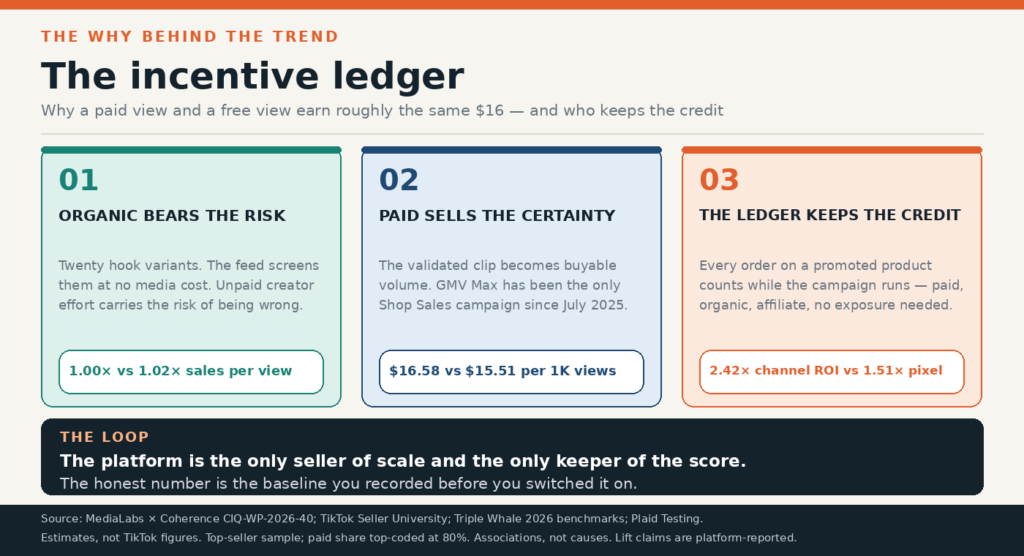
None of this is a bug. MediaLabs itself warns these are associations among top sellers, not proof that spend caused sales — spend follows winners rather than creating them. Total channel ROI is an honest name for what the system measures, just not the number most sellers thought they bought.
Why the ledger keeps the credit
Ask who benefits from the ambiguity and the incentives line up fast. There is no click-only model to fall back to inside the platform; GMV Max does not even require an exposure before it claims a conversion. It reports on the very products the setup guidance tells you to hand it — the ones already selling well through creators, where the organic baseline is fattest and the credit easiest to absorb — and sellers have been required to run it to qualify for major promotions. A platform that is the only seller of scale and the only keeper of the score has little reason to make the score smaller. Would you?
The trap I did not expect to find
The obvious danger is over-reporting; the real one is recursion. Industry guides warn explicitly: do not set your target ROI from the dashboard’s own number, because it includes organic and affiliate orders and will lead to a target that loses money on incremental orders. The inflated measure is not merely displayed — it is fed back into the machine as the constraint. The bias becomes the input, and the input produces a larger bias. A ruler that stretches itself does not lie to you once; it teaches you to budget by the lie.
Field notes: the free screen was never free
Sit with a Shop account for a week and the asymmetry stops being abstract. The dashboard is green, the affiliates are posting, and every sale lands in the campaign’s column. The one thing nobody recorded is the four-week baseline before launch — and without it there is no way to say what the spend changed. The most valuable input in the whole system is the free screen, and it is the only one the system never logs, because logging it would shrink the win.
So the honest ruler is the one you kept off-platform: total orders before and after, net of fees, with one product line held out. Organic absorbs the risk, paid buys the certainty, and the ledger will always keep the credit. The job was never to pick a ratio. It was to keep a second set of books.