Pinterest Marketing in 2026: The Search Engine Disguised as a Mood Board
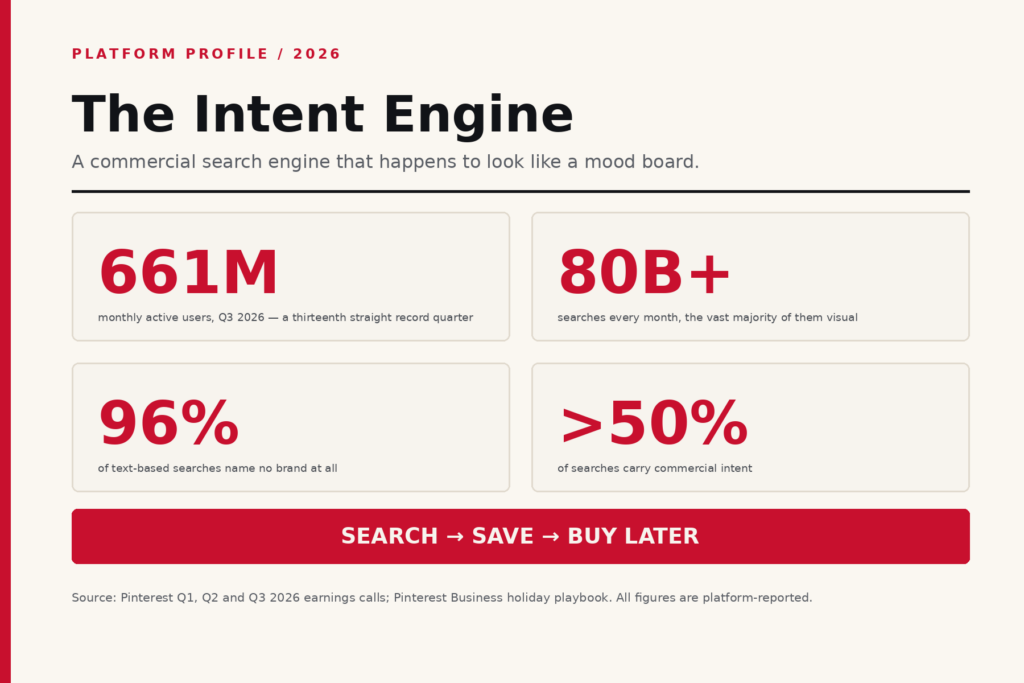
Somewhere in your media plan there is a line item nobody has audited in about three years. It sits between TikTok and Meta, gets labelled social, and gets cut first when the CFO asks for efficiency. Last month that line item processed more than 80 billion searches — and 96% of its text queries named no brand at all.
Executive summary
Pinterest closed Q3 2026 with 661 million monthly active users and revenue up 12% year over year, yet it is still misfiled as a social network. Two-thirds of interactions on the platform involve search, more than 96% of text searches are unbranded, and there is no incumbent brand to outbid. The 2026 twist: it has become an AI shopping assistant — Gen Z is now 57% of users, roughly 80% of Assistant queries are commercial, and the ad business has flipped so that more than two-thirds of revenue comes from lower-funnel performance ads. The trap is unchanged. People save now and buy weeks later through another channel, so last-click systematically punishes the platform that shaped the decision. Run it like SEO with a shopping list, and judge it on normalised windows and incrementality, not on last-click ROAS.
1. The mood board that runs 80 billion searches a month
Let us start with the number that should embarrass the category. Pinterest’s own Q3 2026 earnings call stated that users conduct more than 80 billion searches per month, the vast majority of them visual, and more than half commercial. Put that beside eMarketer’s observation that this is roughly comparable to the query volume then being reported for ChatGPT, and the word “social” starts to look like a filing error.
Then there is the detail that changes the whole media strategy: over 96% of text-based searches on Pinterest are unbranded. Not “cheap running shoes Nike”. Just “cool running shoes”. Pinterest’s own 2025 holiday playbook puts it plainly — 96% of top searches are unbranded, meaning people arrive without their minds made up about where, or even what, they want to buy.
Think about what that means for a small brand. On Google or Amazon you pay a tax for entering an auction where the incumbent already owns the query. On Pinterest, most of the auction has no incumbent at all. You are not interrupting someone’s feed; you are answering a question before the person has learned the word for the answer.
2. Stop calling it social — intent is the product, not attention
Two-thirds of interactions begin with search
Bill Ready told Business Insider, in remarks eMarketer relayed in late 2025, that two-thirds of Pinterest interactions involve search and that “search is the core of the business” — a clarity he says the company did not have three years ago, when it was still losing users. Pinterest’s Q1 2026 call added the mechanical detail: over 72% of ad impressions occur on search surfaces. Forrester’s Evelyn Mitchell-Wolf called that intent data what makes Pinterest an attractive high-intent surface for advertisers. A feed sells attention; a search sells a stated intention. Those are different products with different pricing, different creative and different measurement.
The 2.8% share that tells you everything
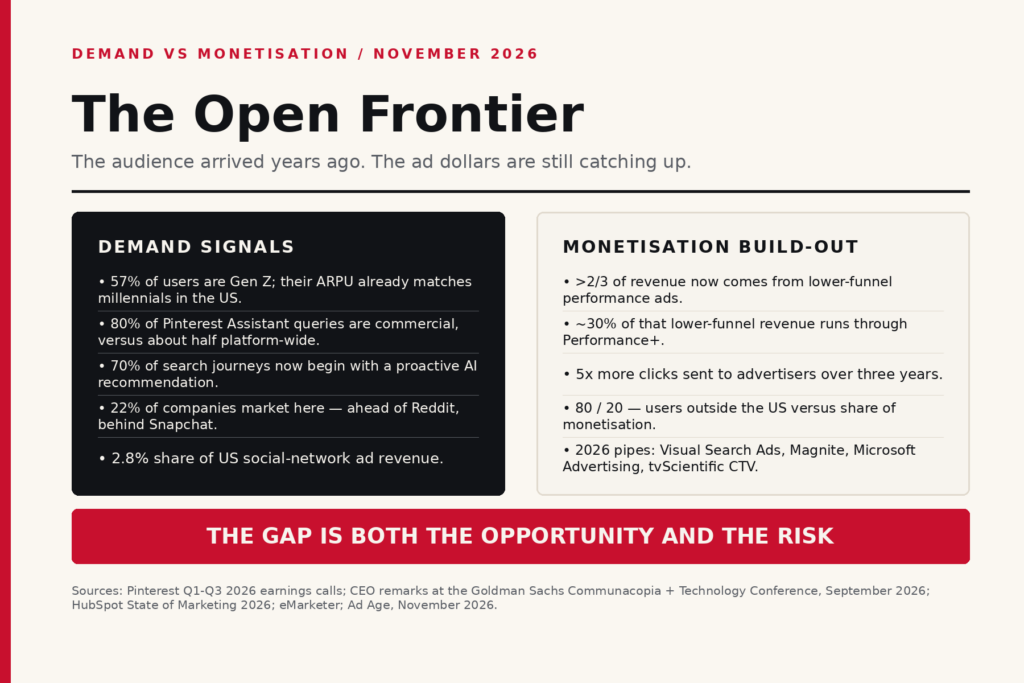
Here is the arbitrage in one line: eMarketer estimated Pinterest held just 2.8% of US social-network ad revenue share in 2025. Raymond James called it an “untapped” advertising platform. HubSpot’s 2026 State of Marketing report, surveying more than 1,500 marketers, found only 22% of companies use Pinterest for marketing — ahead of Reddit at 15%, behind Snapchat at 25%.
So the audience is enormous, the intent is unusually commercial, and the competitive density is thin. That combination does not last forever. It is a window, not a law of physics.
Intention beats attention, and the industry is finally saying it
Pinterest’s own holiday research says users are twice as likely to say they are ready to shop when they open the app, and 68% agree the platform helps them decide what to buy. Separate research commissioned by Pinterest (Talk Shoppe, US, July 2024) found weekly users spend 40% more per month and build 20% larger baskets than non-users. Treat those two as platform-commissioned and directional — but note the direction is consistent across every source, including Adobe’s. The same HubSpot report found 58% of marketers now say AI referral traffic carries higher intent than traditional search, and 49% say traditional search traffic has already declined because of AI. Intention is becoming the scarce asset; attention is becoming the cheap one.
3. The Gen Z inversion nobody budgeted for
57% of users, and ARPU parity has already arrived
The Q3 2026 call was the quarter the demographic story stopped being a forecast. Gen Z now represents 57% of Pinterest’s users, its most engaged cohort across monthly retention, saves and sessions. Two-thirds of Gen Z users say they come to Pinterest to shop. And — this is the part that should change your model — Gen Z ARPU in the US is comparable to millennial ARPU, while the cohort has not yet entered its peak spending years.
At the Goldman Sachs Communacopia + Technology Conference in September 2026, Ready put the longer arc plainly: Gen Z is the largest and fastest-growing cohort at more than half the platform, with the deepest engagement and highest retention, and their US ARPU is “roughly consistent” with millennials. He also said more than half of all users now come to the platform to shop, not just browse. A young audience with old-audience economics is unusual. Most platforms wait a decade for that.
The Adobe study — and the caveat the headlines skipped
Ready cited an Adobe study at that conference: 39% of Gen Z view Pinterest as the first place they go to search, and 71% see it as more personalised than other search destinations. Go to Adobe’s own write-up and the numbers get both better and smaller.
Adobe surveyed 800 consumers and 200 business owners on a single day, 12 March 2025. 47% of Gen Z respondents said they had used Pinterest as a search engine (39% of all consumers). 36% of consumers who use Pinterest for search said they start there instead of Google — 39% among Gen Z. 61% said results feel more tailored than Google’s, rising to 71% for Gen Z; 73% cited the visual format; 56% liked that ideas are easy to save. Among the business owners using Pinterest, 47% named “understanding SEO and best practices” as a top hurdle, and 80% said the platform outperforms others at keeping people engaged.
Now the caveat, because you will be asked. Adobe counted only responses from people who already use Pinterest for search, on one day, with no geographic breakdown published, all self-reported. Retail analysts on the Omni Talk podcast tore into the “36% have ditched Google” framing on exactly that basis. So do not write “a third of consumers abandoned Google” in a deck. Write the defensible version: among people who already use Pinterest as a search tool, a meaningful share start product discovery there rather than at a text engine, and Gen Z over-indexes hard. That is still a big deal for a visual category, and it will survive scrutiny.
4. Unbranded search is the last open frontier in discovery
Write Pins like search results, not captions
Here is where most brands import the wrong muscle memory. An Instagram caption is written to be felt. A Pinterest Pin title and description are written to be matched. The platform’s own data says 96% of top searches are unbranded — which means the query is a problem statement (“small kitchen storage ideas”, “linen curtains that block light”), not a product name. Your job is to own the problem statement.
That means literal, boring, useful language in titles and descriptions: material, room, occasion, constraint, colour, body type, budget. Adobe found standard image Pins were the most engaging format at 61%, with idea Pins at 37% and video Pins at 27% — a useful reminder that this is still a still-image-indexed library first. Pinterest’s own 2026 trend report noted a 150% jump in searches for “lace bandana” and similar micro-specific terms. Specificity is not the enemy of reach here; it is the mechanism of it.
Boards are taxonomies, not lookbooks
A board named “Our favourites” tells the algorithm nothing. A board named “Linen curtains for north-facing rooms” tells it exactly which queries to surface you in. Naming boards as keyword-organised libraries is the single cheapest optimisation available, and almost nobody does it. Adobe’s business-owner data says 47% of them already know SEO is their weak point. Fix the taxonomy before buying a single ad.
The compounding shelf life is the whole point
A feed post has a useful life measured in hours. A well-indexed Pin is a search result that can keep surfacing across a season, which is why brands that plan holiday content in November are already late — Pinterest users plan months ahead, and Pinterest Predicts has claimed an 88% accuracy rate across six years of forecasts. Treat each Pin as a small piece of durable infrastructure, not a unit of content output. That reframing is what makes the economics work: you are building an asset library, not feeding a treadmill. One useful cross-reference for readers working in China: Xiaohongshu runs a strikingly similar seed → search → save loop, which is exactly why the two platforms reward the same keyword discipline and punish the same repurposed-feed creative. The mechanics are global even when the surfaces are not.
5. The save-to-buy gap — where the money disappears from your dashboard
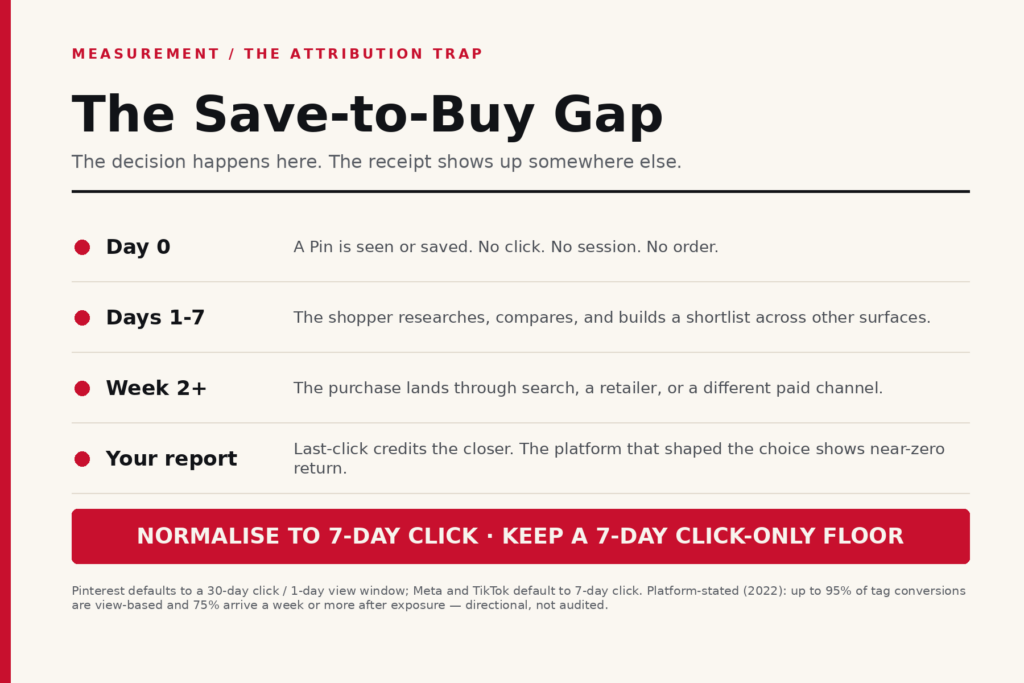
This is the section that decides whether you keep the channel. A user saves a kitchen idea on a Tuesday. They compare finishes on Friday. Three weeks later they buy through a retailer, a branded search, or a retargeted Meta ad. Pinterest shaped the decision and the dashboard shows a rounding error.
The structural reason is the window. Pinterest’s reporting API defaults to a 30-day click / 1-day view attribution window and reports conversions against the day of the ad interaction, not the day of purchase — so recent days always look thin and late sales land in other channels’ columns. Meta and TikTok default to 7-day click. Compare the two platforms’ default dashboards without normalising and you are not comparing performance; you are comparing accounting policies.
There was also a real change worth knowing: effective 1 April 2025, Pinterest removed the “engagement” component from its attribution window settings to align with industry standard, and by 2026 the engagement window no longer returns new data. If your BI connector still maps an old 30-day-click-plus-engagement setting, your historical and current numbers are not the same series. Check the window before you check the ROAS.
Pinterest has said, as a directional platform-stated figure from 2022, that up to 95% of tag conversions can be view-based and 75% of conversions land a week or more after ad exposure. Label it as such — it is the vendor’s own framing — but it matches the behaviour. Which brings us to the practical question: why does Pinterest ROAS look so bad, and what do you do about it?
6. Repair the measurement before you judge the channel
Normalise to seven-day click, keep a stricter floor
The clean discipline: use 7-day click plus 1-day view as your working optimisation number, and hold the channel to a 7-day click-only floor for scaling decisions. Never judge Pinterest on 1-day click. A one-day window amputates exactly the behaviour that makes the platform valuable. Also pin down whether your reports count conversions on the ad-action date or the purchase date; two settings, two different weeks, endless arguments in the Monday meeting.
Incrementality, not ROAS theatre
Once windows are aligned, the honest test is a geographic or audience holdout: does total blended revenue rise when Pinterest is live? Watch branded-search volume, blended MER and new-customer share, not just platform-attributed ROAS. Third-party cross-channel tools exist for precisely this reason — the platform that introduces a product rarely gets to close it, and last-click will always lie about who did the introducing. Save rate and search-impression share are legitimate leading indicators here: a save is a stated intention to return, which is more than an impression ever promised.
7. The assistant layer — 80% commercial, and it answers questions about your brand
Rolled out to the vast majority of US users by the end of July 2026 and generally available by Q3, Pinterest Assistant is where this stops being an SEO story. Roughly 80% of Assistant searches are commercial, against about half across the platform as a whole. On the Q3 call, Ready also said approximately 70% of search journeys now begin with a proactive AI recommendation before a user types a word. Read that twice: the platform increasingly guesses the question before it is asked.
That changes what optimising means. Assistant supports follow-up questions inside a conversation — Ready’s own example was whether a shoe brand runs large or small. By November 2026 Pinterest was testing a full-screen conversational mode, an “Ask Mode” for multi-step planning, and a “Compare” feature that puts price, availability and reviews side by side. If a shopper asks an AI whether your sizing runs true, your product feed, your structured attributes, your review corpus and your third-party mentions are the answer. You are no longer trying to rank a blue link; you are trying to be the fact inside someone else’s answer engine. That is GEO work applied inside a retail surface, and almost no brand has an owner for it yet.
Cost is part of the strategy too. Pinterest has said its mix of compact in-house models and post-trained open-weight models runs at less than 8% of the cost per transaction of comparable closed proprietary models — which is why it can afford to put an assistant in front of hundreds of millions of users without a matching inference bill. Cheap answers scale; expensive answers get rationed.
8. Performance+ and the quiet re-platforming of the ad business
From awareness to lower funnel: two-thirds and counting
Speaking in September 2026, Ready said the business was “almost entirely” upper-funnel when he joined four years ago, while more than two-thirds of revenue is now lower-funnel performance advertising. Business of Fashion independently reported the same shift: in Q3 2022 Pinterest’s revenue was evenly split across awareness, consideration and conversion; by Q3 2025 two-thirds came from driving sales. He also said Pinterest has sent more than five times as many clicks to advertisers over the past three years — while being candid that revenue has not grown nearly as fast. That gap is the entire monetisation thesis.
Performance+, generally available since the start of 2025, now carries about 30% of lower-funnel revenue. On the Q1 2026 call, adopters of Performance+ were growing lower-funnel spend at nearly twice the rate of non-adopters, and the newly launched native A/B tool in Ads Manager produced a clean result for fine-jewellery brand Mejuri: a four-week test delivered a 46% increase in ROAS and a 62% increase in conversions versus business as usual. Q2 added a reported 28% ROAS improvement in bidding tests, and the company said advertisers running objectives across multiple funnel stages now see three times the conversion rate, up from the two-times benefit it had previously discussed.
What the A/B test actually proved
Underneath the campaign automation is a stack worth understanding, because it tells you where the platform is investing: PinRack, a proprietary generative retrieval model extended site-wide in Q1 2026, improved search fulfilment by roughly 180 basis points and cut advertiser CPA and CPC by a similar margin; a unified and retrained Shopping ROAS model produced up to 11% ROAS gains in experimentation; and Canvas, an in-house image-generation model, handles creative automation at a fraction of third-party cost. In other words, Pinterest is quietly turning “mood board” inventory into a measurable auction. If your mental model is still a collage of wedding cakes, your bid strategy is three years out of date.
9. Category fit — where this works, and where it quietly doesn’t
The Maguire file
Business of Fashion published the most useful real case study in January 2026. Canadian footwear brand Maguire, balking at Meta costs before its first New York store, diverted budget to Pinterest. Between 2022 and 2025 it raised Pinterest ad spend 77%, saw sales generated on Pinterest rise 86%, and now calls Pinterest its top-performing paid channel in the US — with a 5.59% conversion rate against Meta’s 1.72% for the same business. The co-founder’s explanation was not a clever tactic: “It’s still not crowded like Meta.” That single sentence is the 2026 opportunity in plain language.
The short no list
This is a planning surface, which means it rewards considered, visual, aspirational purchases: home and kitchen, furniture, fashion and accessories, beauty, food, travel, weddings, and anything with a season or a renovation attached. It is a poor fit for B2B software, low-ticket impulse commodities, and categories with no visual vocabulary. Do not paste TikTok Shop scripts onto Pinterest either — the agency consensus in 2026 was blunt about it: TikTok creative sells the flash sale, Pinterest creative sells the room the product will live in. If your product cannot belong on a mood board, your budget belongs somewhere else. No amount of clever bidding fixes category mismatch.
10. Opening the pipes — programmatic, Microsoft, and CTV
2026 is the year Pinterest stopped requiring advertisers to come to it. In September it launched Visual Search Ads and top-of-search placements. In October it opened display and video inventory to outside demand-side platforms with Magnite as supply-side partner, reaching buyers on Yahoo DSP, Amazon Ads and Google DV360. Then, in the last week of November 2026, Microsoft Advertising began letting eligible search advertisers extend existing campaigns into Pinterest’s home feed, search results and related Pins — targeted by Pinterest search queries, contextual signals and first-party intent data through a custom contextual bidding model, initially in North America, Australia and New Zealand (Europe excluded from this first rollout). Jason Fairchild’s line to Ad Age was admirably blunt: “Anywhere a marketer wants to activate, we want to be.”
tvScientific and the off-platform bet
The other pipe is the biggest. Pinterest announced the acquisition of tvScientific on 11 December 2025 — its first major deal since 2022 — framing it as bringing intent-rich audience signals to connected TV with deterministic attribution, integrated into Performance+. At the time the official release cited 600 million users saving to 15 billion boards and described the Taste Graph as a predictive signal of what people plan to do next. Reuters reported in February 2026 that Pinterest raised its Q1 revenue forecast on the deal’s contribution. The numbers since are worth labelling carefully: eMarketer reported that initial tests saw an average 27% increase in outcomes per $100 spent and a 65% increase in purchases, with an LG test producing 73% higher unique household reach and a 24% lift in net-new customers; the Q1 2026 call cited one partner seeing roughly 190% more incremental audience reach and 159% higher incremental sales; and Ready said in September he had observed a more than 60% lift in purchases from layering Pinterest intent on CTV. Different tests, different baselines, all vendor-reported — but all pointing the same way.
For budget planning, the implication is simple: Pinterest is no longer just a line inside paid social. It is becoming a demand source you can buy through search budgets, programmatic budgets and TV budgets. Competitors have noticed — Reddit has begun testing ads in its own search results. The land grab for commercial queries is on.
11. The budget case, and the adoption gap
22% of companies, 2.8% of ad dollars
Put the two numbers side by side again: only 22% of companies market on Pinterest, and the platform holds 2.8% of US social ad revenue. Cheap auctions are a symptom of that, not a permanent feature. The playbook most practitioners have landed on is deliberately unglamorous — treat Pinterest as a third channel alongside Meta and Google, funded at roughly 10–20% of paid social, with a mandate to capture mid-funnel shoppers who were introduced on another platform and have not converted. A portfolio optimisation, not a migration.
The 80/20 international arbitrage — and why it is hard
Ready has been explicit that more than 80% of users are outside the US but only about 20% of monetisation comes from international markets. That is either the largest runway in the story or the largest execution risk, and in 2026 it was both. Which brings us to the part most glowing write-ups leave out.
12. Where the thesis can break
A credible strategy has to survive the bad quarter, so here is the Q3 2026 one in full. Revenue of $1.17 billion grew 12% but came in below the company’s own guidance range, and Q4 guidance of $1,425–$1,475 million (8–12% growth) landed under consensus; shares fell about 14% on the news. Management named two causes: EU regulatory changes to the de minimis exemption hitting Asia-based cross-border sellers — worth roughly three points of the sequential slowdown in global revenue growth — and a restructuring of the international go-to-market organisation. Global ARPU was $1.80, up just 1.1% year over year. The CFO departed in August 2026. And competitive pressure from horizontal AI assistants and ChatGPT-style ad products is no longer hypothetical.
So the honest version of the thesis: the user and intent story is real and verified; the monetisation of that intent is still unproven outside the US, and the newest distribution pipes are too young to have a track record. If you are a performance marketer, that argues for a bounded test with a hard measurement protocol, not a reallocation. Which, conveniently, is what the rest of this article has been arguing all along.
13. A measurement stack you can actually run
Stop asking Pinterest to behave like a last-click channel and give it a scorecard that fits the job:
- Save rate and save growth — the platform’s cleanest stated-intention signal, and a leading indicator weeks before revenue.
- Search impression share on your priority unbranded terms — your SEO-equivalent rank tracking, tracked monthly.
- Normalised ROAS — 7-day click plus 1-day view as the working number, with a 7-day click-only floor for scale decisions. Lock the reporting-date setting across every dashboard.
- Branded-search lift and blended MER — did total demand rise while Pinterest was live? This is the honest incrementality read.
- New-customer share and basket size — the intent premium should show up in who bought, not just how many.
- Holdout tests — one region or audience kept dark, reviewed over six to eight weeks, not six days.
And one cultural note for teams running both markets: the Xiaohongshu seed-search-save loop has been doing this in China for years, which is why its practitioners intuitively understand a save that converts three weeks later. Western teams keep trying to fix it with a shorter attribution window. The fix is the opposite.
Conclusion — run it like SEO with a shopping list
Pinterest in 2026 is a commercial search engine with an unusually long memory, an unusually young audience, and an ad stack that only recently learned how to charge for what it has always been doing. The unbranded query is the opening. The save is the intent receipt. The assistant is the new answer surface. And the measurement gap is the one thing standing between a genuinely cheap source of demand and a channel your CFO will switch off in the next efficiency review.
So: write keyword-native Pins, build boards as taxonomies, publish ahead of the season, use shoppable and video formats for considered purchases, let Performance+ handle scale once the organic foundation exists, and hold the whole thing to a normalised window plus a holdout. Judge it over a quarter, not a week. The brands that worked this out early — Maguire is one — are buying attention at a discount while everybody else is still arguing about whether Pinterest counts as social.