Your phone buzzes. You look. You always look — which is the entire pitch for SMS, and the entire problem with it. The channel people reserve for humans is the one place a brand cannot afford to be boring.
Email forgives. Send a mediocre campaign to 40,000 people and the marginal cost is a rounding error; a few of them may even open it on Saturday. SMS does not forgive. Every message is a line item, the subscriber you burn cost real money to acquire, and one lazy blast can lose a customer who will never opt back in. So here is the reframe worth carrying into 2026: stop running SMS like a broadcast channel with an opt-in box, and start running it like a margin machine. The only number that survives contact with a P&L is revenue per message.
That sounds obvious. Almost nobody budgets that way.
The channel people reserve for humans
Think about your own lock screen. A handful of messages, nearly all from people you know. No promotions tab, no preview-pane triage, no algorithmic feed quietly burying you. A text arrives in a queue measured in single digits, and it gets read. That scarcity is the asset. It is also a lease, not a deed — the moment a brand treats that queue like an inbox to fill, the lease gets revoked with a single word.
There is a deeper asymmetry hiding in the arithmetic. Email is a channel you own with near-zero marginal send cost, so its economics run on blended ROI across a huge list. SMS gives up that free-marginal-send property. Every send costs money, whether or not anyone clicks. That flips the whole discipline: you are not optimising a campaign, you are pricing a moment. Get the moment right and a two-cent message can carry four dollars of attributed revenue. Get it wrong and you have paid two cents to annoy someone who was already yours.
Which raises a question most benchmark roundups skip: what, exactly, are we measuring?
The attention math nobody can actually measure
The number you have seen a hundred times is the 98% open rate. Treat it as folklore, not measurement. SMS has no pixel and no read receipt — there is no technical event that corresponds to an open. Tracing the claim back, it shows up as an estimate in a 2022 FCC Consumer Advisory Committee report, as unverified marketing copy on a trade association page, and as an attribution to a research firm that never published the underlying study. Klaviyo, which sits on one of the largest SMS datasets in the industry, does not publish an SMS open rate at all. When a channel cannot measure a metric and the largest vendor refuses to print it, the honest move is to stop quoting it.
Same discipline applies to the famous 6–8× click-through advantage over email. It is arithmetic performed on vendor medians and then repeated until it hardens into a fact; we could not trace it to a primary benchmark, so it does not belong in your model. What does belong is first-party and testable: on Klaviyo 2026 data, automated flow messages click at roughly 10% while one-off campaigns sit near 5.6%. That is a real, published, within-account comparison — and it is a much more useful anchor than a multiplier someone invented.
Kill the open rate and something clarifying happens. You are left with click rate, conversion rate, unsubscribe rate, and revenue per recipient. All four are countable. All four can go in a dashboard. Suddenly the channel stops being magic.
The ROI honesty ladder
Now to the headline numbers. The widely quoted figures — roughly $28 of revenue per dollar from one large vendor cohort, and $71 from a mature-program survey — travel well because they are round and enormous. They also do not survive a cost audit. We could not trace either one to a first-party methodology disclosing sample, category, time window, and full cost stack; they live mostly in roundups citing other roundups. That does not make them lies. It makes them marketing, and marketing is not a budget input.
Build the ladder from the bottom instead. A new program in months one to three is buying a list and wiring its first flows, so its return is naturally worst there. An established program with a real flow library improves sharply. A mature program with full coverage, segmented broadcasts and two-way commerce does best of all. The shape of that curve matters more than its ceiling, because it tells you where your own number should be — and it tells you the strongest lever is not discounting harder or sending more. It is shifting send volume from broadcasts into triggered flows.
There is one attribution trap worth tattooing on the reporting template. Klaviyo Attributed Value, the metric the company reports to investors and defines in its SEC filings, credits an SMS within 24 hours and an email within five days. The in-product default is configurable and different again. Platform-attributed revenue is not incremental revenue. If you want to know what SMS actually caused, you need a holdout — suppress the channel for a randomised slice of eligible subscribers and compare. It is unglamorous, it costs you some send volume, and it is the only way to find out whether you built a revenue engine or a very efficient credit-claiming machine.
The five-line invoice behind one text
Let us price a single outbound message properly, from primary pricing pages rather than a roundup.
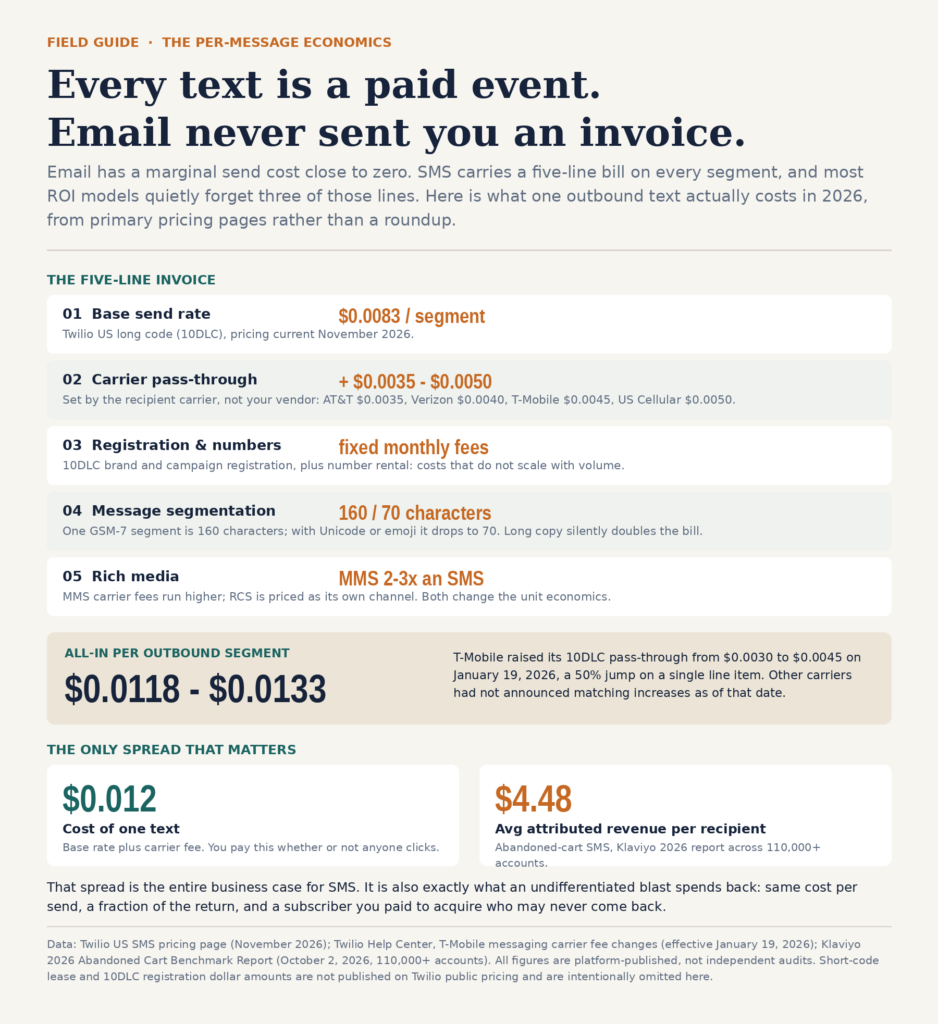
The base send rate on Twilio US long code is $0.0083 per segment, a figure published on its pricing page as current in November 2026. On top of that comes a carrier pass-through fee set by the recipient network, not by your vendor — roughly $0.0035 to $0.0050 depending on the carrier. Then come the costs that do not scale with volume: 10DLC brand and campaign registration, number rental, and whatever compliance tooling you switch on. Then segmentation: one GSM-7 segment is 160 characters, but add an emoji or an accented character and the limit drops to 70, so a cheerful 200-character text quietly becomes two or three billable segments. Then rich media, which is priced on its own schedule entirely.
Add the first two lines and one ordinary outbound segment lands around $0.0118 to $0.0133. That is your floor before a single click. And the floor moved this year: effective January 19, 2026, T-Mobile raised its 10DLC outbound pass-through from $0.0030 to $0.0045 — a 50% jump on a line item nobody put in the deck. Its own notice adds that no other major US carrier had announced a matching increase as of that date. So there is no honest basis for the “+9% carrier CPM” figure circulating in 2026 operator posts; the verifiable fact is narrower and stranger: one carrier repriced, and it was enough to change the math on every T-Mobile subscriber you text.
We deliberately left two numbers out of the figure above. Short-code lease prices and the exact 10DLC registration dollars are quoted all over third-party blogs but are not published on Twilio public pricing, so they fail the verification bar. If your vendor will not print a price, do not print it either.
TCPA 2026: the consent rule that never took effect
Here is where a lot of 2026 content goes confidently wrong. You will read, in otherwise competent marketing posts, that new FCC rules took effect in January and rewrote SMS consent. They did not. That sentence is a ghost.
The docket, not the deck
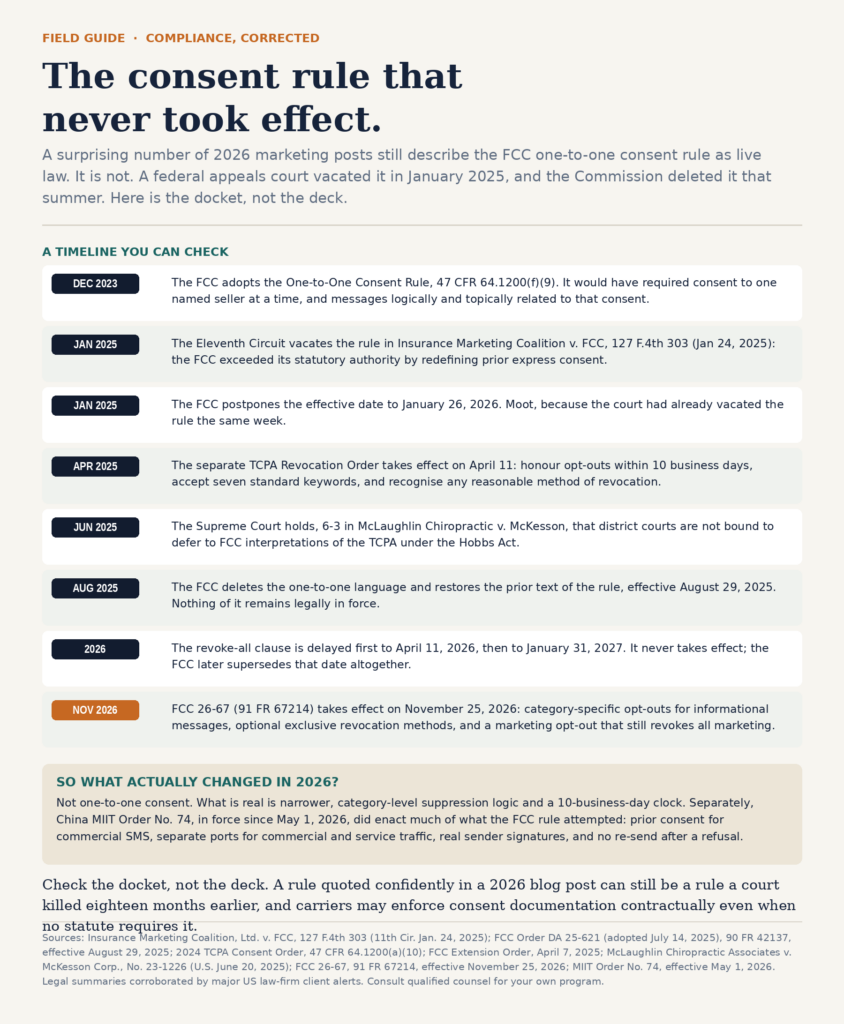
The FCC adopted its One-to-One Consent Rule in December 2023, amending the definition of prior express written consent so that a consumer could only consent to one named seller at a time, and only to messages logically and topically related to the interaction. It was due to take effect on January 27, 2025. Three days before that, the Eleventh Circuit vacated it in Insurance Marketing Coalition v. FCC, holding that the Commission had exceeded its statutory authority by rewriting the ordinary meaning of consent. The FCC had simultaneously postponed the effective date to January 26, 2026 — moot the moment the court ruled. In July 2025 the Commission deleted the language outright under its Delete, Delete, Delete proceeding; the deletion took effect on August 29, 2025, restoring the earlier rule. Nothing of one-to-one consent is legally in force today.
A second, separate rule does matter. The 2024 TCPA Consent Revocation Order, at 47 CFR § 64.1200(a)(10), took effect on April 11, 2025: honor a revocation within 10 business days, treat any reasonable method as valid, and recognise the seven standard keywords — stop, quit, end, revoke, opt out, cancel, unsubscribe. Then in June 2025 the Supreme Court held, 6–3 in McLaughlin Chiropractic v. McKesson, that district courts are not bound under the Hobbs Act to defer to FCC interpretations of the TCPA. Read those two together and you get the real 2026 risk: less deference to agency guidance, more room for courts to interpret the statute independently, and a live private right of action carrying $500 per violating message, trebled to $1,500 for willful violations.
What is actually live on November 25
As this piece goes to press, the genuinely new item is FCC 26-67, adopted September 30, 2026 and published at 91 FR 67214, effective November 25, 2026. It does three things that touch SMS programs. It lets a sender treat an opt-out from an informational message as applying only to that category — so someone who quits payment reminders can still get a fraud alert — while an opt-out from a marketing text still revokes all marketing from that caller. It permits, but does not require, a sender to designate one of three exclusive revocation methods, provided the method is clearly and conspicuously disclosed on every message; disclose one keyword if you like, but you must honor all seven. And it expands the fraud-alert exemption for financial institutions. The old “revoke all” clause, twice delayed and most recently pointed at January 31, 2027, is superseded before it ever arrives. A companion proposal floated a seven-day deadline, mandatory two-way texting and a required revoke-all option; as of now that is a proposal, not a rule.
One distinction worth keeping straight, because it is where lawyers and marketers talk past each other: carriers, the 10DLC registration ecosystem and messaging platforms still demand documented opt-in consent as a contractual condition of sending traffic. That is an industry gate, not the vacated FCC rule. You may be fully compliant with the statute and still have your traffic filtered because your consent records are thin. Compliance and deliverability are two different audits.
Rebuild the list anyway
So do not rebuild your program around a rule that never happened. Do rebuild the parts that are unambiguously live: capture consent with a timestamp and the exact disclosure text, keep it auditable, honor every one of the seven keywords across every channel, and instrument suppression so a revocation stops the right category of messages inside 10 business days. If you designate an exclusive method under the new order, put the disclosure in the template, not in your terms and conditions — burying it there does not satisfy clear and conspicuous. And treat every list you bought as contaminated until proven otherwise.
Flows before broadcasts: the 7.6 / 45.2 rule
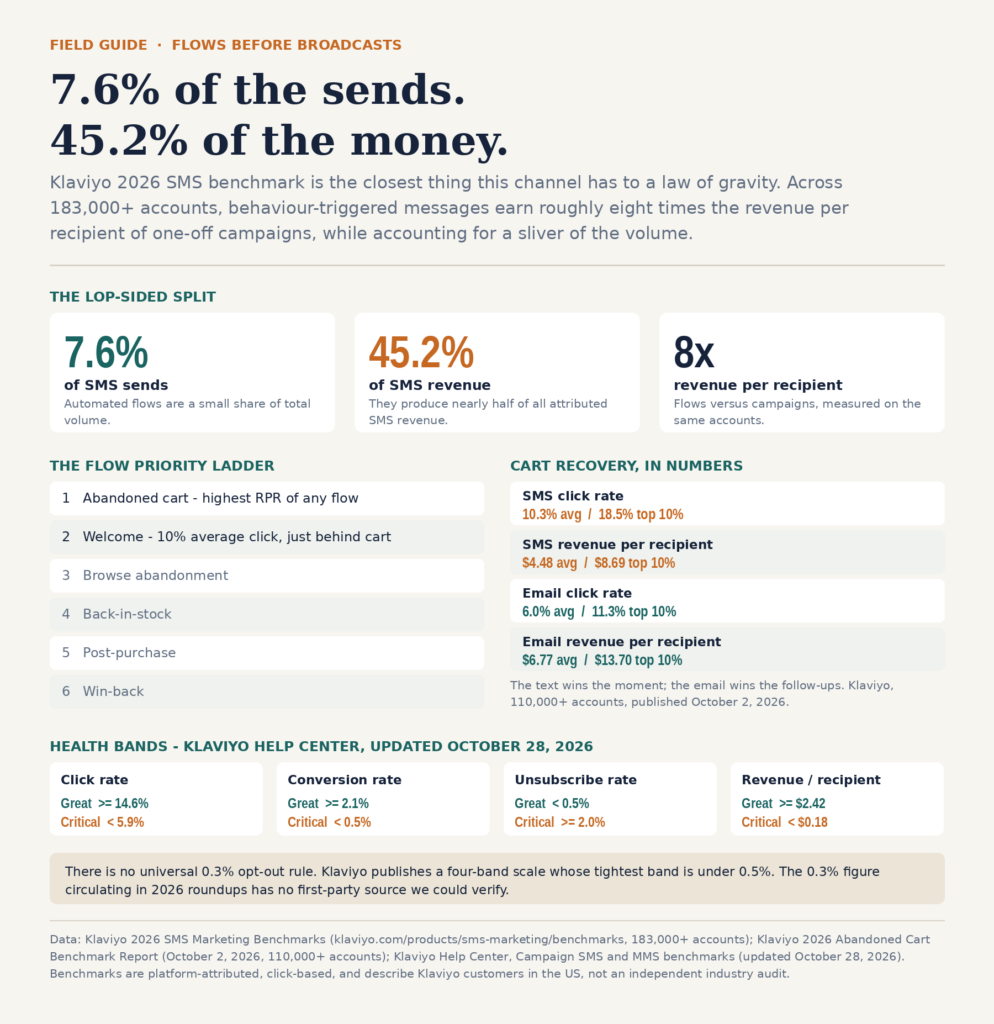
If this article leaves you with one number, make it this split. On Klaviyo 2026 SMS benchmarks, drawn from more than 183,000 accounts, automated flows account for just 7.6% of sends but drive 45.2% of total SMS revenue, with revenue per recipient running roughly eight times higher than campaigns measured on the same accounts. Same platform, same list, same copywriter — the difference is entirely timing. A flow fires because somebody did something: left a cart, browsed a product, bought, went quiet. A campaign fires because Tuesday arrived.
This is not a marginal optimisation. It is a different theory of the channel. Behaviour-triggered sends arrive inside a decision that is already in progress; broadcasts try to start a decision from cold. On a channel where every message is paid for, that is the difference between buying a moment and interrupting one.
The priority ladder writes itself. Abandoned cart first, then welcome, then browse abandonment, back-in-stock, post-purchase, win-back. Build them in that order and resist the urge to add a seventh before the first three are tuned. One caution on the cohort: these are platform-attributed, click-based figures from Klaviyo customers in the US, not an independent industry audit. The direction is robust; the decimals belong to them, not to you.
Cart recovery: the workhorse flow
Klaviyo publishes a dedicated abandoned-cart report, released October 2, 2026 and covering more than 110,000 accounts, and it is the cleanest evidence for why cart recovery earns the top slot. The average cart text clicks at 10.3% and returns $4.48 in attributed revenue per recipient; the top 10% hit 18.5% and $8.69. The welcome text is nearly as engaging at 10% average click, and for the top decile it is essentially tied at 18.3%.
Now put the two channels side by side, because the comparison is frequently misreported. The average cart email clicks at 6.0% and returns $6.77 per recipient; the top 10% reach 11.3% and $13.70. So the text wins the moment and the email wins the money per head. That is not a contradiction, it is a division of labour. US carrier guidance generally allows a single cart text, and the email carries the follow-ups. The sensible sequence is one text within the hour, then a short email series — let the high-urgency channel open the door and the cheap channel do the explaining.
Industry variation is real and available first-hand. Automotive cart texts average close to $11 per recipient; the top decile of home and garden brands reach $16.57 on SMS cart flows. If you sell a considered purchase, the cart text is not a reminder, it is a sales conversation, and it deserves the copy budget accordingly.
Segmentation economics: why a blast spends back the spread
Return to the spread from earlier: about $0.012 out, roughly $4.48 back on a decent cart flow. That gap is the entire business case. It is also exactly what an undifferentiated blast consumes — identical cost per send, a fraction of the return, and a permanent unsubscribe from someone you paid to acquire.
There is no shortage of confident claims about how much worse blasts perform. We could not verify the specific 3–4× opt-out penalty or a tidy 60–70% incrementality haircut from any primary source, so we are not going to print them. The mechanism does not need invented multipliers. A message sent to a segment defined by recent behaviour carries information; a message sent to everyone carries none. On a channel where the recipient’s attention is the scarce input, information is the only thing your copy can trade on. Segment by what people did, not by who they are demographically, and the return follows.
The practical version: tag recency, category interest, cart status, subscription state, and opt-in source. Build audiences from those tags. Suppress anyone whose last meaningful engagement is older than your natural repurchase cycle. Then write one message per segment rather than one message with a merge tag. It is more work. It is also the entire job.
Frequency governance without the 0.3% myth
You will see a crisp rule repeated everywhere: keep unsubscribe under 0.3% per campaign, and treat 0.5% as a red line. It sounds like an industry standard. On Klaviyo first-party help pages it does not exist. What Klaviyo actually publishes, in its Campaign SMS and MMS benchmarks updated October 28, 2026, is a four-band scale: unsubscribe under 0.5% is graded great, 0.6–1.4% good, 1.5–1.9% needs work, and 2.0% or more critical — with an explicit warning that elevated unsubscribe rates can trigger carrier filtering. The same page grades click rate (great is 14.6% and above), conversion rate (great is 2.1% and above), and revenue per recipient (great is $2.42 and above, critical is below $0.18).
Use those bands as a circuit breaker, not a target. Watch unsubscribe alongside click rate, because the dangerous pattern is not either number alone — it is flat clicks with climbing opt-outs, which almost always means frequency rather than creative. And remember what an unsubscribe costs here: unlike an email unsub, which quietly trims a list you can re-grow with a pop-up, an SMS opt-out ends a relationship that began with an explicit, legally significant yes. Carriers notice the rate too, so frequency governance is simultaneously a deliverability control.
Vertical fit: where SMS earns its keep and where it quietly bleeds
SMS is not uniformly good at selling things. It is good at selling things people buy repeatedly, on short cycles, with low deliberative load and a clear trigger. A restocked serum, a subscription renewal, a flash price on a familiar consumable, a cart left ten minutes ago — these are moments, and moments are what a text is for. A considered electronics purchase, a B2B evaluation, a durable good bought once every four years: the text arrives with urgency the buyer does not feel, and urgency without relevance reads as pressure.
The published vertical tables with tidy 22% and 9.4% click rates make this look precise, but they are compilations we could not verify against a first-party source, so we are not reproducing them. The first-party cart data already tells you the same story more honestly. Categories differ by multiples in revenue per recipient on the identical flow, and the difference tracks purchase frequency and emotional engagement rather than anything magical about the copy. Before you build a program, ask the boring question: does my customer have a reason to act within the hour, several times a year? If yes, SMS is a margin machine. If no, it is an expensive notification system, and notifications belong in email or an app.
Picking a platform: three different contracts
By 2026 the platform decision is less about features — everyone has flows, segmentation, two-way messaging and some AI — and more about which contract you are signing.
Klaviyo is the consolidation bet: a public company that, per its FY2025 Form 10-K, ended 2025 with more than 193,000 paying customers, pricing primarily on active profiles and message volume, with email and SMS sharing one customer record and one attribution view. If email is already there, the unified data model is genuinely hard to replicate with a point solution. Attentive is the enterprise bet, built for large programs with dedicated support, compliance governance and early support for richer channels. Postscript is the Shopify-native, SMS-first bet, optimised around two-way conversation and deliverability on dedicated infrastructure. Those characterisations come from comparative industry write-ups rather than audited feature matrices, so read them as orientation, not a scorecard.
The trap is the pricing model, not the logo. Contact-based email pricing and per-message SMS credits behave completely differently as you scale, and a revenue-share or annual enterprise contract changes who carries the risk when carrier fees move. Model your own bill at three volume levels using your actual segment length — remember the 160/70 character rule — and ask each vendor one question in writing: when T-Mobile or the next carrier raises a pass-through fee, who absorbs it? The answer tells you more than any demo.
Where AI helps — and where it flattens your voice
Generative copy is genuinely useful for the parts of SMS that are repetitive: producing variants for a segment, tightening 160 characters down to one segment, testing a call to action, and keeping send-time selection inside the platform machine-learning layer. Those are real gains in throughput, and they cost nothing in voice because the decisions are structural.
It is less useful for the part that makes a text work, which is sounding like a specific brand at a specific moment. Let a model write every cart text for you and you will converge on the same bright, hyphen-heavy, urgency-sprinkled register every other brand converged on. On a channel people reserve for humans, generic is the one unforgivable tone. You will also see a tidy vendor claim that AI assistance lifts SMS click rate by 22%; we could not trace it to a published test with a disclosed sample, so it stays out of the budget. Use AI to multiply your options, then have a human pick the one that sounds like you. The moment of truth is still an editorial decision.
The China mirror: SMS became a trigger, not a storefront
The standard Western take is that China skipped SMS commerce altogether. The government data says something more interesting. Person-to-person SMS collapsed first — from 5,451.8 hundred-million messages in 2010 to 2,705.8 in 2015, a share that fell to 38.7%, as WeChat and QQ absorbed person-to-person chat. But enterprise SMS went the other way over the same period, from 2,825.7 to 4,286.0 hundred-million messages, a compound annual growth rate of 8.69%. China did not abandon SMS. It reassigned it.
Reassigned to what? The rail for messages you expect: verification codes, payment confirmations, logistics updates, appointment reminders, government notices. MIIT’s 2025 statistical bulletin puts national mobile SMS volume at 23,020 hundred-million messages, up 14.2% year on year, even as SMS revenue fell 2.4%. Then 2026 turned: first-half volume fell 8% and revenue 12.9%, and by the first eight months the declines were 9.8% and 12.4%. Volume and price are now falling together, which is what a channel looks like when the low-value traffic is being squeezed out.
The regulatory twist is the part worth stealing. MIIT Order No. 74, the revised Provisions on the Administration of Short Message Services, took effect on May 1, 2026, replacing the 2015 rules. It requires prior consent for commercial SMS, forbids mixing commercial and service traffic on the same port, requires the sender’s real identity to be transmitted in the signature, bars re-sending after a refusal, and mandates a convenient opt-out. In other words, the port separation and explicit-consent regime the FCC attempted and a court struck down is, in China, ordinary administrative law. Meanwhile the selling moved into apps — service notifications, mini-programs, private-domain groups — where the canvas is richer and the identity layer is already logged in.
The lesson is not “China is different”. It is that SMS converges on being a trust rail almost everywhere, because its two durable advantages are reach and verified identity, neither of which helps you merchandise. Build the selling layer where the canvas lives. Keep SMS for the moments that must arrive.
RCS and the next rail: what changes when the text gets a canvas
Which brings us to the obvious question: what happens when the text stops being plain text? Twilio made RCS Business Messaging generally available in August 2025, with branded sender profiles, logos and taglines, trusted sender verification through Google, rich media and interactive actions, reachable on Android and on Apple devices running iOS 18.1 or later. Twilio’s own January 2026 fee notice points senders toward RCS and WhatsApp precisely as a hedge against rising SMS pass-through costs, and frames verified sender identity as a trust advantage over high-volume SMS.
One distinction to keep honest. Apple added RCS support at the operating-system level for person-to-person messaging; full RCS Business Messaging on iPhone depends on Apple and carrier support, and no native iMessage-for-Business equivalent has shipped in the same form as Google’s business offering. So “RCS is live on iPhone” and “your branded, verified RCS campaign reaches every iPhone” are not the same sentence.
What changes strategically is not the unit price, it is the job. A plain text is a trigger. A verified, rich, interactive message is a small storefront — and once the message can carry images, buttons and a checkout, the economics stop being about revenue per segment and start being about revenue per conversation. The discipline from this whole article survives the change: pay for a moment, not a list. The canvas just gets bigger.
The bottom line
SMS is the most attention-dense owned channel you can buy and the least forgiving, because both sides of the trade are priced. The honest 2026 picture is smaller and sharper than the headlines: roughly a cent and a bit out per segment, a few dollars back on a well-timed flow, a 7.6/45.2 split that punishes broadcast-heavy programs, and a consent regime that most marketing posts describe backwards. Kill the 98% open rate, delete the unverifiable ROI multiples, price the full cost stack, and put your effort into flows, segmentation and suppression logic. Then run a holdout and find out how much of your attributed revenue was actually yours.
The consent rule everyone said arrived in January never did. The carrier fee that did arrive went up by half on one line item. The channel rewards people who check the docket and the invoice, and quietly bills everyone who checks the roundup instead.