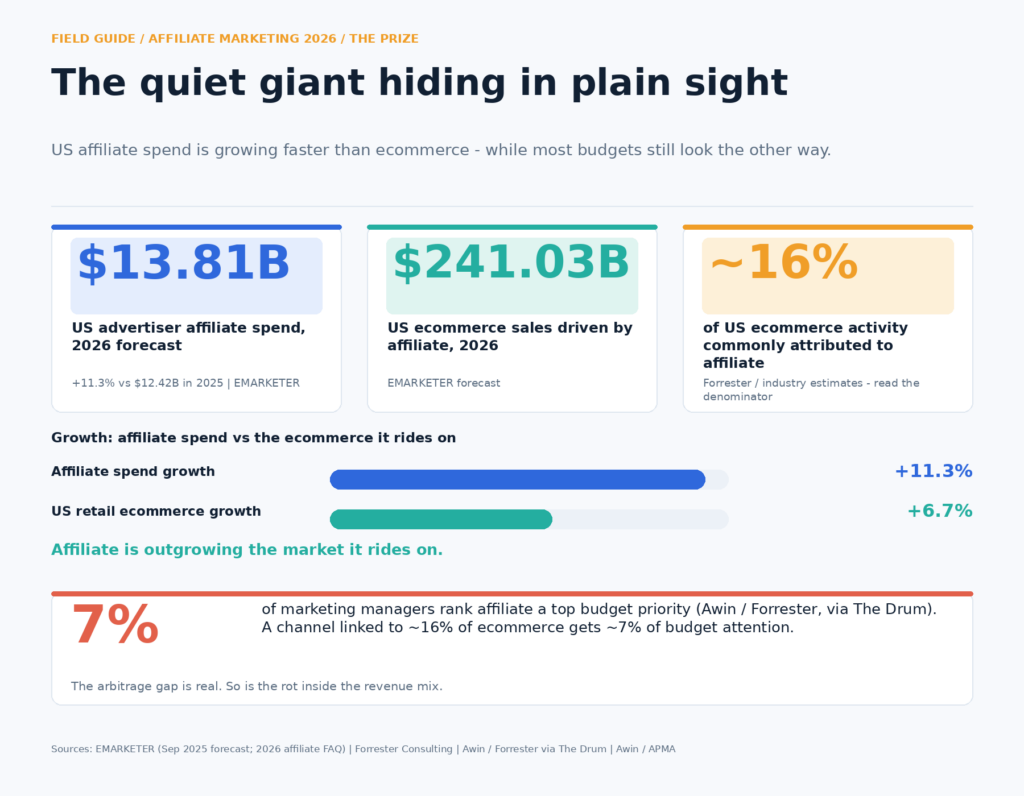
Here is a number that should embarrass the marketing industry. EMARKETER projects that US advertisers will spend $13.81 billion on affiliate marketing in 2026, up 11.3% from $12.42 billion in 2025 — growth nearly twice the 6.7% pace of US retail ecommerce over the same period. That spend is forecast to drive $241.03 billion in US ecommerce sales. By widely cited industry estimates rooted in Forrester research, affiliate is linked to roughly 16% of US ecommerce activity.
Now the embarrassing part: only about 7% of marketing managers rank affiliate as a top budget priority, a figure Awin and Forrester surfaced and which The Drum reported alongside the channel’s £13:1 average return on ad spend. A channel touching a sixth of ecommerce gets a fourteenth of the attention. That gap is the opportunity. But lean in closer and you find the rot: discount and coupon publishers now take 42.4% of US affiliate revenue, last-click attribution systematically overpays them, and a 2,368-retailer benchmark found clicks rising while transactions fell. Affiliate is not a channel you switch on. It is a portfolio you have to rebalance — paying for incrementality and editorial authority, not for demand that would have converted anyway.
Size the prize properly: three numbers, three meanings
Most affiliate arguments are really arguments about denominators, so let us settle them first.
$13.81 billion is advertiser spend — the commission and platform dollars brands pay out. $241.03 billion is the ecommerce sales EMARKETER attributes to the channel, an outcome roughly seventeen times the spend. 16% is neither; it is a share of ecommerce activity, which depending on the study means orders, sales or digital revenue. Forrester’s commissioned work for Pepperjam put affiliate at 16% of all digital revenue, while later industry coverage frames it as 16% of ecommerce orders. These are not interchangeable, and anyone quoting 16% without a denominator is guessing.
There is a fourth number worth keeping out of the same sentence: the global affiliate and partner platform software market, often cited around $18–24 billion. That is vendor revenue, not commissions, not GMV. Mix it with spend and you inflate the category by an order of magnitude. Treat every affiliate market-size claim the way you would treat a currency conversion: ask what exactly is being counted, in which geography, and in which year. EMARKETER’s figures are a September 2025 forecast, not a 2026 actual — a distinction that matters more now than it did when the channel was small.
The publisher mix flipped, and last click cannot see it
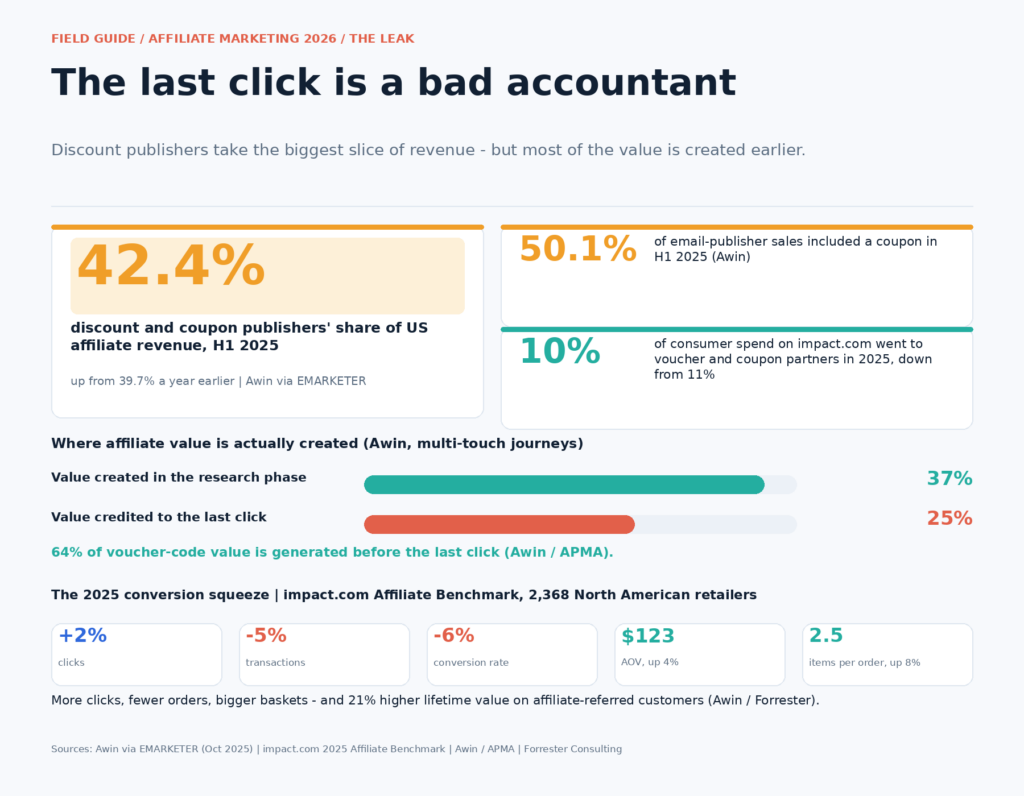
Awin data reported by EMARKETER shows discount and coupon publishers took 42.4% of US affiliate revenue in the first half of 2025, up from 39.7% a year earlier — the largest single publisher category. Email publishers leaned in too: 50.1% of their sales included a coupon in the same period. This is not inherently a scandal. Coupons close hesitant shoppers, and Awin’s own multi-touch analysis found that 64% of voucher-code value is generated before the last click, in the awareness and research phases.
But here is the accounting trap. In Awin’s multi-touch journeys, only 25% of affiliate value is credited to the last click while 37% is created in the research phase. Last-click attribution, the default logic of most programs, pays the partner who showed up at checkout and underpays the editorial partner, reviewer or creator who made the shopper want the product in the first place. Coupon and browser-extension partners sit structurally at the end of the journey — a click away from the cart — so a last-click model hands them the credit for demand someone else built. The fix is not banning coupons; it is paying for assists. Awin’s Commission-by-Assist feature, APMA guidance on stand-down rules for extensions, and impact.com’s default stand-down behavior all exist because the industry has already admitted the old credit rule is wrong.
The incrementality audit: prove the sale would not have happened
If last click is a bad accountant, the holdout test is the honest one. Before you rebalance a dollar of commission, run the audit Forrester’s Partnerize study found marketers most often admit they cannot do: measure incremental impact on revenue.
Three tests do most of the work. Geo or audience holdouts: suppress affiliate exposure for a randomized control group and compare net revenue per session, discount cost and commission included. A coupon partner can lift conversion and still cost more than it adds, so read the net, not the gross. New-to-file rates: a partner bringing first-time buyers is worth more than one harvesting existing customers, and most growth-stage brands now pay 15–25% on new customers versus 5–10% on returning ones. Assisted versus incremental revenue: split the path by partner type and de-duplicate against email, brand search and direct traffic. For browser extensions, hide the pop-up for a random share of sessions and keep a control that still sees it; for cashback and voucher sites, a storefront holdout cannot isolate them, so compare new-customer share, code use and net revenue per order in network reports, changing one term at a time.
One reason to bother: Awin and Forrester report affiliate-referred customers carry roughly 21% higher lifetime value than customers from other channels. Read that as a directional benchmark from a commissioned study, not a guarantee — but it is exactly the kind of value a last-click report makes invisible.
The creator-affiliate hybrid collapsed the old divide
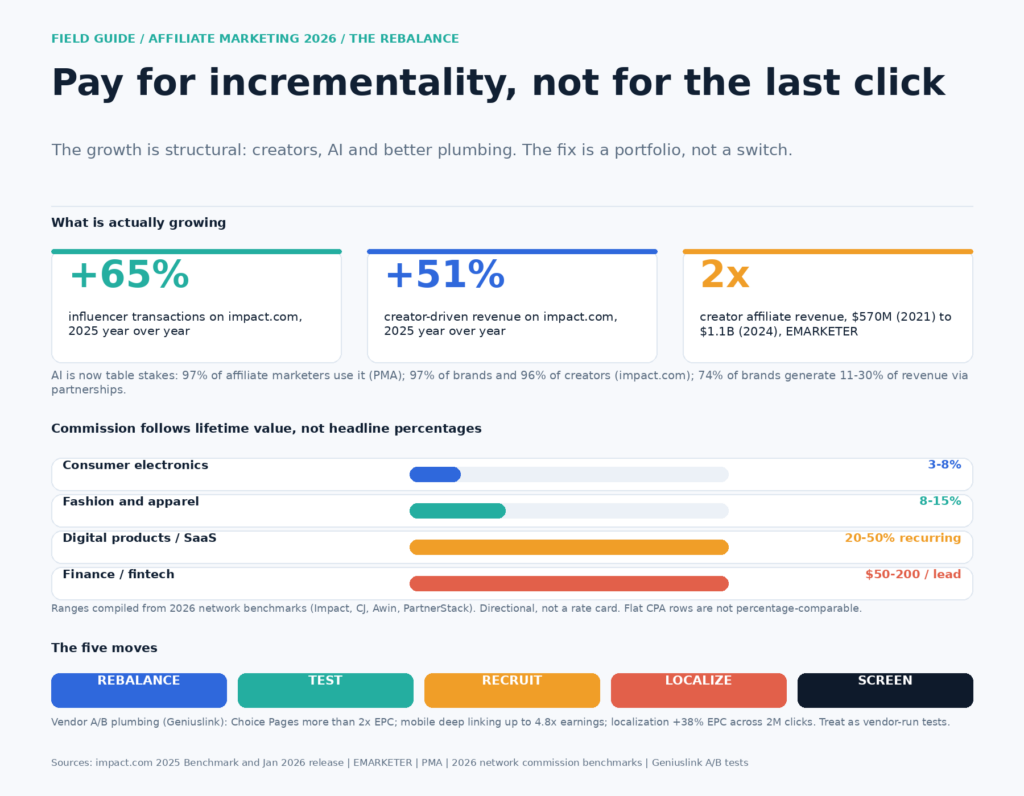
The most structural change is that creator and affiliate stopped being separate budgets. EMARKETER data shows creator affiliate revenue roughly doubled from $570 million in 2021 to $1.1 billion in 2024, and newer advertisers entering affiliate prioritize content and influencers over traditional tactics. impact.com’s 2025 Affiliate Benchmark, drawing on 2,368 North American retailers, nearly a billion transactions and over $116 billion in GMV, found influencer transaction volume grew 65% year over year in 2025, with creator-driven revenue up 51%. During Cyber Week 2025, influencers’ share of impact.com transactions rose from 5% to 9%.
Why it compounds: platforms like TikTok Shop, YouTube Shopping and Instagram put the commission rail inside the content. A single video introduces the product, demonstrates it, recommends it, carries the affiliate link and returns conversion data. The KOL-versus-affiliate distinction was an artifact of two separate contracts; native commission rails collapse them into one. In Southeast Asia, impact.com’s 2026 research found 56% of consumers had bought through an affiliate channel, and among them 71% did so through a creator — ahead of cashback sites at 41% and review sites at 37%. Trust, not reach, did the converting: 48% of consumers said they trusted affiliate-linked recommendations more than a year earlier. Creators place these links in Stories and link-in-bio pages far more than on blogs, so the creative asset and the tracking asset are now the same object.
Video, mobile and localization: plumbing beats persuasion
When the link lives inside a format, small pieces of plumbing matter more than a bigger media buy. Geniuslink’s own A/B tests — vendor-run, so treat them as directional — report that Choice Pages, which present one product across several retailers, more than double earnings per click versus direct single-retailer links; that mobile deep linking into the Amazon app has produced up to 4.8× earnings and 7.9× conversions on mobile traffic; and that localization across a 2-million-click analysis lifted EPC by 38%, from $0.05 to $0.069 per click, with larger gains for publishers with more international traffic. Awin’s tracking policy makes the infrastructure side explicit: server-to-server conversion tracking and a MasterTag using first-party cookies are now mandatory precisely because third-party cookies and cross-device journeys break naive tracking.
The lesson is unglamorous. Most leaky affiliate programs do not have a creativity problem; they have a routing problem. A shopper in Germany clicking a US link, a mobile user dumped into a browser login instead of an app, a product that is out of stock at one retailer — each is a commission that quietly evaporates. Fix the plumbing, and then re-run A/B tests on high-traffic assets with a single variable changed, a documented hypothesis and enough clicks to be meaningful.
Commission is a function of lifetime value, not a headline percentage
Ask a room what a good commission rate is and you will get a number. Ask a CFO and you will get a question: what is the margin on the product, and how long does the customer stay? The benchmark ranges are consistent across 2026 network compilations from Impact, CJ, Awin and PartnerStack:
- Consumer electronics: 3–8% — thin margins, high order values.
- Fashion and apparel: 8–15% — healthy margins offset by high return rates; a 20% commission against a 25% return rate is effectively 26.6% on retained revenue.
- Digital products and SaaS: 20–50%, often recurring — near-zero marginal cost. PartnerStack cites 15–50% of subscription value; HubSpot pays 30% recurring for 12 months and Surfer SEO 25% lifetime.
- Finance and fintech: $50–$200 per qualified lead — a flat CPA, not a percentage, because the value sits in the account, not the basket.
Two rules follow. First, compare on EPC (earnings per click), not the percentage: a 25% commission at a 0.5% conversion rate loses to 12% at 4% with a higher AOV. Second, price on LTV: a 30% recurring commission on a $100/month tool retained two years returns $720, while a flashy 75% one-time hosting payout on a $60 plan pays $45 once. Travel is seasonal, fashion returns, SaaS compounds — the commission design should borrow its shape from the cash flow it is buying.
AI’s double edge: the moat moved to earned authority
AI is now table stakes inside the workflow. The Performance Marketing Association’s study found 97% of affiliate marketers use AI, led by content creation at 90%, optimization at 67% and recruitment at 47%. impact.com’s 2025 research put adoption at 97% of brands and 96% of creators, with 74% of brands generating 11–30% of company revenue through affiliate and partnership channels. EMARKETER notes that nearly 70% of the sites cited in ChatGPT’s mentions of eyewear brand Zenni came from affiliate content.
That is the upside — and the trap. When AI Overviews and answer engines compress organic discovery, the tracked click that triggers a commission may never happen. EMARKETER’s analyst Max Willens put it plainly: the winners will be publishers and creators who are less reliant on Google, because they own first-party audiences and rich data. Original testing, real screenshots and a clear point of view become the differentiator precisely because AI-written content is now cheap. APMA reports 67% of affiliate professionals actively use AI day to day, but the strategic response is not more content — it is Generative Engine Optimization: becoming the source an answer engine cites. If a chatbot answers the product question without a click, the only durable asset left is being the authority it quoted. Partnerize’s VantagePoint, independently certified by the Alliance for Audited Media in pilot programs with Vox Media, BuzzFeed, Shopify and HubSpot, is an early attempt to attribute value to AI citations rather than clicks.
Fraud and brand safety: the bill arrives after the conversion
Affiliate fraud is not a fringe problem, and it tends to look profitable until the money settles. Lunio’s 2026 Global Invalid Traffic Report, which analyzed 2.7 billion ad clicks across six platforms, eight industries and ten countries, found an average invalid-traffic rate of 8.51% and estimated $63 billion lost to invalid traffic in 2025 — with lead-gen businesses facing IVT about 32% higher than transactional models. Fraudlogix’s full-year 2025 benchmark of 105.7 billion impressions found a 20.64% invalid-traffic rate, easing to 18.12% in Q1 2026. Lunio’s coverage puts affiliate traffic specifically at roughly 24% invalid. Other industry compilations cite affiliate click-fraud losses around $3.5 billion a year, driven by click fraud, cookie stuffing and fake lead generation — treat those as directional estimates with mixed methodologies, not a single audited figure.
The mechanics matter more than the headline number. Cookie stuffing drops invisible tracking cookies via hidden iframes or pop-unders to claim conversions the partner never drove. Browser extensions can overwrite attribution at the moment of checkout. Bots now simulate cursor movement and scroll depth well enough to fool basic analytics. The practical defense is layered: compare network-attributed conversions against an independent analytics tool, pass discount codes into the conversion tag so unauthorized codes can be declined before auto-approval, keep stand-down logic on for software partners, de-duplicate against email and generic PPC, and validate at click, session, lead, sale, refund, chargeback and LTV level rather than trusting the first conversion. Brand safety is the same discipline pointed outward: when 98% of brands reuse creator content across their own channels, who speaks for you is no longer a side issue.
The China mirror: same logic, different rails
The performance logic travels even when the platforms do not. China’s equivalents — Taobao Ke on Alibaba, Douyin’s 精选联盟 (Selected Alliance) and Kuaishou’s distribution rails — run the same commission-for-conversion model, but the link lives inside a super-app ecosystem rather than an open web of coupon sites and blogs. A creator’s short video or livestream carries the product, the recommendation and the tracked purchase in one surface, which is precisely the creator-affiliate convergence Western networks are now rebuilding with TikTok Shop and YouTube Shopping. The lesson for global operators is not to copy the platform; it is to notice that when discovery, validation and checkout collapse into one surface, attribution has to be designed inside the content, not bolted onto a cookie at the end. If you want the mechanics rather than the metaphor, the private-domain and content-commerce playbooks in the same series cover the rails in detail.
The playbook: five moves, in order
Rebalancing is a sequence, not a shopping list.
- Rebalance the mix. Pull last season’s network report by publisher type, with the codes on those orders. Separate discount, cashback, content, creator and technology partners. Know what you are actually paying for before you change a rate.
- Test incrementality. Run holdouts, measure new-to-file rates, and read net revenue per session including discount and commission. Split assisted from incremental revenue and de-duplicate against owned channels.
- Recruit editorial partners. Pay for the research phase. Use Commission-by-Assist or an equivalent, offer higher rates on first orders, and treat reviews, comparisons and tutorials as acquisition assets rather than overhead.
- Localize and fix the plumbing. Turn on server-to-server tracking, app deep links, country-aware routing and multi-retailer Choice Pages. Re-run single-variable A/B tests on your highest-traffic assets.
- Automate fraud screening. Layer IP and device fingerprinting, behavioral analysis, conversion-velocity checks and geographic validation, then hold payouts until post-conversion quality clears.
Do them in this order and the second step keeps you honest about the first. Skip it and you will simply pay a different partner for the same demand.
Conclusion: pay for the sale that would not have happened
Affiliate in 2026 is a genuinely large, genuinely fast-growing channel being measured by a genuinely broken ruler. The spend is real, the creator convergence is structural, and the lifetime value of referred customers is a legitimate reason to lean in. But 42.4% coupon concentration, a 25%-to-37% gap between credited and created value, and a 2025 in which clicks rose 2% while transactions fell 5% all point at the same disease: paying for proximity to the checkout instead of for influence on the decision.
The operator’s question is no longer “is affiliate working?” It is “which of these partners changed a decision that would otherwise have gone the other way?” Answer that with holdouts, pay the answer with assist-aware commission design, and the channel stops eating its own margin. Keep last click as your ledger, and you will keep funding the coupon while the creator who made the sale goes somewhere else.