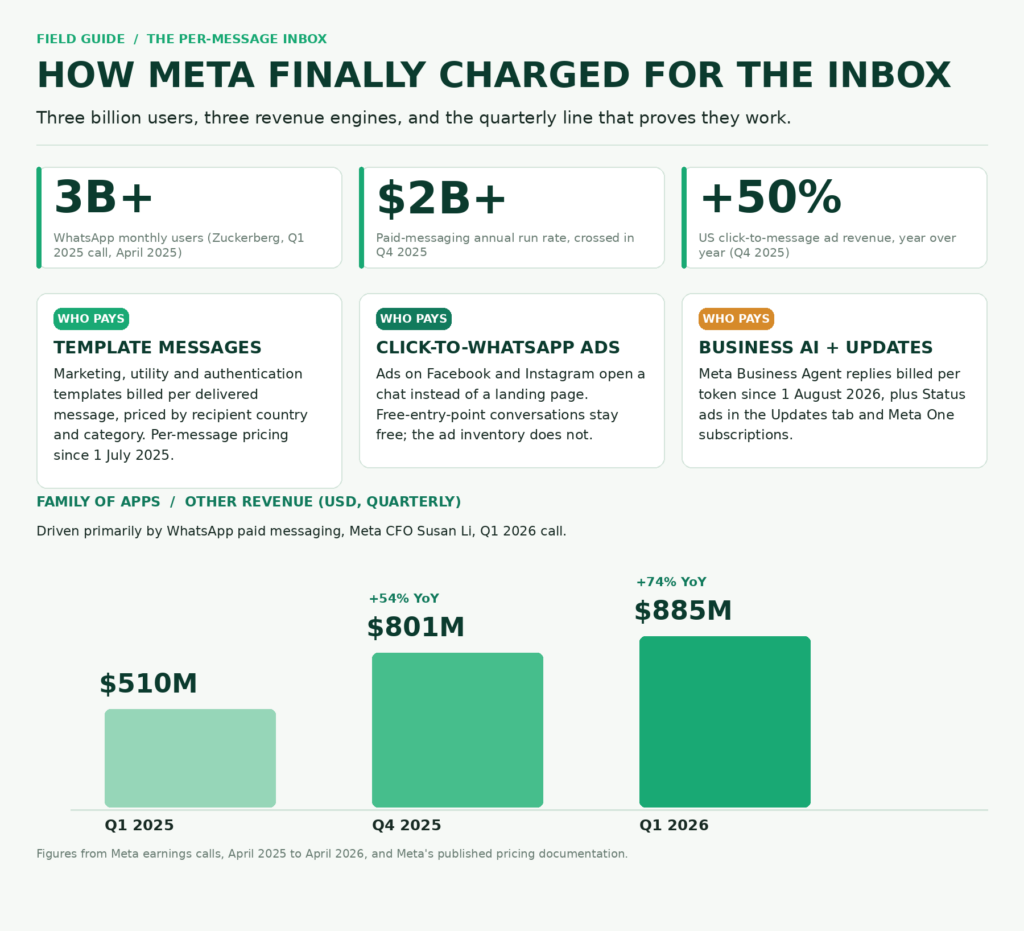
Some channels arrive quietly and then send you an invoice. WhatsApp did both. On an earnings call in April 2025, Mark Zuckerberg said the app had passed three billion monthly users, a number Meta has not officially refreshed since. That is why you should treat every “3.5 billion” figure in a vendor deck as somebody’s spreadsheet, not a fact. By January 2026, Meta was telling investors that paid business messaging had crossed a $2 billion annual run rate in the fourth quarter of 2025, and that US revenue from ads that open a chat instead of a web page had grown more than 50% year over year.
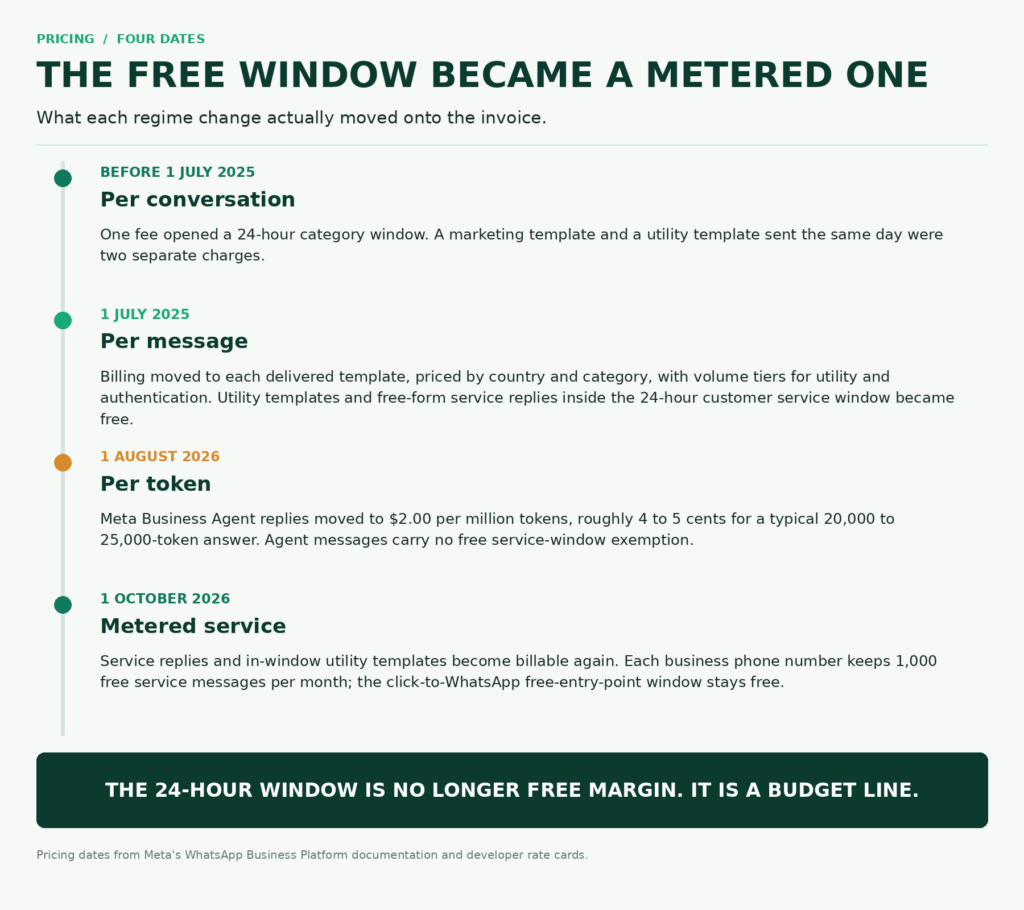
Then the price list changed twice in fifteen months. On 1 July 2025, billing moved from conversations to individual messages. On 1 August 2026, Meta’s own AI agent began charging by the token. On 1 October 2026, the free-form replies your support team sends inside the 24-hour customer service window became billable beyond a small monthly allowance. If you built your 2025 forecast on “free replies forever”, that forecast is now a historical document.
Here is the part most teams get wrong: WhatsApp is not “email with 98% opens”. It is a high-intent, per-message-priced conversation channel where the free window is a budget line and revenue per recipient is the only scoreboard that cannot lie to you. This field guide is about the mechanics, the numbers worth trusting, and the ones worth throwing out.
The inbox Meta finally learned to charge for
For a decade, WhatsApp was the strange asset in Meta’s portfolio: enormous, intimate, and almost unmonetized. No ads in the chat list. No subscription. The free WhatsApp Business app, which Meta last said serves more than 200 million monthly business users back in July 2023, was an on-ramp rather than a revenue line, and Meta has not published a newer official count for it. You will still see “175 million people message a business every day” and “100 billion messages a day” in conference decks; both come from Meta announcements in 2020 and 2021 that were never refreshed. We left both out of the arithmetic below. A floor is not a forecast.
What changed was not the app, it was the plumbing around the app. Three things started getting billed: templates, ads that open chats, and AI-generated replies. You can see the shape of it in Meta’s own financial reporting. “Family of Apps other revenue”, the line where WhatsApp paid messaging and subscriptions land, was $510 million in Q1 2025, $801 million in Q4 2025 (up 54% year over year), and $885 million in Q1 2026 (up 74%), with CFO Susan Li saying the Q1 jump was driven primarily by WhatsApp paid messaging. That is a clean, boring, auditable trajectory, and it is far more useful to a budget owner than a headline about two billion dollars.
Think of it as a landlord who spent ten years letting people live in the building for free, then quietly installed a meter on each door.
The monetization map: who actually pays whom
Four parties touch a WhatsApp message: Meta, the brand, the solution provider that carries the traffic, and the customer. Almost every pricing surprise comes from confusing which one is charging you.
The template meter
Outside an open conversation, a business can only send a pre-approved message template. Templates come in three categories — marketing, utility and authentication — and each delivered template is priced by the recipient’s country code and its category, not by where your company is incorporated. Since 1 July 2025 the unit of billing has been the message, not the 24-hour conversation. Utility and authentication templates also earn volume-tier discounts that reset monthly; marketing templates do not.
The ad that opens a chat instead of a page
Click-to-WhatsApp ads run on Facebook and Instagram and land the person in a thread, not on a landing page. Meta pays for the ad inventory; you pay for whatever templates follow. In Q4 2025, US click-to-message ad revenue grew more than 50% year over year, helped by website-to-message formats that let someone browse a site and then continue the conversation. This is the growth engine, and it is also the cheapest way to open a conversation, because a chat started from one of these ads carries a free-entry-point window.
The agent, the Updates tab, and the subscription ladder
In June 2026, at its Conversations event in London, Meta launched the Meta Business Agent globally. It said more than one million businesses were already using a Business Agent on WhatsApp and Messenger, and that there were more than one billion active business threads every day across WhatsApp, Messenger and Instagram combined. Note the wording: that billion is a three-app total, not a WhatsApp-only figure, and it is a count of threads, not of people or purchases. By Q1 2026, Meta reported more than ten million weekly conversations with business AIs, up from one million at the start of the year, and said plainly that today’s free access would eventually become a monetization model.
Around the same time, ads in Status and promoted Channels moved from the June 2025 announcement toward global availability in February 2026. Meta says 1.5 billion people use the Updates tab daily, and in Q1 2026 said hundreds of millions were viewing Status ads each day — while also warning investors that near-term revenue would be modest because of where those users live and how many accounts are linked. Then in September 2026 came Meta One, a subscription ladder for creators and businesses from $14.99 to $499 a month, with higher tiers buying more Business Agent capacity. Meta has not published the actual response quotas, which is awkward if you are sizing for Black Friday.
Two resets and two dates nobody budgeted for
1 July 2025: from conversations to messages
Before that date, a single fee opened a 24-hour category window. Send a utility template and then a marketing template four hours later and you bought two windows. After that date, you buy two messages. Country rate cards were updated, volume tiers appeared for utility and authentication, and — this is the bit people remember wrong — utility templates and free-form service replies sent inside an open customer service window became free. Service conversations had already been free and unlimited since November 2024. So 2025 was, oddly, the generous year.
1 August 2026: the agent starts billing by the token
Meta Business Agent moved to a flat $2.00 per million tokens globally. Meta says a typical reply consumes 20,000 to 25,000 tokens, which works out to roughly four to five US cents, with a simple four-message inquiry nearer 16 to 20 cents and a complex ten-message sales chat closer to 40 to 50 cents. One line covers both the AI processing and the delivery. There is a practical trap: without a payment method attached in Billing Hub, Meta simply does not deliver agent replies. And agent messages are the one exception to the free-window rule — they are charged whenever delivered, window or not. Meta’s own comparison puts 1,000 AI replies in Brazil at roughly $40 to $50 against about $27 for a lighter third-party setup and about $97 for a heavier one, while explicitly warning the comparison is not like-for-like.
1 October 2026: the service window gets a meter
This is the one that changes behaviour. From that date, service messages — the ordinary human or third-party-AI replies you send inside an open 24-hour window — are billed per delivered message at the market’s utility and authentication rate, with no volume tiers. Each business phone number keeps 1,000 free service messages per calendar month; the allowance resets on the first and does not roll over. Utility templates sent inside the window also become billable again, and unlike service messages they get no free allowance at all. India sits around ₹0.115 per message, North America around a third of a cent, and some markets as high as five and a half cents — a spread of roughly seventy times, which means a single global support budget is now a fiction. In-window service replies also do not qualify for volume discounts.
The free-entry-point conversation opened by a click-to-WhatsApp ad or a Facebook page call-to-action stays free. One caution: the published duration of that window has shifted in the documentation over 2026, with carrier release notes describing it differently from the older 72-hour wording, so read your current rate card rather than a blog post from last spring.
The 24-hour window is a budget line, not free margin
Here is a small piece of arithmetic that should change your flow design. A single conversation in October 2026 can carry five separate charges: a cart-abandonment marketing template, two Business Agent replies, a human service message, and an in-window utility order confirmation. Before August 2026 that same thread carried three. Same messages, same outcome, two extra line items.
So the old advice — “keep the customer talking and reply for free” — has quietly become the expensive advice. Batch your answers. Resolve a question in one well-constructed reply instead of five fragments. Push product questions into the free-entry-point window that a click-to-WhatsApp ad already opened. Move confirmation into a template you were going to send anyway. None of this is glamorous, but it is the difference between a 4% and a 9% channel margin.
The free entry point is the last real free lunch
If a customer messages you after tapping a click-to-WhatsApp ad, everything inside that conversation is free of Meta template charges. That is not a loophole; it is the design. Which is why the ad team and the lifecycle team should be looking at the same dashboard. The ad buys a free conversation, and the conversation is where the margin lives. Separating those two budgets is how companies end up paying twice for the same customer.
The markup you never see on the rate card
Meta’s rate is only one number. Solution providers add a platform fee, and they do it in two very different ways: pass-through, where you pay Meta’s rate plus a small disclosed per-message fee, or markup, where the rate is bundled and you cannot see the split. On high-volume utility traffic the difference is real money. Ask for the pass-through schedule in writing before you sign, and ask what happens to volume-tier discounts — some providers pass them on, some quietly keep them.
Intent economics: WhatsApp inherits intent, it does not create it
The 98% open-rate myth, and what the honest number looks like
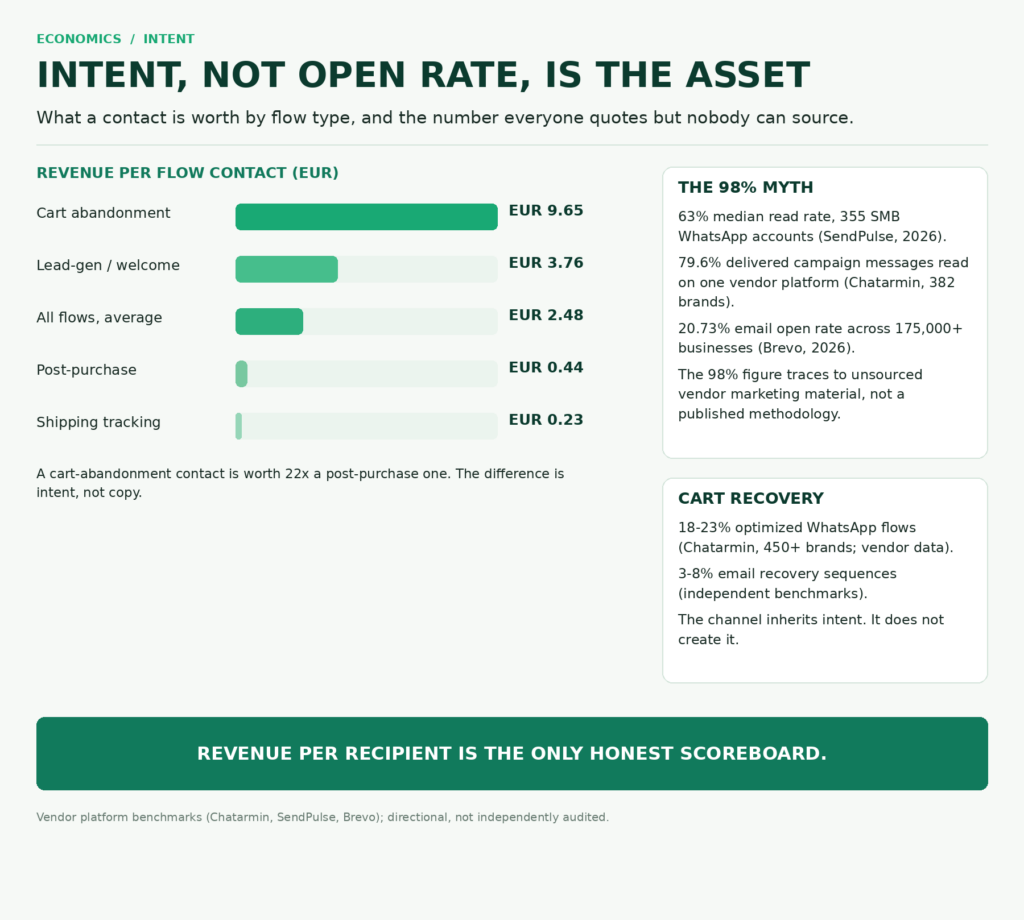
You have seen the stat: WhatsApp messages get opened 98% of the time. It traces back to unsourced vendor marketing material and an old estimate, with no published methodology or sample size. Meanwhile, SendPulse’s 2026 broadcast study of 355 WhatsApp SMB accounts found a median read rate of about 63% (66% pooled), with roughly 0.6% median click-through — the pooled click rate of 8.3% was dragged up by a handful of enormous senders. SendPulse says it plainly: almost no real SMB account actually hits 98%. On the other side of the comparison, Brevo’s 2026 benchmark across more than 175,000 active businesses puts the average email open rate at 20.73% once bot-triggered opens from Apple’s privacy tools are excluded. A vendor platform study from Chatarmin, covering 382 brands and 49.3 million campaign messages between June 2025 and June 2026, reported 79.6% of delivered campaign messages read.
So the defensible range is 60% to 80%, not 98%. That is still a thumping advantage over email. It is just a smaller, more variable one — and it depends on list quality, opt-in status and whether the message is a broadcast or a triggered flow. Build your model on 65% and you will never be surprised.
Cart recovery, rated honestly
The other number that gets stretched is recovery rate. Chatarmin, which sells WhatsApp automation and therefore has a stake in the result, reports 8% to 15% for a standard single-reminder flow, 18% to 23% for an optimized flow with cart-level tracking, a two- or three-step sequence and decent timing, and 25% or more in high-average-order-value categories. Email recovery sequences sit around 3% to 8% in independent benchmarks, against a cart-abandonment baseline near 70% documented by the Baymard Institute. Treat 18% to 23% as a vendor-stated, non-audited figure, not a law of nature.
Why does it work at all? Not because of the open rate. Because the person abandoned a cart thirty minutes ago and is still deciding. The channel inherits intent; it does not manufacture it. A message that lands on the lock screen of the app where people talk to their family arrives inside a decision that is still warm, and unlike email it lets the customer ask “does this ship to Canada?” in the same thread. That two-way reply is the whole trick.
Chatarmin’s own ROI example is instructive: a shop doing €250,000 a month at a €60 average order value, with 70% abandonment and 25% opt-in, recovers about 437 orders and €26,220 a month against roughly €267 in Meta fees. It also lists four cases where the project is simply wrong — average order value under €25, fewer than 200 monthly opt-ins, tracking checkouts instead of carts, and stacking three recovery sequences a week on top of a newsletter. That honesty is worth more than the headline.
The flow priority stack: what to build first, and what to leave alone
Build in this order and you will rarely regret it.
- Cart abandonment. Highest intent, shortest elapsed time, measurable in revenue per contact. Send within 30 to 60 minutes; the first message does most of the work.
- Win-back, value-first. Fire roughly two purchase cycles past the customer’s normal reorder interval, and lead with a reason to come back — a new drop, a related product, a replenishment reminder — not a coupon. Hold the discount until the shopper actually engages, or you will train your list to wait for markdowns.
- Onboarding inside the free window. A welcome sequence after opt-in, which Chatarmin’s flow data shows is the biggest revenue contributor in total volume even though it is not the most valuable per contact.
- Promotional broadcasts, last and tightly segmented. One to two marketing touches per customer per week is a ceiling, not a target. Broadcasts are where quality ratings go to die.
The order is really a ranking by how much intent the trigger already contains. Every step down the stack asks you to manufacture urgency that the customer did not bring.
Revenue per recipient: the only honest scoreboard
Open rate, click rate, delivery rate, reply rate, conversion rate — a dashboard full of numbers, none of which tells you whether the channel earned its keep. Collapse them into one: attributed revenue divided by recipients. It normalizes across list sizes, survives pricing changes, and makes the October 2026 bill legible.
The best public benchmark here is Chatarmin’s 2026 platform data, with all its caveats: 382 brands, 49.3 million campaign messages, June 2025 to June 2026, about €1.03 of attributed revenue per campaign message and €2.48 per contact entering an automated flow. Flows generated 47% of all WhatsApp revenue on the platform. A companion flow study of 18.3 million contacts found a cart-abandonment contact worth €9.65, a lead-gen contact €3.76, post-purchase €0.44 and shipping tracking €0.23 — a 22-fold spread driven almost entirely by purchase rate, since basket sizes were similar across flow types. About 8.7% of cart-abandonment contacts ordered, versus 0.4% after purchase.
Read those numbers as directional. The sample is the vendor’s own customers, not e-commerce as a whole; attribution uses a 24-hour default window; and the company itself warns that soft view-through attribution can overstate results. But the ranking is the useful part. If your cart flow earns less per recipient than your broadcast, the problem is the flow, not the channel.
List building and consent: the part that decides everything else
Where good opt-ins actually come from
A recovery flow with 50 opt-ins is a spreadsheet exercise. You need 15% to 30% opt-in coverage of relevant traffic before the maths starts to work. Practical entry points: a QR code on packaging or in-store, a click-to-chat ad, a specific unchecked checkbox at checkout, and a welcome-flow lead magnet. In the EU and UK, double opt-in is the safest reading of consent, and you need to be able to prove when and where someone agreed. Every marketing message needs a simple opt-out — a STOP reply is enough.
Your quality rating is a credit score
Meta watches how people react. Blocks and reports pull your phone number’s quality rating down, and that rating governs your messaging limits. Worse, there is a per-user marketing cap that adapts to each recipient’s own recent behaviour, which means the same campaign can reach one person and quietly fail to reach their neighbour, with no report telling you why. This is the failure mode that email marketers find most disorienting: email fails into a spam folder invisibly, WhatsApp fails into a score you can actually see, but also into a per-person throttle you cannot.
Both channels fail into indifference, which nothing measures. The reply is the only honest engagement metric left. It cannot be faked by a privacy relay or triggered by a security scanner.
Click-to-WhatsApp ads: the +50% engine
The ad is no longer an awareness buy; it is the top of a conversation funnel. A Status or feed ad opens a chat, the chat opens a catalog, the catalog opens a payment, and the payment happens without leaving the app. In markets where mobile data is patchy and a landing page is a liability, that is not a nice-to-have.
The India and Brazil playbook
India is WhatsApp’s largest market — Meta said more than 500 million users there in December 2024, and DataReportal estimated 535.8 million in February 2025 — and in-chat payments run on UPI. A neighbourhood kirana store can publish a catalog, take an order in a thread and settle it on the national rail, with no website in the middle. Brazil rebuilt around Pix: Meta retired direct in-chat card payments for new purchases in January 2026, and business payments now run through Pix, boleto and payment links. Singapore offers business-only in-chat payments through Stripe covering cards and PayNow, and Mexico has a narrower setup for registered businesses collecting in chat. There is no announced timeline for the US or the EU. If native payments are missing where you sell, a hosted payment link inside the thread still closes the loop.
One boundary worth drawing: Indonesia appears in Meta’s Q1 2026 reporting as a market where business AIs expanded to small businesses. That is an AI rollout, not a payments launch. Do not put it on a payments slide.
Business Agent or your own bot?
The token math, without the sales pitch
At four to five cents a reply, Meta’s agent is cheap for straightforward questions and expensive for long, multi-step sales conversations, because cost scales with tokens rather than messages. Ask a precise question, get a precise answer, keep the thread short, and it wins. Let it wander through a ten-message negotiation and you are paying close to fifty cents before any WhatsApp message fee.
The data trade-off nobody puts in the onboarding flow
The agent answers from your catalog, your website and your connected systems — Meta lists integrations with Shopify, Zendesk and Shopee — and it hands off to a human when you decide. That is genuinely useful. It also means a first-party conversational layer sits between you and your customer, with the morning briefings and thread insights Meta is building on top. Solution providers also report that Meta excludes seven verticals from Business Agent, including finance, government, health, alcohol, gambling, over-the-counter drugs and matrimony services. Treat that list as reported by partners rather than audited policy, and check eligibility before you design around it.
A reasonable rule: use Meta’s agent for coverage — nights, weekends, languages, the long tail of repetitive questions — and keep your own bot or your own people for the conversations where the data, the brand voice or the regulatory exposure actually matters.
Broadcast discipline: Status, Channels, and the frequency cap
Channels and Status are not a broadcast list with better branding; they are a discovery surface. Ads in Status and promoted Channels live in the Updates tab, separate from personal chats, which Meta says remain end-to-end encrypted and ad-free. Targeting uses coarse signals — country or city, device language, Channels followed, ad interactions — not the contents of anyone’s messages. That means creative has to do the targeting. An ad that says who it is for in the first second works; a generic brand ad gets swiped past or collects accidental taps from a fast thumb.
There is also an honest asymmetry: WhatsApp is where high-intent, event-triggered messages belong, and the economics punish mass broadcasting. SendPulse’s data shows WhatsApp accounts send the fewest broadcasts of the three platforms it studied, yet can still produce the highest revenue per message. That is exactly the shape you want. Cap frequency, protect the quality rating, and never move your email newsletter onto WhatsApp unchanged. It arrives four times too long, in a place where length is billed, to people who agreed to something else. If you take one thing across, take the deadline, not the newsletter.
Four regional playbooks, and one mirror
India: the kirana store with a catalog
The winning unit is a small merchant with a phone, a catalog and UPI. Optimize for low average order values by keeping message counts per order tiny, and use the free Business app or the Platform depending on whether one person or a team answers. Meta One’s $14.99 Essential tier is built around the app, not the API, which matters more than the badge in the feature list.
Brazil: Pix closed the loop
Conversation is the storefront. Design the funnel so the payment link arrives inside the thread, and remember that the January 2026 card-payment change altered which payment methods you can offer to new versus returning buyers.
Singapore, Mexico and MENA: narrower rails, higher tickets
Where in-chat payments are business-only or unavailable, treat WhatsApp as a qualification and concierge layer. Higher average order values make a five-cent reply irrelevant, which is exactly where luxury concierge and property use cases work. Note that financial services are among the verticals partners say Business Agent excludes, so a Hong Kong or Gulf financial brand needs its own stack.
The China mirror: same logic, different landlord
If you have run WeChat service accounts, WeCom and mini-programs, none of this will feel new: a conversation that carries catalog, service and payment, with the free window doing the work a landing page does elsewhere. The difference is ownership. On WhatsApp, Meta sets the rate card and owns the AI layer. In China, the platform owner and the merchant’s private-domain stack share that control. The mechanics rhyme; the bargaining power does not.
What to do in the next 90 days
Pull your last three months of message-level data and split it into templates, free-entry-point conversations, service replies and agent replies. Price each bucket against the October 2026 rate card in the recipient’s market, not your own. If you cannot see those buckets separately, your provider is bundling the markup — fix that first.
Then rebuild the flow stack in intent order, kill any broadcast that earns less per recipient than a triggered flow, and put the 1,000 free service messages per number into the support rota as a real constraint. Attach a payment method in Billing Hub before an agent goes live. Re-check the published duration of the free-entry-point window against your current rate card. And retire the 98% slide from the deck; replace it with 60% to 80% and a footnote about where the range came from. Nobody has ever lost a budget meeting by being the person with the defensible number.
One last framing. Meta spent 2025 making service conversations free and 2026 putting a meter on them. The companies that will do well are not the ones with the biggest lists. They are the ones that can answer a customer’s question completely, in one message, at the moment the customer still cares. That was always the job. Now it is also the unit of billing.
Five questions people actually ask
How much does a WhatsApp message cost in 2026? There is no single price. Each delivered template is priced by recipient country and category; from 1 October 2026, service replies cost the market’s utility/authentication rate after 1,000 free messages per number per month; and Meta Business Agent costs $2.00 per million tokens, about four to five cents a typical reply.
Is the 24-hour service window still free? Not entirely. Free-form service replies are free only up to 1,000 per phone number per calendar month, and in-window utility templates are billed from the first one. The free-entry-point conversation opened by a click-to-WhatsApp ad stays free.
What should a cart-recovery flow actually hit? Vendor data from more than 450 brands puts an optimized flow at 18% to 23%, a standard single reminder at 8% to 15%, and high-average-order-value cases at 25% or more, versus roughly 3% to 8% for email. Treat these as vendor-stated, not audited.
WhatsApp, email or SMS for e-commerce? Use WhatsApp for anything with a deadline and intent already in the room — cart, delivery, appointment, replenishment. Use email for anything with a shelf life — long explanations, receipts, B2B nurturing. Use SMS where consent and cost make sense. Never send the same content down two channels.
Should I use Meta Business Agent or my own chatbot? Use Meta’s for coverage and the repetitive long tail; keep your own for conversations where data ownership, voice or regulated verticals matter. Check eligibility first, since partners report seven excluded verticals.
Where the numbers come from
User counts, run-rate figures, quarterly other-revenue figures, business-AI conversation counts and Status-ad reach come from Meta’s Q1 2025 through Q1 2026 earnings calls and prepared remarks (April 2025, January 2026 and April 2026), plus Meta’s own June 2026 Business Agent announcement and June 2025 Updates-tab announcement. Pricing dates and category rules come from Meta’s WhatsApp Business Platform pricing documentation and developer rate cards, cross-checked against published implementation notes from Twilio, Vonage, 8×8, Manychat, WATI and SleekFlow; where carrier documentation disagrees about the free-entry-point window’s duration, this guide says so rather than picking one. Benchmark data comes from the Chatarmin WhatsApp Marketing Benchmark Report 2026 (382 brands, 49.3 million campaign messages, June 2025 to June 2026) and its Flow Benchmark 2026 (18.3 million flow contacts), from SendPulse’s 2026 broadcast study (355 WhatsApp SMB accounts), from Brevo’s 2026 benchmark (175,000+ active businesses), and from the Baymard Institute’s cart-abandonment research. All vendor benchmarks are self-reported platform data from companies that sell WhatsApp or email tooling, with non-representative samples and short attribution windows; they are used here for ranking and direction, never as guarantees. Figures described as Meta’s most recent official count are dated, because Meta has not published newer ones. Third-party estimates of 3.3 to 3.5 billion users, the 2020-era daily message and business-messaging counts, and the unsourced 98% open rate were deliberately excluded.