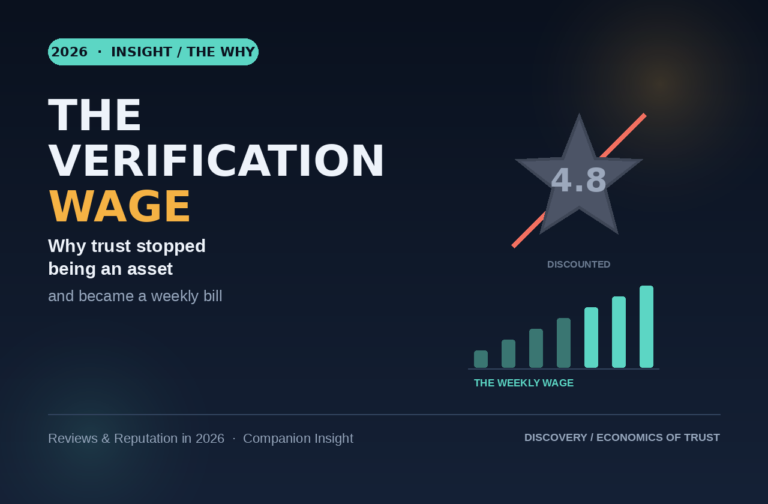
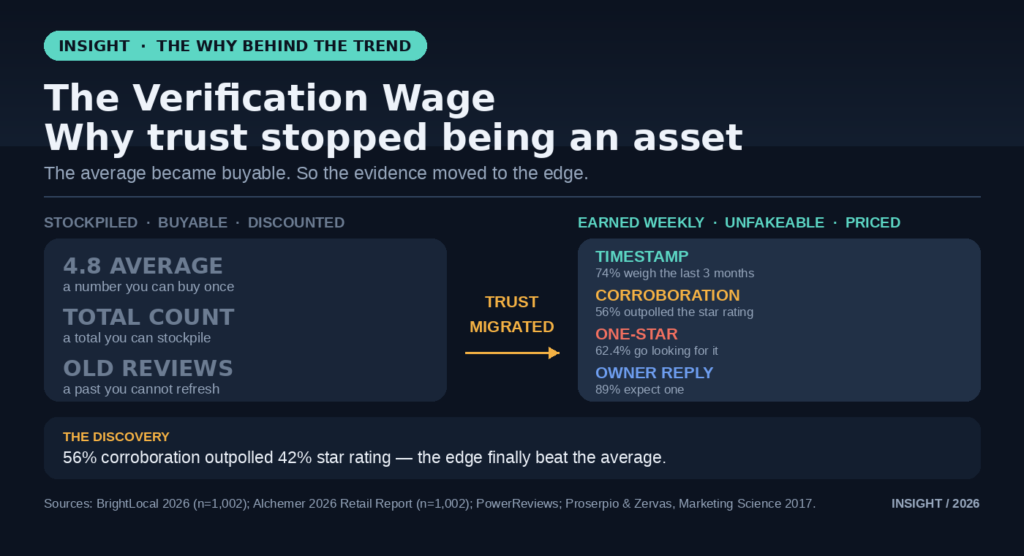
Here is a result that should bother anyone who has ever paid for a five-star campaign. In BrightLocal’s 2026 survey of 1,002 US adults, the factor consumers ranked highest for whether a review actually matters was not a high star rating. It was corroboration: 56% said a review counts most when other reviews describe a similar experience. The star rating itself came in at 42%. For the first time in that survey’s own ranking, the edge outpolled the average.
Sit with that. A 4.8 assembled over six years lost to a stranger saying “yes, that happened to me too, last Tuesday.” It looks like shoppers getting fussy. It isn’t. It is a price change.
The average became a commodity, so its price fell
A star average is a stock. You accumulate it once, it sits on the shelf, and — this is the part that matters — it is cheap to counterfeit. Alchemer’s 2026 Retail Report found 42% of shoppers suspect the reviews they read are fake or AI-generated. The FTC’s 2024 rule had to explicitly ban AI-generated and sentiment-conditioned reviews, and the platforms now remove fakes in the millions each year. When a signal can be manufactured at near-zero marginal cost, rational buyers stop paying full price for it. They don’t reject reviews — reviews are still the most-trusted input at the moment of purchase, ahead of friends and AI recommendations. They quietly discount the one number anyone can fake.
That is ordinary information economics wearing a marketing badge. The average didn’t get worse. It got cheap.
Then a second reader arrived and made the discount permanent
The same BrightLocal survey found AI tools for local recommendations jumped from 6% to 45% in a single year, and 82% of consumers now read AI-generated review summaries. A summary does something brutal to a star rating: it deletes it. You cannot compress a lone 4.8 into a sentence; there is nothing there but a number. What the machine can reuse is repeated, dated, specific prose — “showed up on time,” “no hidden fee,” “fixed it on the second visit.” So the corpus acquired a reader that is structurally incapable of valuing the very metric the industry spent two decades optimising.
So trust moved to the things you cannot stockpile
Once the average was discounted, the value didn’t vanish. It migrated to the margins — to four signals that share one property: none of them can be bought once and stored.
A timestamp. 74% only care about reviews from the last three months, and the share wanting the last two weeks nearly doubled in a year. Freshness is a flow. Let a week lapse and the asset decays.
Corroboration. That 56% isn’t asking for a better score. It’s asking for a second witness. Two independent accounts agreeing is expensive to fake, because the fakes have to agree on the details.
The one-star you didn’t delete. PowerReviews’ behavioural analytics found 62.4% of star-filter users deliberately open one-star content — and those review-interactors convert 108.8% higher than the average page visitor. Shoppers aren’t hunting for a reason to leave; they’re checking that somebody paid a cost. A frictionless 5.0 is precisely the signature of a counterfeited signal, so the absence of friction reads as the presence of scrubbing.
A signed reply. 89% expect one, and the cleanest causal evidence we have — Proserpio and Zervas, in Marketing Science — found that when hotels began responding, ratings rose about 0.12 stars. Not because the rooms improved. Because a visible human on the other end makes the corpus look alive and makes baseless complaints less worth posting. A reply is a receipt, not charm.
The wage, not the asset
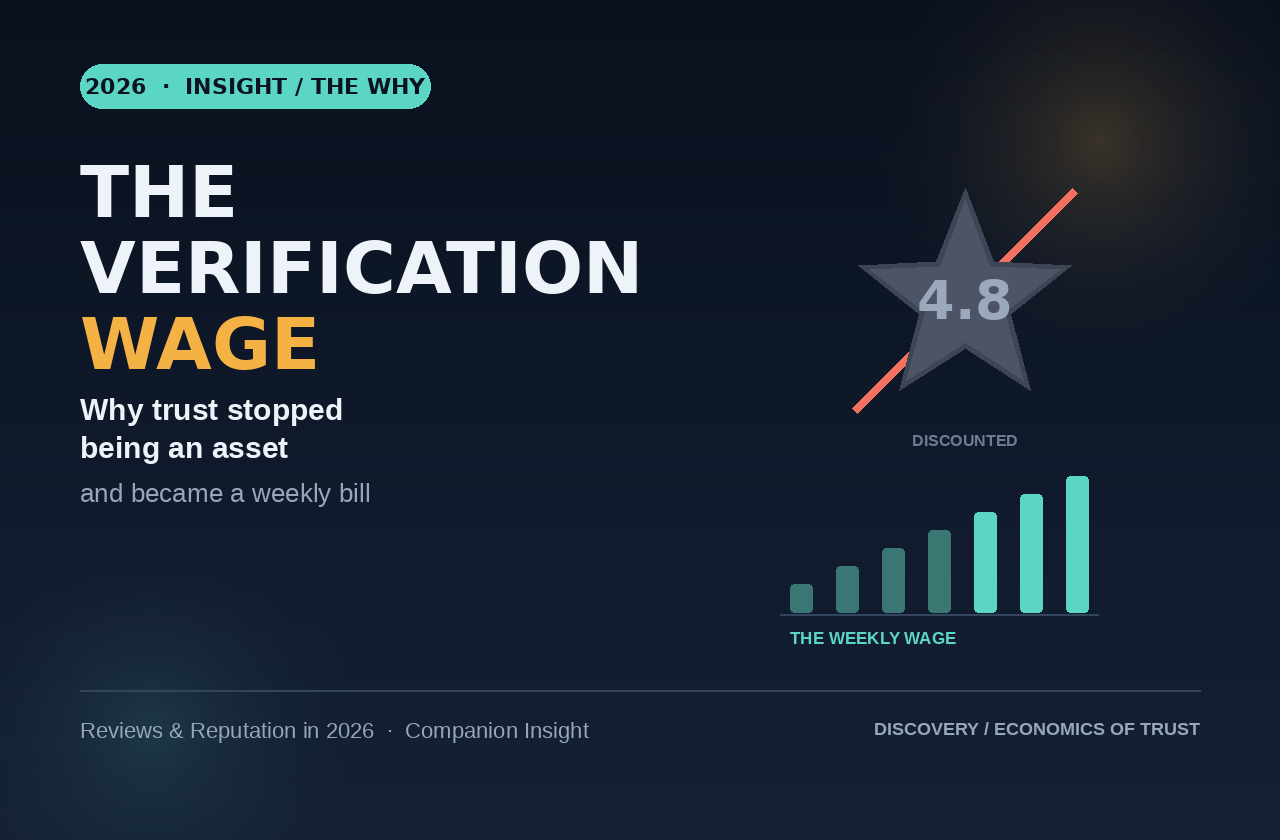
Put it together and the shape changes. Reputation used to look like property: build it, own it, defend the number. It now behaves like a wage — paid weekly, in dated reviews, consistent detail, one honest complaint left visible, and a reply signed by a person. Miss a week and there is no arrears to draw on; nearly three-quarters of your readers have already stopped counting the old entries.
And because an AI summary now reads the same corpus before the human does, the wage gets collected twice. The shopper wants proof it’s real; the machine wants text it can repeat. Both are fed by the same boring Tuesday habit, and neither can be prepaid with a campaign.
The discovery, then, isn’t that consumers got harder to please. It’s that the market found a cheaper way to tell the truth: stop pricing the average, and start paying the margin. You can’t buy that back. You can only show up again next week.