Here is a sentence no growth deck wants to print: your UGC campaign’s incentive budget is also its quality filter. Set the per-post reward below what an honest human’s time is worth, and you haven’t bought cheap content. You’ve bought a bot subscription.
The mechanism nobody budgets for
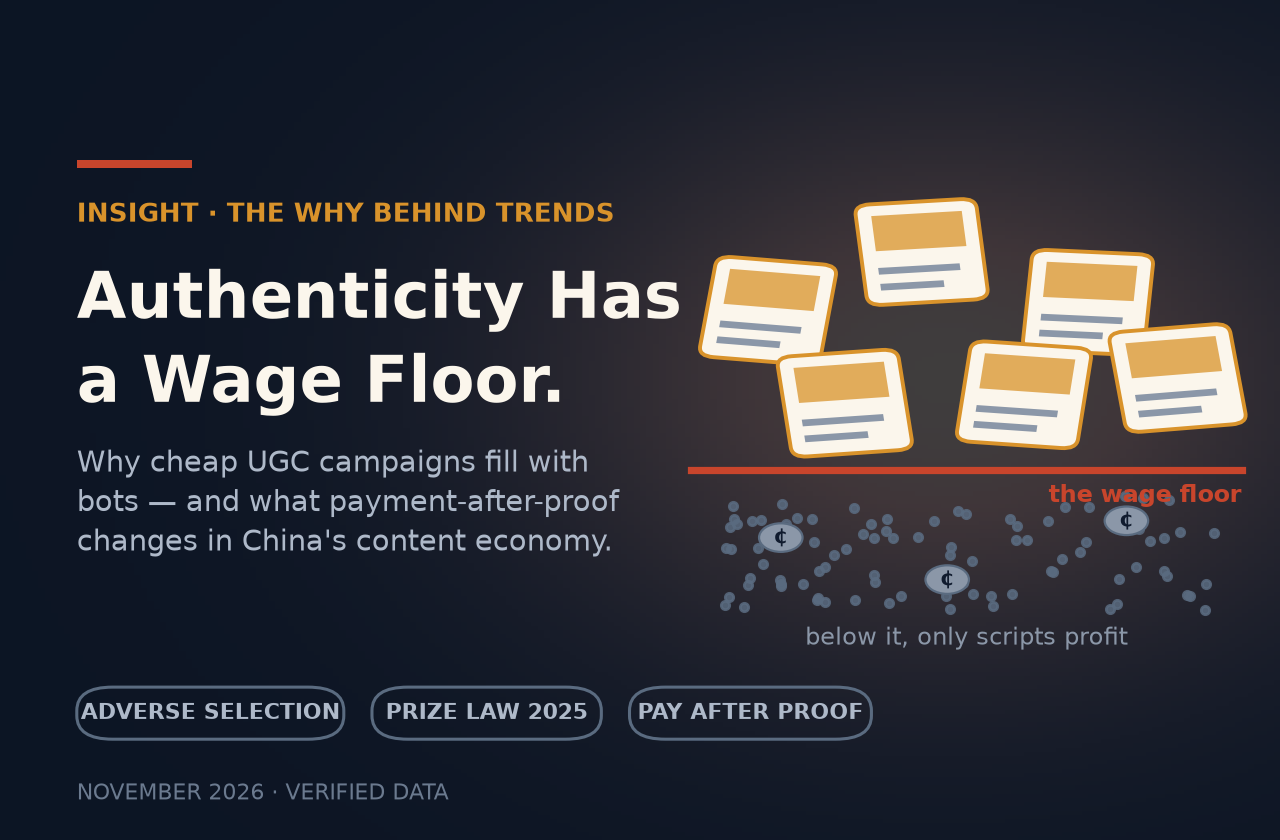
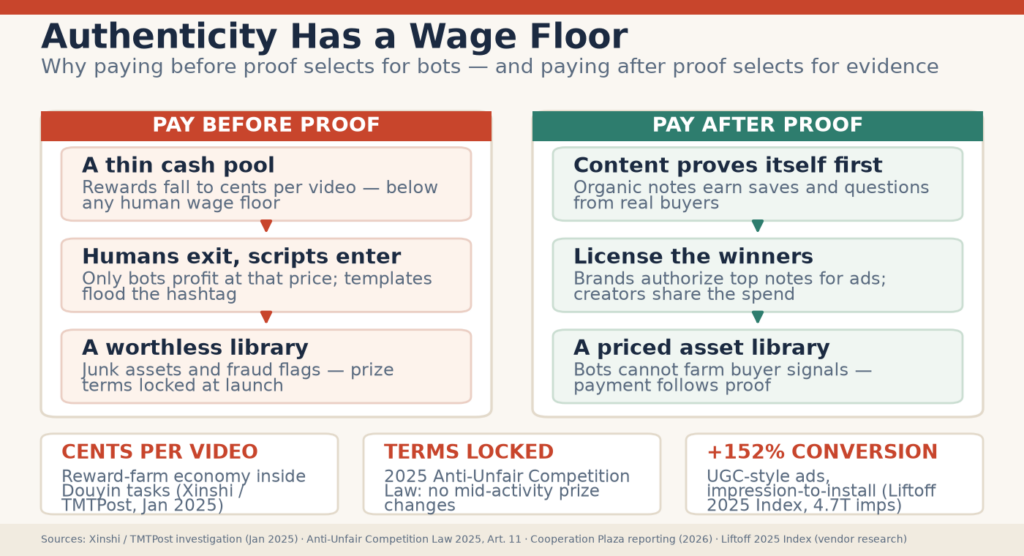
A January 2025 investigation by Xinshi Research, published by TMTPost and 36Kr, walked through the economy inside Douyin’s official task marketplace. When brands fund thin cash pools, rewards per video collapse to a few cents. At that price, filming anything real is irrational — an actual customer would spend twenty minutes to earn less than a bus fare. But a template-reposting script running ten accounts earns the same cents at near-zero marginal cost. Do that arithmetic a million times and the hashtag fills with seven-second junk.
This is adverse selection wearing a marketing costume. The reward doesn’t just motivate participants; it selects them. Below the wage floor of honest effort, the only profitable participants are synthetic — so the campaign optimizes itself into worthlessness while the dashboard celebrates volume.
Why you can’t fix it mid-flight
The obvious rescue — top up the pool once you see the junk — just became legally harder in China. The revised Anti-Unfair Competition Law, effective October 15, 2025, explicitly prohibits changing prize-promotion terms after the activity launches without justification. Your pool is locked at the number you chose before you understood who it would attract. The design decision you can’t revisit is the one most teams make last.
The inversion that prices effort honestly
Watch what Xiaohongshu built instead. Its Cooperation Plaza, launched in January 2026 and upgraded with creator revenue share, pays after proof: an organic note first earns saves and question-comments from real buyers, then the brand licenses it for advertising and the creator shares the ad spend. A bot cannot farm that signal, because the signal is other humans deciding to trust you. Payment follows evidence, so evidence is what the system produces. Industry reporting describes the mechanics; exact share rates live in the platform console, not in folklore.
The upside explains why platforms are racing here: Liftoff’s 2025 index measured a 152% average lift in impression-to-install conversion for UGC-style video ads. Real-looking content is the scarcest input in paid media — and scarcity is exactly what a wage floor protects.
The one-line takeaway
Authenticity isn’t a vibe you request in a brief. It’s a price you pay per unit of honest effort — and every cent you shave below that price is a subsidy to the machines.