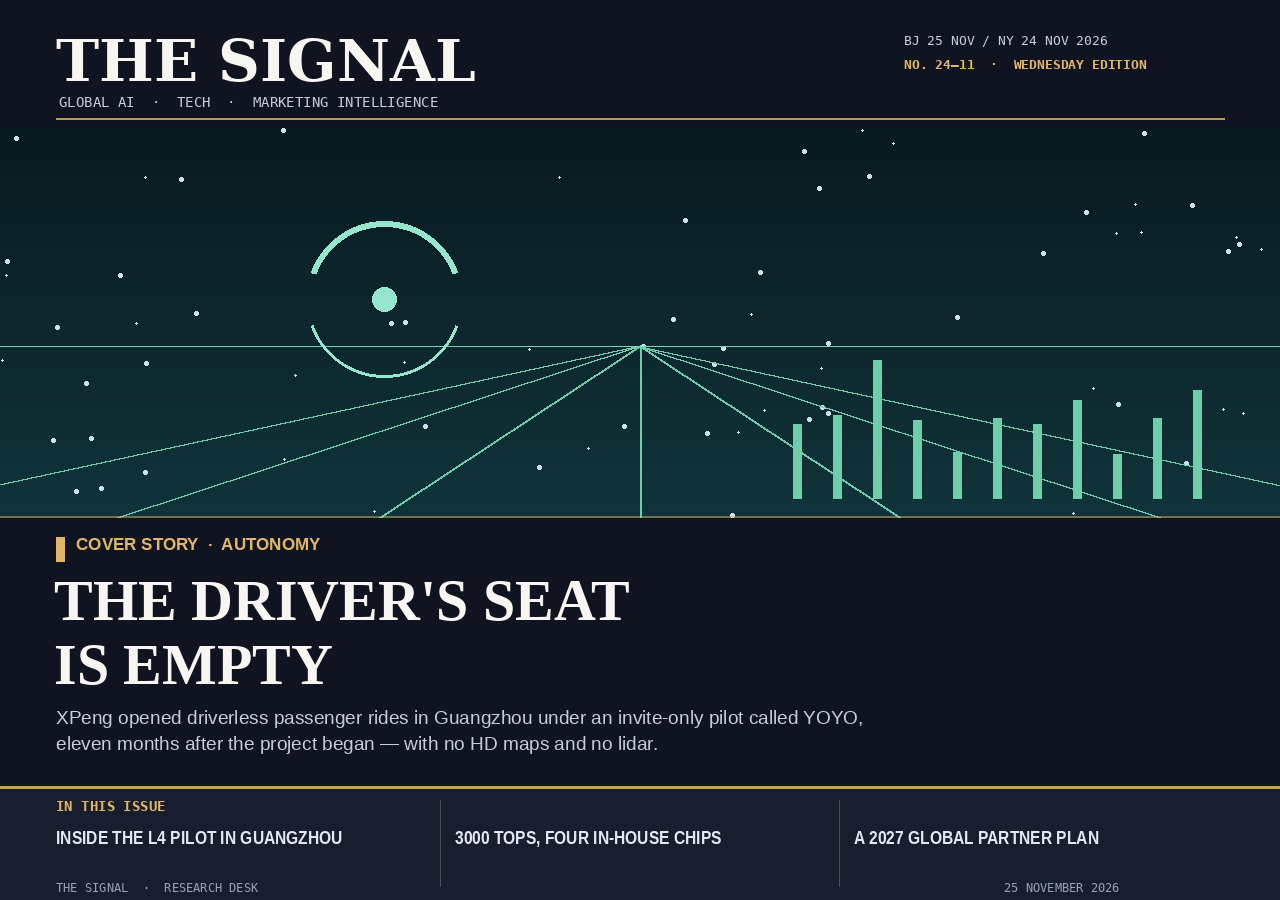
The invite-only “YOYO” pilot runs in designated zones in Guangzhou. Eleven months from project start to L4 Demonstration operation, on a stack that uses neither HD maps nor lidar.
XPeng said on Tuesday that its Robotaxi service has begun carrying passengers with no safety driver in the front seat. The service is named XPENG YOYO , with a dedicated mini-program for hailing; access is being opened gradually by invitation code rather than to the general public. Rides run inside approved demonstration zones in Guangzhou.
The timeline is the part the company is leaning on. The first mass-produced Robotaxi unit rolled off the line in May, employee trials began in July with chairman He Xiaopeng as the first customer, Guangzhou granted a remote-testing permit in August, and on October 26 the city approved L4-level demonstration operation across the whole of Guangzhou. From project start to driverless road testing took eight months; to the L4 permit, eleven.
The technical claim is a single second-generation VLA model spanning both L2 assistance and L4 driving, without high-definition maps and without lidar. The vehicle is built forward on the GX platform as a production model, carrying four in-house Turing AI chips rated at around 3,000 TOPS of effective compute. XPeng argues that model generalization plus a closed data loop is what allows fast deployment across cities — the same argument it needs if the system is ever to leave Guangzhou.
That last point is the business model, not a footnote. XPeng describes itself as a technology and platform supplier, packaging the vehicle, the driving software and the model into one solution, with local operation left to partners. Guangzhou is the template city; the company says it will start offering the full Robotaxi stack to global partners in 2027.
A few limits desire to sit next to the announcement. This is a demonstration operation in designed areas, in only, with a cloud based remote assistant and emergency layer behind it – not an unrestricted commercial service. For a carrier to move from a production line to empty seat passenger rides inside a year is a fast clock, and it sets a concrete marker along with Waymo, Baidu’s Apollo Go and Tesla’s robotaxis plans.