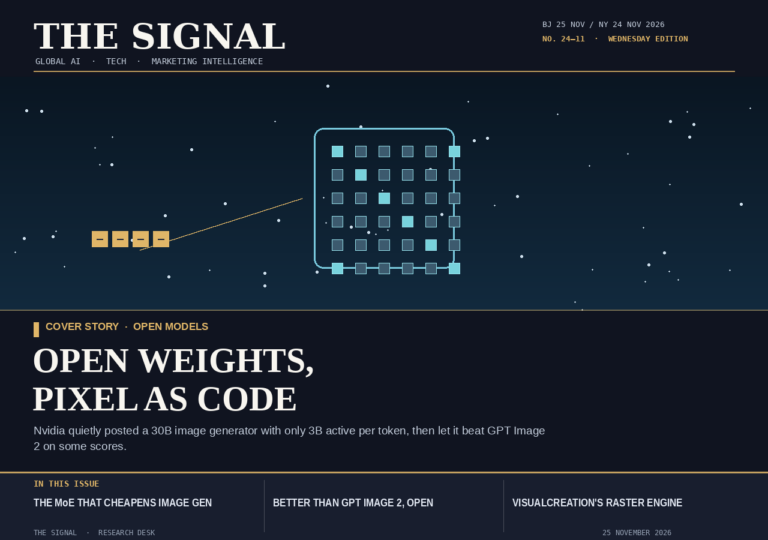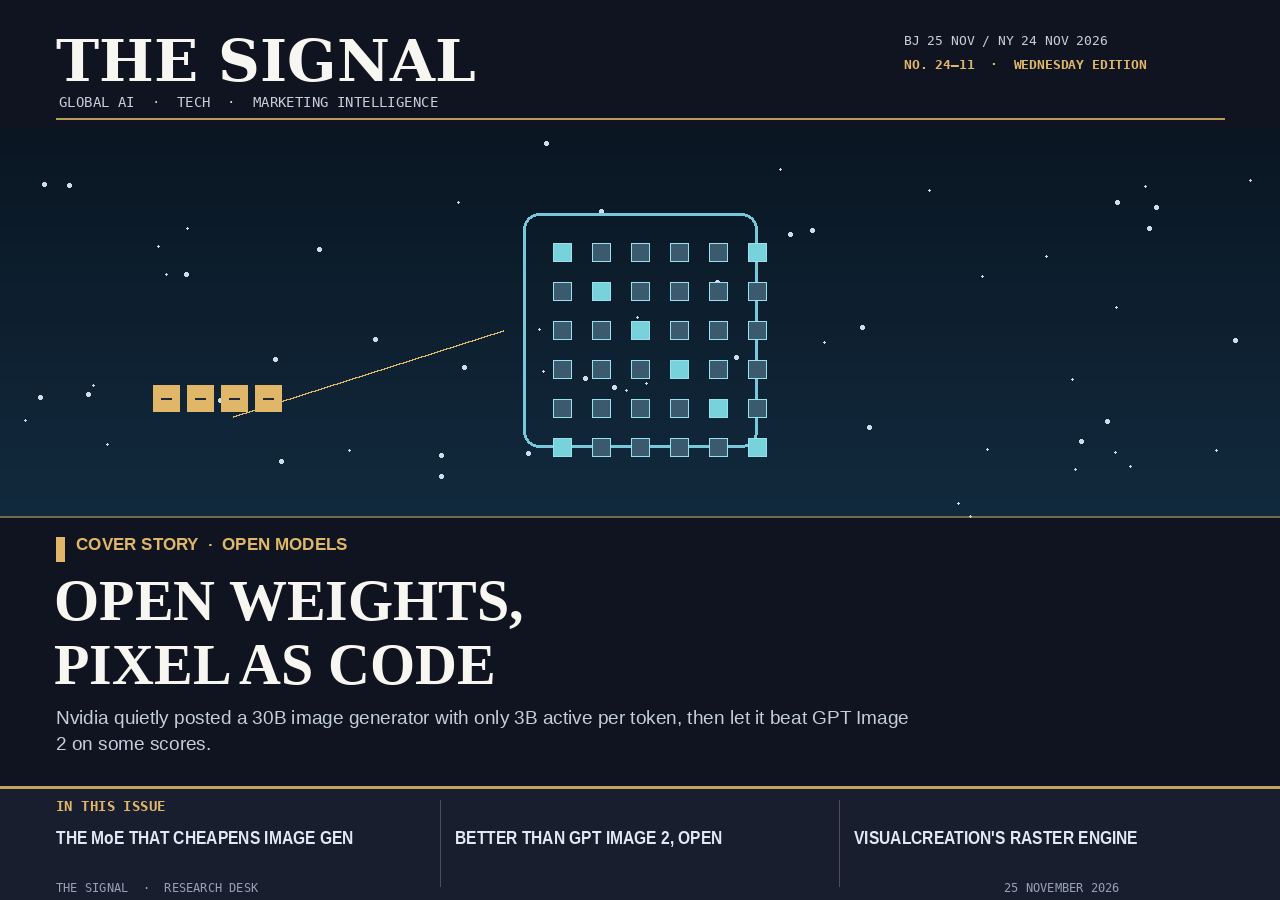
Nvidia has released open weights for Nemotron-Labs-Image-30B-A3B, an autoregressive image-generation model that packs 30 billion total parameters but activates only about 3 billion per token. Posted to Hugging Face under the nvidia-license, it is built as an extension of Nvidia’s existing Nemotron-3-Nano-30B-A3B language model, and framed as the core raster-rendering engine of a new framework the company calls Nemotron-Labs-VisualCreation — a “pixel as code” approach in which images are emitted as token streams rather than diffused.
The numbers that matter: a sparse mixture-of-experts design means it delivers 30B-class quality at a 3B-class compute cost per step, which is friendlier to local hardware than monolithic models. Early benchmark reporting — including Wccftech — says it outperforms OpenAI’s GPT Image 2 on several scores, while being open-weight where GPT Image 2 is a closed API.
Two caveats keep this honest. First, “beats GPT Image 2” is a benchmark claim, not a settled fact; independent re-testing will decide whether it holds beyond the cherry-picked scores. Second, “open weights” is not “open everything” — the license is Nvidia’s own, so commercial terms still need to be read. What is not in dispute is the direction: a major chipmaker shipping open image weights is one more step toward a world where the default path to usable generative imagery runs on hardware you already own, not a per-token API meter.
For content teams, the takeaway is the same one the video side just got with MAGI-2: the marginal cost of generated visual media keeps falling, and the differentiation is shifting from “can we generate it” to “can we control, edit, and brand it.”