Most “Semrush vs Ahrefs 2026” articles are quoting plans you can no longer buy. Semrush retired Pro, Guru and Business during 2026 and replaced them with SEO, Starter, Pro+ and Advanced at $139, $199, $299 and $549 a month. Ahrefs kept its familiar ladder but now meters usage with credits and folds a small AI-visibility allowance into every paid tier. The real decision is not price. It is the job you are hiring for: Ahrefs for link depth and a faster daily workflow, Semrush for multi-channel breadth and a more operationalized GEO stack. Two accuracy rules sit above both of them. Vendor traffic estimates are modelled rather than measured, and Google says plainly that third-party tools have no access to its internal ranking data. Buy the workflow, attach first-party Search Console and GA4 data, and price the four numbers that actually differ: sites, keywords, seats and AI prompts.
1. The pricing ledger nobody updated
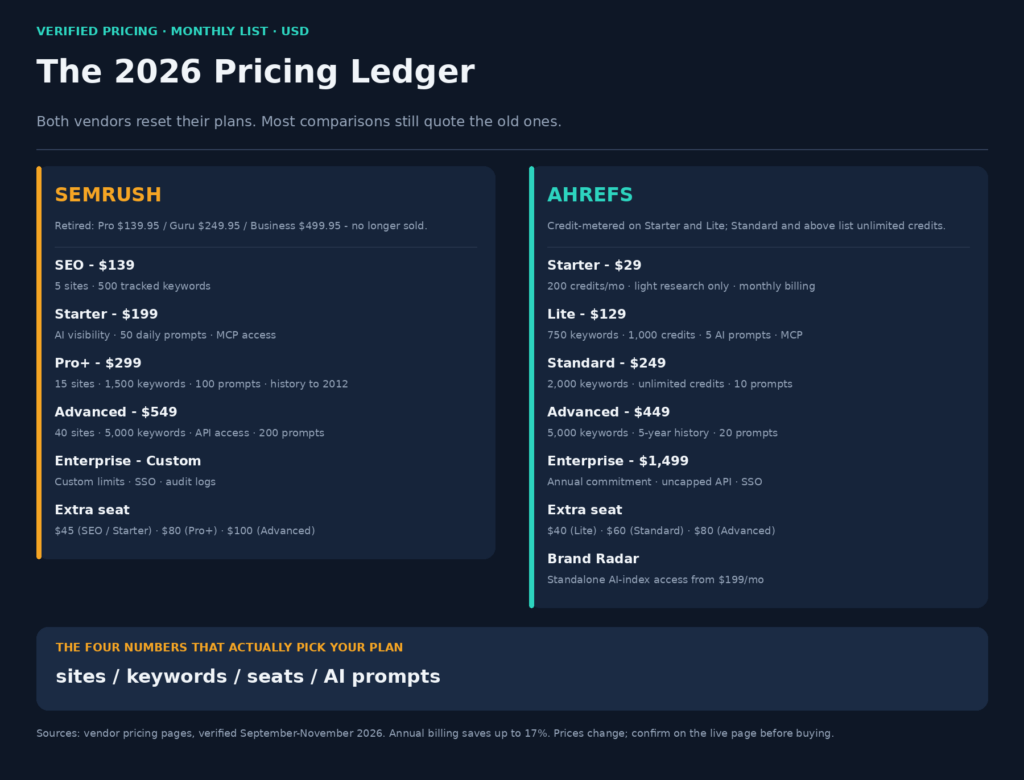
Here is the quiet little scandal of this comparison. Search for it and you will find pages still listing Semrush Pro at $139.95, Guru at $249.95 and Business at $499.95. Those plans are gone. Semrush restructured its lineup in 2026 into four self-serve tiers plus a custom Enterprise tier, and it now sells SEO and AI visibility together rather than as separate products. The company calls Starter, Pro+ and Advanced the Semrush One plans. If a review still quotes Guru, it was written before the reset — or copied from something that was.
The current monthly list, verified against vendor pricing pages between September and November 2026, looks like this. Semrush SEO is $139 for 5 sites and 500 tracked keywords. Starter is $199, same sites and keywords, but adds 50 daily AI prompts and MCP access. Pro+ is $299 for 15 sites, 1,500 keywords, 100 prompts and historical data back to 2012. Advanced is $549 for 40 sites, 5,000 keywords, 200 prompts, share of voice and API access. Every plan includes one user; extra seats run $45 on SEO and Starter, $80 on Pro+, and $100 on Advanced. Annual billing cuts roughly 17 percent, bringing the same tiers to about $117.33, $165.17, $248.17 and $455.67 a month, paid upfront.
Ahrefs kept its names. Starter is $29 a month, monthly billing only, with 200 credits and no room to buy more seats or add-ons inside the plan. Lite is $129, Standard $249, Advanced $449, and Enterprise $1,499 with an annual commitment and from three included users. Tracked keywords run 750, 2,000, 5,000 and from 10,000 respectively. Lite is credit-metered at 1,000 credits per user with six months of history; Standard and above list unlimited credits per user, with two, five and unlimited years of history. Extra seats cost $40, $60, $80 and $100 depending on tier. Ahrefs does not run a free trial on paid plans and says it does not discount, offering only a limited free tier for verified site owners.
There is one detail worth pinning to the wall: Ahrefs says its Rank Tracker updates weekly on every plan. Semrush tracks daily. If your week revolves around Monday morning position reports, that difference is not a footnote.
The retired-plan trap
Why does this matter beyond pedantry? Because pricing is the frame most buyers use to start. If you walk in believing Semrush costs $139.95 for Pro and Ahrefs costs $129 for Lite, you will compare the wrong two things. The honest comparison at the entry point is Semrush SEO $139 against Ahrefs Lite $129 — close enough that price stops deciding anything. The gap that actually matters sits higher, at $199 versus $249, where Semrush sells AI prompts and Ahrefs sells unlimited credits and Content Explorer. Two hundred dollars buys very different work on the two sides.
2. The hiring question: link depth or channel breadth
Stop asking which tool is better. Ask what you are paying it to do.
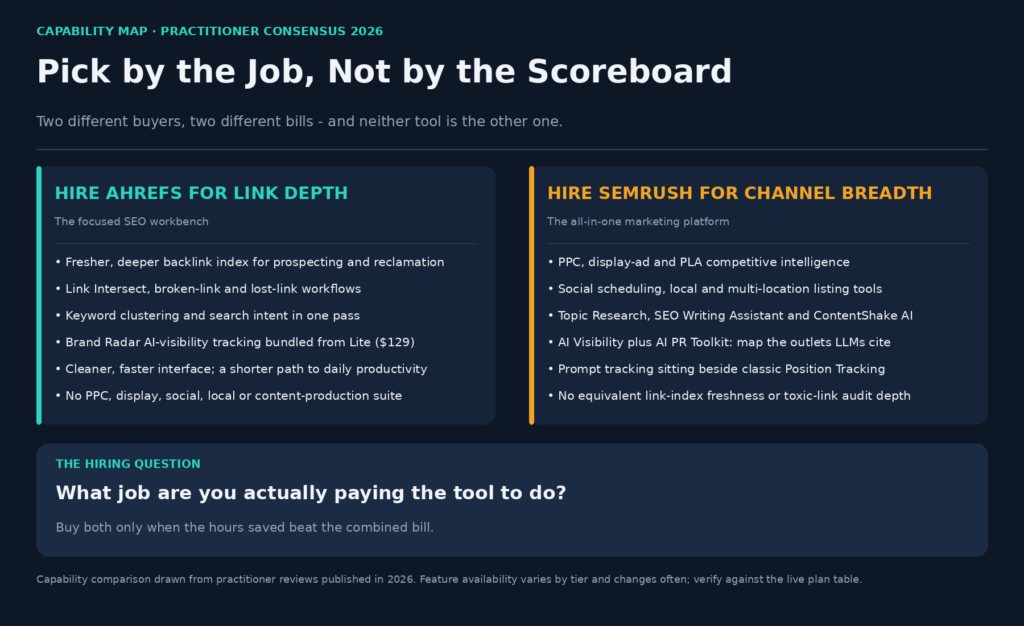
There is a useful old framing from the business world: customers do not buy products, they hire them to get a job done. A drill is hired for a hole, not for a drill. Applied here, Ahrefs is hired for the link job and Semrush for the channel job. They overlap in the middle, which is exactly why this debate never dies, and they diverge sharply at the edges, which is exactly where your decision lives.
Two buyers, two budgets
One buyer is a link builder or a technical SEO who lives inside backlink profiles all day. She wants a crawler that notices a new link before her competitor does, a Link Intersect report that surfaces prospects nobody else found, and a broken-link reclamation workflow that turns dead pages into outreach. She wants a clean interface she can open without navigating a menu tree. She does not want a social scheduler.
The other buyer runs paid and organic for the same executive, reports on both in one deck, manages three locations, and has a content team that needs briefs rather than raw exports. He wants PPC and display intelligence, a writing assistant, local listing management, and — increasingly — a single place where classic rankings and AI answer mentions sit side by side. He does not want to reconcile two vendor invoices.
These two people should not buy the same product, and no scoreboard will tell them that.
3. Backlink index reality: freshness beats headline size
Let us deal with the numbers everyone likes to shout. You will see Ahrefs credited with 35 trillion links and Semrush with 43 trillion, or the reverse, or both figures attached to both vendors depending on which affiliate page you landed on. These claims are published by the vendors themselves, they are not independently audited, and they do not agree with each other. Treat the headline size as a direction, not a measurement.
What is consistent across practitioner reviews is more useful: Ahrefs is widely regarded as the fresher and more granular link index. Its crawler is commonly described as the most active commercial bot after Googlebot, new links tend to surface faster, and the reporting around referring-domain history, anchor distribution, link velocity and lost links is deeper. Ahrefs also ships Link Intersect, broken backlinks, broken pages and an audit plugin that pulls Search Console and Analytics data into the same view. For prospecting, reclamation and toxic audits, it is the tool most specialists reach for first.
Where the Semrush gaps show
Semrush is not weak here; it is differently shaped. Its backlink database is large, and its Backlink Audit adds toxic-link scoring and disavow file generation that Ahrefs does not name as an equivalent. Its Link Building Tool folds outreach into the same subscription, which is a genuine workflow advantage. Where practitioners repeatedly report friction is discovery speed and granularity for pure link work — the sense that you are querying a big database through a marketing platform rather than a link workbench.
So the honest verdict is asymmetric. For link-led SEO, Ahrefs wins the workflow. For link auditing and cleanup inside a broader marketing stack, Semrush holds its own. And neither vendor’s index-size marketing claim should be allowed to settle the argument.
4. Keyword research architecture: clustering versus orchestration
Keyword research is where the two products stop being variations on a theme and start being different software.
Ahrefs Keywords Explorer is built for the practitioner who wants to reason about one query at a time. It gives you click-level estimates and a clicks-per-search view that exposes how much of a keyword’s volume is actually available after SERP features absorb the rest. Standard and above add keyword clusters and search-intent classification, so grouping and intent live inside one workflow rather than in a spreadsheet you maintain. Content Explorer, also from Standard upward, is the better research surface for finding pages worth emulating or earning links from.
Semrush Keyword Magic Tool goes the other way: breadth, topic grouping and intent labels at scale, with CPC and difficulty alongside. It is the better tool when you are building a content programme across a portfolio, and its Topic Research, SEO Writing Assistant and ContentShake AI carry the work from idea to draft. Ahrefs helps you decide what to write; Semrush helps you write it. Neither publishes to your site for you.
One practical caveat applies to both. Search-volume figures for low-volume B2B terms routinely run several times above the impressions Search Console later records. Practitioner tests report this repeatedly, but they are self-run comparisons, not an audited industry study, so treat the magnitude as a warning rather than a constant. Use vendor volumes to rank keywords against each other. Never use them to forecast traffic or to build a business case.
5. The GEO layer, and the gate that flipped the narrative
For years the story was simple: Semrush was the one taking AI search seriously, and Ahrefs was the link tool that had not caught up. In 2026 that story inverted, and most comparisons have not noticed.
Ahrefs now includes a tracked AI-prompt allowance in its paid plans: 5 prompts on Lite, 10 on Standard, 20 on Advanced, from $129. Brand Radar, the fuller AI-visibility product, covers AI Overviews, AI Mode, ChatGPT, Perplexity, Gemini and Copilot, plus Reddit threads, YouTube transcripts and web mention visibility, and it is sold as a standalone add-on from $199 a month with custom prompt packages at $50, $100 and $250. Ahrefs also ships an MCP Server and API access on paid plans, which lets an assistant query Ahrefs data inside a conversation.
Semrush gates AI visibility at Starter, $199, with 50 daily prompts; Pro+ raises that to 100 and Advanced to 200. The standalone AI Visibility Toolkit starts at $99 a month per domain with 25 custom prompts. Inside it, Semrush’s own knowledge base lists Visibility Overview, Brand Performance with weekly-updated sentiment and share of voice, Competitor Research against up to four rivals, Prompt Research, Position Tracking that holds SEO keywords and AI prompts in one campaign, and an AI-Readiness Site Audit that flags blocked AI crawlers such as GPTBot, Claude-User and PerplexityBot. Domain Overview and Organic Rankings report AI mentions and AI Overview triggers even on the free plan.
What the $199 actually buys
Here is the nuance that gets lost. Ahrefs’ bundled allowance is small — a handful of prompts on one platform in one location will consume it. Full Brand Radar reporting costs extra. Semrush’s $199 buys a broader operational loop, especially when you add the AI PR Toolkit, formerly Prowly, which starts at $149 a month and includes an AI-cited media finder over a database of more than 600,000 journalist profiles. In other words, Ahrefs lowers the entry price to AI tracking, while Semrush sells the more complete path from measurement to the off-page work that changes the answer.
One more disclosure, because it belongs in any honest comparison. Semrush is now an Adobe company; Adobe completed the acquisition in April 2026. Adobe reported a 269 percent year-over-year rise in AI traffic to US retail sites in March 2026, and it sells Adobe LLM Optimizer alongside the Semrush stack. Those are vendor-produced figures from a company selling the category. Useful, but not neutral. Ahrefs, for its part, published its own server-log study of 137,000 domains in June 2026 finding that 97 percent of llms.txt files received zero requests in May, with AI retrieval bots accounting for barely over one percent of requests. That is Ahrefs’ own Bot Analytics data, published by a vendor selling Brand Radar — and, to its credit, a finding that runs against the hype it could otherwise sell.
A note on the prompt-database arms race. Ahrefs’ corpus has been reported under several different figures across 2026 coverage, and Semrush cites its own Prompt Database without a single stable public number. These are self-reported, they move between publications, and no independent audit backs them. Do not buy either tool on a database-size headline. Ask for your own questions in the actual report.
6. What prompt tracking actually measures
Let us be precise, because this is where GEO dashboards do the most damage.
These tools send a scheduled set of prompts to AI engines, capture the full responses, and score each one for brand mentions, competitor mentions, sentiment, position in the answer and cited source pages. Semrush’s Brand Performance documentation is admirably candid: it generates a set of synthetic prompts related to your domain and location, then tracks AI responses across Google AI Overviews, AI Mode, ChatGPT, Perplexity and Gemini, with reports updating weekly. Synthetic. Sampled. Weekly.
That output is directional share of voice. It is not a ranking, because AI engines do not produce stable rankings for an open-ended question. It is not a census of what users actually see, because answers vary with context, region and phrasing. A zero does not mean your brand has no AI presence; it may mean no match appeared in the prompt set, platform or country you configured. And because a score is computed over a changing denominator, a rising line can mean you improved — or that somebody quietly made the prompt mix easier.
The discipline that follows is simple and unglamorous. Freeze your prompt set, competitors, countries and platforms. Read the raw answer text before assigning a fix. Keep the evidence around any change: answer, sources, platform, region, date. Compare trends within a stable setup, and never compare an Ahrefs share-of-voice percentage directly with a Semrush visibility score.
7. What Google itself says about third-party tools
Now for the sentence that should be printed on every GEO dashboard.
Google Search Central published dedicated guidance on third-party SEO tools, services and advice in June 2026. It names AEO and GEO tools explicitly, states that Google does not evaluate third-party services, and warns that using a service or tool does not guarantee ranking success. Then it says this: “Third-party tools don’t have access to our internal ranking data. They can’t guarantee performance. Any predictions are their own and like predictions generally, may not happen.” A companion message from Google’s VP of Search and Commerce for Global Ads Solutions put it even more bluntly for CMOs: Google does not evaluate third-party SEO tools or vendors directly, and they have no access to our internal metrics.
Google also treats AEO and GEO as part of SEO rather than a separate discipline, and recommends its own first-party tool as the reference point. That is not a ban on third-party tools — the same documentation lists legitimate services like content review, technical advice and keyword research. It is a boundary. When a vendor dashboard disagrees with your Search Console data, Search Console wins.
8. Accuracy discipline: three rules that keep the numbers honest
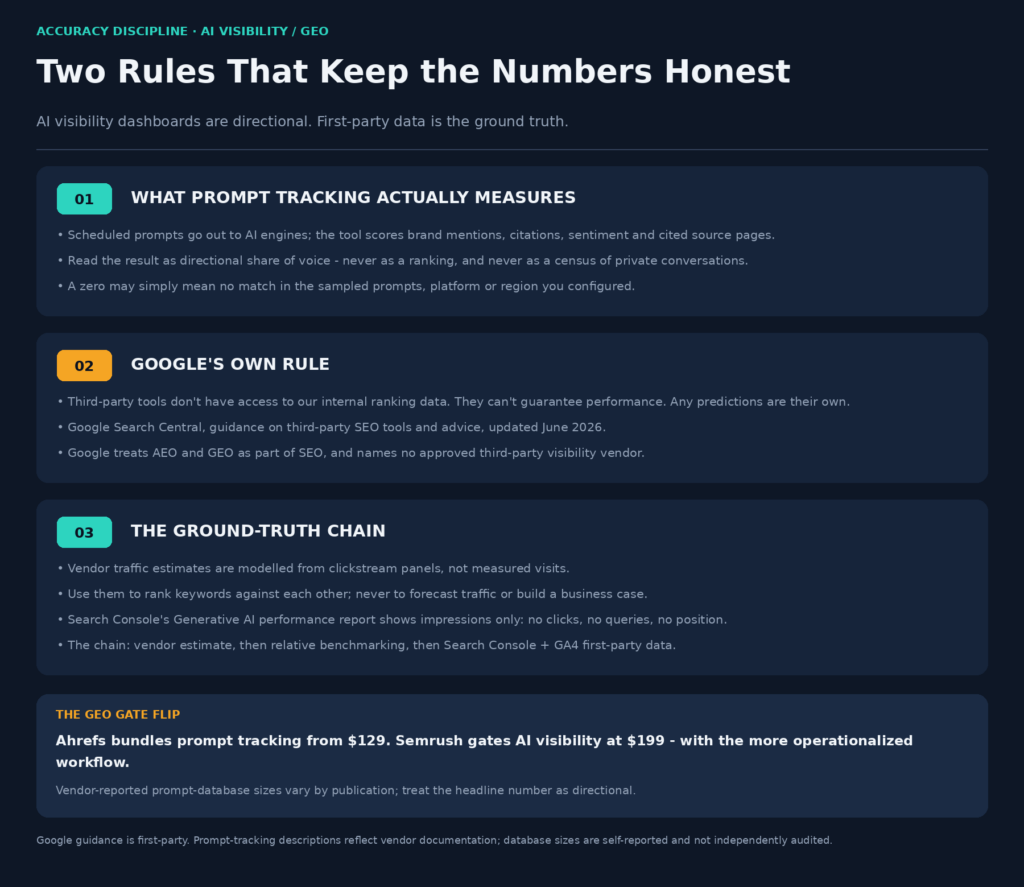
Rule one: vendor traffic estimates are modelled from clickstream panels and keyword databases, not measured from your server. They are useful for relative benchmarking and useless for absolute forecasting. If you need a number for a board deck, pull it from Analytics and Search Console.
Rule two: third-party AI-visibility metrics are estimates over a sampled prompt set. Google says so indirectly and Semrush says so directly. Read them next to first-party data, never instead of it.
The first-party anchor
Rule three is the chain that ties the first two together. Google began rolling out a dedicated Generative AI performance report in Search Console in June 2026. It shows impressions, pages, countries, devices, dates and search type for AI Overviews and AI Mode. It does not show clicks isolated to AI features, queries, or position — and Google has said position and impression tracking for AI features will evolve over time. AI clicks are recorded, but mixed into the regular Performance report with no filter to separate them. There is also a Discover report, a 1,000-row table limit, and a multimodal search-type filter added later in 2026.
So the chain looks like this: a vendor tells you which prompts cite which page; Search Console tells you how often Google’s AI features actually showed those pages; GA4 tells you whether anyone arrived and converted. Disagreement between the three is information, not an error. Keep all three open.
9. The breadth Ahrefs simply does not sell
Strip away the AI layer and the old asymmetry returns, undiminished.
Semrush sells PPC and display competitive intelligence — ad copy history, PLA research, paid keyword data — that Ahrefs does not attempt. It sells social scheduling and monitoring, local and multi-location listing management, and a content production suite running from Topic Research through SEO Writing Assistant to ContentShake AI. Its Site Audit prioritises fixes by severity and feeds an On Page SEO Checker, while its reporting layer builds white-label client reports. Copilot and the AI-readiness checks push suggested fixes toward the top of the queue.
Ahrefs stays narrow on purpose. Content Explorer is excellent for discovery, but there is no built-in writing assistant comparable to Semrush’s, no PPC data, no social suite, no local toolkit. Its Report Builder is a $99 add-on, and its Content Kit is another add-on from $99. That focus is a feature for the specialist and a limitation for the generalist. As one practitioner put it, Ahrefs helps you find what to write; Semrush helps you write it — and then schedule it, report on it and bid on it.
Both sit around 4.5 out of 5 on G2, though review counts differ by source and change constantly. The support asymmetry is more durable: Semrush offers phone support, live demos and structured onboarding with Semrush Academy certifications; Ahrefs leans on a login-gated help centre, Ahrefs Academy and faster technical answers. Practitioners commonly describe Ahrefs as the quicker tool to become productive in and Semrush as the deeper but heavier one. That is a workflow observation, not a timed benchmark.
10. API, MCP and the automation question: resolving the conflicting claims
This is the one place where published comparisons flatly contradicted each other, so let us resolve it rather than hedge.
Ahrefs lists API and MCP access on paid plans, with per-request row caps that scale by tier — roughly 100 rows on Lite, 250 on Standard, 500 on Advanced — and uncapped API, custom endpoints, SSO and audit logs reserved for Enterprise. So “API on all plans” and “full API only on Enterprise” are both true, depending on whether you mean row-capped access or uncapped pipeline access.
Semrush splits the two capabilities differently. MCP access arrives at Starter, $199, with 50,000 API units a month on Starter and Pro+, which lets an assistant query Semrush data through an official app in ChatGPT, Claude or Perplexity. The traditional API is gated at Advanced, $549, with units purchased separately — and, oddly, Advanced includes no MCP units, so using Semrush inside Claude on that tier means buying a unit package on top. The SEO plan offers no MCP route at all, and the AI Visibility Toolkit is not in the MCP data list.
For a BI pipeline, the practical question is not which vendor has an API. It is whether your row caps, units and export ceilings survive a month of real pulls, and whether the data you actually need — notably AI visibility in both cases — is exposed through that connector at all. Ask the vendor to show your query in the live report before you build anything.
11. Agency math: seats, reports and the four numbers that pick your plan
The headline price is a floor, not a bill.
On Semrush, a three-person team on Pro+ pays $299 plus two extra seats at $80, so $459 a month before a single add-on. On Ahrefs Standard, the same team pays $249 plus two seats at $60, so $369. Add reporting and the shapes diverge: Semrush sells a Base Report at $10 and a white-label Pro Report at $20, while Ahrefs sells Report Builder at $99 a month with a cap on included reports that most agencies outgrow. Add-ons stack on both sides — Content Kit, Brand Radar, Project Boost on Ahrefs; Traffic & Market, Content, Local, AI PR on Semrush.
This is why the four numbers that actually pick your plan are sites, keywords, seats and AI prompts. Everything else is packaging. Count your heaviest week, not your average one: the sixth client site forces Pro+, the 751st keyword forces Ahrefs Standard, the third seat exposes the seat-price gap, and the 51st daily prompt forces the next tier. Pricing pages change, so verify live before you commit — but count these four first and the tier almost picks itself.
12. The both-stack threshold, and the cheaper combinations
So should you buy both?
At current list prices, Ahrefs Standard plus Semrush Pro+ is $548 a month before a single extra seat. Give each tool two additional seats for a three-person team and the total lands at roughly $828 a month. That is the real threshold, recomputed from the post-reset pricing rather than from the older figures still circulating in comparison articles. It pays for itself only when link building is a revenue line — when finding one extra referring domain or reclaiming one dead page has a price you can name. If links are a hygiene task, $828 a month is an expensive way to feel thorough.
The cheaper combinations are less glamorous and often better. One paid suite plus Ahrefs Free for verified sites plus Search Console covers a surprising amount of ground. A solo consultant can start at Ahrefs Lite $129, or Semrush SEO $139, and add the standalone AI Visibility Toolkit at $99 per domain only when a client actually asks for AI reporting. A $29 Ahrefs Starter is the cheapest honest look inside a tool that offers no trial. And the free tier on Semrush, with ten reports a day and AI mentions visible in Domain Overview, is enough to test whether the GEO question is even live for your brand before you spend anything.
13. A decision matrix by role (plus a note for non-Google markets)
Here is the short version, by person rather than by feature.
A link builder or technical SEO buys Ahrefs, because the daily job is link data and the interface should get out of the way. A content team buys Semrush, because the job runs from topic to draft to report in one place. A multi-channel head who owns paid and organic buys Semrush, because one invoice and one reporting layer beat a spreadsheet stitched from two vendors. A beginner starts at Ahrefs Starter $29 or Ahrefs Free, plus free first-party tools. A GEO-first team buys Semrush One or the standalone toolkit — with the caveat that no subscription improves visibility by itself; it only supplies evidence your team still has to act on.
One last note for readers working outside Google’s index. None of the above transfers cleanly to a market where the dominant engine is not Google. For Chinese search, the equivalent discipline pairs local tooling — 5118, Zhanzhang tools — with Baidu’s own webmaster platform as the first-party anchor, and the same rule applies: third-party estimates are directional, platform data is ground truth. Substitute your market’s engine and the logic holds; copy the vendor names and it does not.
Conclusion: buy the workflow, attach the first-party data
The 2026 comparison is not a cage match. It is a mirror. Both vendors reset something this year — Semrush its entire plan ladder and its ownership, Ahrefs its metering model and its AI ambitions — and the articles that still rank for this query are describing a market that no longer exists.
So do not buy the scoreboard. Buy the job. If your week is backlink profiles, buy Ahrefs. If your week is paid plus organic plus content plus reporting, buy Semrush. If you genuinely need both, price the $548 floor and the $828 three-person reality honestly, and let the value of link work justify it. Then, whatever you buy, keep Search Console and GA4 open beside it, because Google has told us in its own words that no third-party tool sees its internal ranking data. The dashboard is a compass. Your own data is the map.